
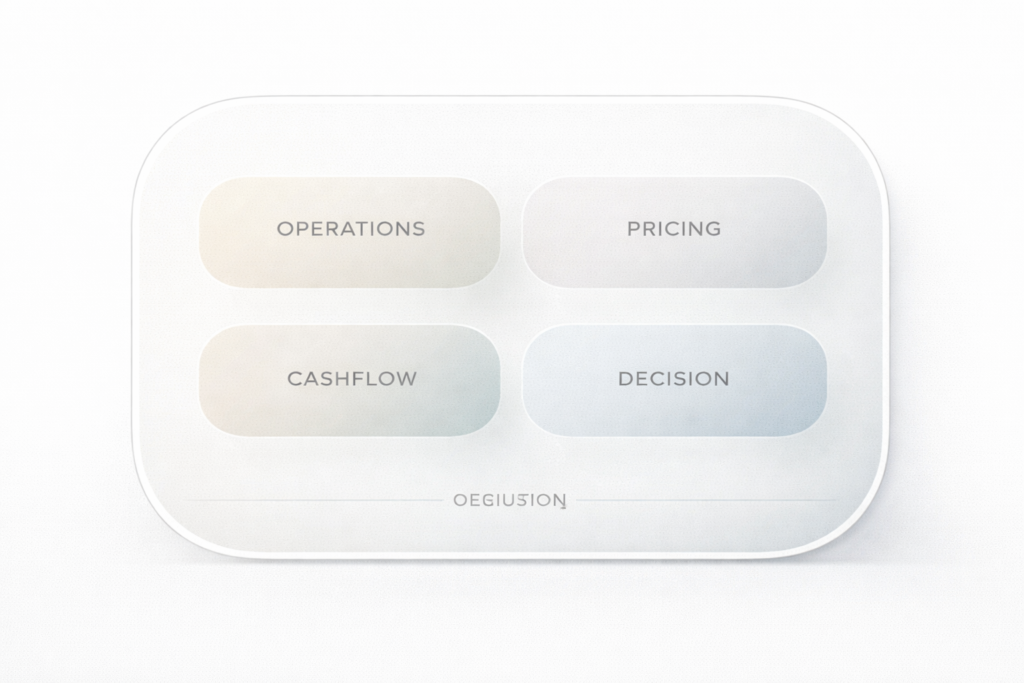
Freelancer business systems are the difference between short-term income and long-term business stability. Most freelancers fail not because of lack of skill, but because their money, work, and decisions operate in disconnected silos.
This pillar introduces AI-enabled freelancer business systems that integrate cash flow, income growth, productivity, and operations into a single operating system—allowing freelancers to scale deliberately, reduce chaos, and build resilient businesses in an AI-driven economy.
Freelancer success is no longer about isolated tools — it’s about building an integrated business operating system.
AI-enabled business systems connect financial control, income growth, operational efficiency, and debt optimization into one coherent framework. This category acts as the central nervous system for freelancers who want predictability, scalability, and professional-grade execution.
Instead of reacting to problems daily, you learn how to design systems that run your freelance business with clarity and control.
🟦 Why Freelancers Need Business Systems to Grow
Most freelancers don’t struggle because of skill.
They struggle because they lack business systems.
Without systems, every task feels heavier than it should:
- Client onboarding takes too long
- Proposals and contracts feel repetitive
- Projects get delayed
- Follow-ups are forgotten
- Files and communication are scattered
- Income feels unpredictable
- Daily operations rely on willpower
Freelancing without systems feels like:
➡️ Constant firefighting
➡️ Working harder than necessary
➡️ Reinventing the wheel for every client
➡️ No scalability
➡️ No mental peace
This is not a motivation problem.
It’s an infrastructure problem.
AI changes everything.
With AI-enabled systems, freelancers finally operate like modern micro-businesses:
efficient, predictable, automated, and scalable.
🟩 What This Category Helps You Build
Inside this category, you’ll learn how to design AI-powered systems that quietly run your business in the background:
- Client onboarding systems
- Proposal and contract automation
- Project management frameworks
- Delivery and revision workflows
- Income and performance tracking systems
- Follow-up and client-retention automations
- SOPs for every repeating task
- Tool integrations that eliminate manual work
When these systems are combined with intelligent cash-flow planning and pricing psychology, freelancers move from reactive survival to strategic growth.
That’s why these frameworks are designed to align seamlessly with:
- AI-Powered Money Management for Freelancers
- AI-Smart Income Growth for Freelancers
These systems help you go from “chaotic freelancer” to organized, scalable service provider.
Your business begins to run with clarity — instead of running on stress.
🧭 What You’ll Find in This Category
This category curates the most powerful AI-assisted business systems for freelancers, including:
- Complete AI-enabled Freelancer Business OS frameworks
- Ready-to-use SOP templates
- AI workflows for onboarding, delivery, and follow-ups
- Tools for automating admin and repetitive work
- Systems for recurring revenue and stability
- Project templates for fast, consistent execution
- Case studies on systemizing a one-person business
- Tools that integrate across marketing, service delivery, and finance
If you want a business that feels predictable and professional — not chaotic — this category gives you the playbook.
🚀 Try AI Business Systems Tools
📚 Related Pillars
💰 AI-Powered Money Management for Freelancers
Build financial clarity and stability with AI systems designed for freelancers.
👉 Explore this category →
📈 AI-Smart Income Growth for Freelancers
Scale earnings using pricing psychology, positioning, and AI-driven growth systems.
👉 Explore this category →
Forecasting & Decision Tools
Income growth inside FM Mastry is supported by forecasting models and decision systems.
🔒 FAQ
Q1 What is a freelancer business operating system?
A freelancer business operating system is a structured set of systems that integrates money management, income growth, productivity, and operations into a single decision-making framework.
Q2 Why do freelancers need systems instead of tools?
Freelancers need systems instead of tools because tools alone create fragmentation. Systems define how tools, decisions, and behaviors work together consistently over time.
Q3 How does AI improve freelance business systems?
AI improves freelance business systems by automating decisions, forecasting risks, and adapting workflows—reducing cognitive load and increasing stability.
How This Page Fits Into the FM Mastry System
This page represents Step 5 — Freelancer Business OS, the integration layer of FM Mastry.
At this stage, financial systems, decision rules, automation, and workflows operate as a single low-friction operating system. The goal is not optimization, but durability — finances that continue to function even when focus, energy, or motivation drop.
This step assumes all previous systems are in place. Without stability, control, and capacity, integration fails.
If you have not followed the system sequence, return to Start Here — FM Mastry System before using this page.
🔒 Closing
Freelancers often try to scale by adding more tools — and end up with more chaos. This guide explains why systems matter more than apps, and how AI enables freelancers to run lean, professional operations.
FM Mastery is built on a structured AI-powered financial system for freelancers designed to operate under irregular income and uncertainty.
📚 Latest Guides in Freelancer Business Systems (AI-Enabled)
Freelancers don’t need more tools.
They need systems that think ahead — and scale with real human behavior.
How to Build a Freelancer Business OS Using AI
A step-by-step framework for designing workflows that replace daily decision fatigue.
From Chaos to Clarity: Systemizing a One-Person Business
Learn how solo freelancers build structure without hiring teams.
AI Workflows That Save Freelancers 10+ Hours a Week
Practical automation setups that reduce admin and protect deep work.
Freelancer Finance Today — Thursday, 12 March 2026
Global regulators are accelerating cross-border payment reforms as SWIFT upgrades settlement infrastructure and new tax reporting frameworks reshape how freelancers receive international payments. Global payment
Freelancer Finance Today — Wednesday, 11 March 2026
Daily financial intelligence briefing tracking global payment infrastructure, cross-border settlement rails, and tax reporting systems shaping freelance income flows. Freelancer Finance Today — 11 March
Freelancer Finance Today — Monday, 09 March 2026
Daily financial intelligence briefing tracking global payment infrastructure, cross-border settlement systems, and tax reporting frameworks shaping freelancer income flows. Freelancer Finance Today — 09 March
Freelancer Business Systems
Freelancer Business Systems: Operational Systems for Freelance Stability Operational systems that support financial stability for freelancers and independent professionals. Freelancers operate as independent businesses rather
Freelancer Financial Planning
FM Mastery Financial Intelligence Hub Long-Term Financial Systems for Freelancers with Irregular Income Freelancer financial planning helps independent professionals manage irregular income, plan taxes, build