
FM Mastery Operating System • Step 1: Stability
If budgeting never works for you, this is why.
AI Money Management for Freelancers: Fix Cash Flow, Control Spending, and Build Financial Stability
AI money system for freelancers stabilizes cash flow, controls spending, and removes financial uncertainty caused by irregular income.
Why Managing Money Is Hard for Freelancers with Irregular Income
Predict your cash flow, control your spending, and make consistent financial decisions—even when your income changes every month.
This is not budgeting. This is a financial operating system built specifically for freelancers with irregular income.
Most freelancers don’t have a money problem. They have a system problem.
- ✔ Know exactly how much you can safely spend
- ✔ Remove financial stress during low-income months
- ✔ Stop overspending after high-income periods
No spreadsheets. No rigid budgets. Works even with unpredictable income.

AI money management for freelancers is a system that stabilizes cash flow, controls spending, and creates consistent financial decisions despite irregular income.
This guide explains how AI money management for freelancers creates financial stability by replacing reactive decisions with structured systems.
Is This Your Situation?
- Your income changes every month
- You overspend after getting paid
- You restrict spending during slow periods
- You don’t know how much you can safely spend
- Budgeting never works consistently
- You feel financially unstable despite earning
If this feels familiar, you’re not alone—and more importantly, this is not a personal failure.
If this pattern continues, it doesn’t just create short-term stress—it compounds into long-term instability, inconsistent savings, and constant financial uncertainty.
→ You need a system designed for irregular income
→ Fix your money system before your next income cycle repeats the same pattern
This instability weakens your financial system for freelancers, especially under income variability.
Why is managing money hard for freelancers?
Why Budgeting and Traditional Money Advice Fail Freelancers
Freelancers don’t struggle with money because they lack discipline —
they struggle because their income is unpredictable.
This is where AI money management for freelancers becomes essential, as it adapts to income variability instead of assuming consistency.
This is not a discipline problem. This is a system design failure.
Traditional budgeting assumes:
- Fixed monthly income
- Predictable expenses
- Stable financial behavior
Freelancers operate in a completely different environment:
- Payments arrive late
- Workload fluctuates
- Expenses spike unexpectedly
- Financial decisions happen under uncertainty
This mismatch is why most money advice fails.
This is why budgeting fails freelancers—it was never designed for income volatility.
If your financial system assumes stability while your income remains unpredictable, no amount of discipline will fix the problem.
The solution is not better budgeting. The solution is a system built for volatility.
Why Budgeting Fails Specifically for Freelancers
Traditional budgeting systems are designed around predictability.
They assume:
- A fixed monthly income
- Stable expense patterns
- Consistent financial behavior
Freelancers operate in the exact opposite environment.
When income is unpredictable, any system built on predictability becomes unreliable.
This creates a structural mismatch:
- Budgets break the moment income changes
- Spending plans become irrelevant during fluctuations
- Financial rules collapse under uncertainty
This is not a failure of execution—it is a failure of system design.
Traditional budgeting assumes predictable income patterns. Research on income volatility shows that irregular earnings significantly impact financial decision-making and stability. Income volatility research
Why Common Financial Advice Doesn’t Work for Freelancers
Most financial advice is built for salaried individuals and then generalized to everyone else.
This leads freelancers to follow strategies that are fundamentally incompatible with their income structure.
Common advice includes:
- “Stick to a fixed monthly budget”
- “Save a percentage of your income consistently”
- “Plan your expenses in advance”
These approaches fail because they assume consistency where none exists.
When applied to freelancers, they create frustration instead of stability.
This is why many freelancers feel like they are “bad with money” when, in reality, they are using the wrong system.
The Shift From Budgeting to Systems Thinking
Fixing freelancer finances is not about improving budgeting—it is about changing the underlying model.
Instead of asking:
- “How do I stick to a budget?”
The correct question becomes:
- “How do I create a system that adapts to income variability?”
This shift changes everything.
Budgets attempt to control behavior within a fixed structure.
Systems create structures that adapt to changing conditions.
This is why systems succeed where budgeting fails.
What Most Competing Advice Misses
Most content in this space focuses on tactics:
- Apps to track expenses
- Templates for budgeting
- Tips to reduce spending
While useful, these approaches do not solve the core problem.
They optimize behavior inside a broken system instead of fixing the system itself.
This is why freelancers can consume endless financial advice without achieving stability.
The missing layer is system design.
Without it, every tactic produces temporary improvement—but no lasting change.
The Decision That Changes Everything
At some point, every freelancer reaches a critical realization:
“I don’t need better financial habits. I need a better financial system.”
This is the turning point.
Once this shift happens:
- Decisions become structured instead of reactive
- Financial behavior becomes consistent instead of emotional
- Progress becomes cumulative instead of cyclical
This is where financial control begins.
And this is exactly what this system is designed to create.
Why does budgeting fail freelancers?
Because it assumes stable income, while freelancers operate with income variability and unpredictable cash flow.
What Is AI-Powered Money Management for Freelancers?
AI-powered money management for freelancers focuses on cash-flow stability, behavioral budgeting, and decision clarity before income growth or optimization.
AI money management for freelancers requires systems that adapt to irregular income, variable expenses, and inconsistent motivation.
This pillar introduces AI-powered money management frameworks built specifically for freelancers—combining cash-flow forecasting, behavioral psychology, and adaptive spending guardrails.
This system exists because traditional financial frameworks break under income volatility.
This approach is part of a broader AI financial system for freelancers designed to manage financial decisions under income uncertainty.
This is the stability layer of your financial operating system.
Step 1: Stability — This is the foundation layer of your financial operating system.
Without this layer, every other financial strategy becomes unstable and reactive.
This system connects to the broader financial operating system, where each layer builds on the previous one through structured decision-making.
This system integrates cash flow stability, spending control, behavioral finance, and financial automation into a unified financial operating system for freelancers.
How This Financial System Works
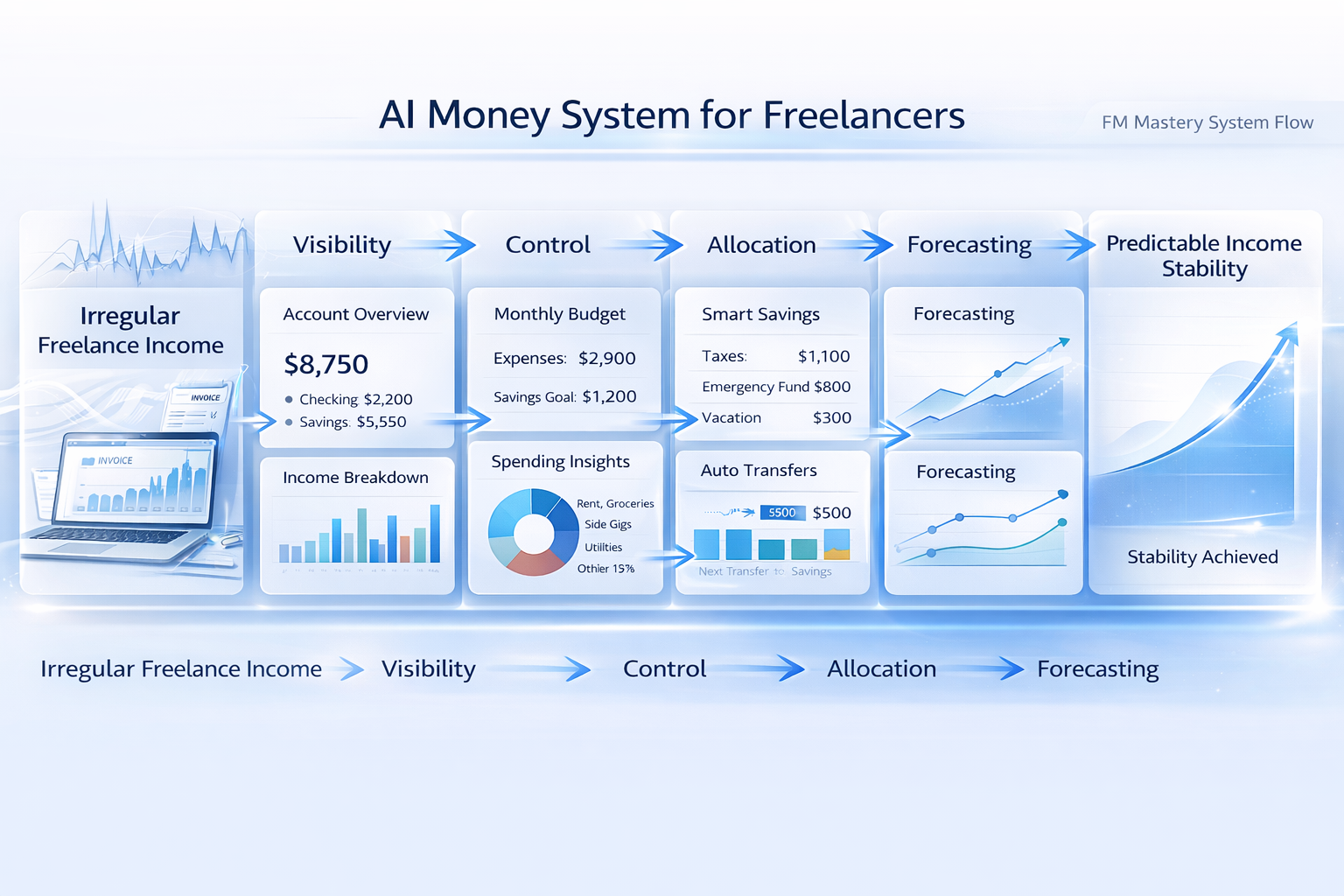
This system operates through three core layers:
1. Cash Flow Visibility
You always know:
- How much money is available
- What is safe to spend
- What is coming next
2. Behavioral Control
Spending decisions are guided by:
- adaptive rules
- emotional safeguards
- structured limits
3. Automated Guardrails
Your system enforces:
- spending boundaries
- savings logic
- financial consistency
- AI budgeting & forecasting
- Behavioral psychology–based money systems
- Spending automation and guardrails
- Smart financial workflows
- Income-stability frameworks
These systems are often supported by structured workflows and automation layers from AI Productivity & Operations, ensuring consistency without relying on willpower.
Traditional budgeting: Fixed, reactive, and dependent on stable income.
This system: Adaptive, predictive, and designed for income volatility.
This system improves cash flow stability and ensures consistent financial decision-making.
How the System Transforms Irregular Income Into Stability
Freelance income is naturally unpredictable. Stability is not created by controlling income, but by structuring how money flows through a system.
This system converts irregular income into predictable financial behavior through a structured sequence:
Income → Visibility → Control → Allocation → Forecasting
- Visibility ensures you always understand your current and future financial position.
- Control defines how money can be used, preventing reactive spending.
- Allocation distributes income into predefined categories automatically.
- Forecasting anticipates future conditions and removes uncertainty.
Instead of reacting to income fluctuations, this structure ensures that every financial decision follows a predefined system — creating consistency even when income is inconsistent.
This system transforms unpredictable income into predictable financial decisions.
Tools support this system—but without the system structure, tools alone cannot create financial stability.
How Each Layer Works Together
Most freelancers try to fix financial problems by focusing on one area at a time—either budgeting, saving, or tracking expenses.
This approach fails because financial instability is not caused by a single issue. It is caused by multiple weak points interacting at the same time.
This system works because all three layers operate together, not independently.
- Cash flow visibility ensures you always know your financial position
- Behavioral control prevents emotional decisions from disrupting stability
- Automated guardrails enforce consistency without relying on discipline
If even one of these layers is missing, the system breaks down:
- Without visibility → decisions are based on guesswork
- Without behavioral control → spending becomes reactive
- Without guardrails → consistency disappears over time
This is why traditional budgeting fails—it tries to solve a multi-layer problem with a single-layer solution.
Core Financial Systems You Will Build
This system is built through interconnected components that eliminate financial instability at its source. Each system addresses a specific failure point in freelance money management.
- Income Stabilization System — separates income timing from spending behavior, preventing cycles of overspending and restriction.
- Cash Flow Visibility System — provides real-time clarity on income, expenses, and upcoming obligations to enable proactive decisions.
- Smart Allocation System — automates how money is distributed across expenses, savings, taxes, and reinvestment.
- Financial Forecasting System — anticipates future income and expense scenarios, enabling strategic planning instead of reactive decision-making.
These systems do not operate independently. Together, they create a structured financial environment where decisions become consistent, predictable, and aligned with long-term stability.
How This System Handles Real Financial Situations
Freelancers don’t operate in predictable environments. Financial decisions must adapt to changing income conditions.
This system provides clear decision logic for common scenarios:
Scenario 1: You receive a large payment
- Instead of increasing spending, the system allocates funds across predefined categories
- A portion is reserved for future low-income periods
- Spending limits remain controlled despite higher income
Scenario 2: You experience a low-income month
- The system adjusts spending based on available reserves
- No panic-driven decisions are required
- Essential expenses remain covered without disruption
Scenario 3: You don’t know how much you can spend
- The system defines a safe-to-spend amount based on real cash flow
- This eliminates guesswork and reduces financial anxiety
In all cases, the system replaces uncertainty with structured decision-making.
Why Most Financial Tools Fail Without This System
Many freelancers turn to apps, spreadsheets, or budgeting tools expecting them to solve financial instability.
However, tools do not create structure—they only operate within one.
This leads to a predictable cycle:
- A new tool is adopted
- Short-term improvement occurs
- Behavior returns to inconsistency
- The tool is abandoned
This cycle repeats because the underlying system is missing.
Without a system:
- Tools cannot enforce behavior
- Tracking does not translate into control
- Information does not lead to better decisions
This is why the system must come first—and tools must support it, not replace it.
What This System Actually Produces
When implemented correctly, this system creates a fundamental shift in how freelancers experience money:
- Income becomes manageable instead of unpredictable
- Spending becomes controlled instead of reactive
- Financial decisions become consistent instead of emotional
The result is not just better money management—it is financial stability under uncertainty.
This is the foundation required before any form of growth, optimization, or scaling can work effectively.
Why This System Works (Behavioral Logic)
Freelancer money problems are not caused by lack of knowledge.
They are caused by inconsistent environments.
When income fluctuates, the brain shifts into short-term survival mode:
- Spending increases after high-income periods
- Fear increases during low-income periods
- Decisions become reactive instead of structured
This system works because it removes the need for constant decision-making.
Instead of relying on discipline, it builds:
- predefined rules
- adaptive spending limits
- automated responses to income changes
This allows freelancers to operate consistently—even when motivation drops.
Decision fatigue plays a major role in inconsistent financial behavior. Studies in behavioral economics explain how repeated decisions reduce decision quality over time. Decision fatigue explanation
This system overrides emotional decision-making with predefined rules, ensuring consistency regardless of income fluctuations or mental state.
How Financial Decisions Change Inside This System
Without a system, financial decisions are based on recent income, emotions, and uncertainty.
With this system in place, decisions follow predefined logic:
- Spending is based on safe allocation, not available balance
- Savings happen automatically, not optionally
- Financial limits are enforced regardless of income spikes
This replaces reactive thinking with structured decision-making.
Over time, this reduces financial stress, decision fatigue, and inconsistency.
How This System Works in Real Freelancer Scenarios
This system is not theoretical—it is designed to operate inside real-world freelancer income patterns.
For example:
- During high-income months, the system automatically restricts overspending by applying predefined allocation rules instead of emotional decisions.
- During low-income periods, spending adjusts based on real cash-flow visibility instead of panic-driven cuts.
- Between payments, the system maintains clarity on what is safe to spend—eliminating guesswork.
This ensures that financial behavior remains consistent regardless of income fluctuations.
Instead of reacting to income changes, the system absorbs volatility and maintains stability.
How does an AI money system work?
It combines cash flow visibility, behavioral control, and automated guardrails to create consistent financial decisions.
How can freelancers manage irregular income effectively?
Why Freelancers Struggle With Money Systems
Freelancers don’t struggle with money because they lack discipline —
they struggle because their income is unpredictable.
Payments arrive late.
Workload fluctuates.
Expenses spike without warning.
No employer provides structure, benefits, or a financial safety net.
This unpredictability creates a unique set of problems:
- Cash-flow gaps between payments
- Difficulty planning monthly expenses
- Overspending during high-income months
- Panic and restriction during slow months
- Inconsistent savings habits
- Poor visibility into where money actually goes
These challenges are not just mathematical — they are behavioral.
Irregular income increases financial risk, making structured systems essential for stability.
If left unmanaged, this cycle leads to long-term financial instability, growing stress, reactive decision-making, and an increased risk of debt accumulation.
Freelancers caught in debt cycles often benefit from systems explained in AI-Enhanced Debt & Credit Optimization, which focus on reducing reactive financial decisions before they compound.
The Real Root Cause Behind Financial Instability
Most freelancers assume their financial problems are caused by low income, inconsistent work, or lack of discipline.
However, these are not root causes—they are surface-level symptoms.
The real problem is the absence of a system that can operate under uncertainty.
When income fluctuates, every financial decision becomes conditional:
- Spending depends on recent payments
- Savings depend on temporary surplus
- Planning depends on unpredictable future income
This creates a constantly shifting decision environment where consistency becomes impossible.
Without a stable system, even high income cannot create long-term financial stability.
The Income Volatility Loop (Why Freelancers Stay Stuck)
Freelancers often operate inside a repeating financial cycle:
- High-income period → increased spending and relaxed control
- Income drop → panic, restriction, and financial stress
- Recovery phase → temporary discipline and correction
- Next payment → cycle resets again
This loop continues indefinitely because decisions are based on recent income instead of system rules.
Over time, this creates instability even if total income increases.
More money does not fix this cycle—without a system, it amplifies it.
Why Decision Fatigue Destroys Financial Consistency
Freelancers make financial decisions more frequently than salaried individuals because their income environment changes constantly.
Each decision—how much to spend, save, or allocate—requires mental effort.
Over time, this leads to decision fatigue:
- Short-term thinking replaces long-term planning
- Emotional decisions override logical ones
- Consistency breaks under pressure
This is why discipline alone cannot solve freelancer financial problems.
Any system that depends on continuous decision-making will eventually fail.
This system removes that burden by replacing decisions with predefined rules.
The Hidden Cost of Not Fixing This Problem
Financial instability does not only affect money—it impacts every part of a freelancer’s life and business.
- Inconsistent finances lead to inconsistent work output
- Stress reduces decision quality in client and pricing decisions
- Uncertainty limits long-term planning and growth
Over time, this creates a compounding effect where instability spreads beyond finances into business performance.
This is why solving money management is not optional—it is foundational.
System vs No System: The Critical Difference
Freelancers without a system:
- Make decisions based on recent income
- Experience constant financial stress
- Reset progress every income cycle
Freelancers with a system:
- Follow predefined financial rules
- Maintain consistency across income fluctuations
- Build stability over time regardless of volatility
The difference is not effort—it is structure.
This is what separates financial survival from financial control.
What This System Prevents Over Time
Most freelancers focus on immediate financial problems—but the real damage happens over time.
Without a structured system, income volatility leads to:
- Repeated financial resets after every income cycle
- Inability to build consistent savings
- Increased reliance on debt during low-income periods
- Chronic financial stress and burnout
This system prevents these long-term patterns by stabilizing financial behavior at the source.
Instead of solving symptoms, it eliminates the underlying cause: inconsistent decision-making under uncertainty.
To apply this system in practice, explore: freelancer cashflow management systems, financial planning systems, and managing irregular freelance income.
What Changes When This System Is In Place
- Financial fog → financial clarity
- Reactive decisions → structured decisions
- Stress → control
- Inconsistency → predictability
This category helps you finally break free from financial fog and step into clarity, control, and confidence.
These changes are not the result of motivation or discipline—they are the direct outcome of structured systems replacing reactive financial behavior.
Each improvement comes from the combined effect of visibility, behavioral control, and automated guardrails working together inside the system.
What You’ll Find Inside This System
- AI budgeting tools for variable-income earners
- Cash-flow forecasting techniques
- Automated savings systems
- Intelligent tax workflows
- Expense and invoice tracking templates
- Behavioral finance strategies
- Reviews of AI finance apps for freelancers
These are not standalone tools or isolated tactics—they are integrated components of a single financial system designed to work together.
Each element plays a specific role inside the system, ensuring that financial decisions remain consistent, predictable, and aligned with income volatility.
How This System Connects With Other Financial Systems
This system does not operate in isolation—it is the foundation for all other financial systems.
Once stability is achieved:
- Debt repayment becomes structured instead of reactive
- Productivity systems become more effective due to reduced stress
- Income growth becomes predictable instead of volatile
Every other financial system depends on this layer functioning correctly.
This is why stability is always the first step in the FM Mastery operating system.
These components form a complete financial decision system designed for freelancers.
What system works better than budgeting for freelancers?
Once financial stability is established, the next step is applying AI income growth systems for freelancers and optimizing financial risk using debt and credit optimization systems.
To implement AI money management for freelancers, structured tools and systems are required to maintain consistency across income cycles.
Start Fixing Your Money System
If you don’t fix your money system, every income cycle will continue resetting your financial progress.
→ View the Full Category Archive
→ Try AI Money Tools
If you continue without a system, each income cycle will reset your financial progress instead of building it.
You can explore execution tools inside the AI Tools Hub, where workflows and automation support this system.
Explore more tools inside our best AI tools for freelancers to support your financial system.
Financial tools alone do not create behavior change. Research shows that systems and automation are required to maintain consistency in financial habits. Why systems beat motivation
To implement this system, explore the AI tools for freelancers and curated best AI tools for freelancers.
Start before your next payment cycle creates another round of inconsistent decisions.
Start now—before your next income cycle repeats the same financial instability.
Where This Fits in Your Financial Operating System
This system is your foundation.
- AI-Smart Income Growth — to scale income
- AI-Enhanced Debt & Credit Optimization — to remove financial risk
- AI Productivity & Operations — to align execution
This is Step 1 in the FM Mastery system sequence: Stability → Control → Capacity → Growth → Integration.
Skipping this step breaks the system—because growth, productivity, and optimization cannot function on an unstable financial base.
Full system integration is achieved through Freelancer Business Systems, where financial decisions become automated and interconnected.
This system is part of a broader financial operating system for freelancers, connecting stability, control, productivity, and growth.
What Comes After Stability
Once your finances are stable, growth becomes easier.
Growth without stability creates financial instability at scale—more income, but more chaos.
👉 Continue to AI-Smart Income Growth for Freelancers
Once stability is achieved, the next step is applying structured growth systems inside AI-Smart Income Growth for Freelancers.
This is where income expansion becomes predictable, controlled, and aligned with your financial system.
Common Mistakes Freelancers Make
- Trying to budget like salaried employees
- Scaling income without stabilizing finances
- Using tools without system structure
- Ignoring behavioral patterns
- Making decisions based on recent income instead of system rules
These mistakes don’t just slow progress—they reinforce instability cycles that repeat with every income fluctuation.
These mistakes reinforce instability instead of solving it.
The goal is not to avoid mistakes through discipline, but to eliminate them through system design.
Frequently Asked Questions About AI Money Management for Freelancers
What is AI money management for freelancers?
AI money management for freelancers is a system that uses automation and structured rules to manage irregular income, control spending, and create financial stability.
How is AI money management different from budgeting?
Budgeting assumes fixed income, while AI money management adapts to income variability by focusing on visibility, control, and forecasting instead of rigid limits.
Can AI help manage irregular freelance income?
Yes, AI systems help track income patterns, forecast future cash flow, and guide financial decisions based on real-time data instead of assumptions.
Do freelancers need special tools for money management?
Tools are helpful, but they only work when combined with a structured system that defines how money should be managed across different income cycles.
What is the biggest mistake freelancers make with money?
The biggest mistake is treating money management as budgeting instead of building systems that handle income variability and decision-making consistently.
Ready to stabilize your finances?
If you don’t fix your financial system now, your next income cycle will repeat the same instability.
→ Start Your Money System
→ Move to the Next Step: Income Growth System
Start now—before another cycle of unpredictable income leads to reactive decisions.
What Most Freelancers Get Wrong About Fixing Their Finances
Most freelancers try to fix their finances by focusing on:
- earning more
- cutting expenses
- using new tools
But these approaches fail because they do not address the core issue:
There is no system controlling financial decisions.
This is why progress never lasts—because every improvement depends on discipline instead of structure.
This system replaces discipline with design, making financial stability repeatable and reliable.
This is why AI money management for freelancers is essential for building long-term financial stability under irregular income.
The goal of AI money management for freelancers is not perfection, but predictable financial behavior regardless of income fluctuations.
The System Behind Financial Stability
Financial stability for freelancers is not created through discipline, budgeting, or income growth alone. It is created through system design.
This system operates as a structural layer that manages income variability before execution, tools, or optimization are applied.
By combining visibility, behavioral control, and forecasting, the system ensures that financial decisions remain stable regardless of income fluctuations.
Instead of relying on motivation or perfect habits, this approach replaces uncertainty with predefined rules, allowing consistent financial behavior across both high-income and low-income periods.
Freelancers don’t need more discipline.
They need money systems that adapt — and work with real human behavior.
This is not about managing money better. It’s about building a system that makes better decisions for you.