
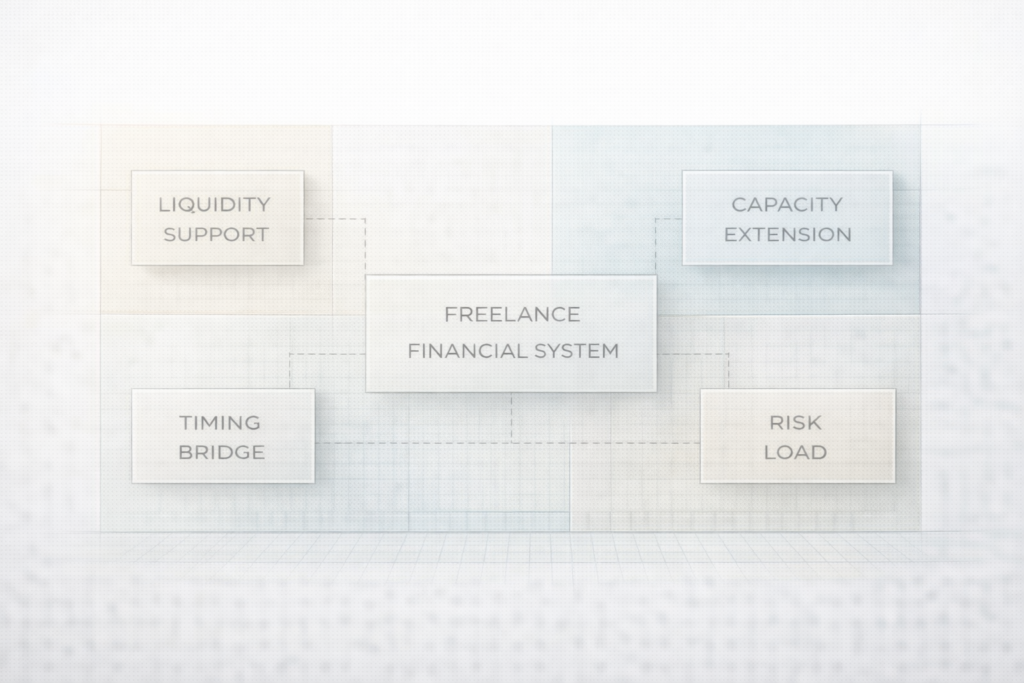
This page defines the structural architecture of Pillar 3 within FM Mastery, mapping how debt and credit assets are organized, governed, and constrained for freelancers operating under income volatility.
AI-Enhanced Debt & Credit Optimization in FM Mastery treats debt and credit as governed system components rather than tactical financial decisions.
This phase establishes what each asset is responsible for — not how it is executed, interpreted, sequenced, or acted upon.
Pillar Context: AI-Enhanced Debt & Credit Optimization
Pillar: AI-Enhanced Debt & Credit Optimization
Phase: Phase 2 — Structural Mapping & Asset Role Definition
Mode: Structural / Conceptual Only
Governance State: Fully Compliant
I. Pillar Authority Layer
P3-A0 — AI-Enhanced Debt & Credit Optimization for Freelancers
Structural Classification:
• Pillar Authority Asset (Canonical)
Architectural Responsibility:
• Defines the complete system boundary for debt and credit within freelance income volatility
• Establishes governance logic for credit usage without amplifying financial or behavioral risk
• Serves as the sole upward authority node for all Pillar 3 cluster assets
Explicit Exclusions:
• No income growth logic (Pillar 2)
• No cashflow, budgeting, or money management control (Pillar 1)
• No execution mechanics, tools, tactics, or behavioral instruction
• No productivity, operations, or business OS logic (Pillars 4 & 5)
II. Supporting Asset Architecture
Assets are grouped by structural responsibility, not by sequence, priority, maturity, or workflow.
Group A — Debt Structure & Load Definition
Structural Question Addressed:
How debt is classified and how its burden behaves structurally under irregular income.
• P3-C1 — Good Debt vs Bad Debt for Freelancers
Classification asset separating productive debt from destabilizing debt
• P3-C2 — Understanding Debt Load & Repayment Pressure
Load-definition asset describing how repayment pressure accumulates independent of tactics
Boundary Conditions:
• No repayment strategies or prioritization
• No interest optimization or timelines
• No behavioral or decision advice
Group B — Credit Health & Signal Interpretation
Structural Question Addressed:
What credit signals represent structurally and how they relate to risk exposure.
• P3-C3 — Credit Score Signals Freelancers Should Understand
Signal-definition asset clarifying the structural meaning of credit metrics
• P3-C4 — Credit Utilization & Risk Exposure
Exposure-mapping asset defining how credit usage shapes fragility or resilience
Boundary Conditions:
• No score-improvement tactics
• No utilization targets, percentages, or thresholds
• No lender-specific or product-specific guidance
Group C — Debt–Income Interaction
Structural Question Addressed:
How debt obligations interact with irregular and volatile income patterns.
• P3-C5 — How Debt Interacts with Irregular Income
Interaction asset mapping friction between fixed debt schedules and variable cash inflow
• P3-C6 — Debt Stress Signals & Early Warning Indicators
Early-warning asset identifying structural stress states before visible failure
Boundary Conditions:
• No mitigation actions or coping steps
• No buffers, reserves, or cashflow fixes
• No response sequencing or escalation logic
Group D — Credit Access & Containment
Structural Question Addressed:
Where credit supports system stability versus where it becomes a structural constraint.
• P3-C7 — When Credit Becomes a Constraint Instead of a Tool
Boundary-definition asset marking the transition from support to risk
• P3-C8 — Credit Expansion vs Credit Containment
Governance asset defining limits on credit growth to prevent systemic instability
Boundary Conditions:
• No expansion strategies or numerical limits
• No lender selection or product advice
• No optimization or growth framing
III. High-Level Relationship Rules (Architectural Only)
• Every P3-C* asset links upward only to P3-A0
• No lateral linking between cluster assets
• All groups are structurally co-equal
• No implied order, priority, funnel, or progression
• No maturity stages, readiness models, or timelines
IV. Pillar Boundary Enforcement Check
Included Domain:
• Debt classification and load behavior
• Credit signals and exposure mapping
• Debt–income interaction under volatility
• Credit containment and governance boundaries
Within AI-Enhanced Debt & Credit Optimization, debt and credit are treated as structural risk variables rather than financial products.
Explicitly Excluded:
• Money management and cashflow control (Pillar 1)
• Income growth and pricing logic (Pillar 2)
• Productivity, operations, and business systems (Pillars 4 & 5)
Result:
No cross-pillar contamination detected.
Phase 2 Validation Summary
• All assets assigned a single, non-overlapping structural role
• Pillar authority preserved without leakage
• Boundaries explicit and enforceable
• No execution, interpretation, tooling, or sequencing introduced
Phase Status
Pillar 3 — Phase 2: Structurally Complete
Status: Pending Final Confirmation
Governance Confirmation:
This page defines structural architecture only. Interpretation, execution logic, tools, sequencing, and optimization are intentionally excluded and will be addressed only if authorized in later phases.