
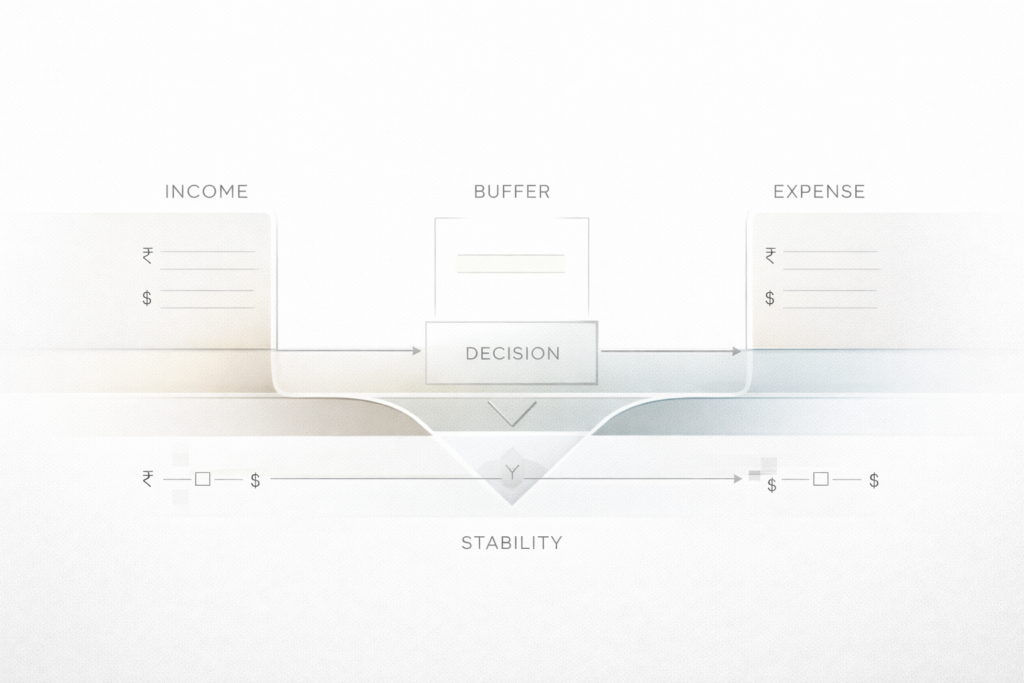
AI-powered money management for freelancers focuses on cash-flow stability, behavioral budgeting, and decision clarity before income growth or optimization.
AI money management for freelancers requires systems that adapt to irregular income, variable expenses, and inconsistent motivation. Traditional budgeting fails freelancers because it assumes stable monthly pay and rigid spending rules.
This pillar introduces AI-powered money management frameworks built specifically for freelancers—combining cash-flow forecasting, behavioral psychology, and adaptive spending guardrails. These systems help freelancers gain clarity, maintain control, and make consistent financial decisions even when income fluctuates.
Freelancers don’t need more budgeting tips.
They need clarity, control, and a money system that adapts to irregular income.
Traditional money advice assumes stable paychecks, predictable expenses, and employer-provided structure. Freelancers operate in a very different reality — one where income fluctuates, payments arrive late, and financial decisions must be made under uncertainty.
This category reveals how modern freelancers can use AI-powered money systems, behavioral psychology, and smart automation to build predictable financial habits — even in an unpredictable world.
✔ AI budgeting & forecasting
✔ Behavioral psychology–based money systems
✔ Spending automation and guardrails
✔ Smart financial workflows
✔ Income-stability frameworks
This is the first money management hub built specifically for freelancers navigating the AI economy — where work is global, income is flexible, and financial decisions matter more than ever.
AI-powered money management for freelancers focuses on cash-flow stability, behavioral budgeting, and decision clarity before income growth or optimization.
🟦 Why AI-Powered Money Management Is Different for Freelancers
Freelancers don’t struggle with money because they lack discipline —
they struggle because their income is unpredictable.
Payments arrive late.
Workload fluctuates.
Expenses spike without warning.
No employer provides structure, benefits, or a financial safety net.
This unpredictability creates a unique set of problems:
- Cash-flow gaps between payments
- Difficulty planning monthly expenses
- Overspending during high-income months
- Panic and restriction during slow months
- Inconsistent savings habits
- Poor visibility into where money actually goes
These challenges are not just mathematical — they are behavioral.
That’s why freelancers caught in debt cycles often benefit from AI-Enhanced Debt & Credit Optimization, which applies psychology-driven systems to break reactive financial decisions before they compound.
Traditional budgeting fails freelancers because it was built for fixed salaries.
AI changes this by offering real-time visibility, automation, and predictive clarity.
🟩 What This Category Helps You Fix
For freelancers building a complete financial operating system, this category acts as the core layer.
It integrates seamlessly with:
- AI-Smart Income Growth — to increase earning leverage
- AI-Enhanced Debt & Credit Optimization — to remove financial drag
- AI-Productivity & Operations — to automate execution
Every tool, guide, and framework here is designed specifically for freelancers, solopreneurs, and independent professionals — not employees, not startups, not corporations.
This category helps you finally break free from financial fog and step into clarity, control, and confidence.
🧭 What You’ll Find in This Category
This category curates the most practical and high-impact money-management resources for freelancers, including:
- AI budgeting tools for variable-income earners
- Cash-flow forecasting techniques designed for freelancers
- Automated savings and sinking-fund systems
- Intelligent tax-planning workflows
- Templates to track expenses, invoices, and late payments
- Behavioral finance strategies for consistent money habits
- Reviews of the best AI finance apps for freelancers
Whether you’re struggling with inconsistency or simply want tighter control — this is your financial command center.
🚀 Try AI Money Tools
Once your finances are stable, growth becomes easier.
👉 Ready to increase income with confidence?
Continue to AI-Smart Income Growth for Freelancers to apply pricing psychology, AI leverage, and scalable income systems.
📚 Related Pillars
📘 AI-Enhanced Debt & Credit Optimization
Remove financial drag, eliminate high-interest debt, and rebuild credit using AI-driven systems.
👉 Explore this category →
💼 AI-Smart Income Growth for Freelancers
Increase earning power using AI-based pricing, positioning, and client acquisition systems.
👉 Explore this category →
Implementation Resources
This system is supported by execution-ready templates and checklists designed for irregular income.
🔒 FAQ
Q1 How should freelancers manage money with irregular income?
Freelancers should manage money using AI-assisted cash-flow forecasting, flexible spending limits, and behavioral systems instead of fixed monthly budgets. This allows money decisions to adapt automatically to income changes.
Q2 Why does traditional budgeting fail freelancers?
Traditional budgeting fails freelancers because it assumes predictable income and consistent expenses. Freelancers need adaptive systems that adjust spending and saving rules based on real-time cash-flow patterns.
Q3 Can AI really help freelancers control spending?
Yes. AI helps freelancers control spending by identifying patterns, setting dynamic guardrails, and reducing emotional decision-making—especially after high-income months.
About This System
AI-Powered Money Management for Freelancers is a core component of the FM Mastry system — a structured financial operating system designed for freelancers with irregular income.
This system focuses on cash-flow stability, behavioral budgeting, and decision clarity before income growth or optimization.
🔒 Closing
Freelancers don’t need more discipline.
They need money systems that adapt — and work with real human behavior.
FM Mastery is built on a structured AI-powered financial system for freelancers designed to operate under irregular income and uncertainty.
📚 Latest Guides in AI-Powered Money Management
Freelancers today are earning more than ever — yet feel less financially secure. Variable income, delayed payments, and emotional money decisions quietly undermine stability. This guide explains why traditional budgeting fails freelancers — and how AI-powered systems restore control without rigidity.
How to Budget With Irregular Income (Without Burning Out)
Why freelancers don’t need stricter budgets — they need adaptive systems that flex with income volatility.
AI Cash-Flow Forecasting for Freelancers
Learn how predictive models help you see financial problems before they happen — and act early.
Behavioral Money Systems for Freelancers
How psychology-aware money systems outperform willpower-based budgeting every time.
Freelancer Finance Today — Thursday, 12 March 2026
Global regulators are accelerating cross-border payment reforms as SWIFT upgrades settlement infrastructure and new tax reporting frameworks reshape how freelancers receive international payments. Global payment
Freelancer Finance Today — Wednesday, 11 March 2026
Daily financial intelligence briefing tracking global payment infrastructure, cross-border settlement rails, and tax reporting systems shaping freelance income flows. Freelancer Finance Today — 11 March
Freelancer Finance Today — Monday, 09 March 2026
Daily financial intelligence briefing tracking global payment infrastructure, cross-border settlement systems, and tax reporting frameworks shaping freelancer income flows. Freelancer Finance Today — 09 March
Freelancer Business Systems
Freelancer Business Systems: Operational Systems for Freelance Stability Operational systems that support financial stability for freelancers and independent professionals. Freelancers operate as independent businesses rather
Freelancer Financial Planning
FM Mastery Financial Intelligence Hub Long-Term Financial Systems for Freelancers with Irregular Income Freelancer financial planning helps independent professionals manage irregular income, plan taxes, build