
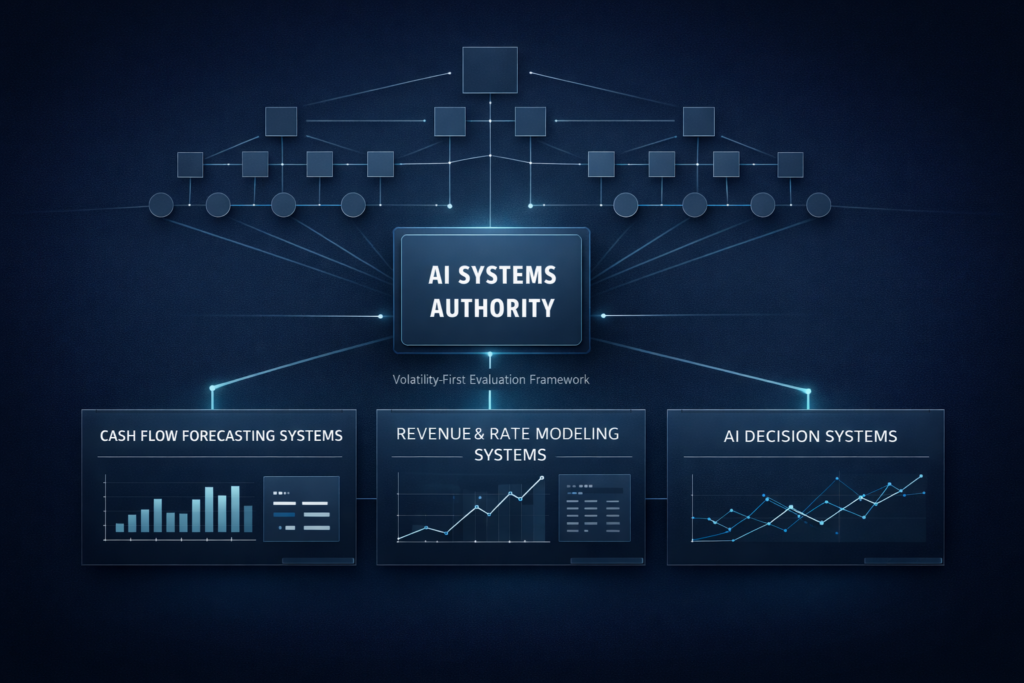
AI Systems for freelancers require structured evaluation, not hype-driven rankings. Freelancers operate under income volatility, project variability, and asymmetric financial risk. This page defines the authority framework used to assess AI financial systems through a volatility-first governance discipline designed specifically for independent professionals.
AI Systems represent the structural evaluation layer within Freelancer Money Mastery. They define how financial AI platforms, modeling software, and automation systems are assessed, categorized, and integrated into a freelancer’s operating architecture.
This is not a curated list of trending tools. It is a governance-based evaluation framework built under the principles outlined in the AI Decision Hub. Every system reviewed within this section is measured for structural resilience, transparency, and decision clarity.
What AI Systems Means for Freelancers
AI Systems are structured financial frameworks supported by software, analytical engines, forecasting platforms, or decision automation tools. They operate above individual features and focus instead on systemic financial stability.
Each AI system category addresses a distinct financial control layer within a freelancer’s business:
- Revenue & Rate Modeling Systems
- Cash Flow Forecasting Systems
- Pricing & Margin Intelligence Systems
- Accounting Automation Systems
- Financial Risk Mitigation Systems
These systems operate at different levels of financial decision-making. They are evaluated independently to preserve structural clarity and prevent category confusion.
Why Structural Evaluation Matters
Most online reviews of AI tools focus on features, usability scores, or surface-level price comparisons. That approach may be suitable for general software selection, but it is insufficient for financial systems that influence income stability.
AI Systems for freelancers are evaluated under a weighted framework that prioritizes structural resilience. Each system is scored across defined governance criteria:
- Volatility Handling
- Forecast Transparency
- Customization Depth
- Freelancer Suitability
- Decision Interpretability
- Cost Efficiency
- Data Control & Portability
- Learning Curve
Each criterion carries a specific weight. Volatility handling is prioritized because freelancers face irregular income cycles. The objective is not to reward popularity. The objective is to measure structural durability.
For proprietary execution utilities, structured calculators, and internal operating tools, visit AI Tools. Evaluation authority and execution assets remain separate layers within the platform architecture.
Governance Discipline Behind AI Systems
All evaluations inside AI Systems align with structural standards defined in the platform’s Master Blueprint and enforced through the AI Tool Scoring Framework.
This governance discipline ensures:
- Consistent scoring methodology across all categories
- Transparent tier classification
- Affiliate neutrality and separation of monetization influence
- Long-term authority integrity
- Documented re-evaluation cycles
Detailed system evaluations can be explored inside categories such as Cash Flow Forecasting Systems and Revenue & Rate Modeling Systems.
Tier Classification Model
Each AI system receives a total weighted score and is placed into one of four structural tiers. Tier classification reflects governance alignment, not marketing preference.
Tier A — Structural Excellence
Demonstrates strong volatility resilience, transparent forecasting logic, high interpretability, and scalable customization. Suitable for freelancers seeking durable financial architecture.
Tier B — Strong but Conditional
Exhibits solid structural alignment with identifiable constraints. May require complementary systems or advanced user discipline.
Tier C — Functional with Limitations
Operationally viable but structurally incomplete. Best suited for early-stage freelancers or limited use cases.
Tier D — Structurally Misaligned
Insufficient volatility handling, limited transparency, or poor interpretability. Not recommended for long-term financial stability.
Tier classification does not constitute endorsement. It reflects measurable structural alignment under the AI Systems evaluation framework.
Active AI System Categories
The following system categories are currently active within the evaluation authority structure:
Each category includes structured evaluations, scoring transparency, governance notes, and tier placement documentation.
Separation of Structural Layers
AI Systems evaluate external financial software platforms.
AI Tools provide proprietary calculators and execution utilities.
The AI Decision Hub explains the strategic doctrine and evaluation philosophy behind the scoring model.
These layers are intentionally separated to prevent structural contamination between authority evaluation and operational execution.
Long-Term Objective of AI Systems for Freelancers
The objective of AI Systems for freelancers is not tool discovery. It is structural financial resilience.
- Reduce financial fragility
- Increase forecasting clarity
- Strengthen pricing discipline
- Enhance decision transparency
- Preserve long-term operating stability
This authority framework is designed to support sustainable financial architecture for independent professionals navigating volatility, automation, and evolving digital markets.
AI Systems for freelancers are evaluated under governance discipline — not popularity metrics — ensuring structural clarity remains the primary decision standard.