
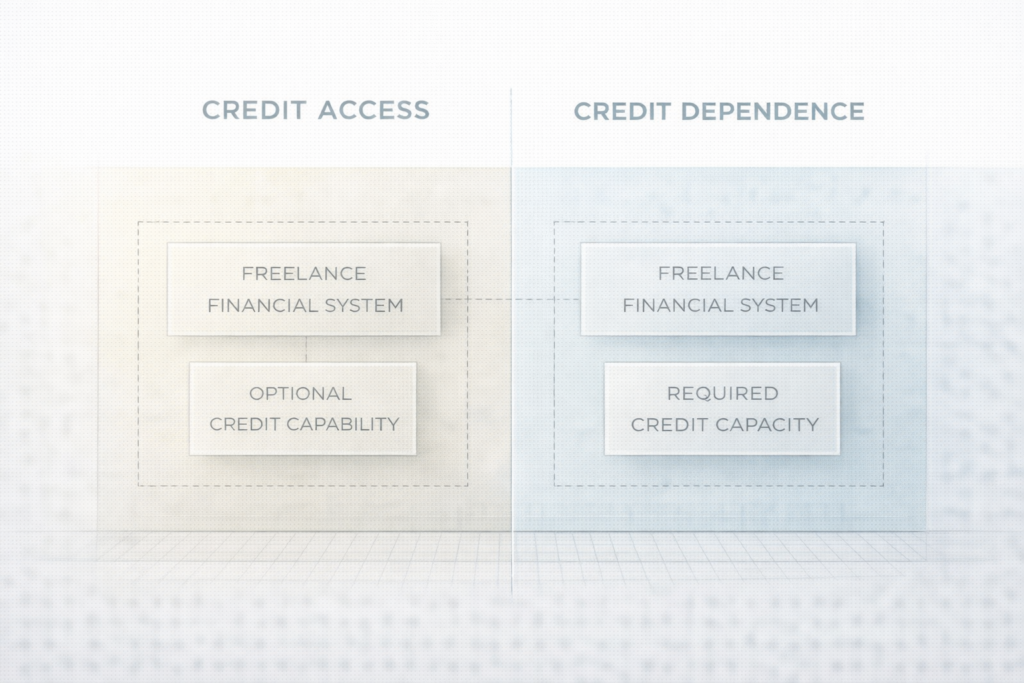
Credit Access vs Credit Dependence explains two structurally distinct states within a freelance financial system. These states do not represent degrees of the same condition. They describe fundamentally different system configurations.
Credit access exists when external liquidity is available but not required for system continuity. Credit dependence exists when external liquidity is required for the system to function as expected. The distinction is not about eligibility, approval, or permission. It is about whether the system can operate without activating credit.
This separation mirrors other Pillar 3 distinctions, including the difference between active utilization and latent exposure, and between configuration-driven pressure and nominal totals.
Structural Definitions: Access vs Dependence
Credit access represents latent capacity. External liquidity exists but remains outside the system’s operating loop.
Credit dependence represents active reliance. Credit becomes embedded in routine system function.
The system state is defined not by availability, but by necessity. When credit must be present for continuity, dependence exists regardless of intent or awareness.
Credit Access as Optional Capacity
When a system has access without dependence, credit functions as reserve flexibility.
Structurally:
• Obligations can be met without activating credit
• Timing mismatches are absorbed internally
• External liquidity remains disengaged from routine operation
In this state, credit does not materially influence system behavior. It remains external to the operating loop. The presence of access alone does not indicate strength or weakness. It indicates potential capacity.
Access is therefore structurally neutral until activated.
Credit Dependence as Embedded Infrastructure
Credit dependence begins when credit is drawn upon regularly to maintain continuity.
Structurally:
• Credit bridges routine timing gaps
• Obligations implicitly assume credit availability
• System stability depends on uninterrupted access
At this stage, credit is no longer optional. It becomes embedded infrastructure. The system’s tolerance for volatility is partially outsourced to external liquidity.
Dependence introduces new constraints. The system inherits the fragility, conditions, and continuity risks of the credit it relies on.
Volatility as the Transition Driver
Income volatility is the primary mechanism that shifts systems from access to dependence.
Volatility introduces:
• Irregular inflow timing
• Persistent gaps between inflows and obligations
• Uneven buffer depletion
A system can transition into dependence without increasing total debt. Repeated activation of credit under volatility converts optional capacity into operational necessity.
This transition is structural. It reflects capacity limits, not behavior, discipline, or intent.
When Credit Stabilizes vs When It Masks Fragility
Credit can perform two different structural functions.
In some system states, credit absorbs temporary volatility. Activation is intermittent, and disengagement is possible without destabilization.
In other states, credit masks underlying fragility. This occurs when:
• Volatility is persistent
• Fixed obligations exceed internal flexibility
• Credit substitutes for missing buffers
In masking states, stability exists only while credit remains available. Constraints are deferred, not removed. This mirrors dynamics observed in rigidity-driven systems, where relief does not eliminate constraint.
Structural Signals of Credit Dependence
Several system-level signals indicate dependence rather than access:
• Credit usage is frequent and expected
• Timing assumptions rely on credit availability
• Internal slack fails to rebuild between volatility events
These signals indicate that credit has moved from contingency to necessity. Operating assumptions have shifted.
Dependence does not imply imminent failure. It indicates reduced optionality.
Sensitivity Introduced by Dependence
Once dependence exists, the system becomes sensitive to factors beyond income volatility.
Structurally:
• Liquidity conditions gain influence
• Access disruptions propagate quickly
• Recovery windows narrow
Dependence introduces secondary volatility sources. Stability now depends on both income behavior and external liquidity continuity.
Interpreting Movement Between States
Movement toward dependence signals:
• Volatility exceeding internal capacity
• Increased reliance on external smoothing
• Constrained flexibility margins
Movement toward access signals:
• Reduced immediate reliance on credit
• Temporary alignment or relief
• Expanded maneuvering room
These movements represent state changes, not guaranteed outcomes or resolution.
Structural Meaning Summary
• Credit access is optional capacity
• Credit dependence is active system reliance
• Volatility drives transitions between states
• Dependence embeds credit into core operations
• Credit can stabilize temporarily or mask fragility
• Optionality, not availability, defines resilience
Phase Boundary Confirmation
This interpretation:
• Remains strictly descriptive and structural
• Contains no advice, recommendations, or prioritization
• Introduces no rules, thresholds, or optimization logic
• Avoids behavioral or prescriptive framing
• Preserves Pillar 3 authority and Phase 3 discipline
P3-C7 — Phase 3 Interpretation is complete and governance-safe.
This analysis operates within the broader framework of the AI-Enhanced Debt & Credit Optimization pillar.