
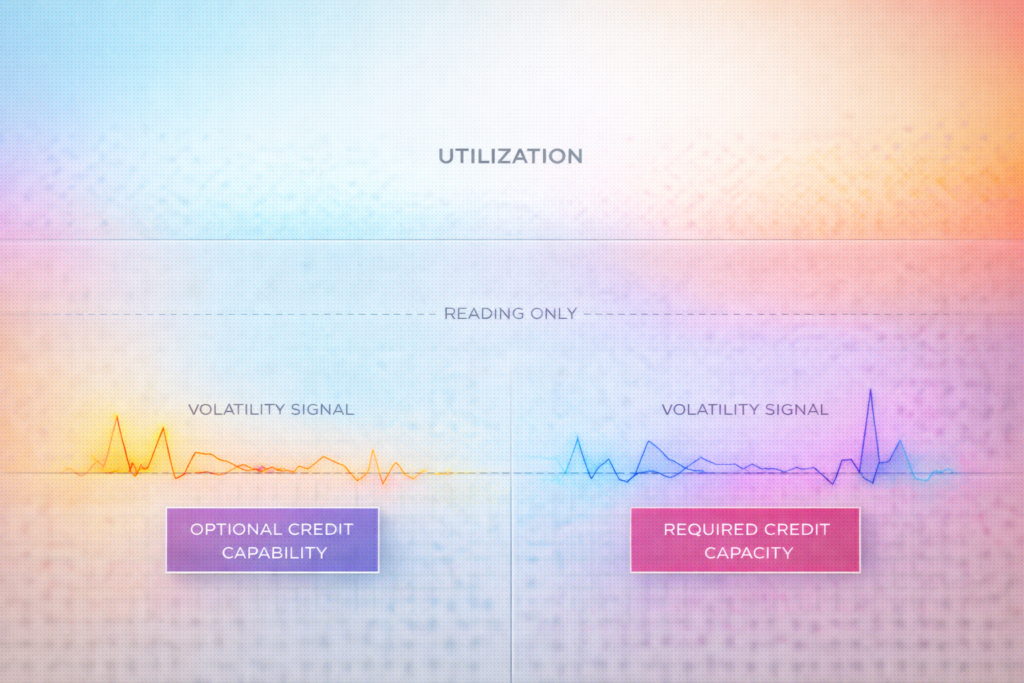
Credit Utilization as a Volatility Signal explains how the active use of available credit functions inside a volatile income system. Credit utilization represents the degree to which external liquidity is being engaged at a given point in time.
In freelance systems, utilization is not a tactic, target, or performance indicator. Structurally, it reflects how much the system is relying on credit to maintain continuity when income inflows are uneven or irregular.
Utilization therefore signals active dependence, not quality, discipline, or intent. This distinction aligns closely with how debt load and repayment pressure operate as interacting but separate system forces.
What Credit Utilization Represents Structurally
Credit utilization captures the current engagement of external liquidity relative to available capacity.
Unlike debt load, which reflects latent exposure, utilization reflects present-state reliance. It shows how much of the system’s continuity is being supported by credit at this moment.
Utilization is therefore a state indicator, not a judgment. It describes how the system is functioning under existing conditions.
Utilization as a Timing-Strain Signal
Income volatility primarily produces timing mismatches rather than constant insufficiency.
Utilization tends to increase when:
• Inflows are delayed, clustered, or uneven
• Fixed obligations remain time-bound
• Internal buffers cannot fully bridge timing gaps
Structurally, utilization signals timing strain. The system is using external liquidity to synchronize outflows with irregular inflows. This interaction mirrors the rigidity effects created by fixed obligations and minimum payments.
Utilization Dynamics Under Volatility
In stable-income systems, utilization changes incrementally. In volatile-income systems, utilization changes episodically.
Short disruptions can produce sharp utilization shifts because:
• Credit access is immediate
• Other system components adjust more slowly
• Obligations continue without delay
As a result, utilization is a fast-responding signal compared to slower structural indicators such as total debt accumulation.
Interpreting Utilization Spikes
A utilization spike does not inherently indicate deterioration.
Structurally, it may reflect:
• Activation of external liquidity to bridge income gaps
• Compression of timing slack
• Increased short-term dependence during income variability
The signal is heightened active dependence, not failure or mismanagement.
Interpreting Utilization Compression
A decrease in utilization does not inherently indicate recovery.
Structurally, it may reflect:
• Improved short-term inflow alignment
• Temporary income concentration
• Reduced immediate need for external liquidity
Compression signals reduced active dependence. It does not remove latent exposure embedded in the system.
Utilization vs. Debt Load: Distinct System States
Debt load describes latent exposure — the mass of obligations present.
Utilization describes active engagement — how much external liquidity is being used now.
Two systems with identical debt loads can exhibit very different utilization states depending on timing alignment and buffer capacity. This distinction builds on the structural separation introduced in good debt versus bad debt analysis.
Utilization answers a narrow question: how much external liquidity is currently required to absorb volatility?
Utilization as a Directional System Signal
Because utilization responds quickly to timing mismatches, it often changes before other system indicators.
This does not make utilization predictive on its own. It makes it directionally informative within the broader system context defined by the AI-Enhanced Debt & Credit Optimization pillar.
Structural Meaning Summary
• Credit utilization indicates active liquidity dependence
• It reflects timing strain rather than behavior or discipline
• Volatility amplifies utilization variability
• Spikes show external absorption of income gaps
• Compression signals temporary relief, not resolution
Phase Boundary Confirmation
This interpretation:
• Remains strictly descriptive and structural
• Contains no advice, targets, ratios, or scoring logic
• Introduces no tools, formulas, or execution guidance
• Preserves Pillar authority and Phase 3 discipline
P3-C4 — Phase 3 Interpretation is complete and governance-safe.