
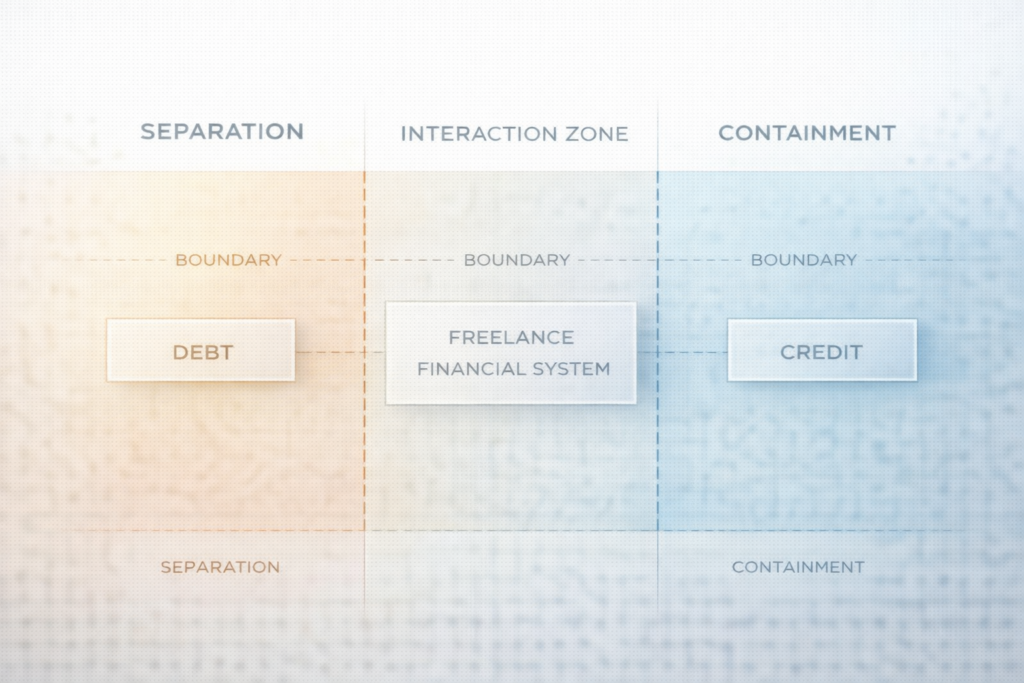
Debt Credit Interaction Boundary Map provides a non-executable, boundary-preserving lens that clarifies how debt risk and credit risk interact structurally under income volatility. This asset does not imply consolidation, leverage, or response. Its sole purpose is to preserve conceptual separation while making interaction points legible.
This Phase 4 asset synthesizes locked Phase 3 interpretations and the locked Phase 4 assets Debt Signal Synthesis Map, Debt Stress Propagation Model, and Credit Fragility vs Resilience Matrix. All upstream inputs are treated as authoritative and immutable.
The boundary map functions as a conceptual firewall. It defines where interpretation is valid and where inference must stop.
Purpose of the Debt Credit Interaction Boundary Map
The primary purpose of the Debt Credit Interaction Boundary Map is to prevent conceptual collapse between debt and credit while still acknowledging their interaction under volatility.
Debt and credit are adjacent system domains. They influence each other under stress, yet they retain distinct logics, signals, and failure modes. This asset formalizes that distinction.
The map clarifies boundaries, identifies overlap zones, and establishes interpretive guardrails—without implying consolidation, leverage, or decision logic.
Upstream Foundations (Locked Inputs)
This boundary map references only locked upstream inputs:
• Phase 3 interpretations of debt risk, credit behavior, volatility interaction, and recoverability
• P3-S1 for coexistence patterns
• P3-S2 for stress transmission context
• P3-S3 for credit posture differentiation
No downstream Phase 4 or Phase 5 assets are referenced.
Boundary Principle (Non-Executable)
Debt risk and credit risk are structurally distinct system domains.
They interact under volatility, but they do not substitute for one another. Each domain retains independent signals, dynamics, and constraint mechanisms.
This map formalizes separation while allowing interaction to be interpreted accurately.
Domain Definitions (Neutral and Structural)
Debt Risk Domain
The debt risk domain is defined by:
• Obligation persistence
• Repayment rigidity
• Cadence alignment with income variance
Primary concern: structural pressure under volatility.
Credit Risk Domain
The credit risk domain is defined by:
• Access elasticity
• Utilization behavior
• Exposure dynamics under variance
Primary concern: exposure behavior over time.
All definitions remain descriptive and non-evaluative.
Interaction Zones (Overlap Without Collapse)
The map identifies zones where debt and credit signals intersect while remaining conceptually distinct.
Repayment Pressure ↔ Credit Utilization
Interaction occurs when debt cadence influences credit usage patterns under income variance.
Boundary preserved: cadence remains a debt property; utilization remains a credit property.
Volatility Amplification ↔ Credit Exposure
Interaction occurs when variance shocks transmit stress into exposure behavior.
Boundary preserved: amplification is contextual; exposure remains posture-specific.
Recoverability ↔ Posture Stability
Interaction occurs when recovery characteristics affect observed credit state stability.
Boundary preserved: recoverability is system-level; posture is state-based.
No interaction implies hierarchy, substitution, or integration.
Interpretive Guardrails (Boundary Enforcement)
The following guardrails are explicit:
• Debt ≠ Credit — neither substitutes for the other
• Overlap ≠ Integration — interaction does not imply merging constructs
• Transmission ≠ Strategy — stress movement does not imply response logic
• State ≠ Trajectory — credit states are not paths or targets
All guardrails are expressed conditionally and descriptively.
Map Representation (Textual, Non-Executable)
The boundary map is represented as:
• Two primary domains (Debt Risk / Credit Risk)
• A defined interaction band where signals intersect
• Annotations describing interaction conditions without action
This structure clarifies interpretive limits and prevents execution leakage.
Relationship to Other Phase 4 Assets
• With P3-S1, the map uses coexistence patterns to locate interaction points
• With P3-S2, it explains how interaction manifests under stress transmission
• With P3-S3, it describes how interaction is absorbed or amplified by posture
P3-S4 introduces boundary discipline, not new signals.
Guardrails Against Execution Leakage
This asset explicitly excludes:
• Advice, recommendations, or prioritization
• Sequencing, consolidation, or leverage framing
• Thresholds, ratios, benchmarks, or optimization logic
• Tools, calculators, checklists, or workflows
• Corrective narratives, urgency cues, or readiness signals
Language remains neutral, conditional, and system-level throughout.
Role Within Pillar 3
P3-S4 functions as the conceptual firewall for Pillar 3 Phase 4.
It preserves analytical clarity, prevents misuse of synthesis layers, and ensures later phases reference interactions without collapsing domains.
Phase Integrity Statement
This document is non-executable by design.
It introduces no prescriptions, transitions, or implied next steps. All content remains within the authorized Phase 4 scope for P3-S4 only.
P3-S4 — Phase 4 drafting is complete and governance-safe.
This synthesis operates within the broader framework of the AI-Enhanced Debt & Credit Optimization pillar.