
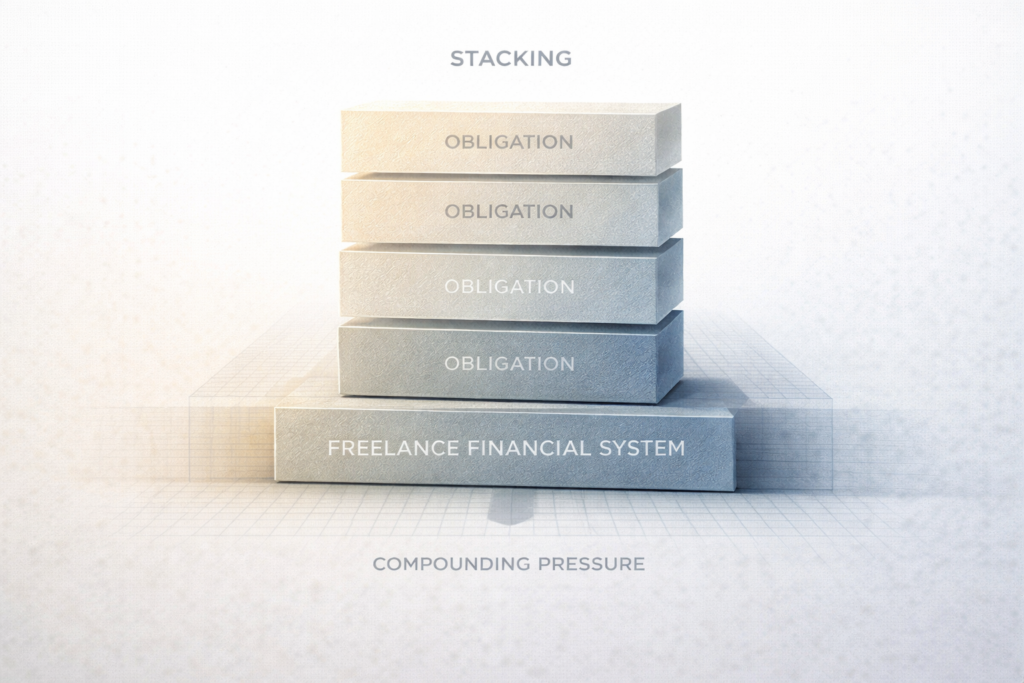
Debt Stacking and Compounding Pressure explains how multiple concurrent debt obligations interact inside a volatile income system. Debt stacking describes a system state in which several obligations operate at the same time rather than sequentially.
Structurally, stacking is not additive. Each additional obligation introduces a new constraint layer that must be satisfied in parallel with existing ones. As a result, the system’s behavior changes because constraints interact rather than operate independently.
Debt stacking therefore reflects system configuration, not debt magnitude. This distinction builds on how debt load and repayment pressure are shaped by interaction effects rather than totals.
What Debt Stacking Represents Structurally
Each individual debt obligation contributes three structural elements:
• A fixed timing requirement
• An enforcement condition
• A rigidity anchor
When obligations stack, these elements overlap. Pressure increases because constraints intersect, not because nominal balances rise.
The system becomes increasingly sensitive to timing misalignment as the number of overlapping constraints grows.
Interaction Effects Between Concurrent Obligations
In stacked systems, obligations do not act independently. Timing pressure in one obligation propagates into others because they draw from the same inflow stream.
As overlap increases:
• Timing conflicts multiply
• Buffer capacity is shared across more constraints
• Adjustment windows narrow simultaneously
This explains why pressure escalates even when individual obligations appear unchanged. The interaction effect dominates the system response.
Why Pressure Compounds Under Stacking
In volatile income systems, stacking produces non-linear pressure amplification.
As stacking increases:
• Timing mismatches propagate across obligations
• Buffers are consumed more rapidly
• The system’s tolerance for variability declines
Pressure grows faster than the number or size of obligations because constraint density increases. This compounding behavior is consistent with rigidity dynamics described in minimum payments and system rigidity.
Compounding Pressure Under Income Volatility
Income volatility amplifies stacking effects by introducing uncertainty into timing.
Under volatility:
• Obligations compete for the same inflows
• Missed alignment affects multiple constraints simultaneously
• Short disruptions persist as overlapping strain
Stacking converts volatility from a temporary disturbance into a sustained pressure state, increasing system brittleness.
Interpreting Changes in Compounding Pressure
Increasing compounding pressure may signal:
• Greater overlap of obligation timing
• Higher constraint density
• Reduced system slack
Decreasing compounding pressure may signal:
• Temporary inflow concentration
• Improved short-term alignment
• External smoothing effects
These changes reflect system state shifts, not resolution. This distinction parallels the separation between active and latent states discussed in credit utilization as a volatility signal.
Debt Stacking vs. Debt Size
Debt size describes total exposure.
Debt stacking describes how that exposure is structured.
Two systems with identical totals can experience radically different pressure depending on:
• The number of concurrent obligations
• The degree of timing overlap
• How rigidity anchors interact
Stacking explains why fragility can increase without any change in totals.
Structural Meaning Summary
• Debt stacking reflects system configuration, not totals
• Constraint interaction drives non-linear pressure growth
• Volatility magnifies overlap effects
• Compounding pressure signals reduced tolerance for variability
• Relief does not imply structural simplification
Phase Boundary Confirmation
This interpretation:
• Remains strictly descriptive and structural
• Contains no advice, prioritization, or execution logic
• Introduces no tools, calculations, or models
• Preserves Pillar 3 authority and Phase 3 discipline
P3-C5 — Phase 3 Interpretation is complete and governance-safe.
This analysis operates within the broader framework of the AI-Enhanced Debt & Credit Optimization pillar.