
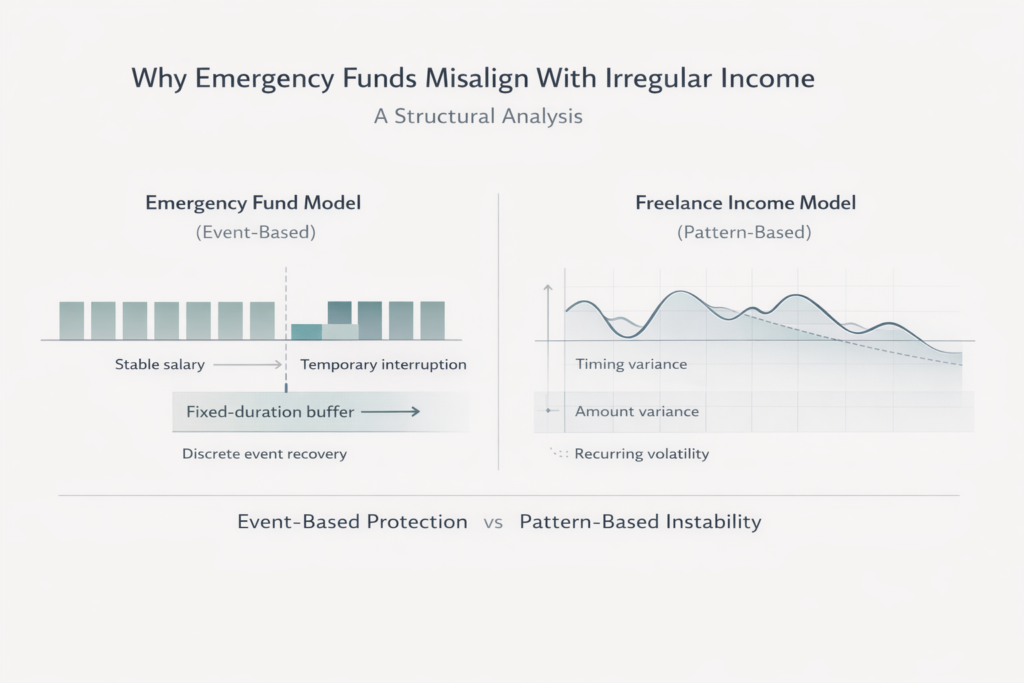
Emergency funds irregular income is a structural tension often overlooked in freelance finance. Emergency funds were designed to protect against income interruption, but irregular income reflects ongoing fluctuation rather than a single disruptive event. Understanding how emergency funds interact with irregular income patterns is essential to evaluating whether the protection mechanism matches the underlying risk architecture.
1. Opening Frame — The Untouchable Rule
Emergency funds occupy a unique position in personal finance doctrine. They are presented as a universal safeguard, a non-negotiable foundation before any other financial decision. The assumption is simple: uncertainty exists, and liquidity neutralizes it.
For salaried systems, this logic holds. Accumulate a defined reserve, protect against disruption, and stability follows. The mechanism performs reliably under the conditions for which it was designed.
Within an AI financial system for freelancers, however, mechanisms must align with income structure rather than tradition.
Misalignment begins when this doctrine is applied to income structures that do not share those conditions. In freelance systems, irregularity is not an anomaly. It is the baseline.
When a mechanism calibrated for rare interruption is placed inside a system defined by recurring fluctuation, the misalignment is structural.
2. What Emergency Funds Were Designed For
The emergency fund emerged from a specific risk model built on:
Stable salary — income arrives at fixed intervals in predictable amounts.
Low income variability — month-to-month earnings remain consistent.
Rare job loss event — disruption is infrequent but severe.
Temporary income interruption — once employment resumes, equilibrium returns.
Within this structure, the emergency fund functions as a bridge. Income stops, reserves activate, employment resumes, reserves replenish. The interruption is discrete and time-bound.
The mechanism is event-based. Risk appears as a singular break in continuity.
3. The Nature of Irregular Income
Freelance income does not follow that model. Variability appears across multiple dimensions:
Timing variance — payments cluster unpredictably, as examined in Cashflow Timing Risk in Freelance Systems.
Amount variance — revenue shifts across periods.
Client dependency — concentration shapes continuity.
Recurring volatility — fluctuation is ongoing, not exceptional.
These conditions do not resemble interruption. They resemble oscillation. Income rarely ceases entirely. It expands and contracts within a range.
The structural distinction between interruption and fluctuation is examined in Income Variability vs Income Risk in Freelance Systems.
Emergency funds are calibrated for interruption. Freelance systems are defined by fluctuation.
4. Structural Misalignment
The misalignment begins with measurement. A fixed-month buffer presumes predictability in income and disruption length. It assumes that once a reserve threshold is reached, the system can withstand a defined period without revenue.
Irregular income introduces a different dynamic. Volatility duration is uncertain because fluctuation does not resolve cleanly. Lower-income periods extend gradually rather than abruptly. Revenue compression can persist across multiple cycles without becoming a complete stop.
In this environment, reserves are not triggered by a single event. They erode incrementally.
Continuous variability drains numeric buffers over time. The reserve functions less as a bridge and more as a shock absorber for recurring oscillation. Because oscillation lacks a clear endpoint, depletion can outlast the original time assumption embedded in the buffer.
The safety mechanism was engineered for interruption recovery. Freelance volatility requires tolerance of ongoing variance.
The emergency fund is a discrete defense against a discrete event. Irregular income represents distributed instability across time.
5. The False Sense of Completion
Reaching a predefined reserve threshold produces psychological closure. “I have six months saved” implies that the core risk variable has been neutralized. The buffer becomes visible proof of preparedness.
Visibility is not structural stability.
When the reserve is treated as completion, redesign of the income architecture pauses. Concentration risk, volatility amplitude, cost rigidity, and dispersion remain unchanged. Exposure persists beneath the numeric safeguard.
Liquidity absorbs early stress without forcing structural adaptation. This creates a perception of control dependent on reserve depth rather than system design.
Closure suppresses re-evaluation. The buffer appears to solve instability even when instability is patterned, not episodic.
6. Reframing Safety in Variable Income Systems
In variable income environments, safety cannot be defined solely by numeric duration. It must be structural.
Volatility range tolerance — the system must withstand income oscillation within expected amplitude.
Adaptive cost structure — obligations must adjust proportionally to revenue shifts.
Income dispersion — reliance on a single source amplifies fragility under variance.
Resilience over time horizon — stability must endure extended fluctuation, not only temporary interruption.
These characteristics operate independently of a specific reserve size. They address the architecture generating instability rather than only the liquidity covering it.
Emergency funds remain relevant within this frame. They provide liquidity against interruption. Liquidity alone does not neutralize recurring volatility embedded in the income structure.
7. Closing Insight
Emergency funds protect against interruption. Freelancers face fluctuation.
An event-based safeguard cannot fully stabilize a pattern-based instability.
When risk architecture changes, safety mechanisms must align with it. In irregular income systems, stability does not emerge from a fixed-duration buffer alone. It emerges from compatibility between the risk structure and the protection applied.
Interruption and fluctuation are distinct risk categories. Safety must match the category.