
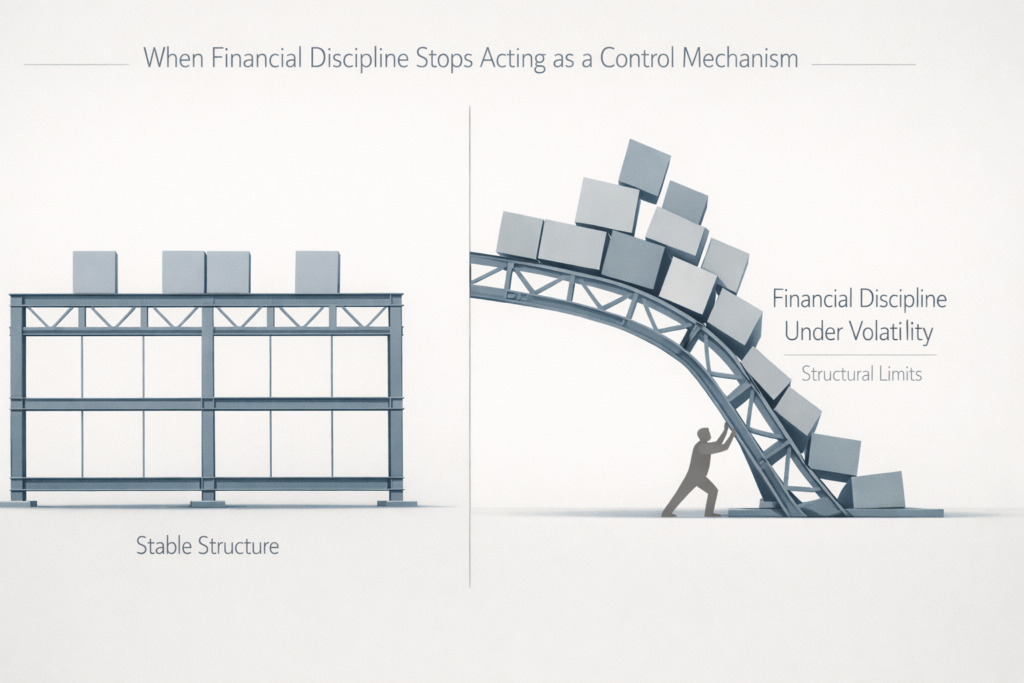
Financial Discipline Under Volatility: Structural Limits defines the boundary where disciplined behavior ceases to function as a stabilizing force. In freelance systems marked by irregular income, increased restraint and consistency cannot compensate for architectural misalignment. When volatility exceeds structural tolerance, discipline shifts from optimization tool to compensatory mechanism, exposing the limits of effort-based control.
1. Opening Frame — The Discipline Doctrine
Financial discipline is positioned as the universal stabilizer of money. Spend less than you earn. Track consistently. Resist impulse. Maintain consistency. Across financial discourse, discipline is framed as the primary control mechanism — the force that contains instability.
This framing assumes effort compensates for variability. When outcomes deteriorate, the implied cause is insufficient restraint or rigor. Discipline becomes both diagnosis and cure.
Within stable environments, this logic holds. Within volatile freelance systems, its limits emerge. Earlier structural analysis in The Illusion of Financial Control established that visibility does not equal durability. Discipline introduces a similar confusion: effort does not equal control.
2. Where Discipline Works
Discipline functions inside stable architectures. When income arrives predictably, expense cycles repeat consistently, and planning horizons remain fixed, disciplined behavior compounds.
Stable income narrows uncertainty. Constraint mechanisms operate within tight variance bands. Adjustments remain incremental rather than reactive.
Predictable expense cycles allow discipline to optimize rather than correct. Costs are known. Timing is consistent. Restraint improves margins without absorbing disruption.
Linear cashflow simplifies forecasting. Revenue and expenses move in coherent patterns. Deviations remain contained.
Fixed planning horizons support consistency. When timelines are stable, disciplined routines align with structure.
In these conditions, discipline reinforces architecture. It refines a system that already functions — particularly within conventional salary-based financial models.
3. Variable Income and System Overload
Freelance income disrupts these assumptions. Volatility increases load on both the financial system and the individual managing it.
Cognitive load rises as income becomes irregular. Each fluctuation requires recalibration. Forecasts shift. Expense timing changes. Planning becomes conditional.
Emotional compression intensifies as surplus and deficit months alternate. The distance between security and scarcity narrows.
Decision fatigue expands because adjustments are recurring rather than occasional. Each fluctuation demands interpretation and response.
Recurring recalibration becomes structural. Budgets are rewritten. Allocations shift. Buffer assumptions change. The system demands continuous supervision.
Under volatility, discipline operates under moving constraints rather than stable parameters. As examined in Why Budgeting Breaks Down Under Variable Income, traditional constraint models strain when variability becomes continuous rather than episodic.
4. Discipline as Compensation
When architecture is misaligned with volatility, discipline shifts roles. It compensates for fragility instead of optimizing stability.
Offsetting fragility becomes its primary function. Income timing gaps are absorbed through temporary spending suppression. Revenue drops trigger intensified restraint.
Absorbing shocks becomes routine. Shortfalls are covered through tighter control rather than structural tolerance.
Artificial expense suppression replaces flexibility. Costs sustainable under average income must be repeatedly constrained to match unpredictable inflows.
Masking architectural flaws becomes a consequence. As long as discipline bridges volatility gaps, structural weaknesses remain concealed.
At this stage, discipline ceases to function as control. It becomes a stress response embedded within an unstable design.
5. The Illusion of Effort-Based Stability
Increased effort does not increase resilience. When volatility repeatedly forces corrective behavior, recurrence signals structural mismatch rather than insufficient commitment.
Frequent correction indicates dependence on exertion. Stability requires constant vigilance. Margin is preserved through effort intensity instead of structural tolerance.
Repeated correction is diagnostic. Architecture and volatility are misaligned. Effort compensates for design limits.
Over time, sustainability declines. Emotional bandwidth contracts. Financial decisions become reactive. Control persists only while effort remains elevated.
This pattern reinforces a consistent structural conclusion: intensity does not equal durability. Behavioral force cannot permanently stabilize flawed architecture.
6. Design Over Effort
Structural control emerges from architecture, not exertion. Within the broader AI-Powered Money Management framework, control is defined by system properties rather than behavioral strain.
Load distribution reduces dependence on single income sources. Dispersion prevents isolated volatility from destabilizing the system.
Volatility tolerance defines how much fluctuation can occur before corrective action is required. Greater tolerance reduces reactive discipline.
Income dispersion moderates concentration risk. Variability becomes distributed rather than amplified.
Adaptive cost base introduces expense flexibility. When costs adjust without destabilization, volatility transmits less pressure.
Structural slack provides surplus capacity. Shock is absorbed without immediate behavioral correction.
Within aligned architecture, discipline returns to its proper role. It optimizes margins and reinforces consistency. It no longer compensates for systemic misalignment.
7. Closing Insight
Financial discipline remains valuable. It refines behavior and strengthens structure. Its effectiveness depends on the system it operates within.
Discipline can optimize a stable structure.
It cannot permanently stabilize an unstable one.
Control belongs to architecture.