
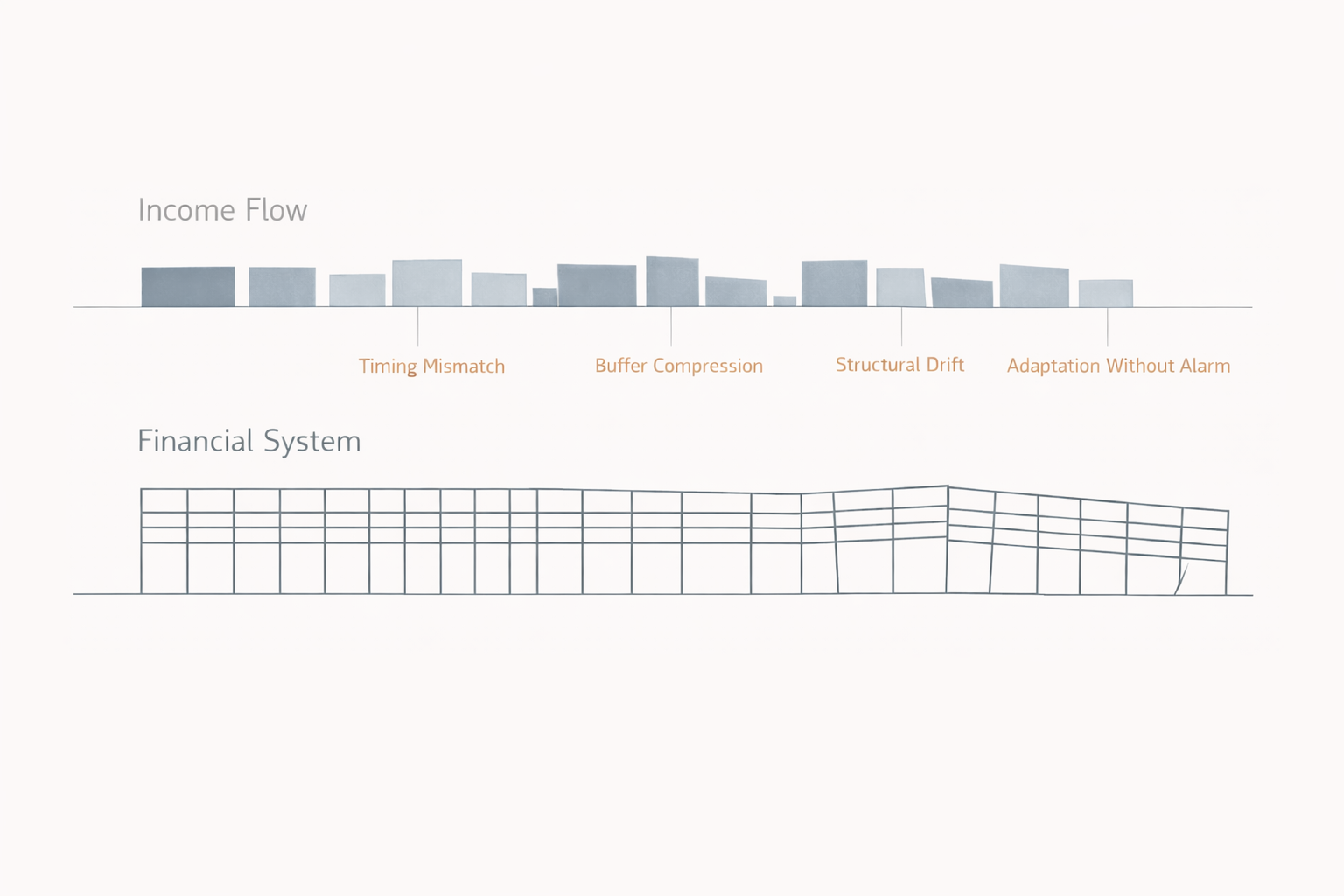
Freelance financial drift rarely appears as sudden collapse. The system seems functional. Income arrives. Bills are paid. Work continues. Nothing signals danger. Yet perceived stability and structural stability are different states, and the gap between them is where quiet degradation begins.
1. The Illusion of Stability
Freelance financial failure rarely appears as sudden collapse. The system seems functional. Income arrives. Bills are paid. Work continues. Nothing signals danger.
Yet perceived stability and structural stability are different states.
Perceived stability is psychological:
“I’m managing.”
“It’s uneven, but it works.”
Structural stability is architectural:
• Cash inflows align with fixed obligations
• Buffers absorb timing gaps
• Decision load remains within cognitive limits
• Lifestyle scale matches volatility tolerance
Under variable income, small misalignments appear normal. Because fluctuation is expected, erosion is misclassified as variance.
Financial systems do not need to break to weaken. They only need to drift.
This framing sits within the broader AI-aligned money management layer for freelancers, where system integrity is evaluated independently of short-term continuity.
→ AI-Powered Money Management for Freelancers
2. What Financial Drift Actually Is
Financial drift is gradual misalignment inside a functioning system.
It is not crisis. It is not insolvency. It is deviation without alarm.
Drift appears as:
• Subtle divergence between income timing and fixed obligations
• Rising cognitive effort to maintain equilibrium
• Narrowing buffers without explicit acknowledgment
• Lifestyle overhead expanding beyond volatility tolerance
• Quiet reliance on informal credit or future income assumptions
Each shift is minor. Together, they reduce structural alignment.
Drift compounds. Local adjustments relieve immediate friction while introducing marginal instability elsewhere. The system continues operating, but under increasing strain.
3. Why Drift Is Hard to Detect
Drift hides inside normal operations.
There is no triggering event. No discrete failure point. No visible break.
Income continues. Bills clear. Clients remain.
Collapse events are identifiable. Drift is continuous.
Because freelance income is inherently variable, moderate volatility becomes baseline. Irregular cashflow masks imbalance. Adaptation is mistaken for resilience.
When the system compensates successfully, the strain becomes invisible.
4. The Four Drift Vectors in Freelance Systems
4.1 Timing Drift
Income timing and expense timing rarely align. Buffers initially absorb the mismatch.
• Payments arrive later
• Fixed obligations harden
• Anticipated income replaces confirmed liquidity
The gap widens without visible failure. Stretching becomes standard.
4.2 Buffer Compression
Buffers absorb volatility. Compression occurs when:
• Reserves are partially used and not restored
• Operating margins narrow
• Income variability rises without proportional buffer growth
The buffer still exists, but its shock capacity declines. Reduced tolerance precedes visible failure.
Buffer compression frequently coexists with silent credit dependence, where future income or informal liquidity substitutes for explicit borrowing.
→ AI Debt & Credit Overview
4.3 Behavioral Adaptation Drift
Mild strain alters behavior.
Decision fatigue rises. Shortcuts normalize. Reviews become irregular. Assumptions replace verification.
Architecture remains intact, but operational discipline erodes. Immediate effort decreases while fragility increases.
4.4 Complexity Creep
Freelance systems expand organically:
• More clients
• Mixed pricing models
• Layered subscriptions
• Variable tax exposure
• Growing operating expenses
Complexity raises cognitive load. When structure does not scale proportionately, drift accelerates. Reduced clarity delays detection.
Complexity-driven drift reflects broader AI-enabled business system expansion, where operational structure fails to scale at the same rate as income sources and obligations.
→ AI-Enabled Business Systems
5. Why “Mostly Okay” Is a Risk Zone
Acute instability is obvious. Full stability is low-friction. The fragile position lies between.
“Mostly okay” systems generate manageable volatility and moderate strain. Because nothing collapses, degradation is labeled normal.
Moderate instability becomes baseline. As long as crisis is absent, misalignment is tolerated. Deviation becomes standard.
6. Slow Degradation vs Sudden Failure
Structural systems fail after fatigue accumulates. Infrastructure weakens incrementally. Load shifts. Redundancy narrows. An ordinary stressor then exceeds reduced tolerance.
Freelance financial systems behave the same way.
Collapse is visible. Drift is cumulative misalignment.
Failure appears sudden but reflects prolonged compression and adaptation that reduced integrity long before the final trigger.
The event is new. The degradation is not.
7. Closing Insight
Financial resilience in freelancing is not the absence of stress.
Volatility is structural. Variation is constant.
Resilience is alignment integrity over time.
When inflow timing, buffer capacity, behavioral consistency, and system complexity remain proportionate, the system sustains itself.
When those elements diverge without detection, drift emerges.
Drift is deviation without alarm.