
(That Works Even When Motivation, Income, and Focus Fluctuate)
Freelancers do not fail financially because they lack discipline. They fail because their financial setup assumes consistency in a world that has none.
Income fluctuates. Focus drops. Motivation fades.
Any system that requires steady effort will eventually break.
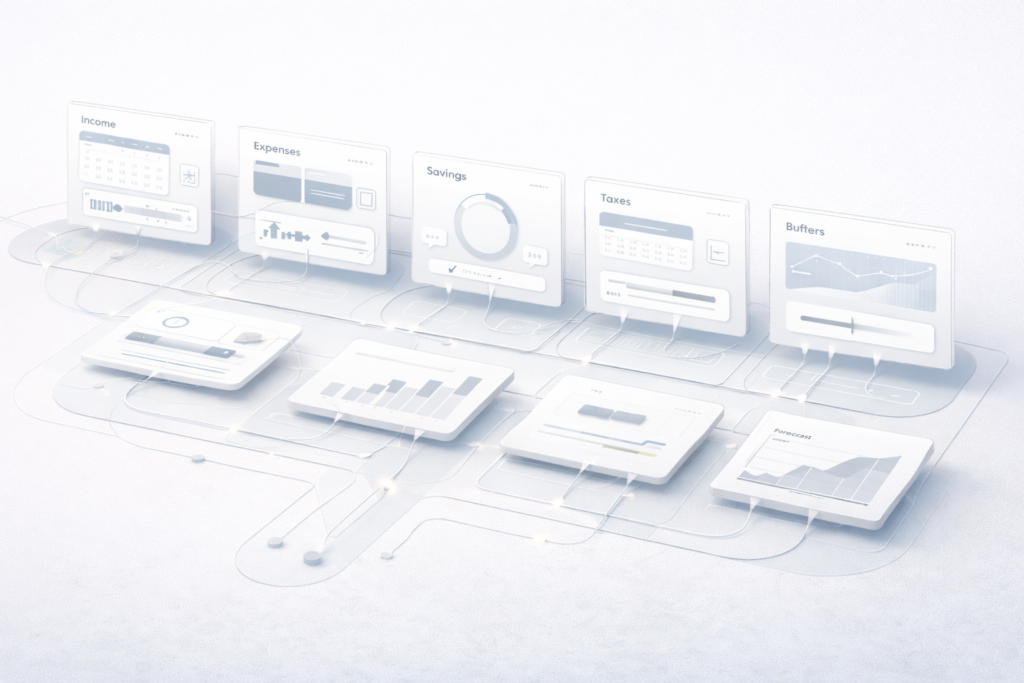
This article brings together everything you have learned so far into a single structure: a Freelance Money Operating System (FMOS) — a set of interlocking systems that keep finances stable even when the human running them is tired, distracted, or under pressure.
No habits to maintain. No motivation required. Just infrastructure.
The Core Shift: From Money Management to System Design
Most freelancers try to manage money.
Managing assumes:
• Regular attention • Emotional energy • Ongoing decisions
Systems assume the opposite.
A money operating system is designed to:
• Run quietly • Absorb volatility • Apply rules consistently • Reduce decisions over time
The goal is not optimization. The goal is resilience.
Why Freelancers Need an Operating System (Not More Advice)
Employees are protected by systems they never see:
• Payroll timing • Automatic tax deductions • Fixed expense rhythms
Freelancers operate without that scaffolding.
Without an operating system:
• Good months create false confidence • Quiet months create panic • Decisions are made reactively • Stress compounds silently
An FMOS replaces missing scaffolding with deliberate structure.
The Five Core Components of a Freelance Money Operating System
An FMOS is not a single tactic. It is a stack.
Each layer protects the next.
1. Cashflow Buffer — Time Protection
The buffer exists to buy time.
Not to earn returns. Not to feel secure. To prevent damage when income pauses.
When time is protected:
• Panic decisions stop • Underpricing disappears • Credit reliance fades
If you have not read it yet, start here:
How to Build a 90-Day Freelance Cashflow Buffer
2. Spending Guardrails — Behavior Protection
Guardrails remove judgment.
Instead of asking:
“Can I spend this?”
The system answers:
“This is allowed right now.”
By adjusting spending automatically based on risk, guardrails:
• Prevent lifestyle creep • Eliminate guilt • Keep good months controlled
This layer stabilizes behavior without willpower:
How to Design Spending Guardrails That Automatically Tighten and Loosen
3. Money Separation — Signal Clarity
One pool of money lies.
Separation tells the truth.
By assigning money a single job:
• Spendable money feels honest • Tax money stops leaking • Business health becomes visible
This restores clarity instantly:
How to Separate Personal, Business, and Tax Money
4. Tax System — Shock Absorption
Taxes become painful only when they are postponed.
When taxes are treated as a year-round system:
• Payments feel routine • Cashflow remains intact • Emotional resistance disappears
This layer removes surprise:
How Freelancers Should Think About Taxes Year-Round
5. Review Rhythm — Light Oversight
An FMOS does not require constant monitoring.
It requires a rhythm.
Weekly:
• Confirm state • Check runway • Apply rules
Quarterly:
• Adjust percentages • Rebalance if needed
No analysis of past mistakes. Only confirmation that the system still fits reality.
How the System Works When You Don’t
This is the defining test.
A working FMOS:
• Protects you during distraction • Holds during emotional months • Applies rules without negotiation • Improves outcomes before income improves
You are not “being disciplined.” You are being supported by design.
Common Mistakes When Building an FMOS
• Adding complexity before stability • Mixing systems into one account • Treating good months as permanent • Optimizing tools instead of structure • Trying to fix behavior directly
A system should feel boring. Boring systems last.
The Psychological Shift That Follows
Once an FMOS is in place:
• Money stops feeling personal • Decisions lose emotional charge • Planning moves from weeks to months • Confidence grows quietly
Stress drops not because income changed — but because uncertainty stopped causing damage.
The Bottom Line
Freelancers do not need better habits. They need systems that work when habits fail.
A Freelance Money Operating System does not eliminate volatility. It makes volatility survivable — and eventually manageable.
Stability is not earned through effort. It is installed through structure.
How to Use This Series (If You’re Reading Out of Order)
If you want to apply everything cleanly, follow this sequence:
1. Build time protection (cashflow buffer)
2. Install behavior protection (spending guardrails)
3. Restore clarity (money separation)
4. Neutralize shocks (tax system)
5. Maintain alignment (review rhythm)
Do not rush. Do not skip layers.
This concludes the FM Mastry foundation system.