
Freelancer Business Systems: Operational Systems for Freelance Stability
Operational systems that support financial stability for freelancers and independent professionals.
Freelancers operate as independent businesses rather than employees. Income stability, financial planning, and pricing decisions are therefore influenced not only by income levels, but by the operational systems used to manage clients, projects, and workflows.
Without structured business systems, freelancers often experience inconsistent workflows, administrative overload, and revenue disruptions.
This guide explains how freelancers design operational systems that support financial stability, improve efficiency, and reduce administrative friction across the entire freelance business.
FM Mastery System Map
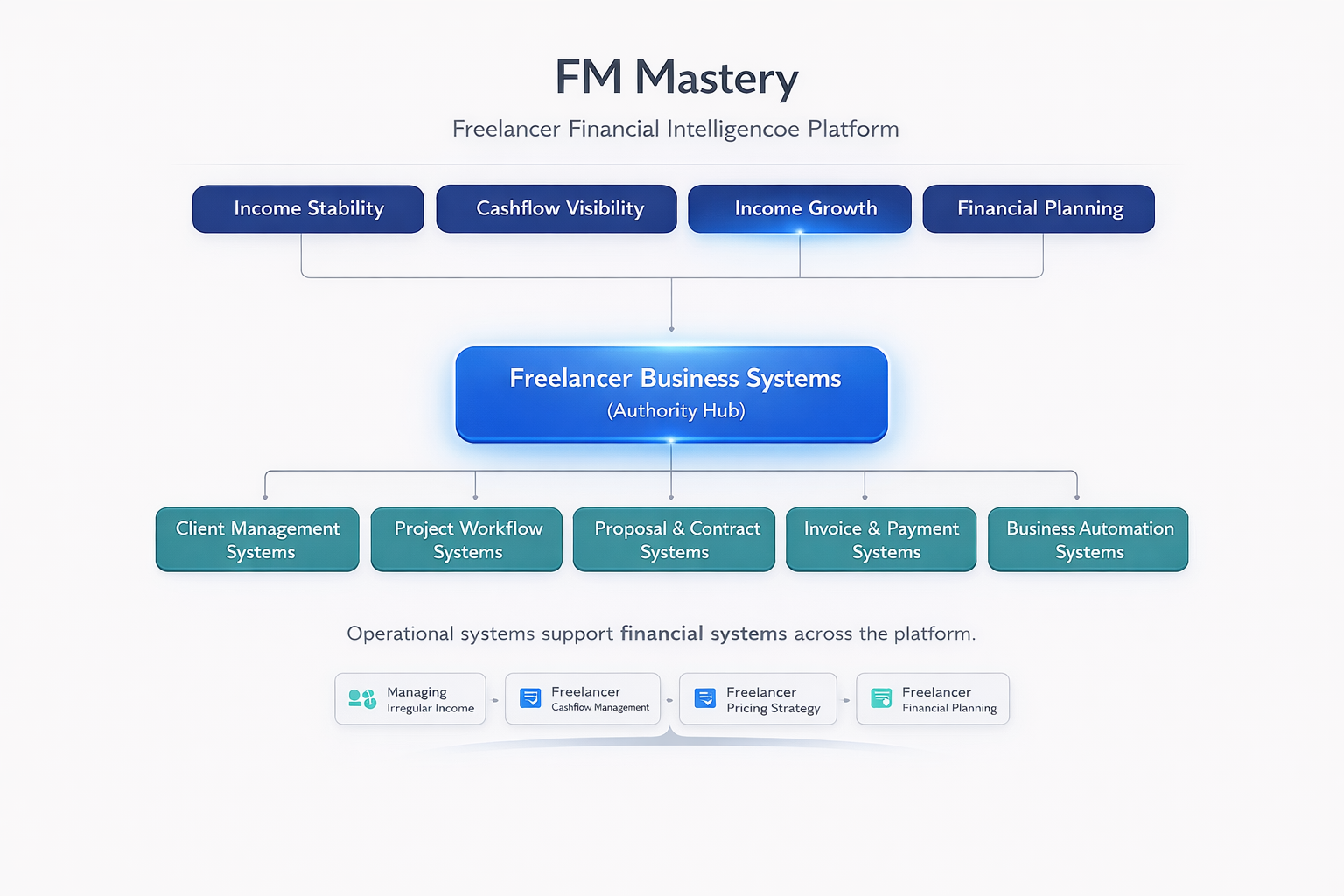
The FM Mastery platform organizes freelancer financial knowledge into interconnected systems designed to support long-term stability.
- Income Stability — Managing Irregular Income
- Cashflow Visibility — Freelancer Cashflow Management
- Income Growth — Freelancer Pricing Strategy
- Financial Planning — Freelancer Financial Planning
Freelancer Business Systems — Knowledge Overview
Definition
Freelancer business systems refer to the operational infrastructure used to manage client relationships, project workflows, contracts, invoicing, and administrative processes within a freelance business.
Platform Context
Within the FM Mastery Freelancer Financial Intelligence platform, business systems function as the operational layer supporting financial systems.
Connected Financial Systems
FM Mastery System Context
This approach is part of a broader AI financial system for freelancers designed to manage financial decisions under income uncertainty.
Operational systems form the infrastructure that allows financial systems—such as pricing strategy, cashflow management, and financial planning—to function reliably.
When these systems are missing or poorly designed, financial decisions become reactive and unstable.
Hub Summary
This authority hub explains how freelancers design operational systems that support both financial stability and long-term business scalability.
- structural operational challenges freelancers face
- why traditional business workflows often fail solo operators
- the FM Mastery operational systems framework
- decision frameworks for managing freelance operations
- cluster guides covering core business infrastructure
Key Takeaways
- Freelancers require structured operational systems to support financial stability.
- Operational inefficiencies often lead to revenue loss and administrative overload.
- Client management, project workflows, and automation systems improve operational reliability.
- Business infrastructure enables scalable freelance operations.
- Structured systems reduce cognitive load and improve decision-making.
Table of Contents
- FM Mastery System Map
- Problem Overview
- Why Traditional Systems Fail
- The Core Business Systems Framework
- Operational Decision Framework
- Business Systems Maturity Stages
- Business Systems Guides
- Tools
- Common Mistakes
- Business Systems Checklist
- Related Financial Systems
- FAQ
Problem Overview
Freelancers often operate without structured operational systems. Client communication, project management, contracts, invoicing, and administrative tasks may all be handled manually or inconsistently.
This creates operational inefficiencies that directly affect financial stability.
- missed invoices or delayed payments
- unclear project workflows
- client communication breakdowns
- administrative overload
Business systems are therefore necessary not only for efficiency but also for maintaining predictable income operations.
Why Traditional Systems Fail
Most business management advice assumes organizational teams, administrative support, and stable operational environments.
Freelancers typically operate independently and must manage every operational function themselves.
Without simplified systems designed specifically for solo operators, administrative complexity can increase rapidly.
The Core Business Systems Framework

Client Management Systems
Freelancers need structured systems for tracking clients, communication history, and project information.
Project Workflow Systems
Defined workflows help projects move efficiently from proposal to delivery.
Proposal and Contract Systems
Standardized agreements clarify scope, reduce disputes, and create professional consistency.
Invoice and Payment Systems
Reliable invoicing systems improve cashflow reliability and reduce administrative friction.
Business Automation Systems
Automation reduces repetitive operational tasks and increases overall efficiency.
Operational Decision Framework
- If administrative tasks consume excessive time → implement automation systems.
- If client communication becomes fragmented → implement centralized client management.
- If projects experience delays → standardize project workflows.
- If payments become inconsistent → improve invoicing systems.
Business Systems Maturity Stages
- Ad Hoc Stage — freelancers manage operations manually.
- Structured Stage — basic systems for clients and projects emerge.
- Systemized Stage — standardized workflows improve efficiency.
- Automated Stage — automation reduces administrative overhead.
Business Systems Guides
Client Systems
- Client Management Systems
- Proposal Systems
Project Systems
- Project Workflow Systems
- Delivery Systems
Automation Systems
- Business Automation Systems
- Operational Dashboards
Tools
- Client CRM tools
- Project management systems
- Proposal and contract platforms
- Invoice automation tools
Common Mistakes
Managing Operations Manually
Manual workflows quickly become inefficient as freelance businesses grow.
Lack of Process Standardization
Without standardized systems, freelancers repeat administrative work unnecessarily.
Ignoring Operational Efficiency
Poor operational systems often lead to revenue loss and client dissatisfaction.
Freelancer Business Systems Checklist
- Client management system established
- Project workflow standardized
- Contracts and proposals systemized
- Invoice and payment tracking implemented
- Operational automation introduced where possible
Related Financial Systems
- Managing Irregular Income
- Freelancer Cashflow Management
- Freelancer Pricing Strategy
- Freelancer Financial Planning
Frequently Asked Questions
Why do freelancers need structured business systems?
Operational systems help freelancers manage clients, projects, and finances efficiently.
What are the most important systems for freelancers?
Client management, project workflows, contracts, invoicing, and automation systems form the operational foundation of a freelance business.
When should freelancers introduce automation?
Automation becomes valuable when administrative tasks begin consuming significant time and reduce the ability to focus on client work.
About FM Mastery
FM Mastery is a Freelancer Financial Intelligence Platform designed to help freelancers manage financial decisions under income volatility.
The platform provides structured financial systems covering income stability, cashflow visibility, pricing strategy, financial planning, and freelancer business systems.