
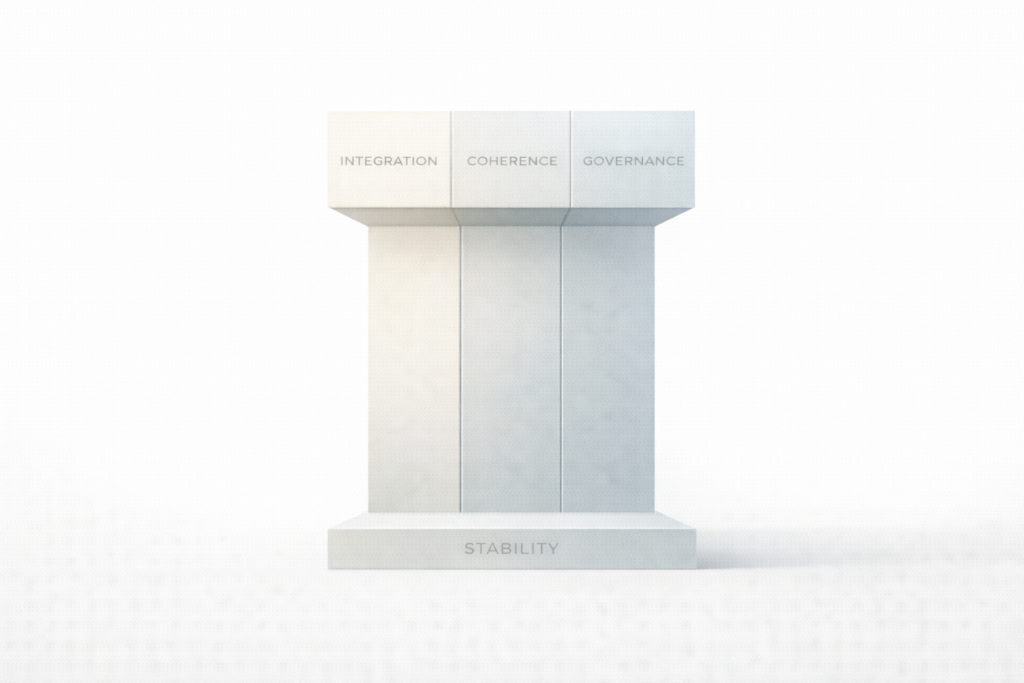
Freelancer Business Systems (AI-Enabled) represents the final integrative layer within the FM Mastery operating system. This pillar exists to ensure that a freelancer’s business continues to make correct financial and operational decisions even when conditions are imperfect—when attention is fragmented, energy is reduced, or clarity is temporarily compromised.
Unlike earlier pillars, Pillar 5 does not introduce new financial methods, productivity tactics, growth strategies, or execution frameworks. Its role is interpretive and structural. It unifies all previously stabilized systems into a single, coherent business logic that remains functional under real-world pressure.
Most freelancers do not fail because they lack information. They fail because their systems degrade under cognitive load. Pillar 5 addresses this fragility by ensuring continuity of decision quality even when the freelancer cannot operate at full capacity.
The Core Question Pillar 5 Exists to Answer
Pillar 5 is designed to answer one foundational question that determines long-term survivability for independent professionals:
Can the freelancer’s business continue to make correct decisions even when attention, energy, or clarity is reduced?
This question reframes freelancing away from peak performance and toward durability. Volatility, distraction, fatigue, and constraint are the default operating conditions for most independent workers.
Canonical Definition (Phase 1 — Locked)
Freelancer Business Systems (AI-Enabled) is the integrative layer that consolidates financial stability, debt containment, operational capacity, and controlled income growth into a coherent business operating context that remains functional during volatility, fatigue, distraction, or cognitive overload.
This definition is intentionally narrow and non-procedural. It establishes what this pillar is, without implying how it is implemented. The definition is binding for Phase 1.
Key characteristics of this definition include:
• Emphasis on integration rather than expansion
• Treatment of freelancing as a business system, not a collection of activities
• Prioritization of decision continuity over performance optimization
• Framing AI strictly as a visibility and support layer, never as authority
Strategic Role Within the FM Mastery Sequence
Pillar 5 occupies the final position in the FM Mastery sequence by design. It is not an alternative entry point, shortcut, or substitute for foundational work completed in earlier pillars.
The sequence logic is intentionally one-directional:
• Pillar 1 — AI-Powered Money Management for Freelancers reduces financial chaos and establishes cashflow stability
• Pillar 2 — AI-Smart Income Growth for Freelancers frames income generation within controlled, risk-aware boundaries
• Pillar 3 — AI-Enhanced Debt & Credit Optimization aligns liabilities and obligations with real operating capacity
• Pillar 4 — AI Productivity & Operations for Freelancers establishes sustainable execution without overload
Pillar 5 ensures that the gains created by these pillars are not lost under pressure. Stability becomes structural rather than situational.
Scope Definition — What Pillar 5 Covers (Phase 1 Only)
Within Phase 1, Pillar 5 is strictly limited to interpretive synthesis across four domains.
1. System Unification
Pillar 5 interprets how financial systems from Pillar 1, income structures from Pillar 2, debt alignment from Pillar 3, and operational capacity from Pillar 4 function together as a single business organism.
The emphasis is on coherence, not enhancement.
2. Decision Continuity
This pillar explains how correct decisions remain consistent over time regardless of emotional state, workload, or external pressure. Decisions are framed as outcomes of system design, not willpower.
3. Business-Level Framing
Freelancing is interpreted as a long-term business asset rather than a sequence of short-term income events. Actions are evaluated through durability, repeatability, and survivability lenses established across earlier FM Mastery pillars.
4. AI as Visibility, Not Authority
AI is interpreted exclusively as a supportive visibility layer that reduces blind spots and cognitive load across the systems defined in Pillars 1 through 4. AI does not replace judgment, override authority, or initiate decisions.
Explicit Boundaries and Non-Goals
To preserve system integrity and phase discipline, the following are explicitly excluded from Pillar 5 Phase 1:
• No financial tactics, models, or strategies
• No operational workflows, SOPs, or procedures
• No tool stacks, comparisons, or recommendations
• No automation logic or execution steps
• No scaling frameworks or growth levers
• No reinterpretation or modification of Pillars 1–4
Pillar 5 does not override, replace, or optimize earlier pillars. Any attempt to do so violates FM Mastery’s sequence doctrine.
Relationship to Prior Pillars (Non-Recursive)
Pillar 5 has a one-way dependency on earlier pillars:
• Financial stability and risk containment from Pillars 1 and 2
• Capacity alignment from Pillar 3
• Controlled execution framing from Pillar 4
There is no backward influence. Earlier pillars remain authoritative, immutable, and locked.
Phase 1 Output Constraints
Authorized outputs for Phase 1 are limited to:
• Canonical pillar definition
• Clear scope and exclusion boundaries
• Strategic role articulation
• Guardrails for future phases
No drafting, publishing, system design, execution logic, or asset creation is permitted at this stage.