
Long-Term Financial Systems for Freelancers with Irregular Income
Freelancer financial planning helps independent professionals manage irregular income, plan taxes, build savings, and create long-term financial stability. Freelancers operate in financial environments that differ significantly from traditional employment, where income may fluctuate between months and payment schedules depend on client behavior.
Because of these conditions, freelancers must design financial systems that adapt to income volatility rather than relying on salary-based financial planning models.
Many freelancers first stabilize income volatility through systems explained in Managing Irregular Income and gain financial visibility through Freelancer Cashflow Management.
As freelance businesses grow, pricing strategies discussed in Freelancer Pricing Strategy influence long-term financial planning decisions, while operational infrastructure from Freelancer Business Systems supports sustainable financial operations.
This guide explains how freelancers design structured financial planning systems that support long-term stability, savings, and wealth creation.
Freelancer Financial Planning Systems
Freelancer financial planning systems help independent professionals manage irregular income, plan for taxes, build savings, and create long-term financial stability.
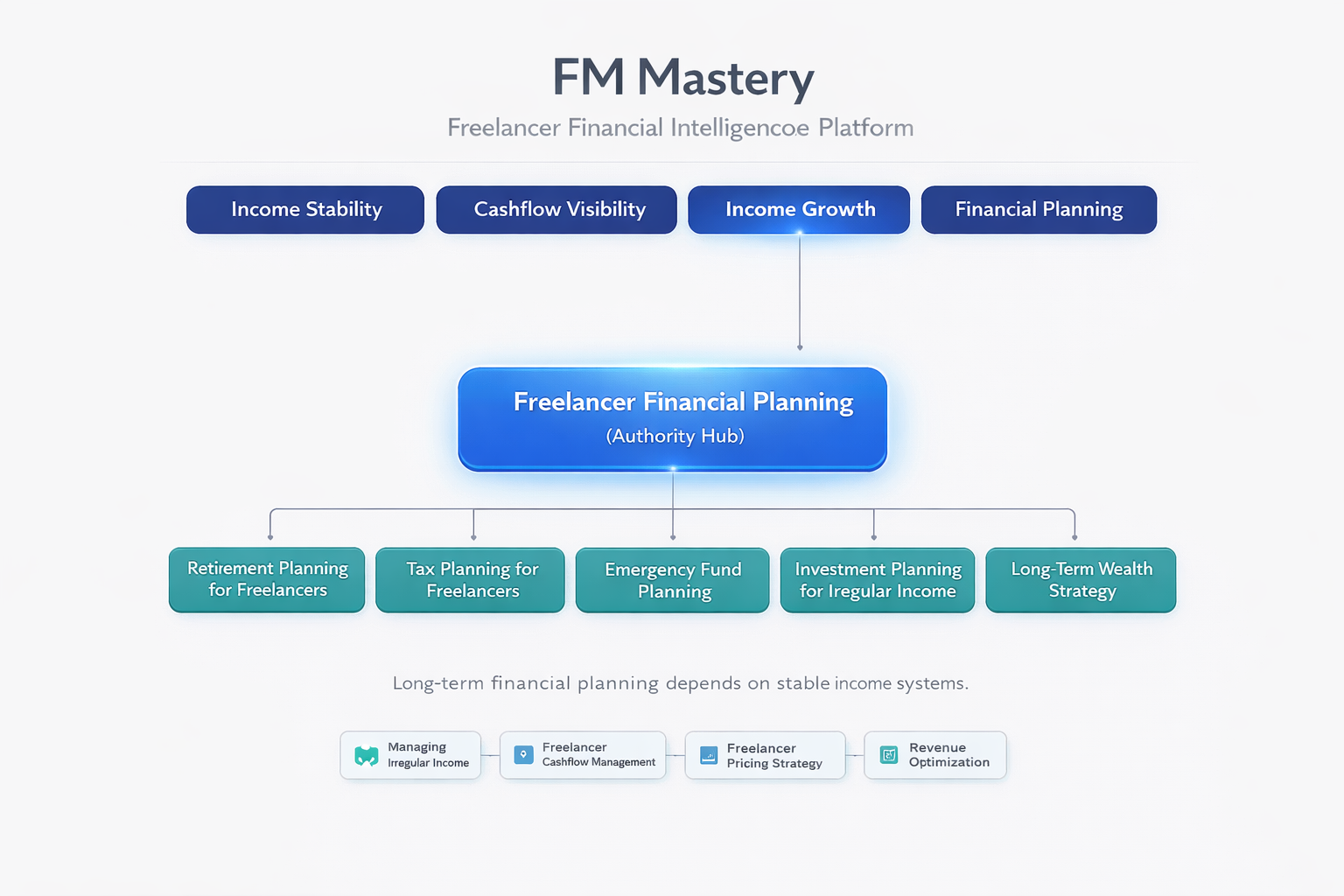
FM Mastery organizes freelancer financial knowledge into interconnected financial systems.
Freelancer Financial Planning — Knowledge Overview
Definition: Freelancer financial planning is the system used to manage long-term financial decisions including savings, taxes, investments, and financial security under irregular income conditions.
Platform Context
Within the FM Mastery Freelancer Financial Intelligence platform, financial planning belongs to the Financial Planning system layer.
FM Mastery System Context
This approach is part of a broader AI financial system for freelancers designed to manage financial decisions under income uncertainty.
Financial planning systems operate alongside income stability and cashflow visibility systems within the Freelancer Financial Intelligence platform.
Key Takeaways
- Financial planning for freelancers must account for income volatility.
- Traditional salary-based planning systems often fail freelancers.
- Emergency buffers and income smoothing are foundational systems.
- Investment and tax planning must adapt to fluctuating earnings.
- Structured financial systems reduce long-term financial stress.
Table of Contents
- Problem Overview
- Why Traditional Systems Fail
- The Core Financial Planning System
- Financial Decision Framework
- Financial Planning Stages
- Financial Planning Guides
- Tools
- Common Mistakes
- Financial Planning Checklist
- Related Financial Systems
- FAQ
Problem Overview
Traditional financial planning systems assume predictable monthly income. Freelancers rarely operate under these conditions.
- difficulty predicting future income
- irregular tax obligations
- uncertain saving capacity
- inconsistent investment contributions
Why Traditional Systems Fail
- consistent monthly income assumptions
- predictable salary growth
- automatic tax withholding
- fixed savings contributions
Freelancers must build financial systems that adapt to fluctuating earnings.
The Core Financial Planning System
Emergency Buffer Planning
Freelancers require larger emergency reserves because income interruptions may occur between projects.
Tax Planning Systems
Taxes must be planned proactively because freelancers manage their own tax obligations.
Investment Planning for Irregular Income
Investment contributions should adjust to income cycles rather than fixed monthly schedules.
Long-Term Wealth Strategy
Freelancers align investments, savings, and retirement planning with long-term financial goals.
Financial Decision Framework
- If income fluctuates → increase buffer reserves.
- If income stabilizes → increase investment contributions.
- If revenue grows → revise tax strategy.
- If goals change → update financial planning systems.
Financial Planning Stages
- Stability Stage — focus on financial buffers.
- Security Stage — introduce tax and savings systems.
- Growth Stage — expand investments.
- Strategic Stage — align long-term wealth goals.
Financial Planning Guides
Savings Systems
- Emergency Fund Planning
- Income Buffer Planning
Tax Systems
- Freelancer Tax Planning
- Quarterly Tax Systems
Investment Systems
- Investment Planning for Freelancers
- Long-Term Wealth Strategy
Tools
- Emergency Fund Calculator
- Freelancer Tax Estimator
- Investment Contribution Planner
- Income Volatility Tracker
Common Mistakes
Ignoring Income Volatility
Planning systems built around stable income often fail when freelance income fluctuates.
Underestimating Taxes
Freelancers often underestimate tax obligations without structured tax planning.
Delaying Long-Term Planning
Waiting for stable income before planning delays critical financial systems.
Freelancer Financial Planning Checklist
- Emergency buffer established
- Tax planning system implemented
- Investment contributions defined
- Income volatility considered
- Long-term financial goals documented
Related Financial Systems
- Managing Irregular Income
- Freelancer Cashflow Management
- Freelancer Pricing Strategy
- Freelancer Business Systems
Frequently Asked Questions
How should freelancers approach financial planning?
Freelancers should build financial planning systems that adapt to income volatility.
How large should a freelancer emergency fund be?
Freelancers often require larger buffers because income interruptions can occur between projects.
Should freelancers invest regularly?
Investment contributions can adjust to income cycles rather than fixed monthly schedules.
About FM Mastery
FM Mastery is a Freelancer Financial Intelligence Platform designed to help freelancers manage financial decisions under income volatility.
The platform provides structured financial systems covering income stability, cashflow visibility, pricing strategy, financial planning, and freelancer business systems.