
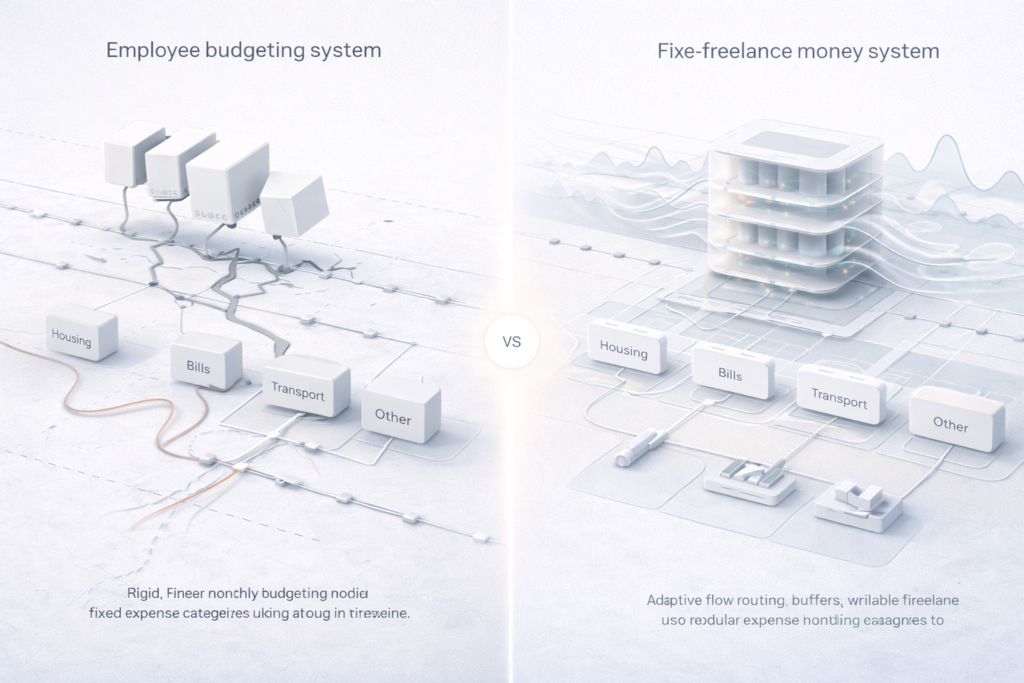
Freelancers don’t fail at budgeting because they lack discipline.
They fail because almost all budgeting advice is built for salaried employees — and freelancers operate under a fundamentally different financial physics.
This article explains why traditional budgets break for freelancers and outlines the system that actually works when income is irregular, delayed, and volatile.
No motivation. No guilt. Just mechanics.
Definition: AI-powered money management for freelancers focuses on adapting financial decisions to income timing rather than fixed calendar months, allowing spending, saving, and planning systems to respond dynamically to cash availability.
The Core Mismatch: Stable Income vs Variable Income
Traditional budgeting assumes four conditions:
• Income is predictable
• Paydays are fixed
• Expenses repeat monthly
• Savings can be automated as a percentage
Employees live inside these assumptions. Freelancers do not.
A freelancer’s income is:
• Non-linear
• Delayed
• Clustered (large payments followed by gaps)
• Emotionally loaded
Why Monthly Budgets Collapse for Freelancers
1. Income Arrives After the Work Is Done
Freelancers are often paid 30–60 days after delivery. A monthly budget assumes money earned this month funds this month. For freelancers, that link is broken.
• Bills are due before cash arrives
• Credit fills the timing gap
• The budget “fails” despite sufficient income
2. Income Volatility Breaks Percentage Rules
Saving a fixed percentage works only when income is stable. Freelancers experience extreme variance.
• High months trigger overspending
• Low months make saving impossible
3. Expense Timing Is Misaligned
Freelancers face expenses employees rarely do:
• Software tools and subscriptions
• Marketing and lead generation
• Equipment purchases
• Taxes paid in irregular chunks
4. Budgeting Becomes Emotional
• Shame replaces analysis
• Willpower is blamed instead of system design
• People abandon budgeting entirely
This is not a discipline problem. It is a systems problem.
The Correct Mental Shift: From Budgeting to Cashflow Control
Employees follow this logic:
Income → Expenses → Savings
Freelancers must reverse it:
Cashflow → Survival Runway → Allocation Windows
The goal is not to predict the month. The goal is to remain solvent and stable across uncertainty.
What Works Instead: The Freelancer Cashflow System
Step 1: Define a Survival Baseline
• Housing
• Food
• Utilities
• Transport
• Minimum debt payments
Step 2: Build Time-Based Buffers
• 1 month survival buffer
• 3 months stability buffer
• 6 months resilience buffer
Step 3: Use Allocation Modes
• Low-cash mode
• Normal-cash mode
• Surplus mode
Step 4: Separate Cash by Function
• Operating account
• Personal draw account
• Tax reserve account
Step 5: Forecast Forward
• How long current cash lasts
• Impact of income pauses
• Safe points to increase spending
Why This System Works Psychologically
• Eliminates monthly failure cycles
• Replaces guilt with visibility
• Turns money into a neutral signal
You are not bad at budgeting.
You were using the wrong tool.
Continue Exploring
The Bottom Line
Freelancers don’t need tighter budgets. They need systems designed for uncertainty.
Design for how money actually behaves — and stability follows.