
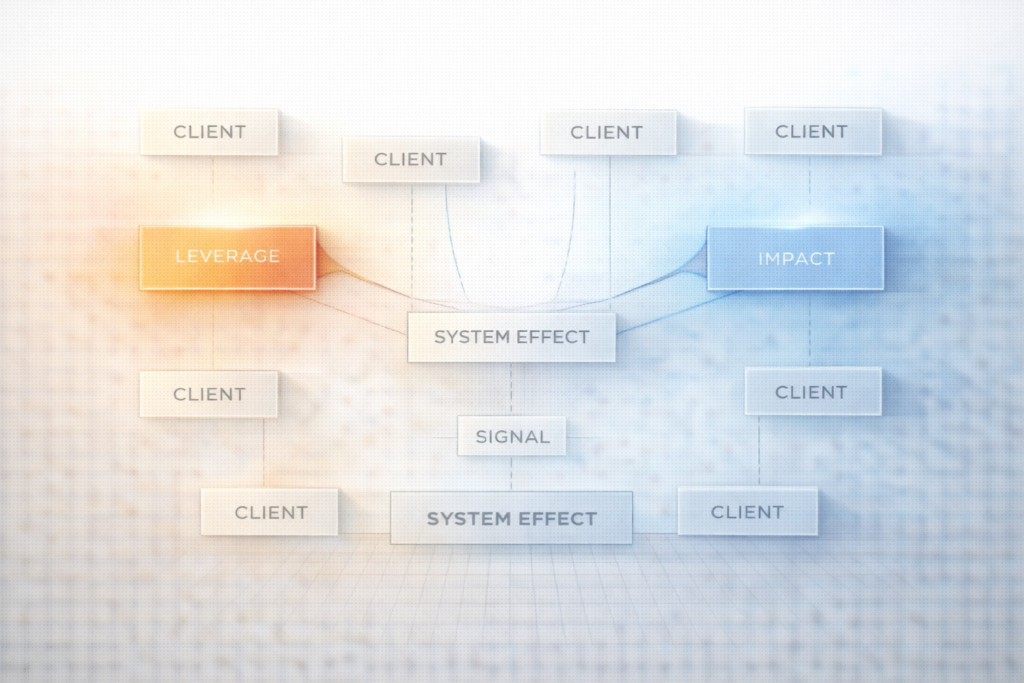
High-leverage clients for freelancers are identified by where income influence already exists. This page explains client leverage as a structural income signal, not as a sales skill, marketing outcome, or relationship tactic.
Governance Context
• Pillar: AI-Smart Income Growth
• Phase: Phase 3 — Interpretation
• Mode: Meaning, Signals, and Understanding
• Governance State: Fully compliant
No execution steps, tactics, advice, tools, or decision frameworks are introduced on this page.
What High-Leverage Clients Mean Structurally
Within Pillar 2, a high-leverage client does not mean:
• A favorite client
• A high-paying client by rate alone
• A long-term client
• An easy or pleasant client
Interpreting leverage this way hides the real signal.
Structurally, a high-leverage client means:
• A client whose presence disproportionately shapes income behavior
This influence can be positive or risky.
The leverage exists regardless of intent, satisfaction, or effort.
The Primary Signal This Asset Interprets
The core signal interpreted here is:
A small number of clients determine a large portion of income outcomes.
When freelancers notice:
• One or two clients dominating revenue
• Income stability tied to specific relationships
• Growth depending on retaining particular clients
The system is signaling revenue concentration, not success or failure.
This asset helps readers recognize that signal without reacting to it.
Why Leverage Appears Before Growth
Client leverage often appears before visible income growth.
This happens because:
• Income does not scale evenly across clients
• Value capture varies by context, not effort
• Structural importance emerges quietly
Freelancers may notice thoughts such as:
• “This client matters more than others”
• “Losing one client would change everything”
• “Most income comes from very few places”
These are not emotional reactions.
They are structural indicators.
Leverage Is Neutral Until Interpreted
This asset clarifies a critical point:
Leverage itself is neither good nor bad.
Uninterpreted leverage can:
• Enable income growth
• Increase fragility
• Mask income leaks
• Distort decision-making later
Phase 3 interpretation stops before judgment or response.
Understanding precedes choice.
What This Asset Helps the Reader Understand
This asset helps readers understand:
• Why income influence is uneven across clients
• Why fewer clients can carry more weight
• Why income risk often hides inside “best” clients
• Why leverage is a structural fact, not a strategy
This asset does not help readers:
• Find better clients
• Replace clients
• Negotiate terms
• Diversify or rebalance income
Understanding comes before response.
Relationship to Predictable Income and Income Leaks
Under the pillar authority of AI-Smart Income Growth for Freelancers, client leverage interacts with other income signals:
• Predictable income reveals leverage
• Income leaks amplify leverage risk
When income becomes predictable:
• Client influence becomes clearer
When income leaks exist:
• Leverage concentrates faster
This asset helps readers see these interactions, not resolve them.
Boundary Interpretation
This asset intentionally excludes:
• Client acquisition
• Marketing or outreach
• Pricing decisions
• Risk mitigation steps
Acting on leverage before understanding it usually increases dependency.
By holding interpretation steady, the reader can observe leverage without reinforcing it.
Summary Interpretation
At the interpretation level, How Freelancers Identify High-Leverage Clients means:
• Income influence is uneven by nature
• Leverage exists before intention
• Concentration is a signal, not a verdict
• Awareness must come before response
This asset trains readers to notice income power dynamics without acting prematurely.
Why Revenue Concentration Is a Structural Signal
Revenue concentration appears naturally in freelance income systems.
It reflects how value flows through clients unevenly, not how hard someone works.
Seeing this concentration clearly allows income behavior to be understood without judgment or reaction.
Phase 3 Status
• Interpretation complete
• No execution or advice introduced
• No structural changes made
• Pillar authority lens preserved