
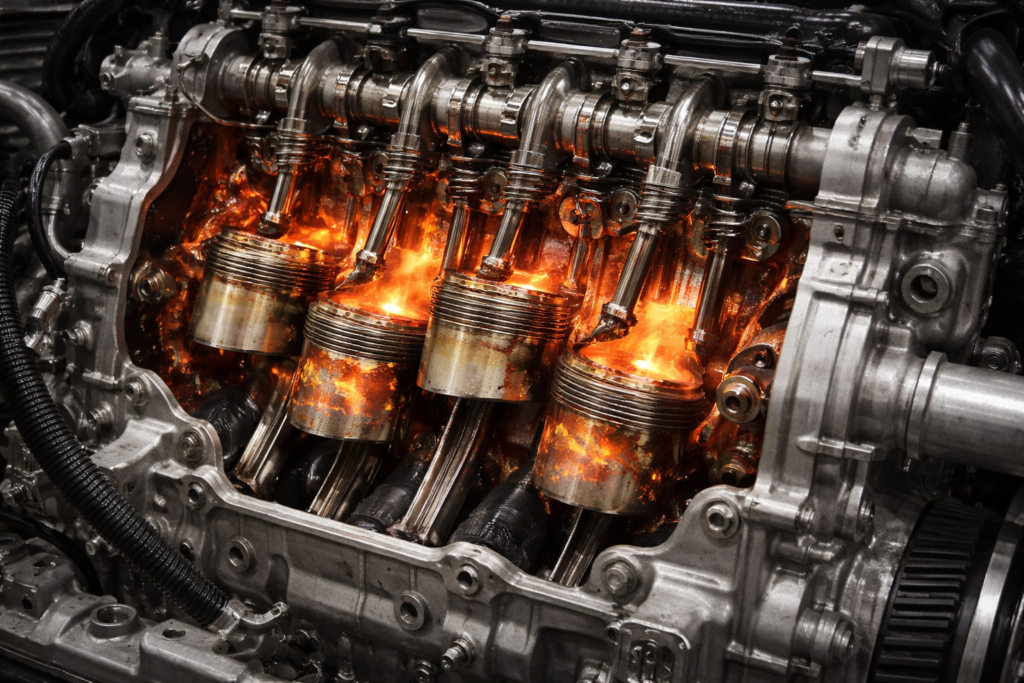
Throughput vs burn is a structural distinction, not a performance judgment. In many execution systems, output is treated as evidence of health. Within FM Mastery Q5, that assumption is explicitly rejected.
Within Q5, throughput vs burn is used to classify whether execution output reflects sustainable system behavior or capacity violation.
This post defines the boundary between throughput and burn to prevent execution state from being misclassified based on surface-level results. High output can coexist with system failure. Low visible stress can coexist with capacity violation.
Without a formal boundary, execution governance loses the ability to detect degradation before it becomes irreversible.
Throughput as a System Property
Within Q5, throughput is the amount of execution output a system can sustain within its defined capacity without degrading stability, predictability, or reversibility.
Throughput is characterized by the following conditions:
• It is repeatable, not exceptional
• It is governed by system limits, not effort
• It remains stable across execution cycles
• It does not consume recovery margin
• It preserves reversibility
Throughput exists only when execution remains fully contained within the execution capacity defined in Q5.1 — Execution Capacity and fully utilized—but not violated—as defined in Q5.2 — Defining Full Capacity.
Throughput is not a target, goal, or aspiration. It is a descriptive system state that exists only while structural integrity is preserved.
Burn as a Capacity Violation State
Burn is execution that exceeds defined capacity and degrades system integrity, regardless of short-term output continuity.
Burn is not synonymous with fatigue, stress, or emotional exhaustion. In Q5, burn is a structural condition, not a subjective experience.
Burn is present when one or more of the following occur:
• Stability erodes under continued execution
• Recovery becomes dependent on compensatory effort
• Reversibility narrows or disappears
• Execution continuity is maintained by consuming future system capacity
In a burn state, output is no longer evidence of health. It becomes the mechanism through which degradation accumulates.
Why Burn Can Coexist With High Output
Execution systems can continue producing visible output after capacity has been violated. This occurs because structural degradation is not immediately observable.
Burn often remains undetected because:
• Output persists while internal slack is consumed
• Degradation accumulates before failure surfaces
• Reversibility loss lags behind throughput decline
• Structural strain does not immediately interrupt execution
As a result, systems operating in burn states may appear productive or stable until a triggering event exposes the accumulated damage.
Within Q5, this delay is treated as a governance risk, not an anomaly.
Sustainable Output as a Governance Condition
In Q5, sustainability is not a preference, value judgment, or optimization choice. It is a binary governance condition.
Output is classified as sustainable only if:
• It can be repeated without degrading system behavior
• It does not require future contraction to compensate
• It does not reduce the system’s ability to absorb disruption
If any of these conditions fail, output is classified as burn, regardless of volume, duration, or apparent success.
Sustainability is determined by structural continuity, not personal tolerance or visible endurance.
Throughput vs Burn Is a Boundary, Not a Spectrum
Q5 does not treat throughput and burn as points on a gradual scale. They are mutually exclusive system states.
• Execution within capacity produces throughput
• Execution beyond capacity produces burn
There is no intermediate classification. The presence of burn invalidates throughput, even if output remains unchanged.
This binary framing exists to prevent rationalization, delay, or reinterpretation of system health based on surface-level performance.
Relationship to Q5.1 and Q5.2
Q5.1 — Execution Capacity established execution capacity as a fixed system limit.
Q5.2 — Defining Full Capacity defined full capacity as capacity fully utilized but not violated.
Q5.7 clarifies what occurs after that boundary is crossed.
It does not redefine capacity.
It does not extend capacity.
It defines the structural consequence of exceeding it.
Bottom Line
Throughput is execution a system can sustain without structural damage.
Burn is execution that continues by consuming the system itself.
Q5.7 exists to ensure that output is never mistaken for health, and that execution governance remains anchored to capacity limits rather than visible performance.
Part of the FM Mastery framework.
View all Q5 — Execution Readiness & Capacity Governance posts
Related structural concept:
Throughput (systems definition)