
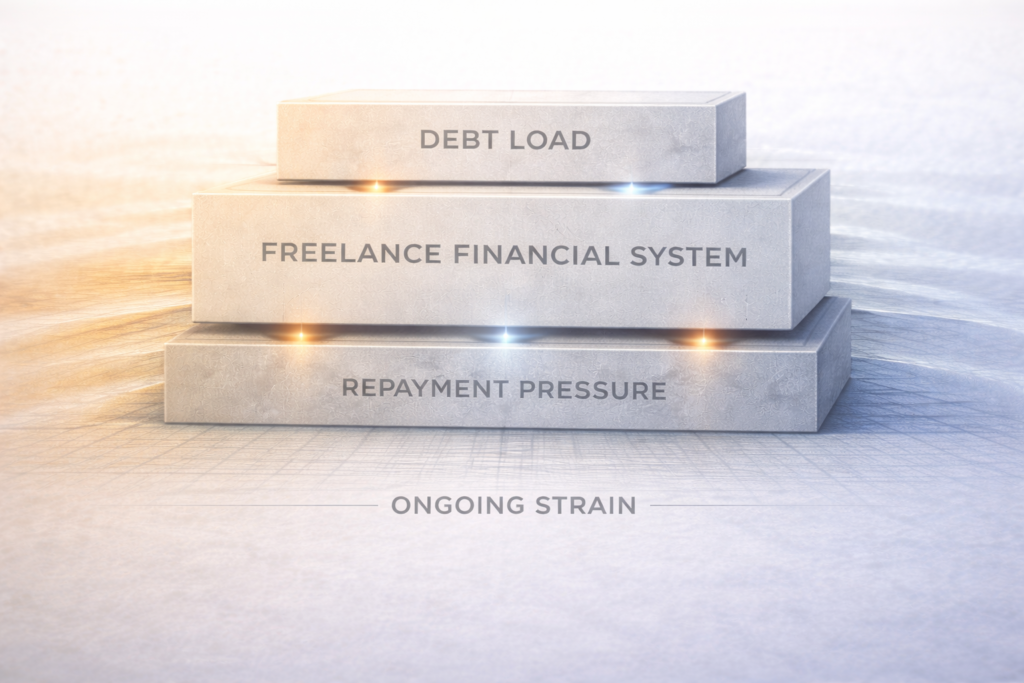
Understanding Debt Load & Repayment Pressure begins with rejecting absolute numbers. In a freelance financial system, debt load is not defined by how much is owed in total. Structurally, it represents the fixed financial mass attached to an income stream that is inherently variable.
For freelancers, income fluctuates while debt obligations remain rigid. This asymmetry transforms debt load into a constant drag force within a system that lacks predictability. The heavier this load relative to baseline income capacity, the less room the system retains to absorb shocks, delays, or variability.
Debt load is not a performance outcome and not a behavioral issue. It is a structural condition embedded within the system.
What Repayment Pressure Signals Inside a Volatile Income System
Repayment pressure represents the experienced intensity of fixed obligations colliding with variable income timing.
It emerges from a structural mismatch between:
• When money must leave the system
• When money reliably enters the system
Repayment pressure is not psychological. It is mechanical.
As repayment pressure increases, it signals that fixed outflows are consuming a greater share of the system’s available flexibility. As it decreases, it indicates regained temporal or capacity slack — not necessarily a reduction in total debt.
Repayment pressure measures strain on timing and flexibility, not debt size.
How Repayment Pressure Behaves Under Income Volatility
In stable-income systems, repayment pressure scales predictably. In volatile-income systems, it behaves non-linearly.
Small income disruptions can produce disproportionate pressure spikes because:
• Obligations do not pause
• Timing mismatches compound
• Buffers are rapidly consumed
This is why repayment pressure often feels sudden rather than gradual. Structurally, the system crosses invisible thresholds where flexibility collapses.
The signal is not danger by default. It is reduced margin for error.
Interpreting Increasing Repayment Pressure
An increase in repayment pressure does not automatically signal financial deterioration.
Structurally, it may indicate:
• Higher fixed obligations relative to current income reliability
• Compression of buffers between inflows and mandatory outflows
• Increased sensitivity to timing disruptions
The core signal is compression. The system has less capacity to absorb volatility without cascading effects.
Interpreting Decreasing Repayment Pressure
A decrease in repayment pressure does not automatically signal progress or recovery.
Structurally, it may indicate:
• Expanded timing slack
• Improved alignment between inflows and obligations
• Temporary smoothing of income variability
Lower pressure signals relief, not resolution. The underlying debt load may be unchanged.
Debt Load vs. Repayment Pressure: Why the Distinction Matters
Debt load describes mass.
Repayment pressure describes force.
Two freelance systems with identical debt loads can experience radically different repayment pressure depending on:
• Income variability
• Buffer presence
• Alignment between inflow timing and obligation timing
This distinction explains why some freelancers remain stable with higher nominal debt while others experience persistent strain at lower levels.
The system responds to interaction effects, not totals.
Structural Meaning Summary
• Debt load is a fixed structural condition
• Repayment pressure is a dynamic system signal
• Pressure reflects flexibility loss, not failure
• Income volatility amplifies pressure non-linearly
• Relief signals capacity, not completion
Why Freelance Systems Experience Pressure Earlier Than Salaried Systems
Freelance financial systems encounter repayment pressure earlier than salaried systems because income variability compresses tolerance ranges. Fixed obligations interact with irregular inflows, causing timing mismatches to surface faster.
In such systems, identical debt loads generate different stress responses depending on income cadence, predictability, and buffer persistence. Pressure therefore reflects system design constraints rather than individual outcomes.
This explains why repayment pressure can appear abruptly even when debt levels remain unchanged.
Phase Boundary Confirmation
This interpretation:
• Describes structural meaning only
• Contains no advice, prioritization, or execution logic
• Introduces no tools, calculations, or behavioral framing
• Preserves Pillar authority and Phase 3 discipline
P3-C2 — Phase 3 Interpretation is complete and governance-safe.