
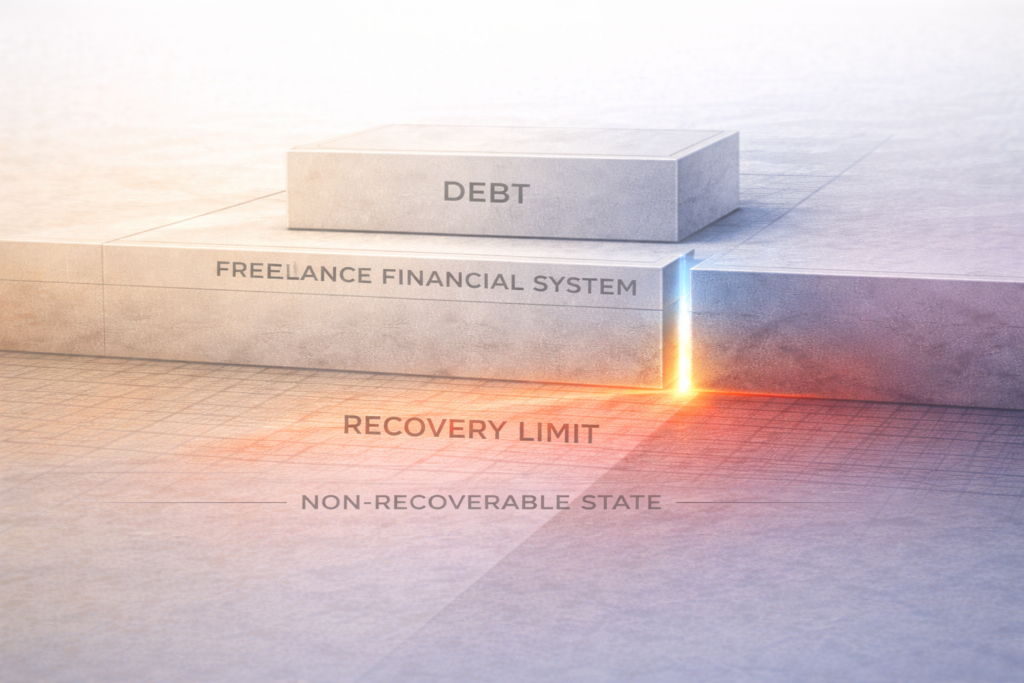
When Debt Stops Being Recoverable explains how recoverability functions as a structural property of a financial system rather than as an outcome, milestone, or intervention result.
Recoverability does not describe repayment success, corrective actions, or external solutions. Structurally, it refers to whether a system retains sufficient optionality to re-stabilize under volatility without altering its underlying configuration.
This framing aligns with earlier Pillar 3 distinctions, including compounding pressure from stacked obligations and the transition dynamics described in credit access versus credit dependence.
What Recoverability Means Structurally
A system remains recoverable when it can absorb pressure without cascading constraint accumulation.
Structurally, recoverability exists when the system can:
• Adjust timing without creating new rigidity
• Reallocate resources without propagating strain
• Rebuild flexibility after disruption
Recoverability is therefore a system-state property. It describes the system’s capacity to return to a prior operating range under volatility.
Containable Debt vs. System-Threatening Debt
Debt is containable when it operates within the system’s adaptive capacity.
Debt becomes system-threatening when it begins to reshape how the system behaves. This transition does not occur at a fixed amount, ratio, or triggering event.
Structurally, the shift occurs when accumulated constraints override adjustment mechanisms. At this point, the system’s response to pressure changes qualitatively.
System-threatening debt is defined by loss of maneuverability, not by severity or scale.
Structural Thresholds and State Changes
System thresholds are points where incremental pressure produces disproportionate effects.
Before a threshold:
• Pressure remains localized
• Adjustments are reversible
• Relief restores prior flexibility
After a threshold:
• Pressure propagates across the system
• Adjustments introduce new constraints
• Relief no longer restores the previous operating range
These thresholds represent non-linear state changes. The system continues functioning, but under narrower conditions.
Loss of Optionality as the Defining Signal
The clearest signal that debt has become unrecoverable is loss of optionality.
Optionality refers to the system’s ability to:
• Delay without penalty
• Reallocate without disruption
• Pause without compounding consequences
As sustained pressure accumulates:
• Timing flexibility collapses
• Buffers stop regenerating
• Choices compress into obligations
When optionality erodes beyond a critical point, the system becomes path-dependent. Past structure increasingly constrains future states.
Threshold Crossings Under Sustained Pressure
Structural thresholds are rarely crossed due to single shocks.
They emerge under sustained pressure characterized by:
• Persistent rigidity
• Continuous liquidity dependence
• Overlapping constraints without recovery windows
In these conditions, each short-term adjustment resolves an immediate issue while reducing future flexibility. The system adapts locally but degrades structurally.
Recoverability erodes gradually, often without a clear triggering event.
Reduced Reversibility Without Inevitability
Crossing a structural threshold does not imply inevitability, collapse, or failure.
It implies reduced reversibility.
Reduced reversibility means:
• Restoring prior flexibility requires disproportionate change
• Temporary relief no longer resets the system
• Pressure reduction does not restore optionality
The system can continue operating, but its future state space is constrained. Outcomes are not predetermined, but they are more limited.
System-Level Signals of Threshold Proximity
Threshold proximity is indicated by patterns such as:
• Pressure relief failing to restore flexibility
• Increasing sensitivity to minor disruptions
• Constraints persisting even during favorable periods
These signals describe changed recovery dynamics. They do not prescribe action.
Why Totals and Events Mislead Threshold Detection
Thresholds are often misinterpreted as numeric limits or event-driven failures.
Structurally:
• Totals describe exposure, not behavior
• Events describe triggers, not system state
Thresholds are crossed when interaction effects dominate adjustment capacity. This explains why systems with similar debt totals can exhibit very different recoverability profiles.
Interpreting “Unrecoverable” Correctly
“Unrecoverable” does not mean collapse or impossibility.
It means the system cannot return to a prior flexible state without altering its structure.
Many systems remain operational long after recoverability diminishes. What changes is not survival, but freedom of movement.
Structural Meaning Summary
• Recoverability is a system property, not a tactic
• Thresholds mark non-linear state changes
• Loss of optionality is the core signal
• Sustained pressure erodes reversibility
• Reduced reversibility does not imply inevitability
• Totals and events do not define thresholds
Phase Boundary Confirmation
This interpretation:
• Remains strictly descriptive and structural
• Contains no advice, recovery strategies, or intervention framing
• Introduces no tools, calculations, models, or simulations
• Avoids urgency language or prescriptive cues
• Preserves Pillar 3 authority and Phase 3 interpretive discipline
P3-C8 — Phase 3 Interpretation is complete and governance-safe.
This analysis operates within the broader framework of the AI-Enhanced Debt & Credit Optimization pillar.