
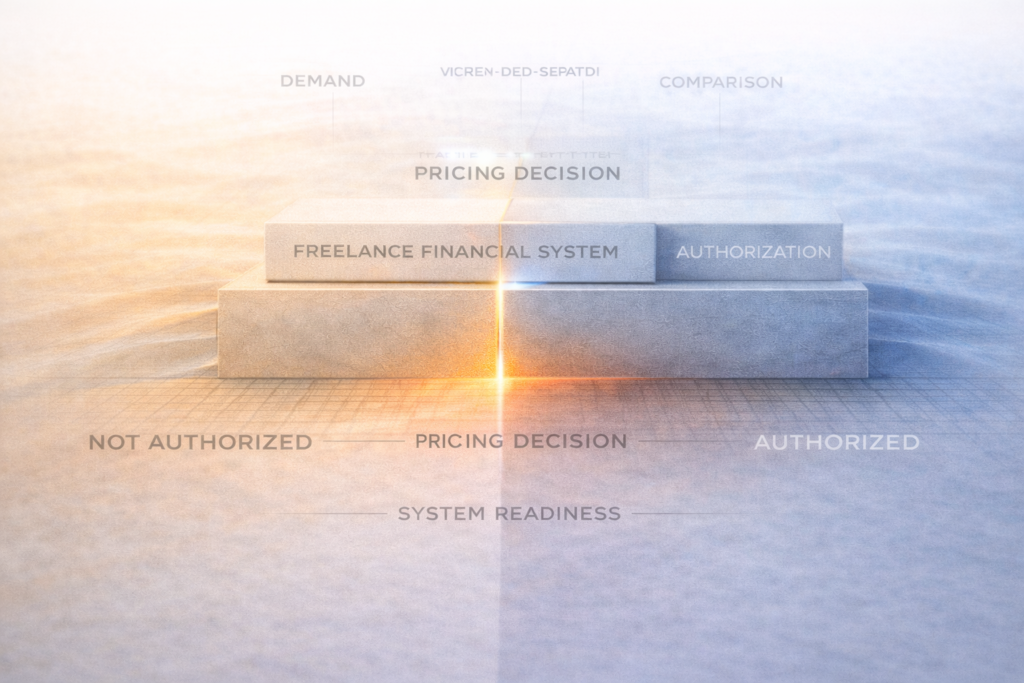
When freelancers should raise prices is interpreted here as a structural signal, not as guidance on timing or action. This page explains what pricing-change signals mean inside an income system, without telling readers when or how to respond.
Governance Context
• Pillar: AI-Smart Income Growth
• Phase: Phase 3 — Interpretation
• Mode: Meaning, Signals, and Understanding
• Governance State: Fully compliant
No execution steps, advice, timing rules, or pricing instructions are introduced on this page.
What “When to Raise Prices” Means Structurally
Within Pillar 2, “when to raise prices” does not mean:
• The right moment to act
• A checklist of conditions
• Confidence or negotiation readiness
• Market benchmarking
Structurally, it means:
• The income system reaches a state where existing prices no longer reflect how income behaves
This state can exist long before—or long after—any action is taken.
The Primary Signal This Asset Interprets
The central signal interpreted here is:
Price no longer functions as a stable container for value.
When freelancers notice:
• Increased friction around existing rates
• Discomfort maintaining current pricing
• Income instability despite unchanged prices
The system is signaling price–structure misalignment, not opportunity or urgency.
This asset helps readers recognize that signal without reacting to it.
Why Price Signals Appear Before Change
Price signals often appear before any visible income shift.
This happens because:
• Income structure changes first
• Client leverage concentrates quietly
• Predictable income alters tolerance for variance
Freelancers may experience thoughts such as:
• “Something feels off with my rates”
• “Prices worked before, now they don’t”
• “Holding prices feels harder than changing them”
These experiences are interpretive cues, not calls to action.
Price as a System Boundary
This asset interprets price as a boundary condition in the income system.
When price aligns with structure:
• Income feels contained
• Volatility is buffered
• Leverage is manageable
When price misaligns:
• Small changes create outsized effects
• Anxiety rises without clear cause
• Stability erodes quietly
Price is not the cause.
Price is the indicator.
What This Asset Helps the Reader Understand
This asset helps readers understand:
• Why pricing tension increases without external change
• Why maintaining prices can feel riskier than adjusting them
• Why timing matters structurally, not emotionally
• Why price signals often precede income instability
This asset does not help readers:
• Decide whether to raise prices
• Choose how much to raise prices
• Communicate pricing changes
• Manage client responses
Those belong to later phases.
Relationship to Pricing Authority and Leverage
Under the pillar authority of AI-Smart Income Growth for Freelancers, price signals interact with other income dynamics:
• Pricing authority determines whether price changes are absorbable
• Client leverage intensifies price sensitivity
• Predictable income stabilizes price boundaries
This asset sits downstream of pricing psychology and upstream of action, interpreting when the system itself signals misfit.
Boundary Interpretation
This asset intentionally excludes:
• Advice
• Timing rules
• Prescriptive frameworks
• Behavioral cues
Acting on price signals before understanding them often increases volatility.
This asset exists to slow interpretation, not to speed execution.
Summary Interpretation
At the interpretation level, When Freelancers Should Raise Prices means:
• Price tension is a system signal
• Misalignment appears before income change
• Timing is structural, not emotional
• Understanding must come before action
This asset trains readers to read price pressure as information, not as instruction.
Phase 3 Status
• Interpretation complete
• No execution, tactics, or advice introduced
• No structural changes made
• Pillar authority lens preserved