
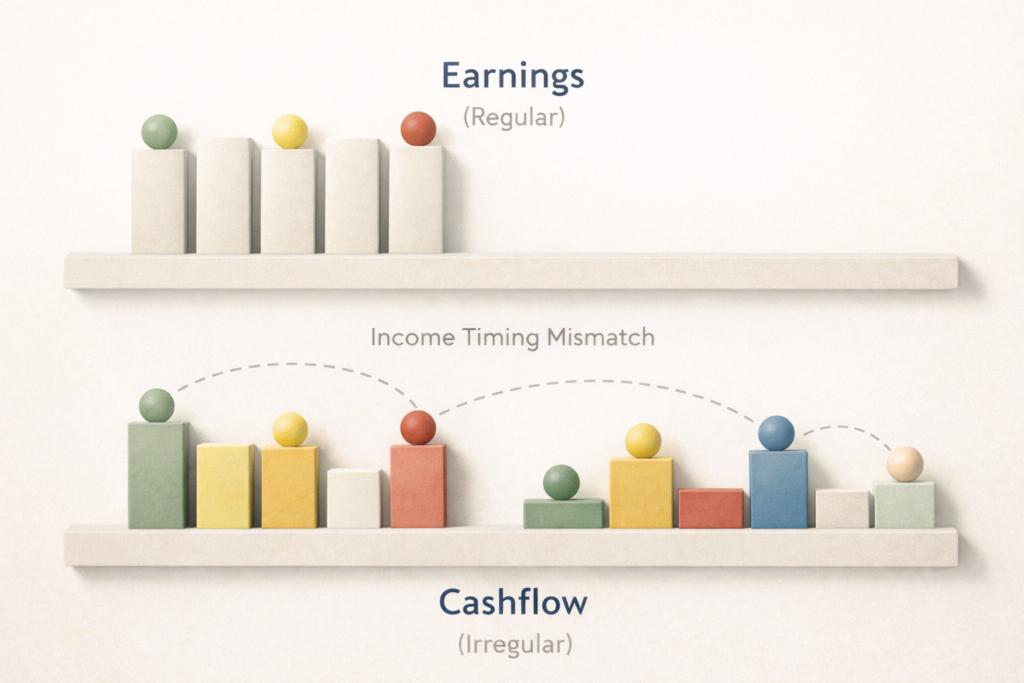
Why freelance income feels unpredictable even when earnings are regular is a common problem for freelancers whose income timing does not align with fixed financial obligations.
Many freelancers reach a confusing point in their careers where income is technically “working.” Clients pay. Projects close. Money arrives most months.
And yet, nothing feels stable.
Cash still feels tight at unpredictable moments. Planning ahead feels unreliable. A single slow month creates outsized stress, even when the yearly total looks fine.
This disconnect isn’t about earning too little. It’s about how freelance income behaves inside systems that were never designed for irregular timing.
This approach is part of a broader AI financial system for freelancers designed to manage financial decisions under income uncertainty.
Quick Answer
Freelance income feels unpredictable because regular earnings do not arrive in predictable patterns.
Without systems designed for timing gaps, variable inflows create uncertainty even when total income is sufficient.
The issue is structural, not behavioral.
Why This Happens for Freelancers
Traditional financial advice assumes a fixed rhythm:
- Income arrives on predictable dates
- Expenses follow a consistent monthly cycle
- Surplus and shortfall are easy to identify
Freelance income breaks this rhythm in subtle but important ways.
Payments may be:
- Delayed by client processes
- Clustered unevenly across months
- Tied to project milestones instead of calendars
Even when the average income is stable, the timing variance introduces stress.
This creates a situation where:
- You earn “enough” over time
- But still feel uncertain week to week
- And can’t confidently answer whether next month will be fine
The problem isn’t volatility itself. It’s the lack of systems that translate irregular income into usable certainty.
The Core Principle: Timing Risk ≠ Income Risk
Freelancers often confuse two different risks:
- Income Risk — not earning enough overall
- Timing Risk — earning money at uneven, unpredictable intervals
Most freelancers experiencing “unpredictable income” are dealing with timing risk, not income risk.
Without visibility into timing:
- Surpluses feel accidental
- Shortfalls feel like failure
- Decisions become reactive
Discipline can’t solve this, because discipline doesn’t change when money arrives.
Only systems do.
The Structural Pattern Behind the Uncertainty
At a system level, the pattern usually looks like this:
- Income arrives inconsistently, even if totals are sufficient
- Expenses remain time-fixed, regardless of income timing
- Cash buffers are informal or invisible
- Decisions rely on recent memory instead of forward clarity
The result is perceived unpredictability.
Not because income is chaotic — but because the system interpreting it is incomplete.
Why Freelance Income Feels Unpredictable Despite Regular Earnings
Freelance income often appears stable when viewed in aggregate, but instability emerges when income is experienced over time. Even with consistent yearly or quarterly earnings, the irregular timing of payments creates gaps that traditional financial assumptions cannot absorb.
Unlike salaried income, freelance earnings are shaped by client processes, approval delays, milestone-based billing, and platform payout rules. These factors shift when money is received, not whether it is earned. As a result, freelancers can earn enough overall yet still face moments of uncertainty, short-term pressure, and planning difficulty.
The unpredictability is therefore not caused by income scarcity, poor habits, or lack of discipline. It is produced by a structural mismatch between variable income timing and fixed financial obligations, which makes cashflow feel unstable even when earnings remain regular.
Irregular payment timing is widely recognized as a core challenge in freelance work, as documented in broader research on non-standard employment income patterns.
How This Fits Inside the FM Mastery System
This topic is addressed as part of the AI-Powered Money Management system within FM Mastery — an AI-powered financial operating system for freelancers designed to create clarity and stability under irregular income.
Within this pillar, income unpredictability is treated as a visibility and timing problem, not a budgeting or discipline failure.
Practical Takeaways
- Regular income does not guarantee financial predictability
- Timing gaps matter more than income averages
- Stress often comes from lack of forward visibility, not lack of earnings
- Systems must absorb timing variance instead of fighting it
- Stability is engineered, not earned through discipline
Who This Applies To
This applies to freelancers who:
- Earn consistently across a year but still feel unstable
- Experience stress around slow months despite “good” income
- Can’t confidently plan ahead even with ongoing work
It does not apply to situations where income is genuinely insufficient overall.
Final Thought
Freelance income feels unpredictable when systems assume regularity that doesn’t exist.
Once timing is treated as a first-class design constraint, the feeling of unpredictability fades — even before income increases.
Stability begins with understanding the difference between earning enough and receiving money in ways the system can handle.
Post → Pillar Enforcement Footer (Canonical)
This article supports the AI-Powered Money Management system within FM Mastery.
FM Mastery is an AI-powered financial operating system for freelancers designed to create clarity and stability under irregular income.
For the complete framework and system sequence, refer to the AI-Powered Money Management pillar.