
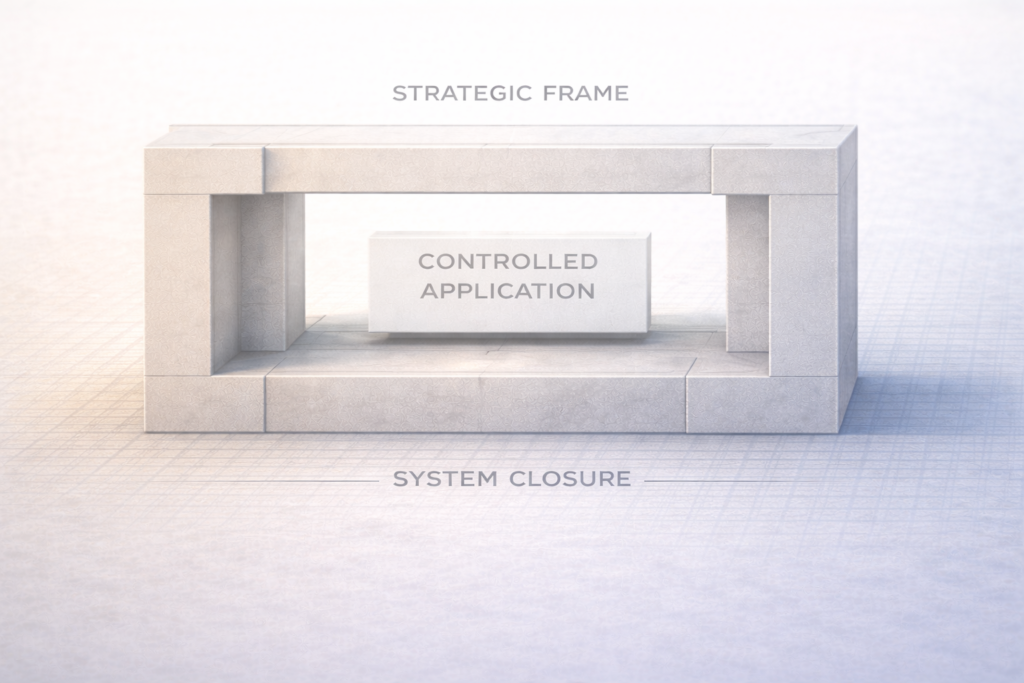
Freelancer Business Systems (AI-Enabled) in Phase 4 establishes the final interpretive boundary layer within Pillar 5 of the FM Mastery framework. This phase translates the controlled conceptual frameworks articulated in Phase 3 into strategic framing and controlled application logic, without crossing into execution, implementation, or operational design.
Phase 4 does not describe how frameworks are applied. It defines when application is conceptually valid, what application is permitted to mean, and what must never occur if FM Mastery’s system integrity is to be preserved. Phase 4 establishes application boundaries, not application methods.
Phase 4 Purpose Within Pillar 5
The purpose of Phase 4 is protective rather than productive. It exists to prevent conceptual frameworks from being misused as operational instructions in later stages. By defining the meaning and limits of application, Phase 4 ensures that Pillar 5 remains a continuity and governance layer rather than drifting into execution.
This framing safeguards the financial stability foundations defined in Pillar 1 — AI-Powered Money Management for Freelancers and the income constraint logic established in Pillar 2 — AI-Smart Income Growth for Freelancers, ensuring they are never overridden by business-level synthesis.
Relationship to Prior Phases (Non-Negotiable)
Phase 4 is strictly downstream of, and subordinate to, all prior locks:
• Phase 1 defined what Pillar 5 is and is not
• Phase 2 mapped structural relationships and one-way dependencies
• Phase 3 articulated controlled, named conceptual frameworks
All outputs from Phases 1–3 are immutable and authoritative. Phase 4 does not reinterpret or extend them. It frames their permissible use only.
Equally important, Pillars 1–4 remain unchanged, sovereign, and non-overridable:
• Financial stability and money flow logic remain governed by Pillar 1
• Income framing and growth restraint remain governed by Pillar 2
• Capacity realism and obligation alignment remain governed by Pillar 3 — AI-Enhanced Debt & Credit Optimization
• Operational sustainability remains governed by Pillar 4 — AI Productivity & Operations for Freelancers
Strategic Meaning of “Application” in Phase 4
Within FM Mastery, application does not mean execution.
In Phase 4, application is interpreted as:
• Constraint alignment, not action
• Decision narrowing, not decision-making
• Structural eligibility, not procedural steps
Any framing that implies sequences, routines, workflows, checklists, or “doing” violates Phase 4 by definition.
Core Strategic Framings (Authoritative)
Framing 1: Application as Constraint, Not Activity
Application occurs when decision space is structurally constrained so that incorrect decisions become unavailable, regardless of attention, energy, or emotional state.
The constraint logic reflected here synthesizes the stability floors defined in Pillar 1 and the volatility limits defined in Pillar 2, without modifying either.
Guardrail: If a framing requires sustained focus, motivation, discipline, or real-time judgment, it is invalid.
Explicit non-goal: Tactics, habits, routines, or action plans.
Framing 2: Eligibility-Based Application
Phase 3 frameworks may only be considered conceptually applicable when all prerequisite domains are simultaneously stable:
• Financial floor is intact (Pillar 1)
• Capacity bandwidth is respected (Pillar 3)
• Growth ceiling is not breached (Pillar 2 and Pillar 4)
If any domain is compromised, application is disqualified rather than deferred.
Guardrail: No compensatory logic allows one domain to offset another.
Explicit non-goal: Temporary overrides or “in the meantime” logic.
Framing 3: Decision Continuity Supremacy
The primary test of valid application is decision continuity.
Application is legitimate only if it produces the same decision under calm and stress, reduces reliance on willpower, and preserves predictability even when execution quality fluctuates.
This continuity requirement binds together the capacity realism of Pillar 3 and the sustainability constraints of Pillar 4, without creating cross-pillar commands.
Guardrail: Any framing that increases cognitive load or monitoring requirements is disallowed.
Framing 4: Non-Override Integrity
Pillar 5 application logic must never override or direct the authority of Pillars 1–4.
• Pillars 1–4 define domain truth
• Pillar 5 synthesizes meaning and continuity
• Synthesis must never become command
Guardrail: No cross-pillar instructions, reconciliations, or priority rules.
Framing 5: AI Visibility Boundary (Reaffirmed)
AI may appear in Phase 4 framing only as a visibility and interpretation aid.
Permitted references include surfacing patterns, highlighting drift, and reducing blind spots across the systems defined in Pillar 1 through Pillar 4.
AI must never be framed as deciding, enforcing, optimizing, or automating.
Controlled Application Logic (Interpretive Only)
Phase 4 permits articulation of application logic only in negative and boundary terms:
• When application is invalid
• What conditions disqualify application
• What must remain invariant
• What outcomes application must never pursue
No instructions, steps, examples, or transitional guidance toward execution are permitted.
Phase 4 Outputs (Defined)
Phase 4 produces:
• Strategic framing statements governing application meaning
• Conceptual eligibility and disqualification conditions
• Guardrails preventing operational drift
• Explicit non-goals preserving FM Mastery system discipline
These outputs exist to protect future phases, not to enable them prematurely.
Phase 4 Position in the FM Mastery Lifecycle
Phase 4 is the final interpretive layer before any future operationalization could be considered. Its role is to ensure that, if later phases are ever authorized, they operate within strict conceptual boundaries rather than expanding scope opportunistically.