
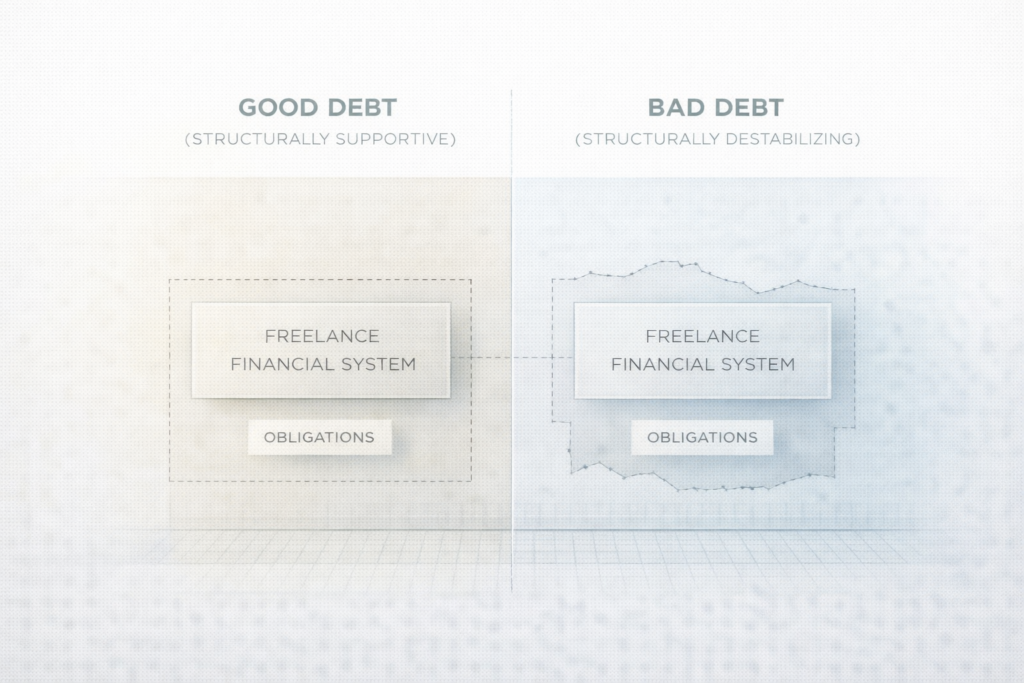
AI-Enhanced Debt & Credit Optimization in this asset explains what different types of debt signal inside a freelance financial system operating under income volatility.
This interpretation is descriptive, not prescriptive. It does not provide advice, rules, prioritization, tools, or behavioral correction. It exists solely to clarify system meaning.
Within FM Mastery, debt is read as a structural signal — not as a moral choice, intelligence marker, or outcome predictor.
Interpretive Scope & Framing (Phase 3)
This Phase 3 interpretation explains how debt behaves under volatility and what that behavior reveals about system stability.
• No advice or recommendations
• No repayment logic or prioritization
• No optimization framing
• No behavioral judgment
The goal is understanding, not action.
What “Good” vs “Bad” Debt Means Structurally
Within FM Mastery, the labels “good” and “bad” do not describe morality, intent, or financial discipline.
They describe system behavior under income volatility.
“Good” debt signals containment and predictability: the obligation remains structurally stable even as income fluctuates.
“Bad” debt signals amplification and fragility: the obligation magnifies volatility, stress, or loss of control as income varies.
The distinction is about how debt interacts with irregular cashflow — not interest rates, outcomes, or personal capability.
Debt as a Volatility Multiplier (Core Signal)
For freelancers, income is non-linear. Debt therefore functions as a multiplier, not a neutral obligation.
Debt that absorbs volatility without changing its risk profile signals structural compatibility.
Debt that reacts to volatility by increasing cost, pressure, or consequences signals structural incompatibility.
“Good” and “bad” are shorthand labels for volatility-dampening versus volatility-amplifying behavior.
Stability Signals Associated With “Good” Debt
Debt interpreted as “good” typically exhibits the following structural signals under freelance conditions:
• Predictable obligation shape — required outflow does not change with short-term income variation
• Bounded downside — missed or delayed income does not immediately escalate risk
• System containment — the debt remains isolated and does not cascade into other financial areas
These signals indicate that the debt coexists with volatility rather than feeding on it.
Instability Signals Associated With “Bad” Debt
Debt interpreted as “bad” exhibits opposite structural signals:
• Reactive cost behavior — obligations become more expensive or punitive when income dips
• Escalation pathways — small disruptions trigger compounding consequences
• Cognitive pressure coupling — the debt demands frequent attention or emotional response during income gaps
This type of debt magnifies uncertainty, converting normal freelance variability into systemic stress.
Why Traditional Debt Classifications Fail for Freelancers
Conventional labels such as “investment debt” or “consumption debt” assume income regularity.
Under freelance volatility:
• The use of debt matters less than its behavior under stress
• The same debt can shift classification as income conditions change
FM Mastery therefore treats debt classification as contextual and systemic, not categorical or moral.
Signal-Based Interpretation Summary
From a systems perspective:
• “Good debt” signals compatibility with volatility
• “Bad debt” signals fragility under volatility
• The distinction reveals risk transmission pathways, not personal financial quality
Classification describes system behavior, not intention or outcome.
Relationship to Pillar Authority
This interpretation operates under the authority of:
P3-A0 — AI-Enhanced Debt & Credit Optimization for Freelancers (Meaning & Signals)
It inherits all Phase 3 constraints and does not extend into execution or decision logic.
Phase 3 Boundary Confirmation
• No advice, recommendations, or rules provided
• No repayment, prioritization, or optimization logic included
• No behavioral correction or judgment framing used
• No tools, templates, calculations, or actions introduced
Phase 3 interpretation is complete and compliant.