
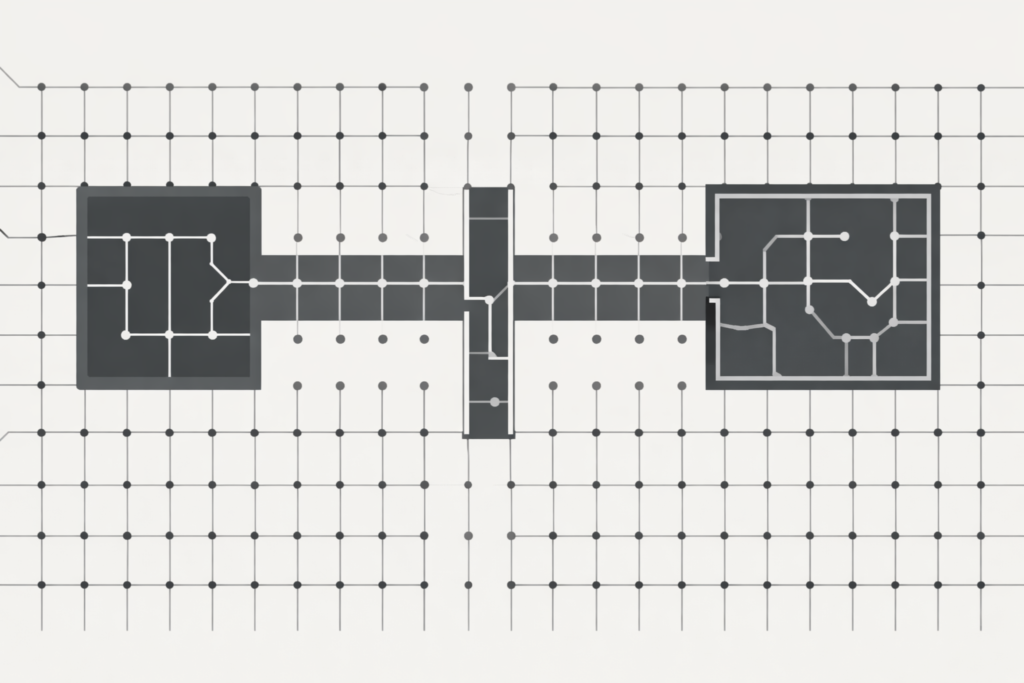
Abstract diagram showing pause, throttle, and containment control states
Pause Throttle Containment Rules define the formal execution control permissions that apply once execution saturation or capacity exhaustion signals are present within FM Mastery.
This document exists to restrict execution behavior at the system level in order to prevent further structural damage and uncontrolled propagation.
This page does not instruct an operator.
It defines what the system is permitted or not permitted to do once tolerance proximity or breach has been detected.
Pause, throttle, and containment are control states, not strategies.
Pause — Immediate Execution Halt State
• Pause is a control state in which all non-essential execution is formally disallowed.
• During pause, the system ceases initiating new execution threads and suspends discretionary continuation of existing ones.
Pause is not corrective action. It is a protective boundary that prevents additional load from being introduced into an already saturated or exhausted system.
Pause does not imply failure, abandonment, or system shutdown. It represents enforced restraint when execution continuation would compound damage.
Within pause, preservation of structural integrity takes precedence over output continuity.
Throttle — Execution Rate Limiting State
• Throttle is a control state in which execution is permitted only at a constrained rate that does not increase cumulative load.
• Throttle applies to rate of execution, not total scope, ambition, or intent.
Throttle is not optimization. It does not improve efficiency, effectiveness, or productivity.
The purpose of throttle is to prevent further acceleration toward tolerance breach while allowing limited, governed execution to continue. Throttle preserves control without expanding capacity or restoring margin.
Throttle exists only within defined system limits and does not alter tolerance itself.
Containment — Execution Boundary Enforcement State
• Containment is a control state in which execution is isolated to prevent cross-system damage.
• Containment restricts execution spillover across domains, layers, or dependencies.
Containment preserves unaffected system components by preventing propagation from saturated or exhausted zones. It isolates damage without attempting to resolve it.
Containment always precedes recovery logic. Its purpose is stabilization through restriction, not repair.
Transition Rules Between Control States
• The system may enter pause when saturation or exhaustion signals indicate that continued execution would increase structural risk.
• The system may shift from pause to throttle only when execution is permitted to resume without increasing load beyond tolerance proximity.
• The system may exit containment only when governance conditions allow boundary relaxation without reintroducing uncontrolled propagation.
Transitions are governed by system state, not urgency, confidence, or intent. No transition implies recovery, readiness, or improvement.
Signal definitions that gate these transitions are formally defined in Q5.6 — Execution Saturation & Capacity Exhaustion Signals, and tolerance limits are defined in Q5.5 — Execution Load Tolerance.
Non-Reversibility Conditions
• Certain containment states are non-reversible once structural boundaries have been compromised.
• Reversal of pause, throttle, or containment is governance-controlled, not reactive.
Premature exit from containment compounds damage by reintroducing load into an already weakened structure. Non-reversibility exists to prevent cyclical degradation caused by repeated tolerance violation.
Control states persist until explicitly lifted through governance authority. They are not dissolved by effort, confidence, or continued output.
Governance Position
Pause, throttle, and containment are enforcement mechanisms embedded into FM Mastery by design. They exist to close execution risk, not to restore performance.
This document defines control permissions only. It introduces no recovery, optimization, or expansion pathways.
Phase dependency: Completion of this post enables formal closure of Q5 — Execution Readiness & Capacity Governance. No further execution readiness rules are defined beyond this point.
Reference context: This control framing aligns with established principles in general systems theory, used here solely for conceptual grounding.