AI Design Tools for Freelancers
Best AI Design Tools for Freelancers (2026): Create Visuals Faster, Scale Output, and Eliminate Design Bottlenecks
Freelancers don’t struggle because they lack ideas.
They struggle because turning those ideas into visuals takes time.
And in today’s freelance economy, visual output is no longer optional.
Whether you are a writer, marketer, consultant, developer, or creator — your work is judged not only by what you say, but how it looks.
You are expected to produce:
- high-converting social media graphics
- clear and engaging client presentations
- professional marketing visuals
- website assets that build trust
- consistent brand identity across platforms
This creates a structural problem.
Because most freelancers are not designers.
And even those who are face a different constraint:
time.
Design is inherently iterative.
It requires experimentation, adjustments, alignment, and refinement.
Every visual requires decisions.
Every adjustment requires time.
Every revision compounds the workload.
And when this process repeats across multiple deliverables, clients, and channels — it becomes a bottleneck.
Not in creativity.
But in execution.
This is the hidden constraint most freelancers operate under.
You are capable of producing high-quality work.
But the system you rely on does not allow you to produce it efficiently or consistently.
This is where AI design tools fundamentally change how freelancers operate.
They do not just make design faster.
They remove the need to repeatedly solve the same design problems.
They replace manual effort with structured generation.
They allow freelancers to move from:
idea → execution → output
without the friction that traditionally slows the process.
And most importantly, they convert design from a manual task into a scalable system.
This shift is part of the broader transformation happening inside the AI tools ecosystem for freelancers, where systems replace repetitive effort and enable compounding output.
Once design becomes a system, it stops limiting your capacity.
It becomes a layer that scales with your work — instead of slowing it down.
- Quick Overview: What AI Design Tools Actually Enable
- The Freelancer Design Problem
- How AI Design Tools Actually Work for Freelancers
- What Are AI Design Tools? (And How They Change Design Work)
- Types of AI Design Tools
- Best AI Design Tools for Freelancers (And When to Use Each One)
- How to Choose the Right AI Design Tool (Based on Your Workflow)
- AI Design Workflow for Freelancers (System-Based Approach)
- Benefits of AI Design Tools for Freelancers
- Common Mistakes When Using AI Design Tools (And Why They Happen)
- Where AI Design Tools Fail
- How AI Design Tools Fit Into the AI Tools Ecosystem
- Explore More AI Tools for Freelancers
- Final Thoughts
Quick Overview: What AI Design Tools Actually Enable
Before exploring tools and workflows, it’s important to understand what AI design tools actually do at a system level.
Most freelancers interpret them as tools that make design faster.
But that framing is incomplete.
AI design tools do not just accelerate design — they restructure how it operates.
They shift design from a manual, decision-heavy process into a system-driven output layer.
This means you are no longer solving the same design problems repeatedly.
You are operating within a system that resolves them automatically.
Instead of designing manually, freelancers begin working with structured inputs that generate outputs.
This unlocks several advantages:
- create professional visuals without formal design training
- generate images, layouts, and assets instantly
- maintain consistent branding across all outputs automatically
- scale visual production without increasing workload or time investment
- eliminate repetitive design cycles that previously consumed hours
But the deeper impact is not operational.
It is structural.
In traditional workflows, every design task is treated as a new problem.
You start from zero.
You make decisions step by step.
You rebuild instead of reuse.
This creates friction, delays, and inefficiency.
AI design tools remove this starting point.
You begin from a generated baseline.
You refine instead of construct.
This changes how effort is applied.
Effort shifts from creation → optimization.
What changes is not just speed.
It is the nature of design itself.
Design shifts from being a task you perform…
to a system that produces outcomes.
From:
manual execution → structured generation
linear effort → compounding output
repeated decisions → automated consistency
This is the key transformation.
And once this shift is in place, design no longer limits your capacity.
It becomes a scalable layer within your freelance system.
The Freelancer Design Problem
The problem freelancers face is rarely creative.
Most freelancers already know what they want to create.
They understand the message.
They understand the goal.
They understand the audience.
In many cases, they even know how the final output should look.
The real problem is execution.
Turning ideas into visuals requires time, effort, and repeated decision-making.
Every element needs to be chosen.
Every layout needs to be adjusted.
Every variation requires iteration.
And while each step feels small, the cost accumulates quickly.
Across:
- multiple clients with different requirements
- multiple deliverables with varying formats
- multiple platforms with unique constraints
This is where design stops being a task — and becomes a bottleneck.
Most freelancers experience this in subtle ways:
- design tasks taking longer than expected
- small revisions turning into extended rework cycles
- difficulty maintaining consistency across outputs
- recreating similar designs repeatedly instead of reusing systems
- adapting the same visual into multiple formats manually
But the deeper issue is not time.
It is fragmentation.
Every design task is treated as a new problem.
There is no continuity.
No system.
No compounding efficiency.
This creates hidden inefficiency inside the workflow.
You are working — but not scaling.
You are producing — but not compounding.
You are solving the same problems repeatedly instead of building solutions that persist.
Over time, this leads to a structural limitation:
Your output is directly tied to your effort.
This is linear growth.
And linear systems eventually break under increasing demand.
Without a system, design becomes reactive.
You respond to tasks as they come.
You adjust based on immediate needs.
You rebuild instead of reuse.
And reactive workflows do not scale.
They create more work as you grow — not less.
This is the real freelancer design problem.
Not a lack of creativity.
But a lack of structure that allows design to scale.
How AI Design Tools Actually Work for Freelancers
Traditional design workflows are manual.
You start with a blank canvas.
You decide layout.
You place elements.
You adjust spacing.
You refine alignment.
You iterate repeatedly.
Every step requires a decision.
And every decision slows execution.
This is why design feels time-consuming — not because it is complex, but because it is decision-heavy.
The real cost of design is not effort.
It is the accumulation of micro-decisions.
AI design tools remove this layer.
They eliminate the need to start from zero.
Instead, they introduce a system where:
- design layouts are generated automatically based on context
- images are created from prompts instead of manual sourcing
- branding elements are applied consistently without reconfiguration
- multiple variations are produced instantly for comparison
This does not just speed up design.
It restructures how design happens.
You are no longer building visuals step by step.
You are directing a system that generates structured outputs.
This changes your role completely.
From:
designer → builder → editor → refiner
To:
director → selector → optimizer
This shift reduces friction at every stage.
Instead of asking:
“How do I create this?”
You begin asking:
“Which output best fits my goal?”
This reduces:
- manual effort required to produce visuals
- decision fatigue from repeated design choices
- iteration cycles caused by trial-and-error workflows
And increases:
- speed of execution across projects
- consistency across all visual outputs
- output volume without increasing workload
But the deeper change is structural.
Design stops being a task you perform.
It becomes a system that produces results.
This is the difference between:
manual workflows that scale linearly
and
system-driven workflows that scale exponentially
The shift is clear:
Manual design → System-driven generation
Iteration-heavy work → Output-focused execution
Reactive creation → Structured production
And once this shift happens, design is no longer a bottleneck.
It becomes a predictable, scalable layer within your freelance system.
What Are AI Design Tools? (And How They Change Design Work)
AI design tools are software platforms that use artificial intelligence to generate, edit, and optimize visual content.
But defining them this way only explains what they do — not what they change.
At a deeper level, these tools function as a decision layer between idea and execution.
They sit between:
what you want to create → how it gets created
Instead of requiring technical design skills, they rely on:
- prompts to define intent
- automation to handle execution
- pre-built systems to structure output
- pattern recognition to optimize design decisions
This removes a critical barrier for freelancers.
You no longer need to understand how to design everything manually.
The system handles structure — you define direction.
This allows freelancers to create high-quality visuals without advanced training.
But more importantly, it changes how design decisions are made.
Instead of asking:
“How do I design this?”
You begin asking:
“What outcome do I want?”
And the system generates the path to reach it.
These tools support multiple layers of visual work:
- graphic design for structured content
- image generation for creative assets
- layout creation for consistency and formatting
- branding systems for identity and cohesion
- visual editing for refinement and optimization
The key difference is not capability — it is starting point.
Traditional design starts from zero.
You open a blank canvas.
You decide layout.
You build structure.
You refine step by step.
AI design tools reverse this process.
You start from a generated output.
You refine instead of create.
This removes the most time-consuming part of design:
starting from a blank canvas.
And once that constraint is removed, design shifts from a slow, manual process…
to a fast, system-driven layer inside your workflow.
Types of AI Design Tools
AI design tools are not one category.
They are a collection of systems solving different parts of the design workflow.
Understanding these categories is critical for building an effective system.
1. Graphic Design Platforms
These tools structure visual output using templates and automation.
They are used for social media graphics, presentations, and marketing assets.
2. Image Generation Tools
These tools generate visuals from prompts.
They are used for illustrations, creative assets, and custom imagery.
3. Branding Tools
These tools generate identity systems.
They define colors, typography, and logos.
4. Visual Editing Tools
These tools refine images.
They automate editing tasks like background removal and enhancements.
No single tool solves everything.
The advantage comes from combining these layers.
Best AI Design Tools for Freelancers (And When to Use Each One)
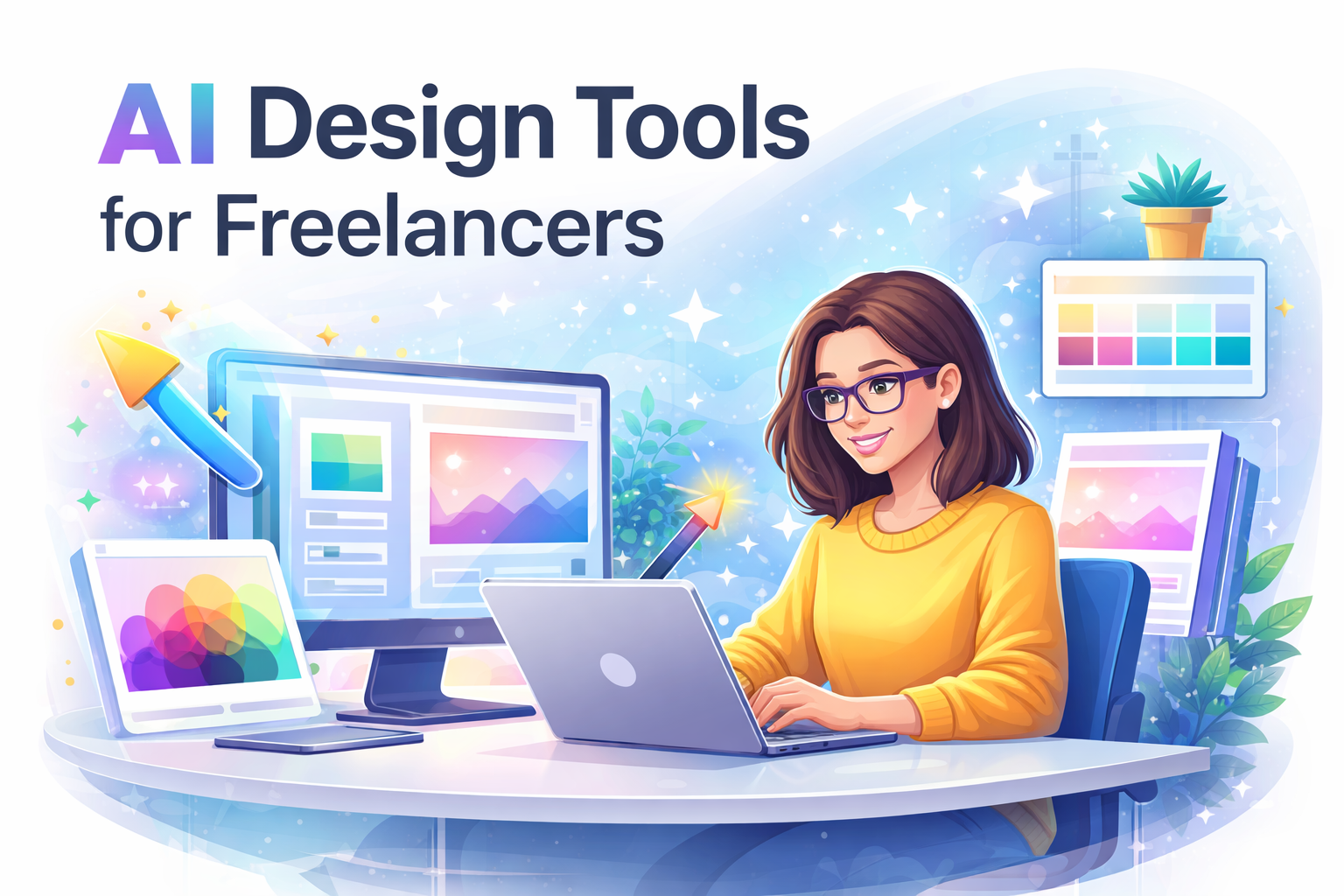
AI design tools help freelancers generate visuals faster, scale output, and eliminate manual design bottlenecks.
AI design tools are not interchangeable.
Each tool solves a specific bottleneck — and introduces trade-offs.
The biggest mistake freelancers make is trying to rely on a single tool.
High-performing freelancers build a stack — not a dependency.
Canva AI
Canva is not just a design tool. It is a layout execution system.
It replaces manual formatting with pre-structured outputs.
What it solves:
- slow design creation for social and marketing assets
- inconsistent formatting across platforms
- manual resizing and duplication work
Where it fails:
- templates can lead to repetitive-looking content
- limited originality for high-end branding
- less control for pixel-perfect design work
Real-world scenario:
A freelancer managing 3 clients needs 20+ social posts weekly.
Without Canva → 10–15 hours/week
With Canva → 2–4 hours/week
System role:
Canva acts as the structured execution layer — where raw visuals become usable assets.
Midjourney
Midjourney is a visual generation engine.
It replaces stock imagery and manual illustration workflows.
What it solves:
- lack of unique visuals
- dependency on stock platforms
- creative limitations
Where it fails:
- no layout or formatting capability
- requires prompt refinement
- inconsistent outputs across iterations
Real-world scenario:
A freelancer building a landing page needs unique visuals.
Stock images → generic, low conversion
Midjourney → unique visuals aligned with brand tone
System role:
Midjourney acts as the creative generation layer — producing raw visual assets.
Adobe Firefly
Adobe Firefly enhances professional workflows rather than replacing them.
It integrates AI into advanced design systems.
What it solves:
- manual asset creation
- slow iteration in professional tools
- lack of design variation
Where it fails:
- steeper learning curve
- slower for quick execution tasks
- requires ecosystem familiarity
Real-world scenario:
A freelancer delivering premium branding work needs variations.
Manual → hours per variation
Firefly → multiple variations in minutes
System role:
Firefly acts as the refinement and professional-grade output layer.
Looka
Looka automates branding decisions.
It converts vague ideas into structured identity systems.
What it solves:
- starting branding from scratch
- decision paralysis in design direction
Where it fails:
- limited uniqueness in competitive niches
- not suitable for high-end brand strategy
Real-world scenario:
A new freelancer needs a brand identity in 1 day.
Manual → weeks
Looka → hours
System role:
Looka acts as the foundational identity layer.
Remove.bg
Remove.bg is a micro-efficiency tool.
It eliminates repetitive editing work.
What it solves:
- manual background removal
- time-consuming image cleanup
Where it fails:
- limited to a specific function
- not useful as a standalone design solution
System role:
Remove.bg acts as a speed multiplier inside the workflow.
Stack Example:
- Midjourney → generate visuals
- Canva → structure layouts
- Remove.bg → clean assets
- Firefly → refine outputs
This is where real efficiency comes from.
How to Choose the Right AI Design Tool (Based on Your Workflow)
Choosing tools is not about features.
It is about solving the right constraint.
Case 1 — Speed vs Creativity
- Canva → fast, structured output
- Midjourney → unique, creative output
Edge case:
If you need both → generate visuals in Midjourney, structure in Canva
Case 2 — Simplicity vs Control
- Canva → easy, fast
- Firefly → advanced, controlled
Edge case:
Start in Canva → refine in Firefly for premium output
Case 3 — Speed vs Brand Depth
- Looka → instant branding
- manual → strategic branding
Edge case:
Use Looka initially → refine manually as business grows
Key insight:
You are not choosing one tool.
You are designing a system.
AI Design Workflow for Freelancers (System-Based Approach)
Freelancer workflows are not linear.
They are dynamic.
Clients request changes.
Assets need revisions.
Platforms demand variations.
A real workflow must adapt.
Step 1 — Generate visuals
Use Midjourney to create base assets.
Failure case:
If output is irrelevant → refine prompt instead of restarting
Step 2 — Structure layouts
Use Canva to convert visuals into usable formats.
Failure case:
If layout feels generic → customize templates
Step 3 — Apply branding
Ensure consistent colors, fonts, and tone.
Step 4 — Refine outputs
Use Firefly for high-quality adjustments.
Step 5 — Adapt and iterate
Resize and modify visuals for different platforms.
Iteration loop:
Client feedback → adjust → redeploy
Time impact:
- manual workflow → 5–8 hours per project
- AI workflow → 1–2 hours
This is where systems create leverage.
Benefits of AI Design Tools for Freelancers
The benefits go beyond speed.
They impact how your business scales.
- reduce design time by 60–80%
- increase output capacity without increasing hours
- deliver faster to clients
- maintain consistent brand quality
Business impact:
- handle more clients
- increase delivery speed
- improve perceived professionalism
Before vs After:
- before → slow, manual, inconsistent
- after → fast, structured, scalable
The real gain:
You stop thinking about design.
You focus on output.
Common Mistakes When Using AI Design Tools (And Why They Happen)
AI design tools are powerful.
But most freelancers do not get the full benefit from them.
Not because the tools are limited — but because they are used incorrectly.
The mistake is not using AI.
It is using AI inside a manual mindset.
Instead of building systems, freelancers often continue working the same way — just faster.
This creates inefficiency, inconsistency, and poor results.
1. Overusing Templates Without Customization
Templates are designed to speed up execution.
But relying on them without modification creates repetitive, generic visuals.
Why it happens:
Speed becomes the priority over differentiation.
Impact:
Your work starts to look similar to everyone else using the same tools.
2. Ignoring Brand Consistency
AI tools can generate visuals quickly — but they do not enforce brand identity unless you define it.
Why it happens:
Freelancers focus on output speed instead of system consistency.
Impact:
Visuals feel disconnected across platforms and projects.
3. Treating Each Design as a New Task
Without a system, freelancers recreate designs instead of reusing structured outputs.
Why it happens:
Lack of workflow standardization.
Impact:
Time is lost solving the same problems repeatedly.
4. Over-Reliance on Automation
AI tools can generate outputs — but they cannot replace judgment.
Why it happens:
Assuming AI output is automatically correct.
Impact:
Design quality drops due to lack of refinement.
5. Lack of Clear Direction
AI systems depend on input quality.
Vague prompts lead to weak results.
Why it happens:
Unclear objectives and lack of defined outcomes.
Impact:
More iterations, more time wasted, lower-quality visuals.
The underlying pattern:
Most mistakes happen because freelancers try to fit AI into manual workflows.
Instead of changing how they operate.
The correct approach is different.
Do not use AI to work faster.
Use AI to build systems that remove repeated work.
Once that shift happens, these mistakes disappear.
And design becomes consistent, scalable, and predictable.
Where AI Design Tools Fail
AI design tools are powerful — but not complete solutions.
They fail in predictable ways.
- generic outputs without direction
- irrelevant visuals from poor prompts
- brand inconsistency if unmanaged
- over-reliance reduces creative thinking
Real-world failure:
A freelancer generates visuals without brand guidance → results feel disconnected
When NOT to use AI:
- high-end branding strategy
- complex design systems
- deep creative work
Key insight:
AI accelerates execution.
It does not replace thinking.
How AI Design Tools Fit Into the AI Tools Ecosystem
AI design tools do not operate in isolation.
They are one layer inside a larger freelance system.
On their own, they improve how visuals are created.
But they do not define:
- what content should be produced
- how work is structured
- how execution is automated
- how output is scaled across systems
This is where most freelancers misunderstand AI tools.
They use tools individually.
But high-performing freelancers build interconnected systems.
AI design tools function best when combined with:
- AI productivity tools → define tasks, priorities, and structure
- AI automation tools → handle execution, repetition, and workflows
- best AI tools → connect multiple systems into one operating layer
This creates a layered system:
planning → creation → execution → automation
Where:
- productivity tools decide what gets done
- design tools produce visual output
- automation tools ensure consistent execution
Design becomes one component of a larger operating system — not a standalone activity.
When these layers work together, freelancers stop managing individual tasks.
They begin operating within systems that generate, structure, and execute work continuously.
That is where real scalability happens.
Explore More AI Tools for Freelancers
If design still feels slow, inconsistent, or difficult to scale — the issue is not creativity.
It is system structure.
AI design tools solve how visuals are created.
But freelancers operate across multiple layers — and each layer requires its own system.
This is where most workflows break.
Design improves, but execution, planning, and automation remain fragmented.
To build a complete freelance system, you need to connect multiple AI layers.
- AI Tools Hub → explore the full ecosystem of AI tools for freelancers
- Best AI Tools for Freelancers → discover the most effective tools across categories
- AI Productivity Tools for Freelancers → structure tasks, priorities, and daily execution
- AI Automation Tools → automate repetitive workflows and scale output
Each layer solves a different constraint.
And when combined, they create a system where:
planning → creation → execution → automation
operate together seamlessly.
This is what allows freelancers to move from manual work to system-driven output.
Next Step:
Once your design workflow is structured, the next bottleneck is execution.
Explore how freelancers automate workflows and reduce manual effort using AI automation tools.
Final Thoughts
Freelancers don’t struggle because they lack design skills.
They struggle because design is treated as a manual task — repeated, adjusted, and rebuilt every time.
That model does not scale.
Every new visual becomes another decision.
Every revision becomes another delay.
Every project increases the workload.
This is where most freelancers get stuck — not in creativity, but in execution friction.
AI design tools change this completely.
They do not just make design faster.
They change how design operates.
Instead of creating visuals manually, you begin operating within a system that generates them.
This shifts design from:
manual effort → system-driven output
repetition → scalable production
decision fatigue → structured execution
The real advantage is not speed.
It is removing design as a bottleneck entirely.
Once that happens, your output increases.
Your turnaround improves.
And your ability to handle more work expands without increasing effort.
High-performing freelancers understand this shift.
They don’t try to design everything better.
They build systems that produce visuals consistently, predictably, and at scale.
And that is the difference between working more — and operating at a higher level.