
AI Finance Tools for Freelancers (2026) — Automate Money, Control Cash Flow, Build Financial Stability
Most freelancers don’t have a money problem — they have a system problem.
Irregular income, delayed payments, and scattered tracking create constant financial pressure.
- No clear income visibility
- Manual tracking leads to errors
- Decisions are reactive, not planned
This guide explains how AI finance tools for freelancers transform financial chaos into structured systems that automate tracking, improve clarity, and enable better financial decisions.
What You’ll Learn
- How AI finance tools automate financial management
- Types of financial tools and how they work together
- How to build a complete financial system for freelancing
- How to improve cash flow visibility and decision-making
- Which tools to use based on your stage
AI Finance Tools for Freelancers — Overview & System Breakdown
AI finance tools for freelancers are systems that automate financial management processes such as tracking income, managing expenses, generating invoices, and forecasting financial outcomes. These tools do not simply simplify accounting—they transform financial operations into structured, automated systems.
The best AI finance tools for freelancers are designed to automate income tracking, manage expenses, forecast cash flow, and provide real-time financial insights.
Freelancers operate in a financial environment defined by irregular income, inconsistent cash flow, and fragmented financial tracking. Without structured systems, financial management becomes reactive, error-prone, and mentally exhausting.
Simple Explanation: AI finance tools help freelancers automatically manage money, track income and expenses, and make better financial decisions without constant manual effort.
Reality:
Most freelancers don’t struggle because they earn too little. They struggle because their financial systems are broken or nonexistent.
This creates a critical limitation:
No system → No clarity → Poor financial decisions
AI finance tools remove this limitation by transforming financial management into automated systems that operate continuously.
Within the ecosystem of AI tools for freelancers, finance tools act as the financial control layer—the system that ensures visibility, stability, and decision-making accuracy.
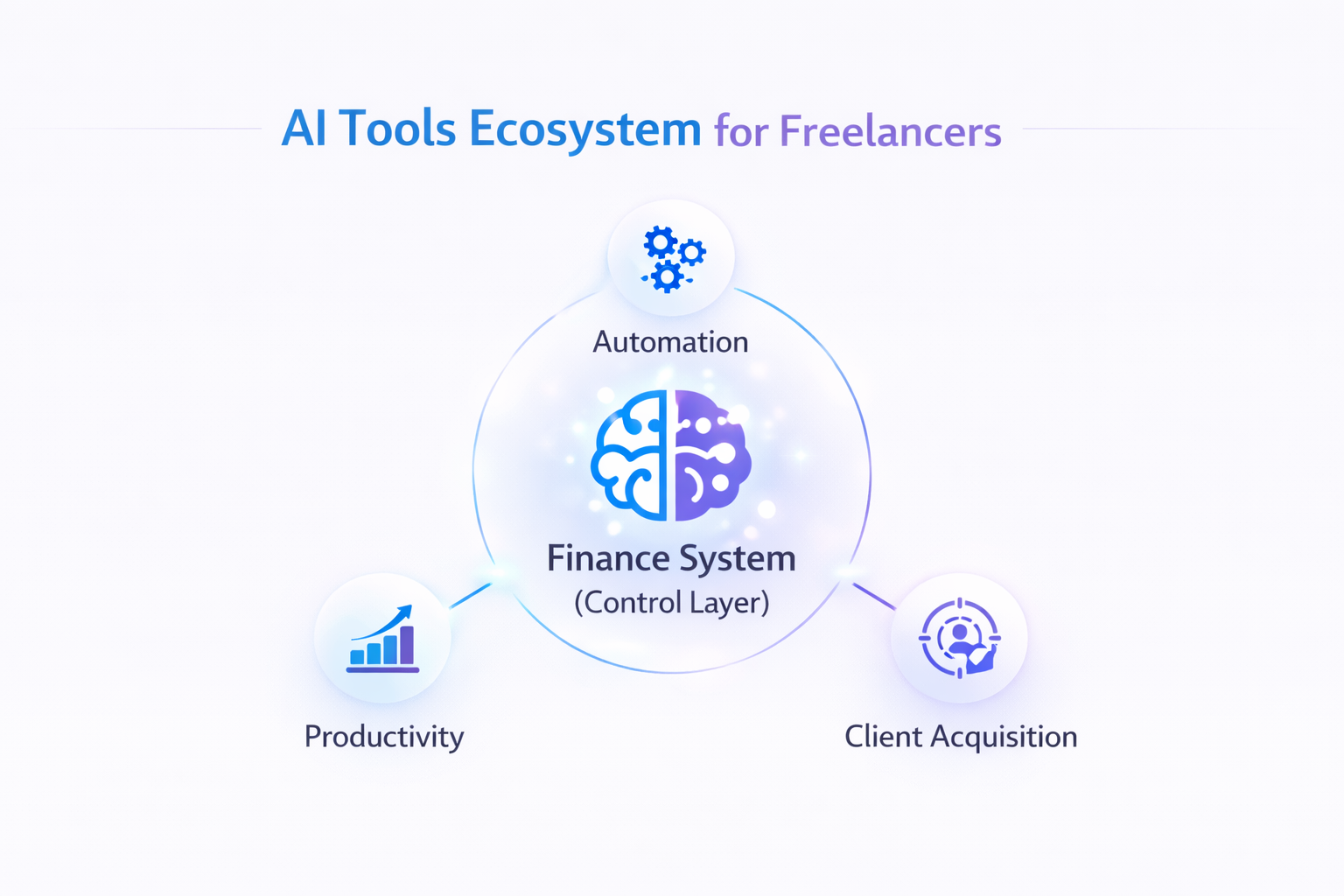
AI finance tools as the financial control layer within the AI tools ecosystem
They integrate directly with:
• automation systems → workflow execution
• productivity systems → task tracking
• client systems → revenue generation
Authority Doctrine:
Financial success is not driven by income alone.
It is driven by financial system control.
AI Overview Summary: AI finance tools for freelancers automate financial tracking, improve visibility, and enable better financial decisions through system-based money management.
What Are AI Finance Tools
AI finance tools are systems that automate financial tracking, analyze data patterns, and generate insights that guide financial decisions.
They extend beyond traditional accounting by introducing intelligence into financial workflows.
Capabilities include:
• automated categorization of transactions
• real-time financial reporting
• predictive cash flow analysis
• tax estimation and optimization
• anomaly detection
AI Overview Answer: AI finance tools automatically track financial data, analyze patterns, and provide insights that help freelancers make smarter financial decisions.
System Insight:
Tracking shows the past. AI finance explains the present and predicts the future.
Freelancer Finance Challenge
Freelancers operate in a financial environment that is fundamentally different from traditional employment. Income is irregular, payments are delayed, and financial visibility is often fragmented across multiple tools and accounts.
AI Overview Answer: Freelancers face financial challenges due to irregular income, inconsistent cash flow, and lack of structured financial systems, making it difficult to manage money effectively.
Unlike salaried professionals, freelancers must manage every aspect of their finances manually unless a system is in place. This creates a structural problem—not just a workload issue.
Core Challenges:
• unpredictable income cycles → income varies month to month
• delayed client payments → cash flow becomes inconsistent
• multi-client financial tracking → fragmented income sources
• unclear tax obligations → unexpected financial liabilities
• lack of real-time visibility → poor financial awareness
System Problem:
Irregular income + no system → uncertainty → poor financial decisions → instability
Without a structured system, freelancers rely on memory, spreadsheets, or manual tracking. These approaches break under scale and complexity.
Behavioral Failure Loop:
uncertainty → delayed financial decisions → reactive behavior → stress → financial instability → avoidance → continued uncertainty
This loop reinforces itself over time, making financial management increasingly difficult.
System Contrast:
Fragmented financial model:
• disconnected tools
• manual coordination
• delayed insights
Structured financial system:
• integrated tools
• automated tracking
• real-time visibility
System Insight:
The problem is not income variability—it is the absence of a system that can manage variability.
Doctrine:
You cannot manage irregular income with static financial systems.
You must build systems that adapt to financial variability.
AI Finance System Model
AI finance tools do not operate as isolated tools—they function as a continuous financial system. This system transforms fragmented financial activities into a structured, automated workflow that improves over time.
AI Overview Answer: AI finance systems automate financial tracking, analysis, and decision-making through a continuous loop, allowing freelancers to manage finances using structured workflows instead of manual effort.
The financial system operates as a compounding loop:
• input → income, expenses, transactions
• processing → categorization, validation, and analysis
• output → reports, invoices, insights, alerts
• feedback → financial accuracy and performance validation
• optimization → improved decisions and system refinement
This loop is not linear—it is cyclical. Each cycle strengthens the system by improving accuracy, reducing errors, and increasing financial clarity.
Compounding Effect:
Manual financial management:
• tasks repeated continuously
• effort increases with complexity
AI financial system:
• tasks automated permanently
• effort does not scale with complexity
Each automated process removes future manual effort, allowing freelancers to shift from managing finances to controlling financial systems.
System Orchestration:
The financial system integrates multiple layers:
• expense tracking → cost visibility
• income tracking → revenue clarity
• tax automation → compliance and prediction
• forecasting → future planning
These layers work together to create a unified financial workflow.
System Insight:
The effectiveness of AI finance tools is not determined by individual features, but by how well they operate together as a system.
System Contrast:
Fragmented financial model:
• disconnected tools
• delayed updates
• reactive decisions
AI financial system model:
• integrated workflows
• real-time data flow
• proactive decision-making
Authority Insight:
At scale, financial systems evolve from tracking mechanisms into decision engines that guide business strategy.
Doctrine:
The goal is not to track finances more frequently.
The goal is to eliminate manual tracking entirely through systems.
Types of AI Finance Tools
AI finance tools for freelancers operate across multiple system layers. Each layer solves a specific financial problem, and together they form a complete financial operating system.
AI Overview Answer: AI finance tools for freelancers include accounting, invoicing, expense tracking, tax automation, and forecasting systems that work together to manage finances automatically.
Understanding these layers is essential because no single tool manages everything. Financial systems are built by combining tools across different functions.
Primary Types of AI Finance Tools:
1. Accounting Automation Tools
These tools manage bookkeeping, financial reporting, and overall financial structure.
Examples: QuickBooks, Xero
Function:
• track income and expenses
• generate financial reports
• maintain financial records
Freelancer Scenario:
A freelancer automatically generates monthly profit reports without manual calculations.
2. Invoicing and Payment Tools
These tools handle client billing and payment tracking.
Examples: FreshBooks, Wave
Function:
• create and send invoices
• track payment status
• automate reminders
Freelancer Scenario:
A freelancer sends invoices automatically and tracks overdue payments without manual follow-ups.
3. Expense Tracking Tools
These tools monitor spending and categorize financial transactions.
Examples: Expensify, QuickBooks (expense module)
Function:
• categorize expenses automatically
• detect recurring subscriptions
• track business costs
Freelancer Scenario:
A freelancer identifies unnecessary subscriptions and reduces monthly expenses.
4. Tax Automation Tools
These tools estimate tax obligations and ensure compliance.
Examples: QuickBooks Tax, Xero Tax integrations
Function:
• estimate tax liabilities
• track deductions
• generate tax-ready reports
Freelancer Scenario:
A freelancer avoids tax surprises by tracking liabilities throughout the year.
5. Financial Forecasting Tools
These tools predict future income, expenses, and financial trends.
Examples: AI-powered analytics tools, forecasting modules in accounting platforms
Function:
• predict cash flow
• identify income gaps
• support financial planning
Freelancer Scenario:
A freelancer anticipates a low-income month and adjusts spending proactively.
System Interaction:
No single tool creates a financial system. A complete workflow looks like this:
Client payment → invoicing tool → income tracking → expense tracking → accounting system → tax estimation → forecasting → decision
This chain transforms isolated tools into a unified financial system.
System Insight:
The effectiveness of AI finance tools depends on how well these layers connect—not on individual tool features.
SEO Reinforcement: AI finance tools for freelancers operate across multiple financial layers, including accounting, invoicing, expense tracking, tax management, and financial forecasting systems.
Doctrine:
Financial clarity is not achieved manually.
It is built by connecting systems that operate together.
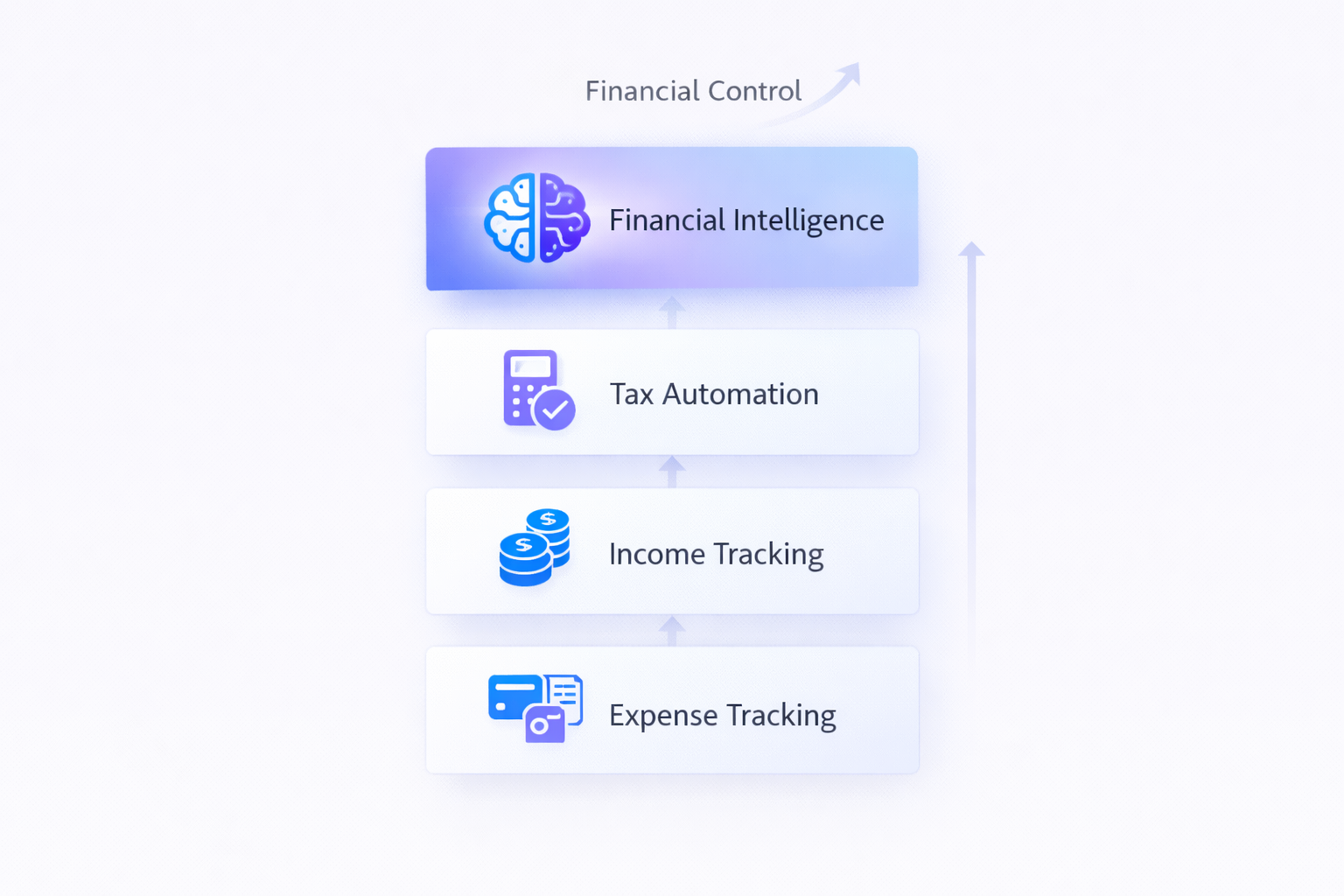
Core layers of AI finance systems for freelancers
Core Layer 1 — Expense Tracking Systems
AI Overview Answer: Expense tracking tools automatically categorize spending, detect patterns, and provide real-time visibility into financial behavior.
Expense tracking is the foundation of financial clarity. Without it, freelancers operate blindly.
System Function:
• automatic transaction categorization
• subscription detection
• spending pattern analysis
Scenario:
A freelancer identifies recurring tools and eliminates unnecessary costs, improving profit margins.
System Insight:
Expense tracking is not about recording costs—it is about controlling financial leakage.
Core Layer 2 — Income Tracking Systems
AI Overview Answer: Income tracking tools centralize revenue across clients and provide visibility into income patterns and stability.
Freelancers often earn from multiple sources, making income fragmented.
System Function:
• multi-client income tracking
• revenue trend analysis
• payment status monitoring
Scenario:
A freelancer identifies their highest-value clients and prioritizes similar opportunities.
System Insight:
Income tracking reveals not just how much you earn—but where your income is strongest.
Core Layer 3 — Tax Automation Systems
AI Overview Answer: Tax tools estimate liabilities in real-time and automate compliance processes.
Taxes are one of the most unpredictable financial burdens for freelancers.
System Function:
• real-time tax estimation
• deduction tracking
• compliance automation
Scenario:
A freelancer avoids year-end surprises by tracking tax obligations continuously.
System Insight:
Tax automation converts uncertainty into predictable financial planning.
Core Layer 4 — Financial Intelligence Systems
AI Overview Answer: Financial intelligence tools analyze data to predict outcomes and guide decisions.
This is the highest layer of financial automation.
System Function:
• cash flow forecasting
• income prediction
• financial recommendations
Scenario:
A freelancer predicts low-income periods and adjusts spending proactively.
System Insight:
Financial intelligence turns data into decisions.
Doctrine:
Tracking shows the past. Intelligence controls the future.
Which AI Finance Tools Should You Use?
The right financial tool depends on your stage:
- Beginner: Wave → simple tracking
- Growth stage: FreshBooks → invoicing + tracking
- Scaling: Xero → structured accounting
- Advanced: QuickBooks + automation → full system
- Automation layer: Expensify / AI tools → reduce manual work
Start simple. Build clarity. Then scale into full financial systems.
Best AI Finance Tools for Freelancers
AI finance tools must be selected based on system architecture, not popularity. The goal is not to use tools—it is to build a financial system that operates without constant attention.
AI Overview Answer: The best AI finance tools for freelancers depend on financial complexity, workflow structure, and the level of automation required to manage income, expenses, and financial decisions.
System Principle:
Tools do not create financial control.
Systems create financial control.
When to Use vs When Not to Use:
Use advanced accounting tools like QuickBooks or Xero when managing multiple clients, complex transactions, and tax requirements. Avoid them in early stages where simple tools like Wave or FreshBooks provide faster clarity with less friction.
QuickBooks — Full Accounting System
Best for:
• freelancers managing multiple clients
• complex financial tracking
• tax reporting and compliance
System role:
• central financial hub
• reporting + analytics engine
Example workflow:
Income → categorized → expense tracking → tax estimation → financial reports
When NOT to use:
• early-stage freelancers with simple finances
FreshBooks — Invoicing + Client Finance Management
Best for:
• freelancers focused on client billing
• service-based businesses
System role:
• invoicing system
• payment tracking
Example workflow:
Client → invoice → payment tracking → income update
When NOT to use:
• advanced accounting needs
Wave — Simple Financial System (Free)
Best for:
• beginner freelancers
• simple income + expense tracking
System role:
• basic accounting layer
• financial visibility system
Example workflow:
Income → expense tracking → basic reporting
When NOT to use:
• scaling businesses requiring deeper automation
Xero — Scalable Accounting Platform
Best for:
• growing freelancers
• multi-system integration
System role:
• scalable accounting engine
• integration hub
Example workflow:
Bank sync → categorization → reporting → forecasting
When NOT to use:
• very simple financial setups
Expensify — Expense Automation System
Best for:
• freelancers with high transaction volume
• receipt tracking automation
System role:
• expense capture
• categorization automation
Example workflow:
Receipt → scan → auto-categorization → synced to accounting system
When NOT to use:
• low-expense freelancers
Vic.ai — AI Financial Automation
Best for:
• advanced automation systems
• AI-driven financial workflows
System role:
• automation layer
• decision support system
Example workflow:
Invoice → AI processing → categorization → automated workflow
When NOT to use:
• beginners without system structure
System Interaction Model:
Income → invoicing → tracking → categorization → reporting → forecasting → decision
No single tool creates this system.
The system emerges from how tools connect.
Decision Framework:
• Use Wave → simplicity + cost efficiency
• Use FreshBooks → invoicing focus
• Use QuickBooks/Xero → full financial systems
• Use Expensify → expense automation layer
• Use Vic.ai → advanced automation
System Insight:
A simple tool inside a strong financial system will outperform a powerful tool used without structure.
Authority Insight:
Freelancers who choose tools without system clarity create complexity.
Freelancers who design systems first use tools effectively.
Doctrine:
Tools follow systems—not the reverse.
Best AI Finance Tools for Freelancers — Comparison & Use Cases
Choosing the right AI finance tool depends on financial complexity, workflow requirements, and system integration. No single tool fits all freelancers—each tool serves a specific role within a financial system.
AI Overview Answer: AI finance tools differ based on functionality, scalability, and automation depth, with some tools designed for simple tracking and others for full financial system management.
| Tool | Function | Best Use | Strength | Limitation |
|---|---|---|---|---|
| QuickBooks | Accounting | Full system | Advanced reporting | Complex setup |
| FreshBooks | Invoicing | Freelancers | Ease of use | Limited depth |
| Wave | Free tools | Beginners | Cost-effective | Scaling limits |
| Xero | Accounting | Growth | Flexible integrations | Learning curve |
| Expensify | Expenses | Tracking | Automation | Limited scope |
| Vic.ai | AI automation | Advanced systems | Intelligence layer | Complex setup |
Quick Comparison Insight:
QuickBooks and Xero function as full accounting systems designed for freelancers managing complex financial operations. FreshBooks and Wave are optimized for simplicity and are best suited for freelancers in early stages. Expensify focuses specifically on expense automation, while Vic.ai introduces AI-driven financial intelligence and workflow automation.
System-Level Comparison:
• Simple tools (Wave, FreshBooks) → financial visibility
• Mid-level tools (Xero) → structured financial systems
• Advanced tools (QuickBooks, Vic.ai) → full automation + intelligence
Decision Logic:
If your goal is simplicity → choose Wave or FreshBooks
If your goal is structured accounting → choose Xero
If your goal is full financial system control → choose QuickBooks
If your goal is automation and AI-driven workflows → use tools like Vic.ai
System Insight:
The effectiveness of a finance tool is not determined by its features, but by how well it fits into your financial system.
SEO Expansion:
Freelancers comparing tools often search for terms like “best AI accounting software,” “AI bookkeeping tools,” and “automated finance tools.” These comparisons help identify the right system based on complexity and growth stage.
Doctrine:
Comparison should guide system decisions—not tool preferences.
Benefits of AI Finance Tools
AI finance tools transform financial management from manual tracking into automated systems.
Core Benefits:
• real-time financial visibility → always know your financial position
• automated tracking → eliminate manual bookkeeping
• reduced errors → improved financial accuracy
• faster decision-making → act on real-time insights
• predictable tax management → avoid financial surprises
System Impact:
Manual finance:
• reactive
• inconsistent
Automated finance system:
• proactive
• predictable
AI Overview Answer: AI finance tools improve financial visibility, automate financial tasks, and enable freelancers to make faster and more accurate financial decisions.
Doctrine:
Financial clarity reduces stress.
Financial systems create control.
AI Finance Strategy
Financial automation must be system-first, not tool-first. Freelancers often fail because they attempt to manage finances manually instead of designing financial systems.
AI Overview Answer: Effective financial automation focuses on building structured systems that manage income, expenses, and decisions automatically.
Stage Model:
Stage 1 → track finances
Stage 2 → automate tracking
Stage 3 → integrate systems
Stage 4 → optimize decisions
System Insight:
Financial systems reduce cognitive load and improve decision quality.
SEO Layer Expansion:
Freelancers searching for financial tools may also look for:
• AI accounting tools for freelancers
• AI bookkeeping software
• automated finance tools
Expanded Keyword Coverage:
Freelancers often search for AI accounting tools for freelancers, AI bookkeeping software, AI tax tools, and automated finance systems. These all fall under the broader category of AI finance tools designed to manage irregular income and financial complexity.
Effective use of AI finance tools for freelancers depends on aligning tools with structured workflows rather than isolated financial tasks.
Doctrine:
Financial systems create stability.
End-to-End Financial Workflow
This is where most freelancers fail. They track finances manually instead of building a connected financial system. Below is a complete workflow showing how AI finance tools operate together.
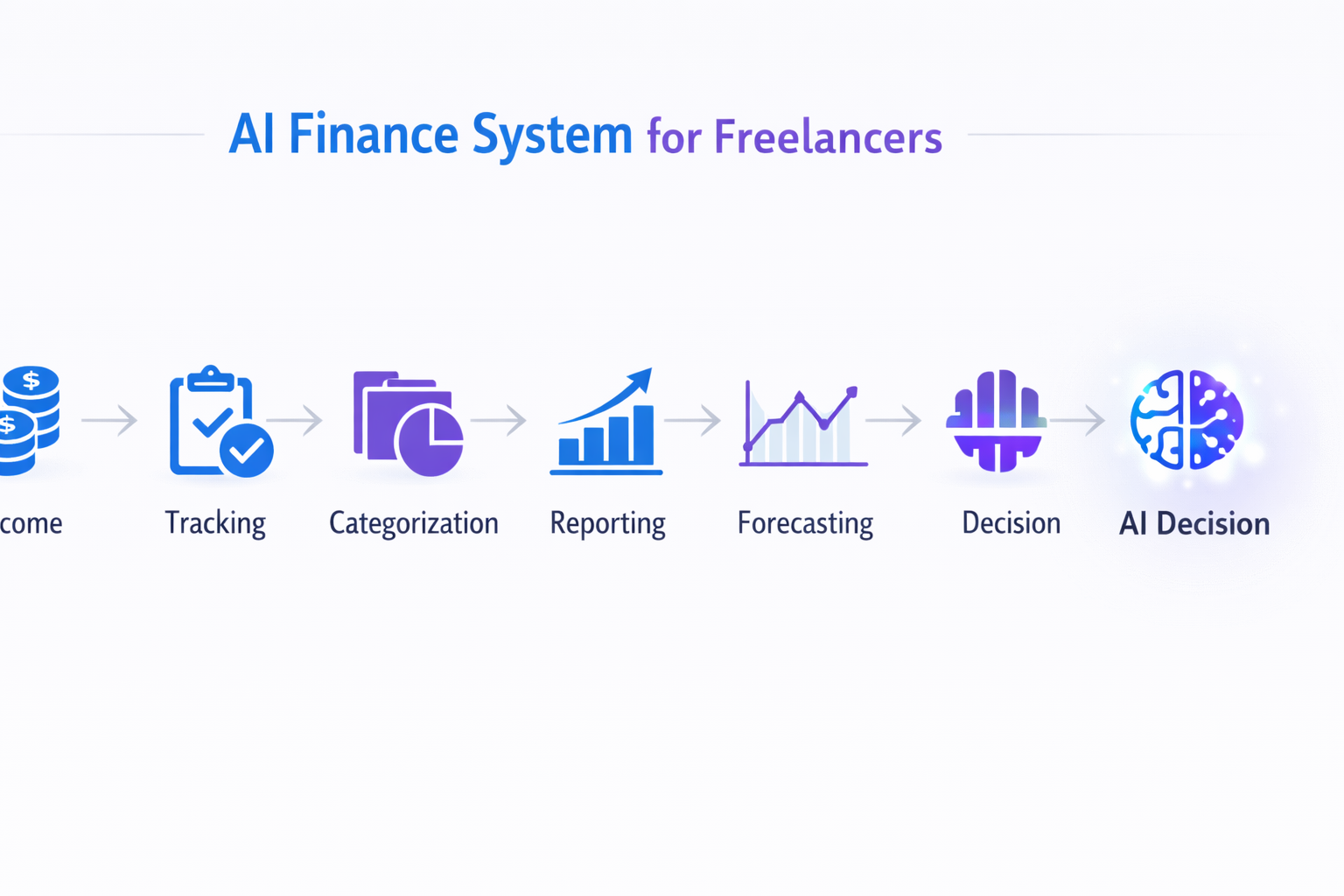
AI finance workflow system showing how freelancers automate financial management
AI finance workflows must operate as complete systems rather than isolated processes. A true financial workflow connects all stages of income, expenses, analysis, and decision-making into a continuous loop.
How do AI finance tools work?
An AI finance workflow captures financial data, processes it automatically, generates outputs, and continuously improves through feedback. Instead of manually tracking finances, freelancers operate a system that manages financial operations in real time.
Full System Flow:
Income → capture → categorization → expense tracking → reporting → forecasting → decision → optimization → repeat
Expanded Workflow Breakdown:
1. Data Capture
Income and expenses are automatically captured from invoices, bank accounts, and transactions.
2. Categorization
AI systems classify transactions into structured categories such as income, business expenses, and taxes.
3. Processing & Analysis
The system analyzes patterns, detects anomalies, and generates financial insights.
4. Reporting
Financial data is converted into reports that provide real-time visibility into cash flow and performance.
5. Forecasting
AI tools predict future income, expenses, and potential financial gaps.
6. Decision Layer
Freelancers use insights to adjust spending, pricing, or client strategy.
7. Optimization Loop
Each financial cycle improves accuracy and strengthens the system over time.
Conditional Logic:
If income increases → adjust forecasts and allocate surplus
If expenses increase → trigger alerts and cost optimization
If cash flow drops → adjust strategy and prioritize revenue
System Orchestration:
This workflow integrates with:
• automation systems → workflow execution
• productivity systems → task coordination
• client systems → revenue generation
Feedback Loop:
system → data → insight → decision → improved system
System Contrast:
Manual finance workflow:
• delayed updates
• incomplete visibility
• reactive decisions
Automated financial system:
• real-time updates
• full visibility
• proactive decision-making
Authority Insight:
At scale, financial workflows evolve from tracking systems into decision engines.
This is how AI finance tools for freelancers transform financial operations into automated decision systems.
Doctrine:
Financial control comes from systems—not tracking.
Systems replace effort with structured execution.
Real Use Cases
Use Case 1:
Outcome: automated expense tracking
Result: reduced unnecessary spending
Insight: visibility improves profitability
Use Case 2:
Outcome: automated invoicing and payment tracking
Result: improved cash flow consistency
Insight: systems stabilize income
Use Case 3:
Outcome: financial forecasting
Result: proactive decision-making
Insight: prediction reduces uncertainty
Common Mistakes
1. Tracking finances manually
Impact: inconsistency and errors
Fix: implement automated systems
2. Using disconnected tools
Impact: fragmented financial view
Fix: integrate tools into a system
3. Ignoring forecasting
Impact: reactive decision-making
Fix: use predictive financial tools
4. Mixing personal and business finances
Impact: unclear financial data
Fix: separate and automate tracking
Frequently Asked Questions
Short Answer:
AI finance tools for freelancers automate tracking, reduce financial errors, and provide insights that help freelancers manage money more effectively and make faster financial decisions.
What are AI finance tools?
AI finance tools are systems that automate financial tracking, analyze data, and provide insights to improve financial decision-making.
Do freelancers need AI finance tools?
Yes. Freelancers operate with irregular income, making automated financial systems essential for stability and clarity.
Which AI finance tools are best for freelancers?
The best tools depend on complexity: simple tools like Wave and FreshBooks for beginners, and advanced tools like QuickBooks or Xero for scaling freelancers.
How do AI finance tools help freelancers?
They automate financial processes, improve visibility, and enable better decision-making through real-time insights.
Conclusion
AI finance tools for freelancers are not just tools—they are the foundation of a structured financial system. Freelancers operating without financial systems rely on memory, manual tracking, and inconsistent decisions. This creates uncertainty, stress, and instability.
By contrast, freelancers who implement AI finance tools operate with clarity. Income is tracked automatically, expenses are categorized in real time, and financial insights guide decisions continuously. The result is not just better tracking—but complete financial control.
Final System Insight:
Financial success in freelancing is not determined by how much you earn. It is determined by how well your financial system is designed.
System Contrast:
Manual financial model:
• reactive decisions
• incomplete visibility
• financial uncertainty
AI financial system model:
• real-time visibility
• automated workflows
• predictable financial outcomes
AI finance tools for freelancers transform financial management from a manual task into an automated decision system. This shift is what enables freelancers to move from instability to control.
Final Authority Doctrine:
Freelancers who track finances stay reactive.
Freelancers who build financial systems gain control.
This page is part of the AI Tools Hub authority system and connects with all major AI tool categories for freelancers, including automation, productivity, client acquisition, and financial decision systems.
To build a complete freelance system, explore the full ecosystem at AI Tools Hub.