
How to Manage Cash Flow as a Freelancer (System for Stability & Control)
A structured system to stabilize irregular income, control spending, and build financial clarity for freelancers.
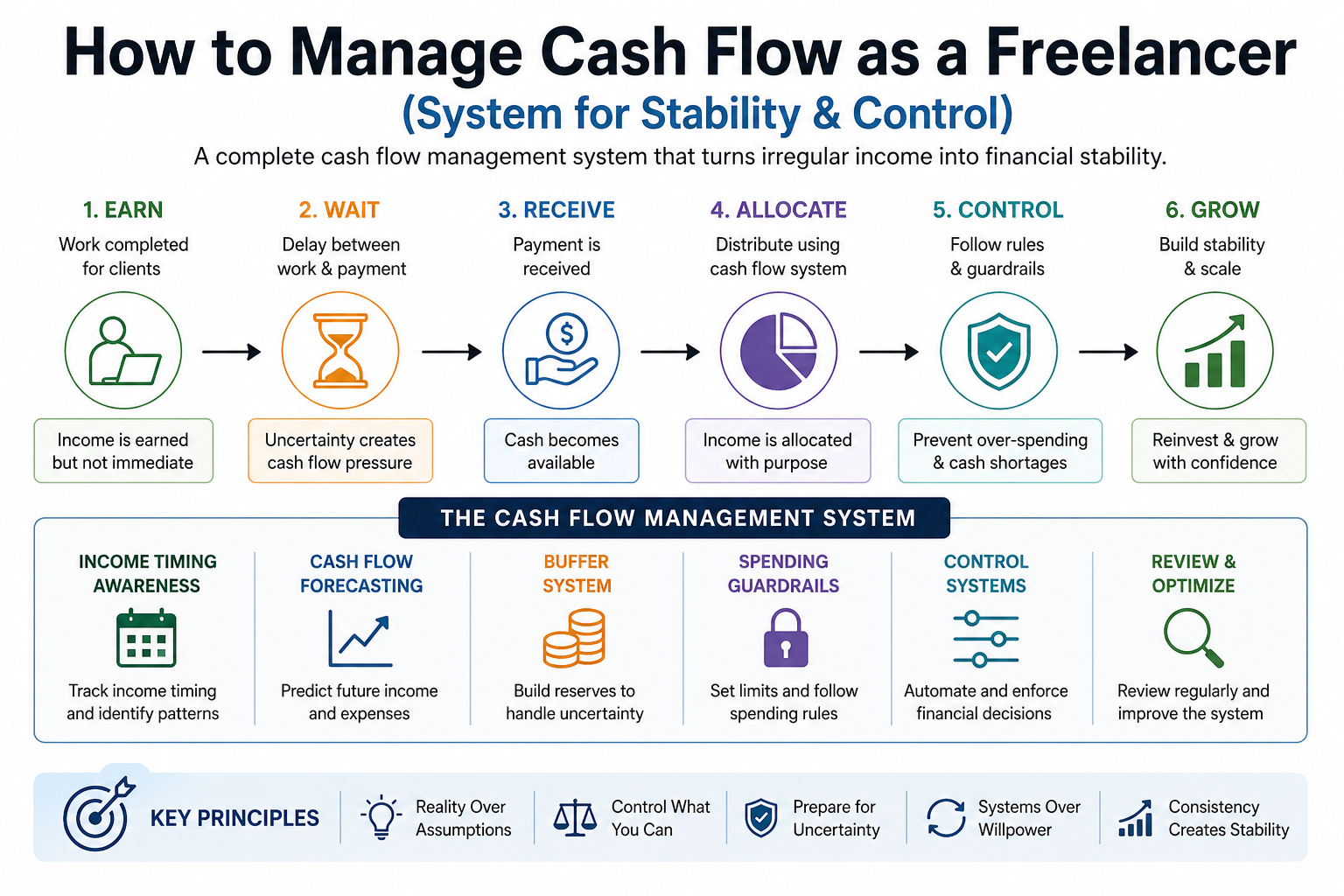
Freelancer cash flow management system illustrating how income timing, forecasting, buffers, and control systems work together
How do freelancers manage cash flow?
Freelancers manage cash flow using a structured system that controls income timing, forecasts payments, regulates spending, and maintains financial buffers to stabilize irregular income cycles.
Freelancers Do Not Have an Income Problem They Have a Cashflow System Problem
Freelancers and independent professionals often experience financial pressure even when their total income is healthy. The underlying issue is rarely income level. Instead, financial stress usually emerges from the timing of income.
Client payments may arrive weeks after projects are completed, invoices may remain unpaid for extended periods, and revenue may fluctuate across project cycles.
At the same time, expenses such as rent, software subscriptions, taxes, and business costs continue on fixed schedules. This creates a structural mismatch where financial obligations are predictable, but income availability is not.
Freelancers do not fail financially because they earn too little. They fail because income arrives at unpredictable times while expenses remain fixed.
This system exists to eliminate that mismatch by controlling how and when money is used.
This Is a System — Not Budgeting, Tools, or Advice
This is NOT:
- budgeting
- expense tracking tools
- financial advice
This IS:
- a structured financial operating system
- a cashflow control framework
- a system that manages timing, liquidity, and decision flow
Unlike traditional financial methods that assume stable income, this system is specifically designed for irregular income conditions.
Freelancer Cashflow System (Definition)
A freelancer cashflow system is a structured financial framework that controls income timing, regulates spending, and maintains financial stability under irregular income conditions.
The system transforms irregular income into predictable financial flow by managing timing, liquidity, and financial behavior.
cash flow definitionAI Overview — Freelancer Cashflow System
Control income timing. Stabilize spending. Build financial stability.
The freelancer cashflow system integrates forecasting, guardrails, buffers, and control systems into a unified framework that ensures stability regardless of income timing.
Why Traditional Budgeting Fails for Freelancers
Traditional budgeting systems assume income stability. They allocate money based on expected monthly earnings and fixed expense categories.
This approach works in predictable environments but fails under irregular income conditions.
Freelancers cannot rely on budgeting alone because budgeting does not address timing. It assumes money is already available, whereas freelance income may not yet be received.
Key Difference:
- Budgeting controls allocation
- Cashflow systems control timing and liquidity
A cashflow system focuses on when money becomes available and ensures that financial decisions are aligned with actual cash availability rather than projected income.
Without this distinction, freelancers make decisions based on expected income, leading to premature spending and recurring financial stress.
Failure Chain Effect
Each failure creates a chain reaction. Spending based on expected income leads to reduced liquidity, which increases dependency on future payments. When delays occur, financial stress compounds rapidly.
The system prevents this chain by aligning decisions with actual availability.
Role in Financial Operating System
- Pillar: AI-Powered Money Management
- Stage: Stability Layer (Foundation)
- Dependency: Required before budgeting, pricing, or income growth systems
This system acts as the entry control layer, ensuring financial stability before any optimization or scaling decisions are made.
Why Freelancer Cash Flow Management Fails Without a System
Freelancers operate in a fundamentally different financial environment compared to salaried individuals. Income is not only variable in amount but also unpredictable in timing.
Payments depend on client cycles, invoicing delays, and external approval processes.
At the same time, expenses remain fixed. Rent, subscriptions, taxes, and operational costs continue regardless of whether income has been received.
This creates a structural mismatch where financial obligations are predictable, but income availability is not.
Without a system, this mismatch leads to recurring financial instability. High-income periods create false confidence and increased spending, while delayed payment periods create liquidity stress.
The result is a continuous cycle of overextension followed by financial constraint.
The freelancer cashflow system exists to eliminate this cycle by separating income variability from financial decision-making.
The Core Timing Problem: Earned vs Available Income
Freelancers often confuse earned income with available income. Income is considered earned when work is completed, but it is only available when payment is received.
This creates a hidden timing gap that is not immediately visible but has a direct impact on financial decisions.
For example, a freelancer may complete $3,000 worth of work in a week. However, if payment is received after 30 days, that income does not support current expenses.
During this gap:
- Expenses continue to occur
- Cash availability remains limited
- Financial decisions become misaligned
Multi-Layer Delay Structure
The delay between earning and receiving income is not a single event. It occurs across multiple stages:
- Work completion delay
- Invoice generation delay
- Client approval delay
- Payment processing delay
- Bank settlement delay
Each layer extends the timing gap and increases financial uncertainty.
Without visibility into these layers, freelancers operate under the assumption that income is immediately usable, which leads to premature financial decisions.
The Financial Instability Loop
Without a cashflow system, freelancers fall into a repeating instability loop driven by timing misalignment.
The sequence typically unfolds as follows:
- Income is earned but not yet received
- Spending decisions are made based on expected income
- Cash reserves are reduced
- Payment delays extend beyond expectation
- Liquidity stress emerges
- Emergency adjustments are made (cutting expenses, delaying payments)
Once income is received, the cycle resets. The temporary relief creates a false sense of stability, leading to the same behavior repeating.
This loop is not caused by poor discipline. It is caused by structural misalignment between income timing and financial decisions.
The cashflow system breaks this loop by ensuring that decisions are based only on available liquidity rather than expected income.
Research on the gig economy confirms that income timing delays—not income level—are the primary cause of freelancer financial instability.
Freelancer Cash Flow Management System (Core Framework)
The freelancer cashflow system is designed to manage the movement of money across different timing stages. Instead of focusing only on how much money is earned, the system focuses on when money becomes available and how it is used.
This system separates income generation from financial decision-making. Income may be irregular, but decisions must remain stable.
The system operates by coordinating inflow, outflow, and liquidity buffers to maintain financial stability regardless of income timing.
Core Components:
- Invoice Tracking
- Payment Forecasting
- Income Smoothing
- Expense Alignment
- Cashflow Buffers
Each component functions as part of an integrated system. Individually, they provide visibility. Together, they create financial control.
Explore each component:
Why Components Fail Without a System
Each component of the cashflow system provides value individually, but none of them can stabilize finances on their own.
- Forecasting without guardrails leads to overconfidence
- Buffers without control systems are depleted quickly
- Income smoothing without forecasting creates misalignment
The system works only when these components operate together as a coordinated structure.
This integration ensures that visibility, control, and liquidity function simultaneously rather than independently.
Multi-Client Cashflow Dynamics
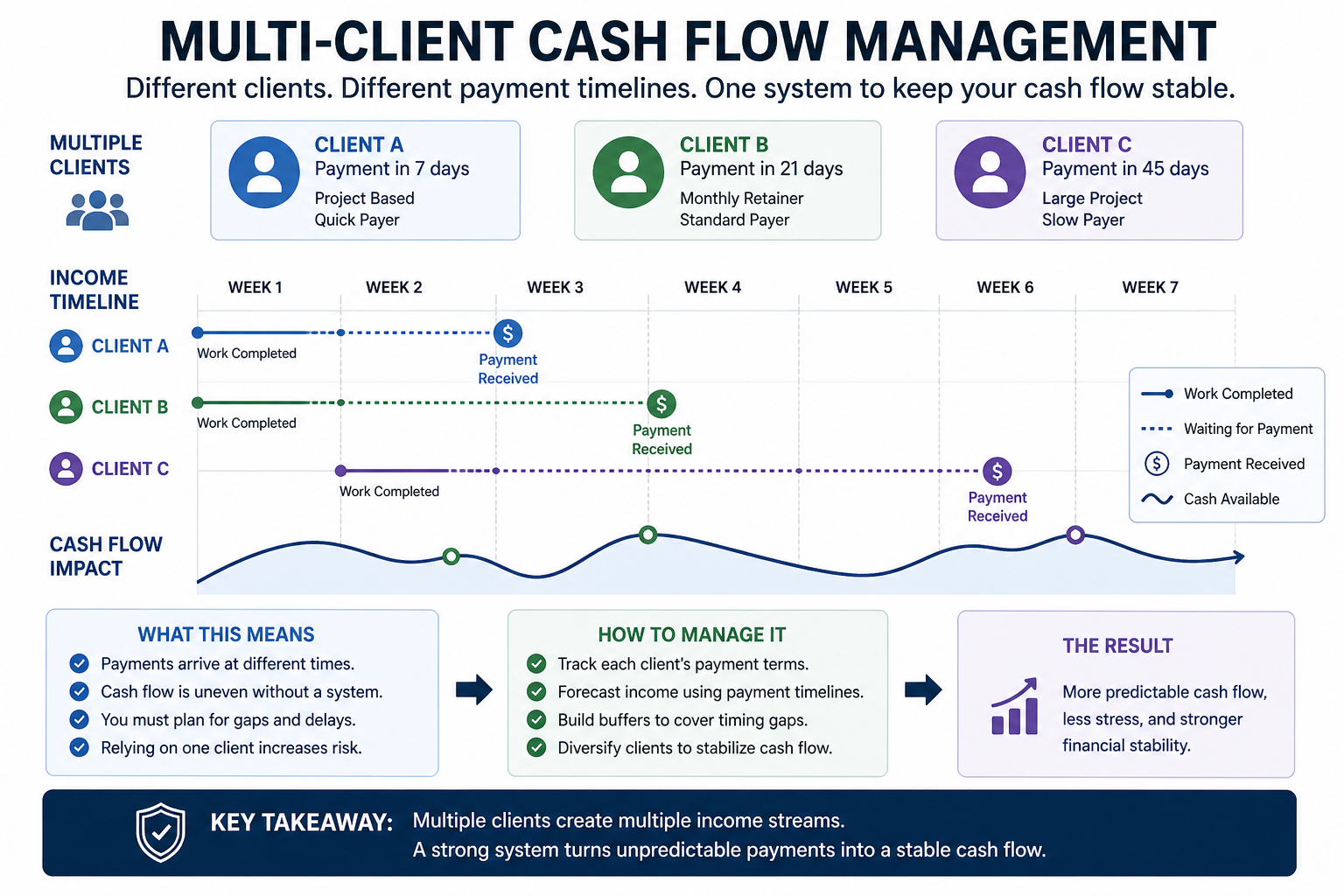
Multiple client payment cycles create staggered income timing, requiring structured cash flow management for stability
Freelancers often work with multiple clients, each with different payment timelines. This creates overlapping income cycles rather than a single predictable flow.
Some clients may pay within days, while others may delay payments for weeks or months.
This creates a staggered cashflow pattern where income arrives at uneven intervals.
The system must manage this complexity by:
- Tracking each client’s payment behavior
- Aligning cashflow projections across multiple income streams
- Reducing dependency on any single payment source
This diversification stabilizes cashflow timing and reduces financial risk.
How Cashflow Actually Works
Work Completed → Invoice Issued → Client Processing → Payment Approved → Funds Received
At each stage, delays are introduced. This creates a gap between when income is earned and when it becomes usable.
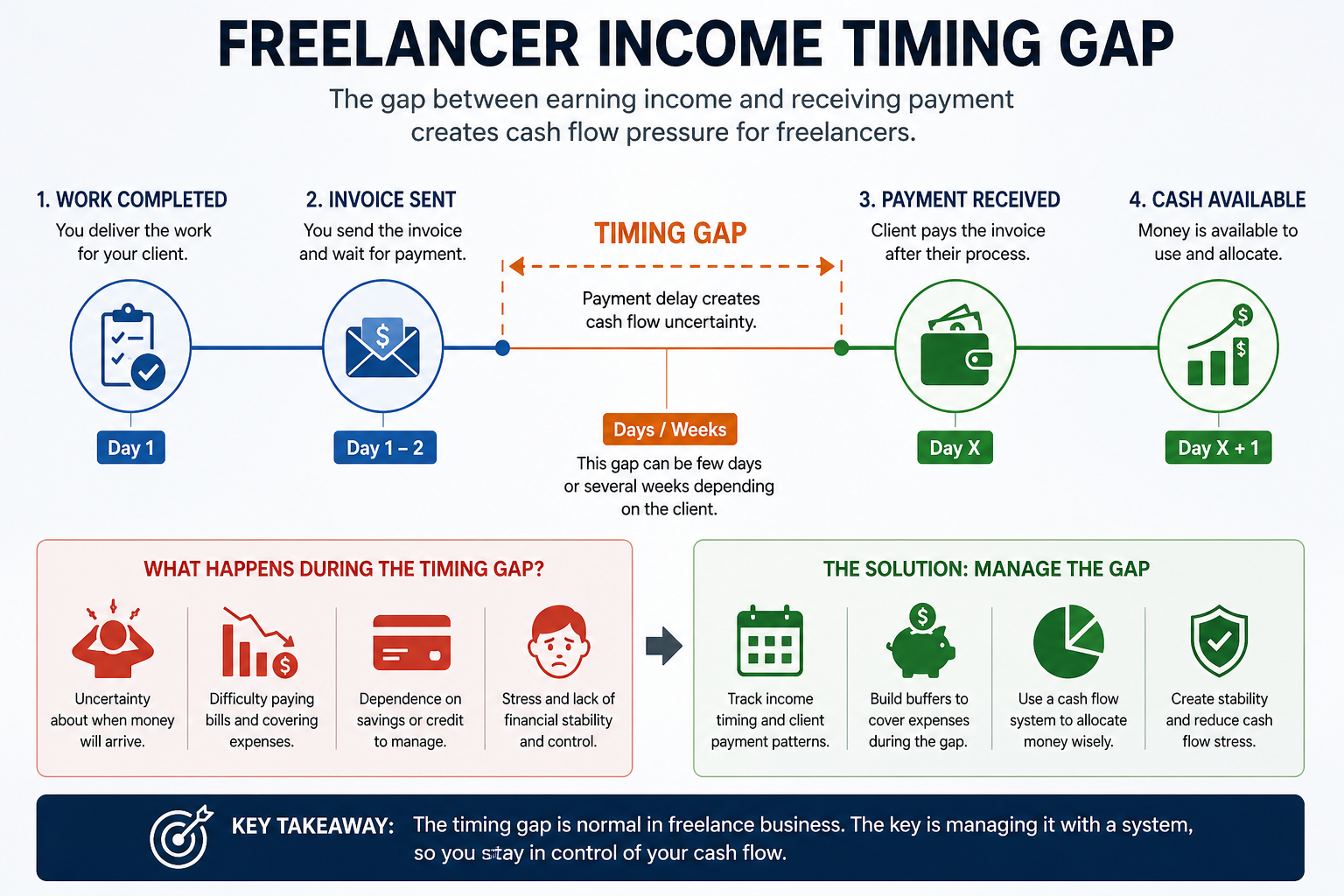
Income timing gap showing the delay between completed work and actual cash availability for freelancers
This delay is the core instability driver in freelance finances.
Without a system, freelancers treat earned income as available income, leading to premature spending and financial stress.
Payment Delay Management System
Payment delays are one of the most common causes of freelancer financial instability. Even reliable clients may introduce delays due to internal processes.
The system must treat delays as expected rather than exceptional.
This involves:
- Building delay buffers into cashflow forecasts
- Avoiding reliance on exact payment dates
- Maintaining liquidity to absorb extended delays
By assuming variability in payment timing, freelancers reduce dependency on precise timelines and increase financial resilience.
Cashflow Visibility in Freelancer Cash Flow Management
Financial stability improves when future income timing is visible and predictable.
Tracking past income does not improve stability. Visibility into when money will arrive allows structured decision-making.
This system shifts focus from retrospective tracking to forward-looking control.
Cashflow Visibility System
Cashflow visibility is the foundation of financial control. Without visibility, freelancers cannot accurately determine when income becomes available or how long current funds will last.
This system tracks not only past transactions but future payment timelines.
It includes:
- Outstanding invoices and expected payment dates
- Confirmed incoming payments
- Available liquidity across accounts
- Upcoming financial obligations
Visibility transforms uncertainty into measurable timelines. Instead of guessing when money will arrive, freelancers operate with a clear view of future cash availability.
This allows decisions to be based on reality rather than assumptions.
Spending Guardrails in Freelancer Cash Flow Management
Spending guardrails are the behavioral control layer of the cashflow system. They ensure that financial decisions are based on available cash rather than expected income.
Freelancers often overspend during high-income periods, assuming future payments will arrive as expected. When delays occur, this leads to financial stress.
Guardrails prevent this by enforcing strict separation between earned income and usable cash.
Key Guardrail Principles:
- Only spend from confirmed available cash
- Do not allocate income that has not been received
- Separate income spikes from spending decisions
- Maintain consistency in financial behavior regardless of income variability
These rules stabilize financial behavior even when income remains unpredictable.
Behavioral Patterns Guardrails Prevent
Freelancers often experience behavioral shifts based on income spikes. Higher income periods create a perception of financial security, leading to increased spending.
When income normalizes or delays occur, these spending decisions become unsustainable.
Guardrails prevent this by stabilizing behavior regardless of income fluctuations.
Cashflow Control Systems for Freelancer Cash Flow Management
Control systems enforce the structure of the cashflow system. While guardrails define rules, control systems ensure those rules are followed.
Without enforcement, financial systems degrade into inconsistent behavior.
Control System Functions:
- Regulate how income enters the system
- Control how funds are allocated
- Prevent premature withdrawals or spending
- Maintain separation between operational and reserved funds
Control systems convert financial discipline into a structured process rather than relying on willpower.
This is the difference between managing money occasionally and operating within a financial system consistently.
How Control Systems Are Implemented
Control systems are implemented through structured financial separation and rule-based allocation.
- Separate accounts for operational spending and reserves
- Defined allocation rules for incoming payments
- Restricted access to buffer funds
This creates a controlled financial environment where money flows through predefined paths rather than being accessed freely.
As a result, financial decisions become consistent and predictable.
What Happens Without Control Systems
When control systems are absent, financial behavior becomes inconsistent even if the freelancer understands what should be done.
In high-income periods, access to funds increases spending flexibility. Without structural restrictions, this leads to discretionary decisions that are not aligned with future cash availability.
In low-income or delayed periods, the lack of control creates immediate constraints, forcing reactive adjustments.
This inconsistency is not a knowledge problem—it is an enforcement problem.
Control systems remove the need for constant decision-making by pre-defining how money flows through the system.
Instead of deciding how to use money each time income is received, the system automatically allocates funds according to predefined rules.
This converts financial management from a series of decisions into a controlled process.
Cashflow Buffer System
Buffers absorb timing gaps between income and expenses. They act as a financial shock absorber that allows freelancers to operate smoothly despite delayed payments.
Without buffers, every delay creates immediate financial stress. With buffers, delays are absorbed without disrupting financial stability.
Buffers are not savings. They are operational liquidity reserves designed specifically for timing control.
Explore buffer system in detail:
Revenue Gap Planning System
Revenue gaps are periods where income is delayed or reduced. These gaps are not exceptions—they are a normal part of freelance income cycles.
The system must account for these gaps in advance.
Revenue gap planning involves:
- Identifying periods of low or delayed income
- Estimating duration of gaps
- Ensuring sufficient liquidity to cover expenses
Without planning, gaps create financial stress. With planning, gaps become predictable and manageable.
This shifts freelancers from reactive survival to proactive control.
Financial Decision Logic
Without a system, financial decisions are reactive and based on assumptions.
- Spending is based on expected income
- Timing is ignored
- Financial stress increases
With a system, decisions are structured and based on actual liquidity.
- Spending aligns with available cash
- Future income is forecasted, not assumed
- Financial behavior remains consistent
The system transforms decisions from reactive → structured → predictable.
Why This Is Not About Discipline
Freelancers often believe financial stability requires stronger discipline or stricter budgeting.
This assumption is incorrect.
Financial instability is not caused by lack of discipline. It is caused by structural misalignment between income timing and financial decisions.
When the system is correct, stability emerges naturally. When the system is absent, even disciplined individuals experience instability.
Next Layer of the System
Once cashflow stability is achieved, the next system focuses on managing income variability and financial planning.
Scenario: Applying the Cashflow System in Real Conditions
Consider a freelancer earning $5,000 in one month and $1,500 the next.
Without a system, spending decisions are based on the higher income period. The freelancer increases expenses, commits to recurring costs, and assumes future income will remain stable.
When the next month produces lower income or delayed payments, financial stress emerges immediately.
This creates a cycle:
- Income spike → increased spending
- Payment delay → financial stress
- Income recovery → temporary relief
- Cycle repeats
With a cashflow system:
- Income is treated based on timing, not amount
- Spending is aligned with available liquidity
- Buffers absorb timing gaps
- Guardrails prevent overextension
The result is not higher income—but consistent financial stability.
Before vs After System Implementation
Before:
- Spending increases during high-income periods
- No visibility into payment delays
- Financial stress occurs unpredictably
After:
- Spending aligns with available cash
- Future income is visible and planned
- Financial stability remains consistent
How to Implement Freelancer Cash Flow Management System
Implementing a cashflow system requires structuring financial behavior around timing, visibility, and control.
Step 1: Track Income Timing
Identify when income is earned versus when it is received. Build visibility into payment delays and client cycles.
Step 2: Forecast Payment Flow
Estimate when invoices will be paid. Create a forward-looking view of expected cash availability.
Step 3: Separate Available vs Expected Cash
Only treat received income as usable. Do not allocate future payments to current spending.
Step 4: Apply Guardrails
Limit spending to available liquidity. Prevent behavior driven by income spikes.
Step 5: Build Buffer System
Maintain reserves to absorb timing gaps and delayed payments.
Step 6: Enforce Control Systems
Structure financial accounts and processes to ensure consistent behavior regardless of income variability.
This process converts irregular income into a stable financial system.
Common Implementation Challenges
Freelancers often struggle during the transition phase when shifting from reactive financial behavior to system-based control.
- Difficulty separating expected vs available income
- Resistance to limiting spending during high-income periods
- Inconsistent tracking during early stages
These challenges are temporary and decrease as the system becomes operational.
The Transition Phase (Critical Stage)
Implementing a cashflow system does not create immediate stability. There is a transition phase where existing financial patterns conflict with the new system.
During this phase:
- Previous spending habits may not align with available liquidity
- Buffers may not yet be fully built
- Cashflow visibility may still be incomplete
This stage often creates temporary discomfort, as freelancers must adjust behavior while the system is still forming.
Stability begins to emerge only after:
- Income timing is consistently tracked
- Buffers are established
- Control systems are enforced
Once these elements are in place, financial behavior becomes stable regardless of income variability.
Freelancer Cash Flow Management Failures and Mistakes
Freelancers typically experience financial instability not because of income limitations, but because of system failure.
Common Failure Patterns:
- Treating earned income as available income
- Spending based on future expectations
- Ignoring payment delays
- Lack of visibility into cashflow timing
- Operating without buffers
- Relying on discipline instead of system structure
These failures create recurring instability cycles even when income is sufficient.
The cashflow system prevents these failures by aligning financial decisions with actual liquidity and enforcing structural control.
How the System Prevents Financial Instability
The system eliminates instability by removing reliance on assumptions and replacing it with structured control.
- Forecasting replaces uncertainty
- Guardrails prevent overspending
- Buffers absorb delays
- Control systems enforce consistency
Instead of reacting to financial problems, the system prevents them from occurring.
How Freelancer Cash Flow Management Connects with Income Systems
The cashflow system does not operate in isolation. It integrates directly with income generation systems.
Income systems determine how money is earned. Cashflow systems determine how that money is used.
Without integration:
- Income growth increases instability
- Higher earnings lead to higher financial risk
With integration:
- Income variability is controlled
- Financial decisions remain stable regardless of income level
Impact of Income Growth Without Cashflow Control
Increasing income without a cashflow system often increases financial instability rather than reducing it.
Higher income leads to higher expenses, which increases dependency on consistent earnings. When variability occurs, financial pressure increases.
The cashflow system ensures that income growth translates into stability rather than risk.
Why Financial Systems Fail Without Cashflow Foundation
Most financial strategies assume stable cash availability. Budgeting, investing, and growth strategies rely on predictable income timing.
Without a cashflow system:
- Budgets become inaccurate
- Investments are mistimed
- Growth decisions increase financial risk
This creates a paradox where higher income does not improve financial stability.
The cashflow system resolves this by acting as the foundational layer that supports all other financial systems.
Once timing is controlled, other systems can function effectively. Without it, every system operates on unstable assumptions.
Why Budgeting Fails Without Cashflow Systems
Budgeting assumes stable and predictable income. It allocates money based on expected earnings and fixed expense categories.
In freelance environments, this assumption breaks down.
Income variability makes budgeting unreliable because allocation decisions are made without certainty of income timing.
This leads to:
- Overspending during high-income periods
- Underfunding during delayed payment cycles
- Frequent adjustments and instability
The cashflow system resolves this by controlling timing first, allowing budgeting to operate on stable financial conditions.
Budgeting becomes effective only after cashflow is stabilized.
Integration with Debt and Financial Obligations
Debt and fixed obligations amplify the impact of income timing.
Without a cashflow system:
- Payments are missed due to timing gaps
- Financial pressure increases
- Debt cycles worsen
With a system:
- Payments are aligned with liquidity
- Financial obligations are managed proactively
- Debt risk is reduced
This integration ensures that fixed commitments do not destabilize financial systems.
How the Cashflow System Evolves
The cashflow system evolves as financial complexity increases.
- Early stage → basic tracking and visibility
- Intermediate stage → forecasting and smoothing
- Advanced stage → full control systems and optimization
The structure remains the same, but depth and precision increase over time.
This ensures that the system continues to function as income scales.
Execution Layer (From System to Action)
The system defines structure. Execution applies it.
Implementation requires tools and workflows that operationalize forecasting, tracking, and control.
- Invoice tracking tools
- Cashflow planning templates
- Forecasting tools
- Expense tracking systems
When to Use This System
- Income timing is unpredictable
- Payments are delayed
- Financial stress exists despite sufficient income
Move forward when:
- cashflow visibility is achieved
- buffers are established
- financial decisions are stable
Next Step
Take Action
Apply this system to stabilize income timing and build long-term financial control.
FAQs
What is freelancer cash flow management?
A system that controls income timing, spending, and financial stability under irregular income conditions.
Why do freelancers struggle with cashflow?
Because income is delayed while expenses remain fixed.
Can budgeting fix cashflow problems?
No. Budgeting manages allocation, but cashflow systems manage timing.