The Hidden Costs of Leverage in an Otherwise Stable System
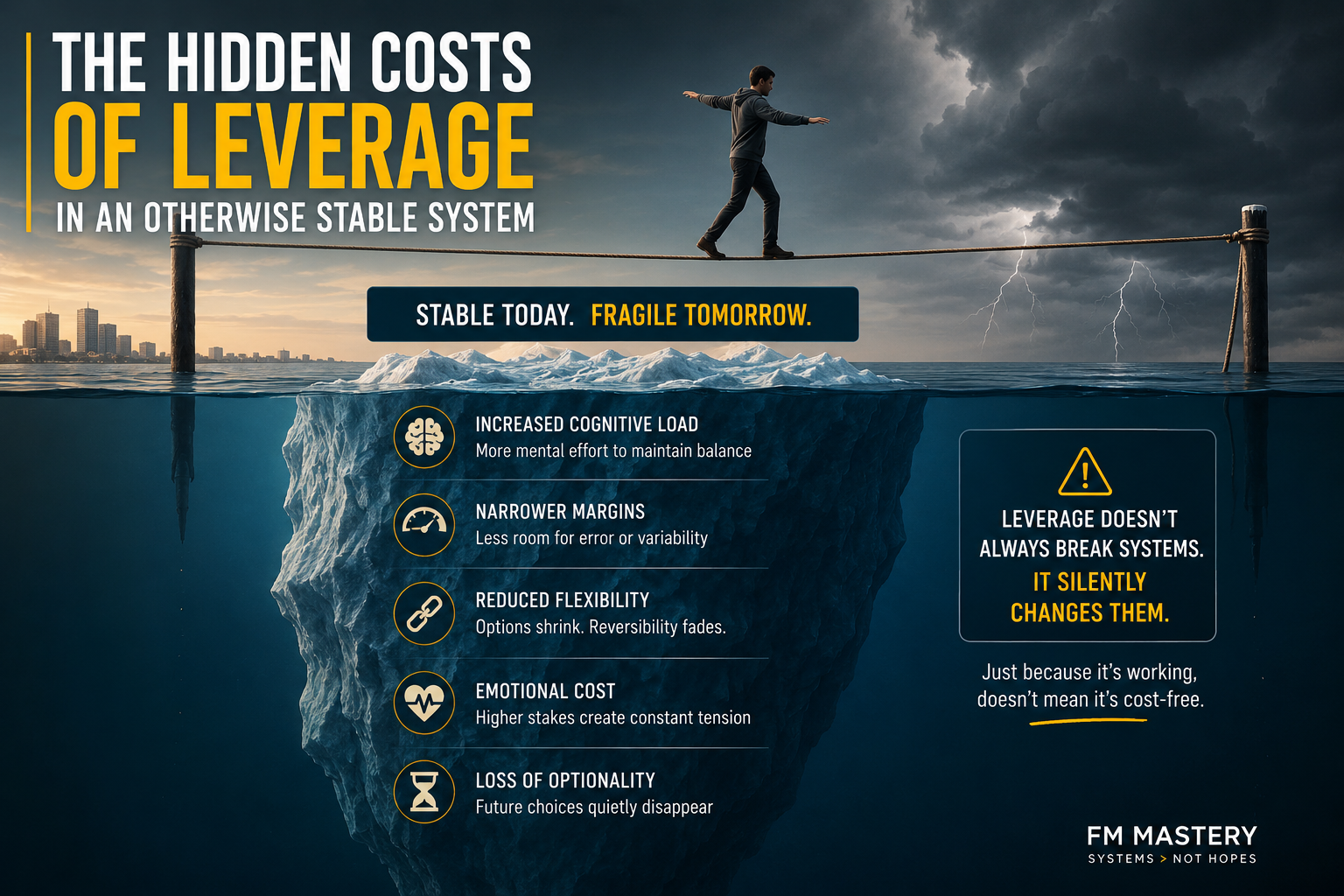
The hidden costs of leverage rarely appear during moments of crisis first. They usually emerge quietly inside systems that still look stable from the outside.
Income may still arrive consistently.
Clients may still remain active.
Operations may still appear under control.
Yet beneath that stability, leverage often changes the structure supporting the system itself.
Margins narrow.
Tolerance declines.
Flexibility erodes.
Recovery becomes harder.
Within FM Mastery, leverage is not evaluated only by whether a freelancer can maintain payments or continue operating. It is evaluated by whether the system remains survivable when variability inevitably returns.
This sub-cluster explains how leverage quietly transforms stable freelancer systems into more conditional systems long before visible instability appears.
The hidden costs of leverage include reduced flexibility, compressed survivability margins, higher psychological vigilance, lower reversibility, and increased dependence on uninterrupted stability. These effects often appear long before visible financial problems emerge.
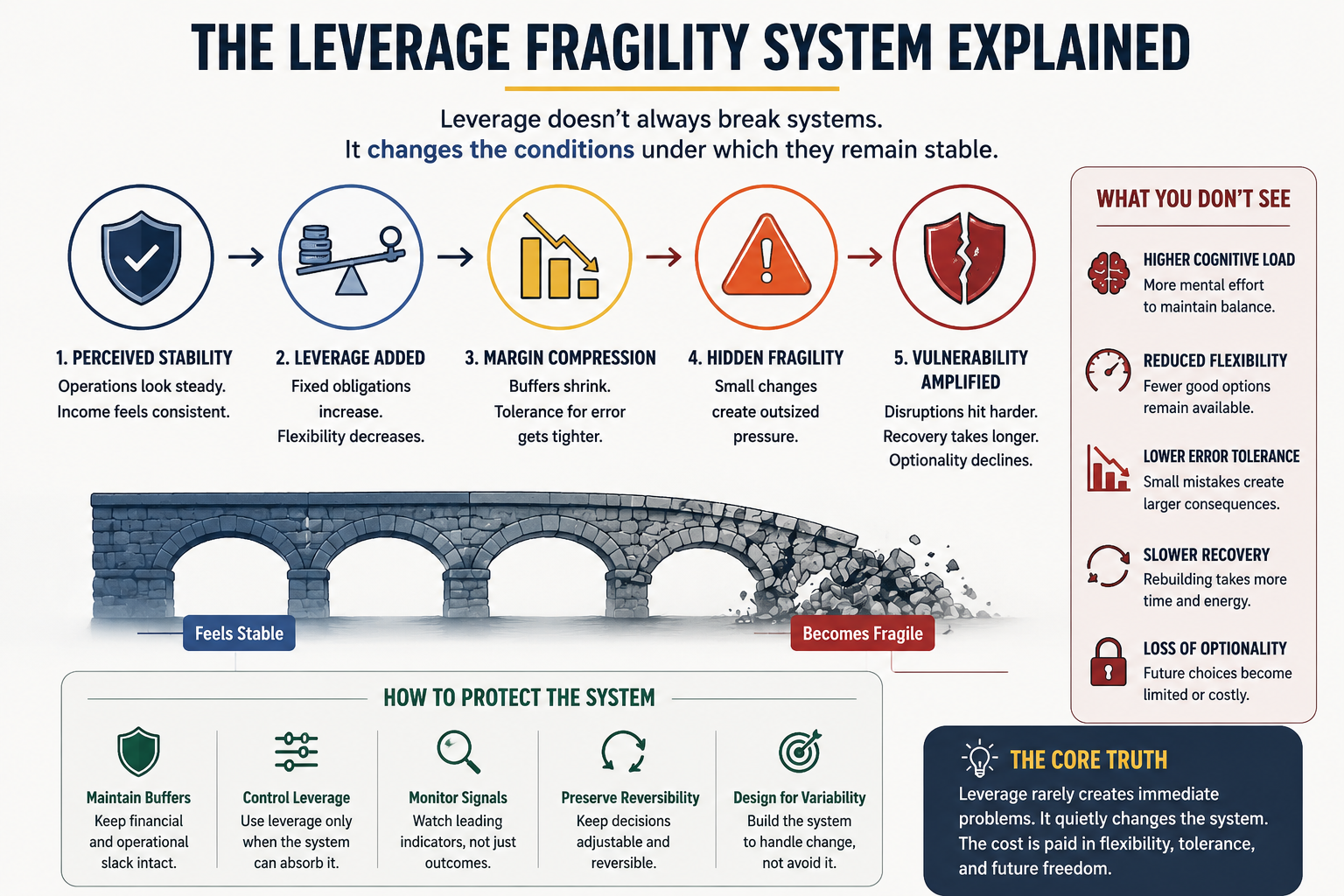
Stable Operations → Added Financial Pressure → Reduced Operational Slack → Narrower Error Tolerance → Conditional Stability → Fragility During Variability
Why Stable Freelancer Systems Often Misjudge Leverage Risk
Freelancers usually become more open to leverage after experiencing periods of operational calm.
Income stabilizes temporarily.
Client work becomes more predictable.
Cash flow interruptions appear manageable.
Financial pressure feels easier to absorb.
This creates a subtle but important psychological shift.
Stability starts being interpreted as proof that the system itself is strong enough to carry additional pressure.
Within FM Mastery, that assumption is treated carefully because stability and resilience are not identical conditions.
A system can continue operating normally while simultaneously becoming less adaptable, less reversible, and less tolerant of disruption.
That distinction matters deeply for freelancers operating under irregular income conditions.
Unlike fixed-salary systems, freelancer systems depend heavily on flexibility, recovery capacity, and margin preservation. Once leverage compresses those stabilizers, the system may continue functioning while becoming increasingly dependent on uninterrupted continuity.
This is where hidden fragility begins.
This approach is part of the broader AI-Powered Money Management system designed to help freelancers manage financial decisions under income uncertainty.
The Real Hidden Cost of Leverage Is Survivability Compression
Most financial discussions evaluate leverage through direct affordability.
Questions usually focus on:
- monthly repayment ability
- interest cost
- cash flow coverage
- income growth projections
These measurements are incomplete because they focus only on visible financial mechanics.
The deeper structural issue is survivability compression.
Leverage reduces the amount of disruption a system can safely absorb before stability begins deteriorating.
That compression often remains invisible because the system may continue performing normally during early stages.
Freelancers may still:
- maintain steady output
- retain clients
- generate income consistently
- meet obligations on time
Yet internally, the operating environment changes.
Recovery windows become narrower.
Operational slack declines.
Flexibility reduces.
Decision pressure rises.
The system slowly shifts from:
stable with resilience
to:
stable through continuous precision
That transition defines leverage fragility.
The Leverage Fragility System Explained
Within FM Mastery, leverage fragility describes the process where stable freelancer systems become increasingly dependent on uninterrupted continuity.
Performance may remain intact for long periods. However, the conditions required to maintain that performance quietly become more demanding.
This usually develops through five structural shifts.
1. Variability Becomes More Expensive
Before leverage, moderate instability may be uncomfortable but manageable.
After leverage, the same instability carries larger operational consequences because obligations continue regardless of changing conditions.
Small disruptions begin consuming more emotional, financial, and operational energy than before.
2. Operational Slack Quietly Disappears
Freelancer systems rely heavily on slack.
Slack includes:
- recovery time
- cash reserves
- optional downtime
- decision flexibility
- buffer capacity
Leverage compresses these stabilizers gradually.
The system still works, but the room for error narrows considerably.
3. Psychological Vigilance Increases
Leverage does not always create visible stress immediately.
More often, it creates constant attentional monitoring.
Freelancers begin tracking continuity more aggressively because interruption now carries greater consequence.
This cognitive vigilance consumes mental bandwidth even during stable periods.
4. Reversibility Declines
Healthy systems preserve the ability to adapt safely.
Leverage reduces that freedom.
Certain decisions become harder to reverse because fixed obligations continue regardless of changing income conditions.
The system slowly loses optionality while outward performance remains unchanged.
5. Stability Becomes Conditional
Eventually, the system no longer remains stable because it is resilient.
It remains stable because current conditions continue cooperating.
That distinction is critical.
Dependence quietly replaces resilience.
Why the Hidden Costs of Leverage Often Go Unnoticed
Most systems evaluate stability visually.
If income continues arriving and obligations remain manageable, leverage appears harmless.
This creates a dangerous interpretive error.
Visible continuity gets mistaken for structural health.
FM Mastery separates those conditions deliberately.
A freelancer can maintain strong performance while operating inside increasingly compressed survivability margins.
The hidden costs of leverage usually remain invisible because they develop gradually through:
- higher dependence on continuity
- reduced recovery tolerance
- narrower operational flexibility
- persistent vigilance
- greater disruption sensitivity
None of these necessarily produce immediate financial crisis.
Instead, they quietly alter what the system requires in order to remain stable.
This is why freelancer leverage often feels safe until variability unexpectedly returns.
How Leverage Quietly Changes Freelancer Decision-Making
The effects of leverage usually appear operationally before they appear financially.
Freelancers often begin noticing subtle behavioral changes:
- difficulty tolerating delayed payments
- greater hesitation to pause work
- reduced willingness to reject clients
- avoidance of operational downtime
- constant continuity monitoring
- higher emotional sensitivity to instability
These changes matter because they reveal that leverage reshapes system behavior long before visible breakdown appears.
The process usually unfolds gradually.
Stage 1 — Stability Encourages Expansion
Consistent operations create confidence and reduce perceived risk.
Stage 2 — Financial Pressure Increases
Fixed obligations expand through:
- higher recurring expenses
- business overhead
- debt commitments
- growth-dependent systems
Stage 3 — Margin Compression Begins
The system still functions normally, but tolerance for disruption narrows.
Stage 4 — Vigilance Replaces Neutrality
Operational calm now depends on uninterrupted continuity.
Stage 5 — Fragility Appears During Variance
The system may appear stable for long periods until normal volatility exposes the compression already present underneath.
Stable Systems and Resilient Systems Are Not the Same
Within FM Mastery, stability is not measured only by calm periods.
True resilience includes:
- recovery capacity
- psychological neutrality
- operational flexibility
- reversible decision-making
- survivability during disruption
Leverage can preserve visible stability while weakening all five simultaneously.
This creates one of the most dangerous financial illusions freelancers encounter:
the illusion that uninterrupted continuity equals structural strength.
In reality, many fragile systems appear stable precisely because instability has not arrived yet.
This connects directly to the broader Managing Irregular Income cluster where FM Mastery examines how volatility reshapes freelancer financial systems over time.
Early Signs That Leverage Is Quietly Reshaping the System
Freelancer systems usually show structural pressure before financial collapse appears.
Common warning signals include:
- reduced tolerance for delayed income
- constant continuity monitoring
- difficulty pausing or recovering
- higher emotional reaction to disruption
- reduced experimentation tolerance
- dependence on uninterrupted client flow
- declining operational flexibility
These signals do not automatically indicate failure.
They indicate that the system now depends more heavily on precision than resilience.
That dependence becomes dangerous when irregular income variability inevitably returns.
Additional Structural References
For broader context on financial fragility and resilience systems:
Where This Fits Inside the Instability Authority System
This sub-cluster strengthens the instability architecture inside the Managing Irregular Income authority system.
It expands earlier instability layers including:
- financial drift
- timing risk
- false predictability
- psychological vigilance
- variability versus risk
The next progression layer naturally becomes:
Why Scaling Without Volatility Is Structurally Rare.
That expansion shifts the discussion from survivability compression toward scaling complexity, operational amplification, and structural asymmetry.
Frequently Asked Questions
What are the hidden costs of leverage?
The hidden costs of leverage include reduced flexibility, compressed recovery margins, higher psychological vigilance, increased dependence on continuity, and lower survivability during disruption.
Why does leverage feel safe before instability appears?
Leverage often feels safe during stable periods because systems continue functioning normally. Stability suppresses awareness of hidden fragility until variability returns.
Can a freelancer system appear stable while becoming fragile?
Yes. A freelancer system can maintain income and operations while simultaneously losing flexibility, reversibility, and disruption tolerance underneath.
Why is reversibility important for freelancers?
Reversibility allows freelancers to adapt safely when income conditions change. Systems with low reversibility become more dependent on uninterrupted performance.
The Hidden Cost Is Dependence on Perfect Continuity
The hidden costs of leverage are rarely limited to financial expense.
More often, they appear through:
- narrower survivability margins
- higher sensitivity to disruption
- compressed recovery capacity
- persistent vigilance
- reduced operational freedom
These pressures can remain invisible for long periods because systems often continue functioning while carrying them.
That is what makes leverage fragility difficult to detect.
Within FM Mastery, the deeper question is never simply:
“Can the system continue operating?”
The more important question becomes:
“How dependent has the system become on uninterrupted continuity?”
The more stability depends on precision alone, the more fragile the system quietly becomes.
Continue Exploring Financial Instability Systems
This sub-cluster is part of the Managing Irregular Income authority system within the AI-Powered Money Management pillar.
Next recommended progression:
Why Scaling Without Volatility Is Structurally Rare
The objective is not avoiding growth.
The objective is preserving survivability while volatility remains unavoidable.
Leverage rarely changes systems all at once.
More often, it quietly changes the conditions required to keep those systems stable.
Flexibility narrows.
Tolerance compresses.
Continuity becomes more important.
A freelancer system may still appear calm externally while becoming increasingly conditional internally.
Within FM Mastery, understanding that distinction is not pessimism.
It is structural awareness.