
Psychology-Based Budgeting for Freelancers (Behavior-First Component)
Psychology-based budgeting for freelancers is a behavioral component that aligns financial decisions with emotional patterns, cognitive limits, and irregular income conditions instead of fixed budgeting rules.
Psychology-based budgeting for freelancers is built on five behavior Rules that stabilize financial decisions under income volatility, emotional pressure, and cognitive load.
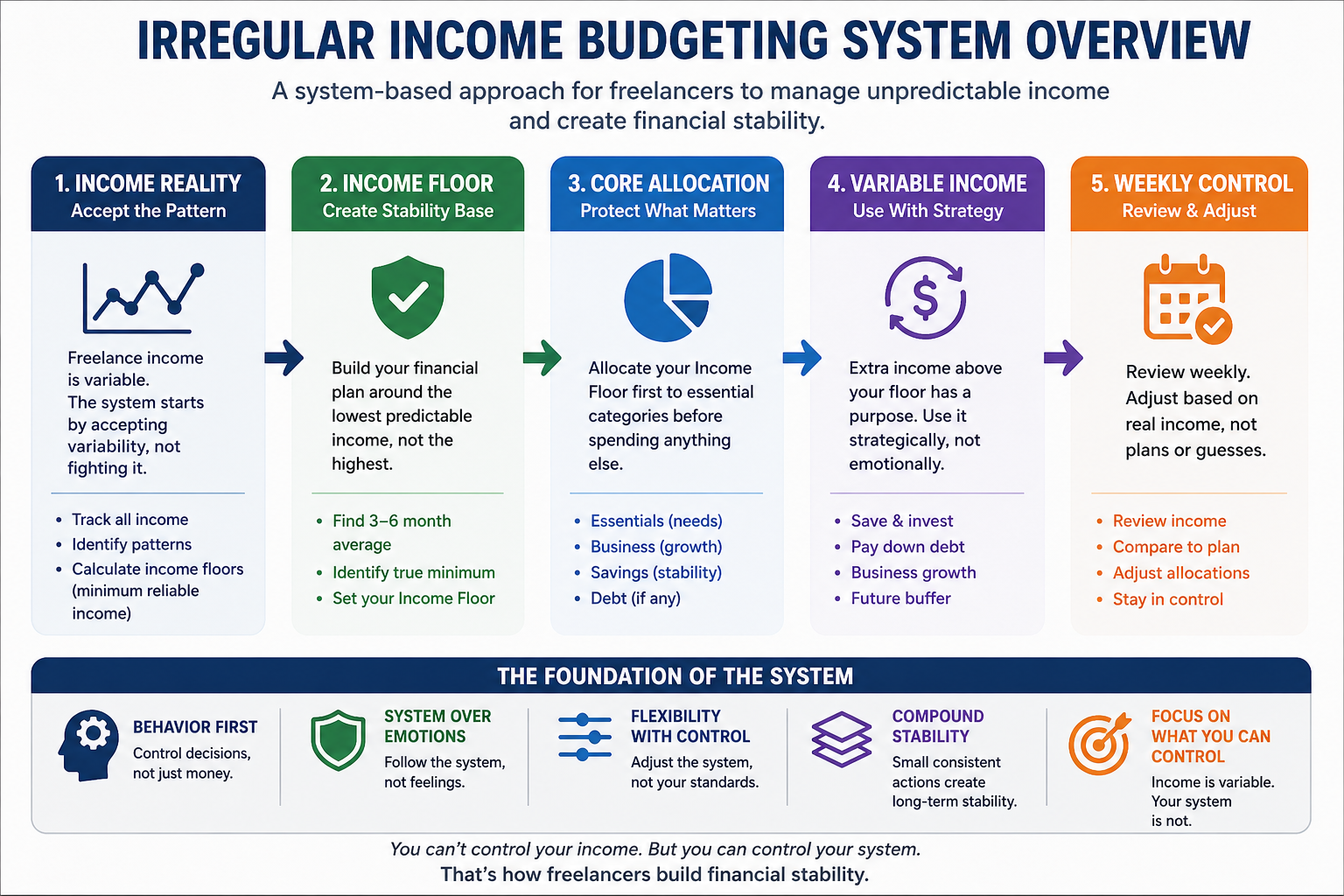
Psychology-based budgeting for freelancers aligns financial behavior with income volatility, emotional patterns, and structured decision-making instead of rigid monthly rules.
Psychology-based budgeting for freelancers works by aligning spending behavior with emotional triggers and income variability, reducing instability caused by rigid budgeting systems.
Freelancers don’t struggle because they lack discipline.
They struggle because budgeting ignores how decisions are made under uncertainty.
To apply psychology-based budgeting for freelancers, financial systems must adapt to behavior — not fight it.
What Is Psychology-Based Budgeting for Freelancers (5 Behavior Rules)
Psychology-based budgeting for freelancers focuses on how financial decisions are actually made in real-world conditions of uncertainty, income variability, and cognitive load.
Unlike traditional budgeting, which assumes consistent behavior, this component recognizes that freelancers operate under fluctuating emotional and financial states.
This makes it a behavioral control layer inside the budgeting system.
To understand psychology-based budgeting for freelancers, it is necessary to recognize that financial decisions are not purely logical. Under irregular income conditions, decisions are influenced by short-term emotions, perceived income security, and cognitive overload.
Freelancers do not experience money in fixed cycles. Instead, they experience income as unpredictable events. This creates decision environments where spending, saving, and allocation are continuously adjusted based on recent income patterns rather than long-term planning.
Psychology-based budgeting for freelancers addresses this gap by aligning budgeting structure with behavioral patterns instead of forcing behavior to match rigid systems.
This includes:
- recognizing emotional triggers such as stress, optimism, and uncertainty
- reducing decision fatigue by simplifying financial choices
- structuring spending behavior to prevent reactive decisions
In traditional budgeting, consistency is expected. In freelance reality, consistency is rare. This component bridges that gap by creating alignment between how freelancers think and how financial systems operate.
This is why psychology-based budgeting for freelancers is not an optional improvement. It is a required behavioral layer that allows any budgeting system to function under income volatility.
Role Within the Irregular Income Budgeting System
This component operates ONLY within the irregular income budgeting system for freelancers.
The system defines structure and allocation rules.
This component ensures those rules align with human behavior.
Without this component:
- systems fail under emotional pressure
- decisions become inconsistent
- financial discipline collapses
This is not a system. It is a behavioral layer within the system.
The irregular income budgeting system provides the structural framework for managing income timing, allocation, and decision control. However, structure alone is not sufficient when behavior does not align with that structure.
Psychology-based budgeting for freelancers ensures that system rules remain usable under real-world conditions. It translates rigid financial constraints into behavior-compatible actions.
This creates a critical dependency:
Without behavioral alignment → structure is ignored
Without structure → behavior becomes unstable
This component resolves that dependency by acting as a bridge between system rules and human execution.
For example:
- a system may define allocation limits
- this component ensures those limits are followed under emotional pressure
This is why psychology-based budgeting for freelancers must exist inside the system and cannot operate independently.
It does not define financial strategy.
It enables financial strategy to work.
This reinforces its role as a component — not a standalone solution.
The cluster system owns financial control.
This component ensures that control is actually applied in real-world conditions.
How Psychology-Based Budgeting Works
This component works by aligning behavior with structure.
Psychology-based budgeting for freelancers operates by recognizing that financial decisions are not made in isolation. They are influenced by recent income events, emotional states, and perceived financial security.
Instead of forcing discipline, this component creates structured environments where behavior naturally aligns with financial goals.
1. Emotional Pattern Recognition
Freelancers tend to overspend during high-income periods and restrict during low-income periods.
These patterns are not random. They are predictable behavioral responses to income volatility.
Psychology-based budgeting for freelancers identifies these cycles and incorporates them into financial structure rather than attempting to eliminate them.
2. Cognitive Load Reduction
Financial decisions are simplified to reduce overwhelm caused by irregular income.
Under uncertainty, decision fatigue increases. Complex budgeting systems require constant evaluation, which leads to avoidance or inconsistent execution.
This component reduces decision complexity by limiting choices and creating predefined behavioral pathways.
3. Behavioral Bucketing
Spending is grouped based on purpose (stability, growth, future) instead of rigid categories.
This aligns financial allocation with how freelancers think about money, making decisions more intuitive and consistent.
Behavioral buckets adapt to emotional and income conditions, ensuring flexibility without losing control.
4. Decision Stabilization
Rules guide decisions so they are not influenced by short-term emotional states.
Instead of reacting to income spikes or drops, decisions follow predefined constraints.
This creates consistency across different income conditions, preventing both overspending and excessive restriction.
Psychology-based budgeting for freelancers ensures that behavior remains stable even when income is not.

Financial decisions follow emotional cycles influenced by income peaks and valleys — psychology-based budgeting stabilizes these behavioral patterns.
Real Application
A freelancer experiencing income spikes tends to increase spending immediately.
This behavior is driven by perceived financial security rather than actual long-term stability.
Using psychology-based budgeting for freelancers:
- spending is pre-structured before income arrives
- decisions follow behavioral rules instead of emotional reactions
- financial behavior remains consistent across income changes
For example:
A freelancer receiving a large payment does not increase discretionary spending immediately. Instead, funds are allocated through behavioral buckets that maintain stability.
This prevents the common cycle of expansion followed by restriction.
The result is controlled financial behavior without requiring increased discipline or constant monitoring.
Limitations
- does not control income timing
- does not replace budgeting system
- requires system structure to function
This component depends entirely on the main budgeting system.
Psychology-based budgeting for freelancers cannot create financial stability on its own.
It does not manage cash flow, income smoothing, or allocation timing.
Without structural support from the budgeting system, behavioral alignment has no framework to operate within.
This reinforces its role as a dependent component rather than a standalone solution.
Common Errors
- treating budgeting as discipline problem
- ignoring emotional spending patterns
- using rigid budgeting methods
These errors prevent psychology-based budgeting from working effectively.
One of the most common mistakes freelancers make is assuming that financial inconsistency is caused by lack of discipline.
In reality, inconsistency is often the result of systems that do not align with behavioral patterns.
Another major error is applying traditional budgeting rules that require stable income and consistent decision-making.
When these systems fail, freelancers abandon them entirely instead of addressing the underlying behavioral mismatch.
Psychology-based budgeting for freelancers only works when behavior is treated as a system input — not a problem to be eliminated.
System Connection
Psychology-Based Budgeting → Irregular Income Budgeting System → Financial Stability
This connection highlights the dependency between behavior and structure.
The irregular income budgeting system provides control over income timing, allocation, and financial decisions.
Psychology-based budgeting ensures that these controls are actually followed in real-world conditions.
Without this component, system rules remain theoretical and are often ignored during emotional or high-pressure situations.
With this component, financial behavior becomes consistent, making the system effective across all income conditions.
Return to Budgeting System
This component does not provide full financial control.
To understand how budgeting works with income timing, allocation, and decision flow:
👉 Return to the full budgeting system
Psychology-based budgeting for freelancers is only one layer within a larger financial structure.
While this component stabilizes behavior, it does not define how income is distributed, when funds are allocated, or how financial decisions are sequenced over time.
Those functions are controlled by the full budgeting system.
This creates a clear dependency:
- this component aligns behavior
- the system controls financial structure
Without returning to the full system, this component remains incomplete and cannot deliver long-term financial stability.
You should return to the system when:
- income timing creates decision pressure
- financial structure feels unclear
- allocation decisions become inconsistent
The system provides the rules.
This component ensures those rules are followed.
Related Component
Why Irregular Income Feels Unstable
Understanding why irregular income feels unstable helps explain why behavior becomes inconsistent under uncertainty.
This related component focuses on the structural and psychological causes of instability, while psychology-based budgeting for freelancers focuses on controlling behavior within that environment.
Together, these components provide a clearer understanding of both cause and response.
Execution Note
Tools like budgeting apps can support tracking, but behavior alignment must come first.
For research: CFPB Financial Behavior Research
Psychology-based budgeting for freelancers is not tool-dependent.
Digital tools can assist with tracking spending patterns or automating actions, but they cannot correct behavioral misalignment.
Without behavioral structure, tools only reflect inconsistent decisions rather than improve them.
Effective execution requires:
- clear behavioral rules
- simplified decision pathways
- consistent application under different income conditions
Tools support execution, but they do not replace the component itself.
This page explains one component: psychology-based budgeting for freelancers.
It does not explain the full budgeting system.
Its purpose is to isolate and explain the behavioral layer that influences financial decisions under irregular income conditions.
For full financial control, this component must be combined with system-level structures such as income timing management and allocation frameworks.
Psychology-based budgeting stabilizes financial behavior under income volatility.
It only works within a structured budgeting system.
When combined with the full system, this component ensures that financial decisions remain consistent, predictable, and aligned with long-term stability.
Without this component, even well-designed financial systems fail due to behavioral inconsistency.
With it, freelancers can maintain control regardless of income fluctuations.
FAQ
What is psychology-based budgeting for freelancers?
It is a behavioral budgeting approach that aligns financial decisions with emotional patterns and income variability.
Does it replace budgeting systems?
No. It is a component within a larger budgeting system.
Why is behavior important in budgeting?
Because financial decisions are influenced by emotions, especially under irregular income conditions.
When should freelancers use psychology-based budgeting?
Freelancers should apply this component when income variability leads to inconsistent spending, emotional decision-making, or difficulty maintaining financial structure.
Can this component improve financial stability?
It improves behavioral consistency, which supports financial stability when combined with a structured budgeting system.