
Freelancer Cashflow Management Explained (Income Timing Guide)
Freelancers and independent professionals often experience financial pressure even when their total income is healthy. The underlying issue is rarely income level. Instead, financial stress usually emerges from the timing of income. Client payments may arrive weeks after projects are completed, invoices may remain unpaid for extended periods, and revenue may fluctuate across project cycles.
Key Concepts in Freelancer Cashflow Management
- Income Timing — understanding when client payments actually arrive rather than when work is completed.
- Cashflow Visibility — tracking invoices, payment schedules, and financial obligations to maintain financial clarity.
- Financial Liquidity — maintaining sufficient cash reserves to handle expenses between client payments.
While expenses such as rent, software subscriptions, taxes, and business costs occur consistently, freelance income rarely follows predictable schedules. This mismatch between income timing and financial obligations creates the core challenge of independent work: cashflow instability.
This guide focuses on explaining how freelancers can understand income timing, improve financial visibility, and maintain liquidity across uneven payment cycles.
For a structured system that actively controls and stabilizes freelance cashflow, refer to the Freelancer Cashflow System.
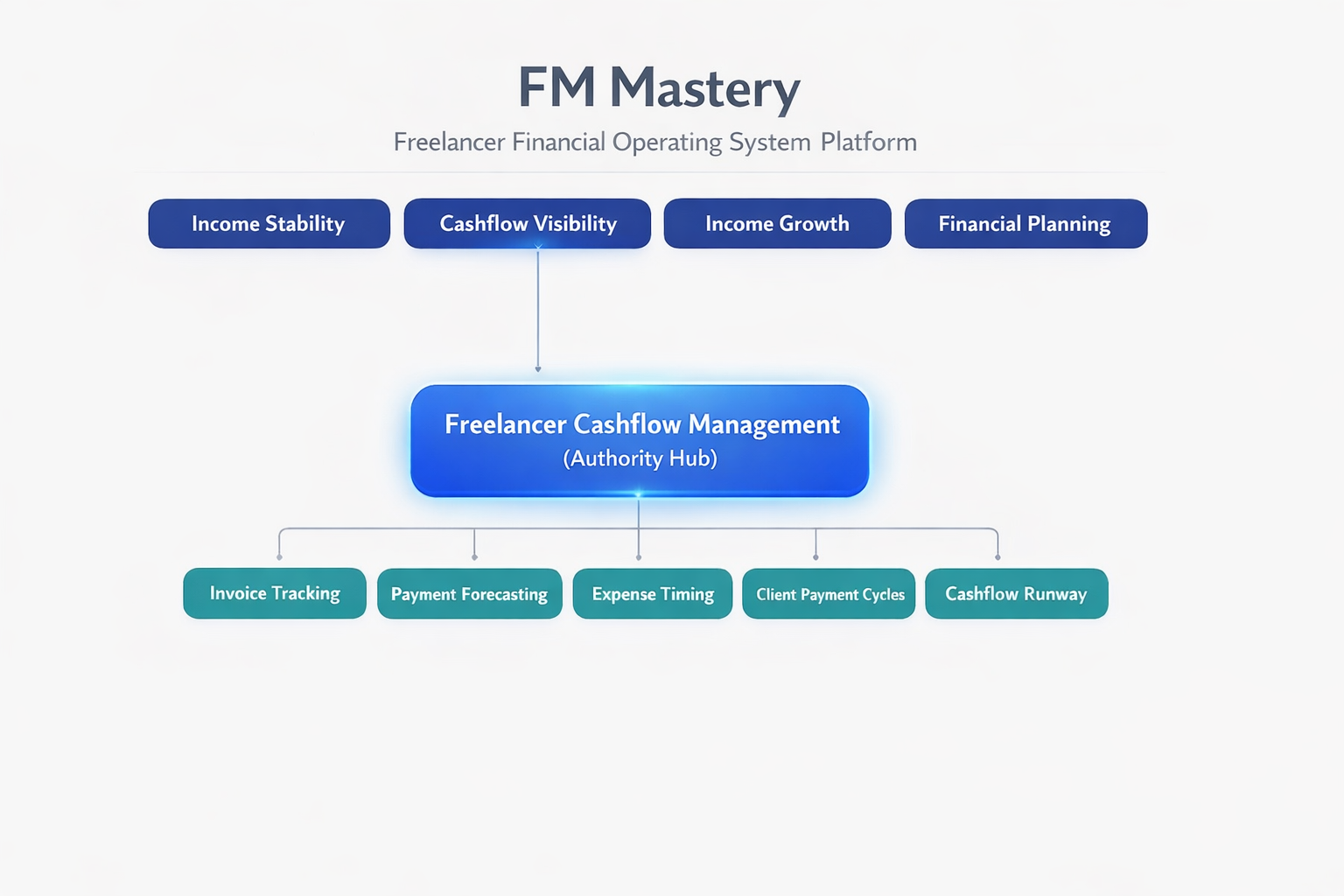
Where Cashflow Management Fits in the Financial System
Freelancer cashflow management operates as a foundational layer within the AI-Powered Money Management pillar of FM Mastery. It focuses on understanding how income timing behaves before control systems are applied.
While this guide explains the mechanics of income timing and liquidity, system-level control is implemented through structured frameworks such as the Freelancer Cashflow System, which integrates forecasting, buffer management, and spending guardrails.
Understanding cashflow behavior is the first step. Control systems are the next layer.
What This Guide Covers
- Why freelancers experience cashflow problems despite earning strong income
- The difference between revenue and available cash
- How income timing affects financial stability
- How freelancers forecast payment timing
- Methods to improve financial visibility and liquidity
Table of Contents
- Understanding Freelancer Cashflow Management
- Why Freelancers Experience Cashflow Problems
- Why Traditional Cashflow Methods Fail
- The Cashflow Visibility Principle
- How Cashflow Systems Work
- Cashflow Decision Flow
- Stages of Cashflow Stability
- Key Cashflow Topics for Freelancers
- Tools for Managing Cashflow
- Common Cashflow Mistakes
- Cashflow Stability Checklist
- Next Steps
How Freelancer Cashflow Actually Works
Freelancer cashflow does not operate as a single event. It functions as a sequence of stages that connect work completion to usable income. Understanding this structure is critical because financial instability often originates from how these stages interact rather than how much income is generated.
Freelancer Cashflow Flow Structure
Work Completed → value is created
Invoice Issued → payment request initiated
Client Processing → internal approval cycles
Payment Authorized → release initiated
Funds Settled → usable cash available
Each stage introduces potential delays. While the total income may remain consistent, the timing of these stages determines when money becomes usable. This is why freelancers often experience financial pressure even when their overall earnings are stable.
Cashflow management focuses on understanding and tracking this flow, allowing freelancers to anticipate delays, plan expenses, and maintain financial stability across uneven income cycles.
Understanding Freelancer Cashflow Management
Freelancer cashflow management refers to the structured approach used to understand when income becomes available, rather than simply how much income is earned. It focuses on tracking payment timing, forecasting expected inflows, and maintaining sufficient liquidity between projects.
In freelance work, revenue and usable cash exist on separate timelines. A freelancer may complete a project and earn income, but that income may not become accessible for several weeks due to invoicing cycles, client processing, and payment delays.
This distinction between earned income and available cash is what creates financial pressure. Expenses continue on fixed schedules, while income arrives unpredictably. Without visibility into this timing difference, financial decisions become reactive and inconsistent.
Revenue reflects total earnings over time.
Cashflow reflects when that income can actually be used.
Freelancer cashflow management helps bridge this gap by improving visibility into payment timing, enabling better financial planning, and reducing the impact of delayed income cycles.
For a structured system that actively controls and stabilizes cashflow, refer to the Freelancer Cashflow System.
Why Freelancers Experience Cashflow Problems
Freelancer cashflow problems do not originate from low income. They emerge from structural misalignment between how income is generated and how expenses are scheduled. Freelancers operate in asynchronous financial systems where inflow and outflow follow completely different timing patterns.
Income is typically tied to project completion, invoicing cycles, and client payment behavior. This creates irregular inflow patterns where revenue arrives in uneven intervals. At the same time, expenses such as rent, subscriptions, taxes, and operational costs follow fixed schedules that do not adjust based on income timing.
Core Structural Causes
Project-Based Income Cycles
Work is completed first, but payment is received later, creating a delay between effort and cash availability.
Client Payment Delays
Invoices pass through review, approval, and processing stages, introducing additional timing gaps.
Expense Timing Rigidity
Financial obligations occur consistently regardless of when income arrives.
Lack of Payment Visibility
Without tracking invoice pipelines, freelancers cannot accurately anticipate incoming cash.
These factors combine to create recurring liquidity pressure. Even when total income is sufficient, the lack of alignment between inflow and outflow leads to instability, forcing freelancers into reactive financial decisions.
Why Traditional Cashflow Methods Fail
Traditional financial methods are designed for predictable income environments. They assume that money arrives at fixed intervals, typically through salary-based systems where income timing is stable and consistent. These assumptions break down completely in freelance environments.
Budgeting models, monthly planning systems, and static expense allocations rely on the expectation of regular inflow. When applied to freelance income, these systems fail because they do not account for variability in payment timing, delays in client processing, or uneven income distribution across time periods.
Traditional systems assume stable income timing.
Freelance systems operate on variable and delayed income cycles.
As a result, freelancers using traditional models often experience cycles of overconfidence during high-income periods and financial stress during delayed or low-income periods. The system itself is not designed for volatility, making it structurally incompatible with freelance work.
The Cashflow Visibility Principle
Financial stability in freelance systems improves when income timing becomes visible before it occurs. Instead of reacting to payments after they arrive, freelancers can anticipate when income will become available and align financial decisions accordingly.
Cashflow visibility is achieved by tracking invoices, estimating payment timelines, and mapping expected inflows against upcoming expenses. This transforms uncertainty into a range-based understanding of future cash availability.
Stability improves when future income timing is visible and planned — not when past income is analyzed.
By shifting from reactive tracking to forward-looking visibility, freelancers can reduce financial stress, avoid liquidity gaps, and make more consistent financial decisions even when income remains irregular.
This principle forms the foundation for structured systems such as forecasting models and spending guardrails, which are implemented within the Freelancer Cashflow System.
How Cashflow Systems Work for Freelancers
Freelancer cashflow systems are designed to manage the movement of money across different timing stages. Instead of focusing only on income or expenses, these systems coordinate how inflow, outflow, and buffers interact to maintain financial stability under irregular income conditions.
A functional cashflow system does not eliminate income variability. It organizes it. By structuring how payments are tracked, forecasted, and allocated, freelancers can reduce uncertainty and prevent financial instability caused by delayed or uneven income.
Core Components of a Cashflow System
Invoice Tracking
Monitoring issued invoices and expected payment timelines to maintain visibility over incoming funds.
Payment Forecasting
Estimating when income will become available based on client behavior and historical patterns.
Expense Alignment
Adjusting spending decisions based on expected inflow timing rather than assumed income.
Cashflow Buffers
Maintaining reserves that absorb timing gaps and protect against delayed payments.
These components form the foundation of structured cashflow control. While this guide explains how they function, full implementation is handled through the Freelancer Cashflow System, where these elements are integrated into a complete financial control framework.
How Cashflow Decisions Are Made
Freelancer cashflow decisions are based on the sequence of events that convert completed work into usable income. Each stage in this sequence determines how and when financial decisions can be made.
Work Completed → value is created
Invoice Issued → payment request initiated
Expected Payment Timing → forecasted inflow window
Cashflow Projection → future liquidity visibility
Expense Allocation → spending aligned with availability
Financial stability depends on making decisions based on projected availability rather than assumed income. This shift from reactive to structured decision-making is central to effective cashflow management.
Stages of Freelancer Cashflow Stability
Freelancers typically move through progressive stages as they develop control over their cashflow systems. Each stage represents an increase in visibility, structure, and financial stability.
Stage 1 — Cashflow Chaos
No visibility into income timing. Financial decisions are reactive and inconsistent.
Stage 2 — Basic Tracking
Invoices and payments are monitored, but no forward planning exists.
Stage 3 — Forecasting
Expected income timing is projected, enabling better financial planning.
Stage 4 — Liquidity Control
Buffers, forecasting, and spending control systems stabilize financial flow.
Progression through these stages reduces financial uncertainty and improves decision consistency, allowing freelancers to operate with greater stability despite income variability.
Key Cashflow Topics for Freelancers
Understanding cashflow management requires exploring specific areas that influence how income moves through freelance systems. These topics expand on different parts of the cashflow process.
- Invoice tracking and payment pipeline visibility
- Forecasting client payment timing
- Managing expenses under irregular income
- Handling delayed or missed payments
- Building and maintaining cashflow buffers
These areas form the operational layer of freelancer cashflow management and connect directly to structured systems that control financial stability.
Tools for Managing Freelancer Cashflow
Tools in freelancer cashflow management function as support layers rather than solutions. They provide visibility, tracking, and forecasting capabilities, but financial stability depends on how these tools are integrated into structured systems.
- Invoice Tracking Tools — monitor issued invoices, due dates, and payment status across clients.
- Cashflow Planning Templates — map expected income against upcoming expenses to anticipate liquidity gaps.
- Payment Forecasting Systems — estimate when income will be received based on client patterns and historical timing.
- Expense Tracking Systems — track recurring and variable expenses to maintain financial clarity.
While these tools improve visibility, they must operate within a structured framework such as the Freelancer Cashflow System to produce consistent financial outcomes.
Common Cashflow Mistakes
Cashflow instability is often driven by structural mistakes rather than individual financial decisions. These errors typically arise when freelancers rely on assumptions instead of system-based control.
- Spending Expected Income — treating projected payments as available cash before funds are received.
- Lack of Invoice Visibility — failing to track outstanding payments and expected timelines.
- Ignoring Payment Delays — assuming payments will arrive on schedule without accounting for processing gaps.
- Overestimating Income Stability — assuming future income will match recent earnings without accounting for variability.
These mistakes reinforce reactive financial behavior and increase exposure to timing risk. Structured systems replace these patterns with controlled financial decision-making.
Cashflow Stability Checklist
Maintaining financial stability requires consistent application of core cashflow principles. This checklist outlines the minimum system behaviors required to manage irregular income effectively.
- Track all issued invoices and expected payment timelines
- Forecast future income based on client pipelines and payment behavior
- Separate expected income from received cash at all times
- Maintain a cashflow buffer to absorb timing gaps
- Review income timing and liquidity position regularly
These actions form the operational baseline for stable cashflow management and support the transition from reactive financial behavior to structured control.
Next Steps
Understanding cashflow management is the first step. Building financial stability requires integrating this knowledge into structured systems across income, pricing, and long-term planning.
- Freelancer Cashflow System — structured system for stabilizing income timing and financial flow
- Freelancer Pricing Strategy — control income consistency and earning structure
- Freelancer Financial Planning — align long-term financial decisions with income variability
Where This Fits in FM Mastery
This guide explains how cashflow behaves in freelance environments. It provides the foundational understanding required before applying structured financial systems.
Within FM Mastery, this knowledge supports the AI-Powered Money Management pillar, where financial stability is achieved through system-based control rather than reactive decision-making.
Frequently Asked Questions
What is freelancer cashflow management?
It is the process of understanding when income becomes available, tracking payment timing, and maintaining financial stability across irregular income cycles.
Why do freelancers face cashflow issues?
Because income is delayed and irregular while expenses occur consistently, creating timing mismatches.
How can freelancers forecast cashflow?
By tracking invoices, estimating payment timelines, and mapping expected income against future expenses.
Do tools solve cashflow problems?
Tools improve visibility, but stability requires structured systems that control financial behavior.
How much buffer should freelancers maintain?
A financial buffer covering multiple months of expenses helps absorb delays and stabilize cashflow.