FM Mastery Operating System • Step 3: Execution
If productivity never sticks, this is exactly why.
AI Productivity & Operations for Freelancers: 3 Systems to Fix Workflow and Scale Output
AI productivity system for freelancers is a structured workflow framework that eliminates scattered work, reduces decision fatigue, and enables consistent execution.
This approach is part of a broader AI financial system for freelancers designed to manage financial decisions under income uncertainty.
Freelancers don’t struggle with productivity. They struggle with broken execution systems.
Organize your workflow, automate repetitive tasks, and execute consistently—without relying on motivation or discipline.
This is not time management advice. This is an execution system designed for freelancers managing multiple tasks and unpredictable workloads.
This system is built specifically for freelancers balancing client work, operations, and income generation simultaneously.
Most freelancers don’t have a productivity problem. They have a system problem.
- ✔ Eliminate scattered work and task switching
- ✔ Build consistent execution without burnout
- ✔ Automate repetitive workflows with AI
No productivity hacks. No rigid schedules. Built for real freelance workflows.
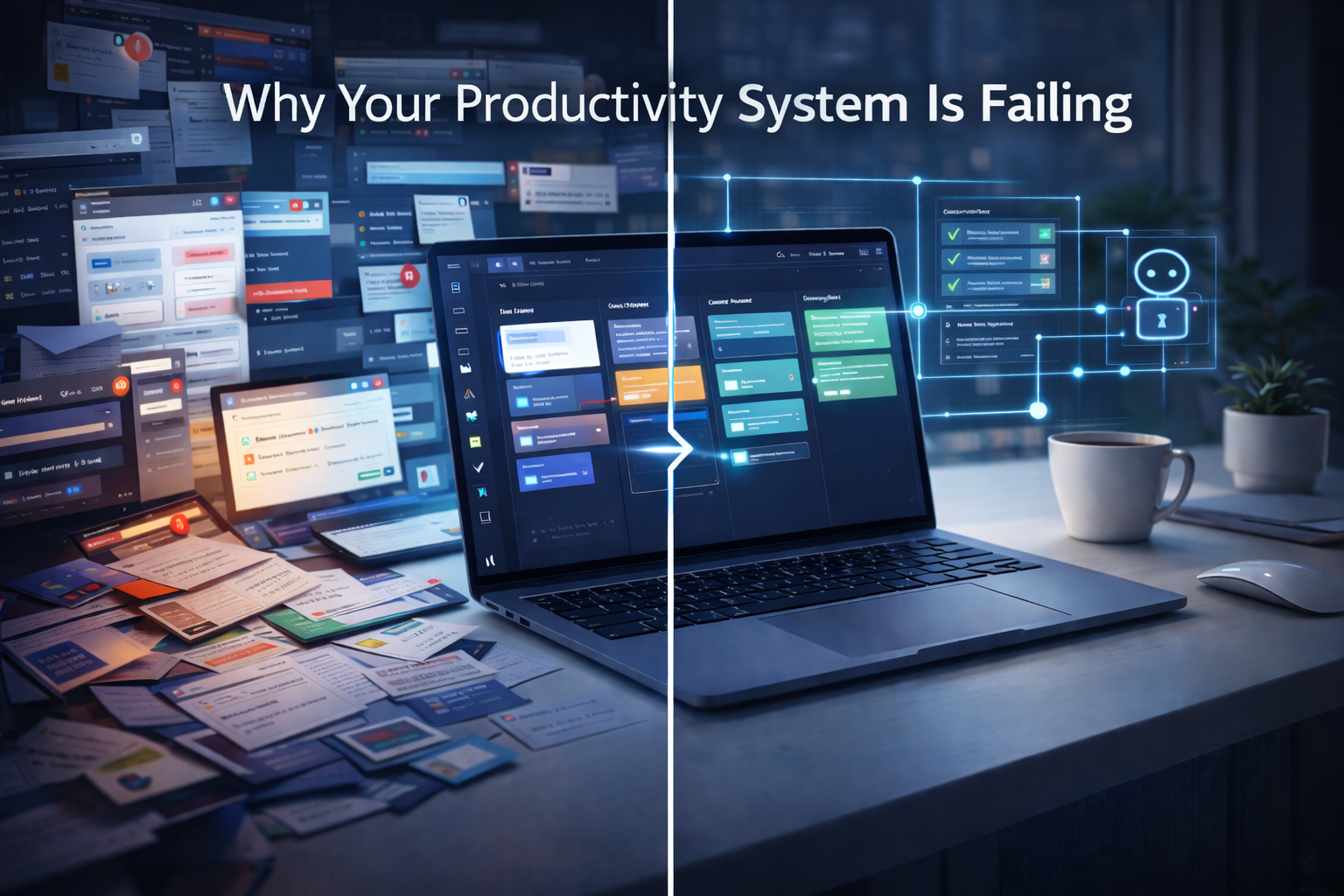
What is AI productivity for freelancers?
AI productivity for freelancers is a system that organizes workflows, automates repetitive tasks, and reduces decision fatigue to enable consistent execution despite unpredictable workloads. It replaces fragmented work patterns with structured execution systems.
How AI Productivity Systems Actually Work
Productivity in freelance work is not driven by effort—it is the result of structured execution flow.
Tasks move through a defined system:
Tasks → Visibility → Prioritization → Execution → Automation → Scalable Output
When this flow is structured, productivity becomes predictable. Without structure, execution becomes reactive and inconsistent.
This system replaces task management with workflow-driven execution, ensuring that work moves through controlled stages instead of being handled randomly.
Why Traditional Productivity Advice Fails Freelancers

Without structured systems, freelance work becomes fragmented, reactive, and difficult to manage as complexity increases. With AI-driven workflows, execution shifts into a controlled system where tasks are organized, decisions are standardized, and operations scale consistently without increasing chaos.
Freelancers don’t struggle with productivity because they lack discipline— they struggle because their work environment is structurally unstable.
This is not a time management problem. This is a system design failure.
Traditional productivity advice assumes:
- Clear job roles
- Fixed schedules
- Defined priorities
- Stable workloads
Freelancers operate in the opposite reality:
- Multiple roles (creator, operator, marketer)
- Constant task switching
- Shifting priorities based on clients
- Unpredictable workload intensity
This mismatch creates inconsistent execution because systems designed for stability cannot function in variable environments.
Research on cognitive load and productivity shows that unstructured task management increases decision fatigue and reduces execution quality. Decision fatigue research
Why does productivity fail for freelancers?
Productivity fails for freelancers because traditional systems assume stable roles and fixed schedules, while freelancers operate in dynamic environments with changing priorities and workloads.
Why Productivity Hacks Don’t Work
Most productivity advice focuses on tactics:
- Time blocking
- Morning routines
- Task prioritization frameworks
- Focus techniques
While useful in controlled environments, these tactics fail under real freelance conditions.
They optimize behavior inside unstable workflows instead of fixing execution structure.
This leads to a predictable cycle:
- You try a new productivity method
- Short-term improvement occurs
- Workload changes disrupt the system
- Execution breaks down again
The Real Problem: Execution Fragmentation
Freelancers rarely work in a single, linear workflow.
Instead, their work is fragmented across:
- Client tasks
- Admin work
- Communication
- Business development
- Learning and skill building
Each of these requires different cognitive modes, creating constant context switching that reduces execution efficiency.
Without a structured system:
- Tasks compete for attention
- Priorities shift unpredictably
- Important work gets delayed
- Execution becomes reactive
The Shift From Productivity to Execution Systems
To fix this, freelancers must shift from:
- “How do I become more productive?”
To:
- “How do I build a system that ensures consistent execution?”
Productivity focuses on individual effort. Execution systems focus on structured workflows.
Instead of relying on motivation, systems create:
- Defined workflows
- Task grouping logic
- Execution sequences
- Automation layers
What Most Productivity Content Gets Wrong
Most content in this space focuses on:
- Apps to manage tasks
- Tips to stay focused
- Motivation strategies
While useful, these approaches do not solve the core problem.
They improve effort without improving execution structure.
Without system design:
- Tools create noise instead of clarity
- Tasks increase without better organization
- Effort increases without proportional results
The Decision That Changes Execution
At some point, every freelancer realizes:
“I don’t need better productivity habits. I need a better execution system.”
Once this shift happens:
- Work becomes structured instead of reactive
- Tasks follow systems instead of urgency
- Execution becomes consistent regardless of workload changes
This is where structured execution begins.
This transition builds a structured execution system equivalent to a financial decision system—where workflows replace guesswork and structure replaces effort.
Why do productivity systems fail freelancers?
What Is AI Productivity for Freelancers?
Most freelancers try to improve productivity by working harder or managing time better.
AI productivity for freelancers is not about effort—it is a structured execution system that organizes workflows, reduces cognitive load, and ensures consistent output under changing workloads.
This system is designed specifically for environments where:
- Tasks are unpredictable
- Workloads fluctuate daily
- Priorities shift based on clients
- Execution depends on context, not fixed schedules
Instead of optimizing effort, AI productivity for freelancers focuses on building systems that operate reliably under variability.
The Core Function of This System
The primary goal of this system is to convert:
- Scattered tasks → structured workflows
- Reactive execution → planned execution
- Mental overload → automated decision-making
The outcome is higher execution quality with lower cognitive effort.
The Three Layers of the AI Productivity System
This system operates through three integrated layers:
1. Workflow Structure
Work is organized into defined workflows instead of random task lists.
- Tasks are grouped by type and context
- Execution follows predefined sequences
- Work is processed in structured blocks
This reduces context switching and stabilizes execution.
2. Execution Logic
Instead of deciding what to do next, the system defines:
- What to execute
- When to execute it
- How it should be completed
This removes:
- Decision fatigue
- Task confusion
- Priority conflicts
Execution becomes rule-based instead of reactive.
3. Automation Layer
Repetitive tasks are handled through structured automation.
- Client communication workflows
- Task tracking systems
- Content and admin automation
This reduces manual workload and frees cognitive capacity for high-value work.
Where Execution Actually Happens
Execution systems operate at the workflow level—not at the task level.
Tasks do not create output. Structured workflows create output.
This means productivity is not determined by how many tasks you complete, but by how efficiently work moves through defined execution stages.
When workflows are structured:
- Tasks are processed in sequence instead of randomly
- Execution becomes repeatable
- Output becomes scalable
This is the difference between working more and executing through systems.
How These Layers Work Together
Execution is a multi-layer system, not a single tactic.
This system works because all three layers operate together:
- Workflow structure organizes work
- Execution logic controls decisions
- Automation ensures consistency
If one layer is missing:
- Without structure → work becomes chaotic
- Without logic → decisions become reactive
- Without automation → effort becomes unsustainable
How This System Changes Daily Work
Without a system:
- You decide tasks in real time
- You switch between unrelated work
- You rely on motivation to execute
With this system:
- Workflows define what gets done
- Execution follows structured sequences
- Automation reduces manual decisions
This creates predictable, repeatable execution.
Where AI Fits Into This System
AI enhances execution by supporting system operations.
Within this structure, AI is used to:
- Automate repetitive workflows
- Assist with content and communication
- Reduce manual task processing
AI amplifies structured systems—it does not replace them.
Without structure, tools increase complexity. With structure, they create leverage.
The Output of This System
When implemented correctly, this system produces:
- Consistent execution regardless of workload
- Reduced mental fatigue and decision load
- Higher output with lower effort
The result is operational control—not just productivity.
This creates a complete execution system for freelancers, where workflows, automation, and decision logic work together to maintain consistent output.
How does AI productivity for freelancers actually work?
How the AI Productivity System Works for Freelancers
Most freelancers understand productivity concepts—but struggle to apply them consistently.
The difference is not knowledge. It is execution structure.
An AI productivity system works by converting unpredictable work into a controlled workflow system for freelancers, where tasks are processed through defined stages instead of handled reactively.
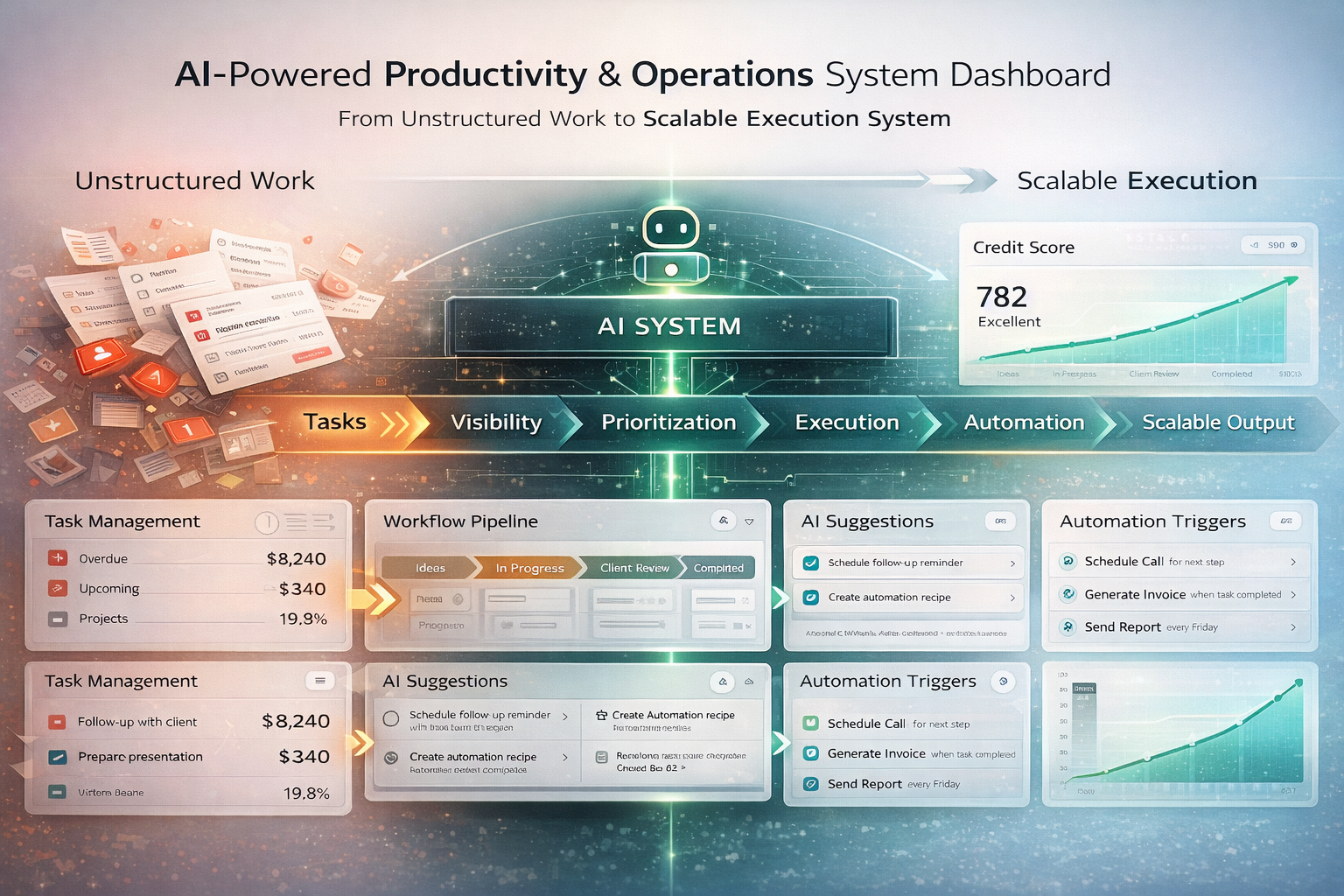
Instead of reacting to incoming work, execution follows a structured system that governs how tasks are captured, organized, and completed.
The Execution Flow: Input → Structure → Execution → Output
At its core, the system operates as a continuous execution cycle:
- Input: Tasks, requests, and work enter the system
- Structure: Tasks are organized into defined workflows
- Execution: Work is completed using predefined rules
- Output: Results are delivered consistently
This replaces randomness with controlled execution.
Step 1: Capture and Control Input
Freelancers receive work from multiple sources:
- Client requests
- Emails and messages
- Internal tasks
- New opportunities
Without a capture system, these inputs create fragmentation.
The first step is to centralize all inputs into a single system.
This ensures:
- No task is lost
- No work is forgotten
- All inputs enter a controlled workflow
At this stage, the objective is control—not execution.
Step 2: Structure Work Into Workflows
Captured tasks are organized before execution.
They are grouped into structured workflows based on type and context.
Examples:
- Client delivery workflow
- Content creation workflow
- Admin and operations workflow
Each workflow defines:
- Task category
- Execution sequence
- Required context
This removes random task switching and stabilizes execution.
Step 3: Apply Execution Rules
Execution is guided by predefined rules instead of real-time decisions.
These rules determine:
- When tasks are executed
- In what order they are processed
- How focus and time are allocated
For example:
- Client work is executed before internal tasks
- Deep work tasks are grouped together
- Communication is handled in dedicated blocks
This creates consistent execution patterns and reduces decision fatigue.
Step 4: Execute in Structured Blocks
Execution happens in predefined blocks instead of constant switching.
- Tasks of similar type are grouped
- Focus remains within a single context
- Work is completed with higher quality and speed
This is where cognitive load is reduced significantly.
Step 5: Use AI to Automate Repetitive Work
Once workflows and execution rules are defined, AI is applied to reduce manual effort.
This includes:
- Automating routine communication
- Generating drafts and content
- Managing task tracking and updates
AI accelerates execution inside a system—it does not replace it.
Step 6: Maintain Continuous Output
Because execution follows a system, output remains stable even when conditions change.
- Workload increases
- Priorities shift
- New tasks appear
The system absorbs variability without breaking workflow continuity.
What Happens Without This System
Without a structured workflow system:
- Tasks are handled randomly
- Priorities shift constantly
- Work is interrupted repeatedly
- Output becomes inconsistent
This leads to increased effort without stable results.
The System Advantage
With a structured execution system:
- Workflows absorb incoming tasks
- Execution follows predefined rules
- Automation reduces manual effort
This creates:
- Consistent output
- Reduced cognitive load
- Predictable work patterns
This is how freelancers move from reactive work to controlled execution.
This strengthens workflow execution for freelancers, where structured systems replace reactive task management and improve consistency.
How do freelancers build a consistent workflow system?
Why AI Tools Don’t Fix Productivity (And What Actually Does)
Most freelancers assume better tools will fix productivity.
This assumption is the root of most productivity failures.
AI productivity tools for freelancers are powerful—but without a workflow system, they increase complexity instead of improving execution.
This leads to a common pattern:
- Adopt new tools to improve productivity
- Increase task tracking and automation attempts
- Feel more organized temporarily
- Become overwhelmed again as workflows remain unclear
The issue is not the tools—it is the absence of a structured execution system.
Studies in behavioral systems and habit formation show that structured systems outperform tools alone in driving consistent output. Why systems outperform motivation
The Execution Gap Most Freelancers Miss
Many freelancers adopt productivity tools but still struggle with execution.
This happens because tools do not define workflows.
The gap exists between:
- Planning work
- Actually executing it consistently
Without structured workflows and execution rules, tools become passive systems that store tasks instead of driving output.
Closing this gap requires system design—not more tools.
Do AI tools improve productivity for freelancers?
AI tools improve productivity only when used within a structured system. Without defined workflows and execution rules, tools increase complexity and reduce efficiency instead of improving output.
The Difference Between Tools and Systems
A tool performs a function. A system defines how and when that function is used.
This distinction determines whether execution improves or becomes fragmented.
Without a system:
- Tools are used inconsistently
- Tasks are scattered across platforms
- Workflows remain undefined
- Execution becomes fragmented
With a structured system:
- Each tool has a defined role
- Workflows determine tool usage
- Execution follows consistent processes
- Output becomes predictable
Tools support execution systems—they do not replace them.
The Tool Overload Problem
Adding more tools does not fix execution problems.
Instead, it often leads to:
- Multiple apps managing similar tasks
- Duplicate tracking systems
- Increased cognitive load
- More time managing tools than completing work
This is tool overload—where tools create friction instead of efficiency.
As a result, freelancers often feel:
- Busy but unproductive
- Organized but inconsistent
- Overwhelmed despite using advanced tools
How AI Tools Fit Into a Workflow System
Within a structured execution system, tools are assigned specific roles based on workflow stages.
1. Input and Capture Tools
These tools centralize incoming tasks and information.
- Task management platforms
- Note capture systems
- Communication tracking tools
Role: Ensure all work enters a controlled workflow system.
2. Workflow and Organization Tools
These tools structure tasks into defined workflows.
- Project management systems
- Workflow automation platforms
- Process tracking tools
Role: Define how work moves through the execution system.
3. Execution and Automation Tools
These tools reduce manual effort during execution.
- AI writing assistants
- Automation tools
- Process optimization systems
Role: Accelerate execution without increasing cognitive load.
To apply this effectively, explore best AI tools for freelancers and integrate them into structured workflows instead of using them in isolation.
Why This Approach Works
When tools are integrated into a system:
- Workflows determine tool usage
- Tasks move through defined stages
- Automation supports execution instead of replacing it
This removes confusion and improves execution consistency.
Instead of asking:
- “Which tool should I use?”
The system answers:
- “This task follows this workflow, which uses this tool.”
Decision-making is replaced by system logic.
The System-First Approach to AI Productivity
The correct sequence is:
- Define workflows
- Establish execution rules
- Assign tools to support each step
Systems are built first. Tools are added second.
Most freelancers reverse this process:
- Choose tools first
- Attempt to build workflows around them
- Create fragmented execution systems
This approach fails because structure is shaped by tools instead of guiding them.
What Happens When Tools Replace Systems
When tools operate without a system:
- Execution becomes inconsistent
- Tasks are managed instead of completed
- Workflows remain unclear
- Productivity depends on effort
This creates the illusion of productivity without improving output.
The Outcome of System-Driven Tool Usage
When tools are integrated correctly into a workflow system for freelancers:
- Workflows become predictable
- Execution becomes consistent
- Automation reduces manual workload
- Output increases without additional effort
This is where AI productivity systems become effective.
This strengthens AI productivity systems for freelancers, where tools operate as components within a structured execution framework.
Why do productivity tools fail freelancers without a system?
These execution problems are often invisible in daily work—but they compound through fragmented workflows, constant interruptions, and cognitive overload that reduce efficiency over time.
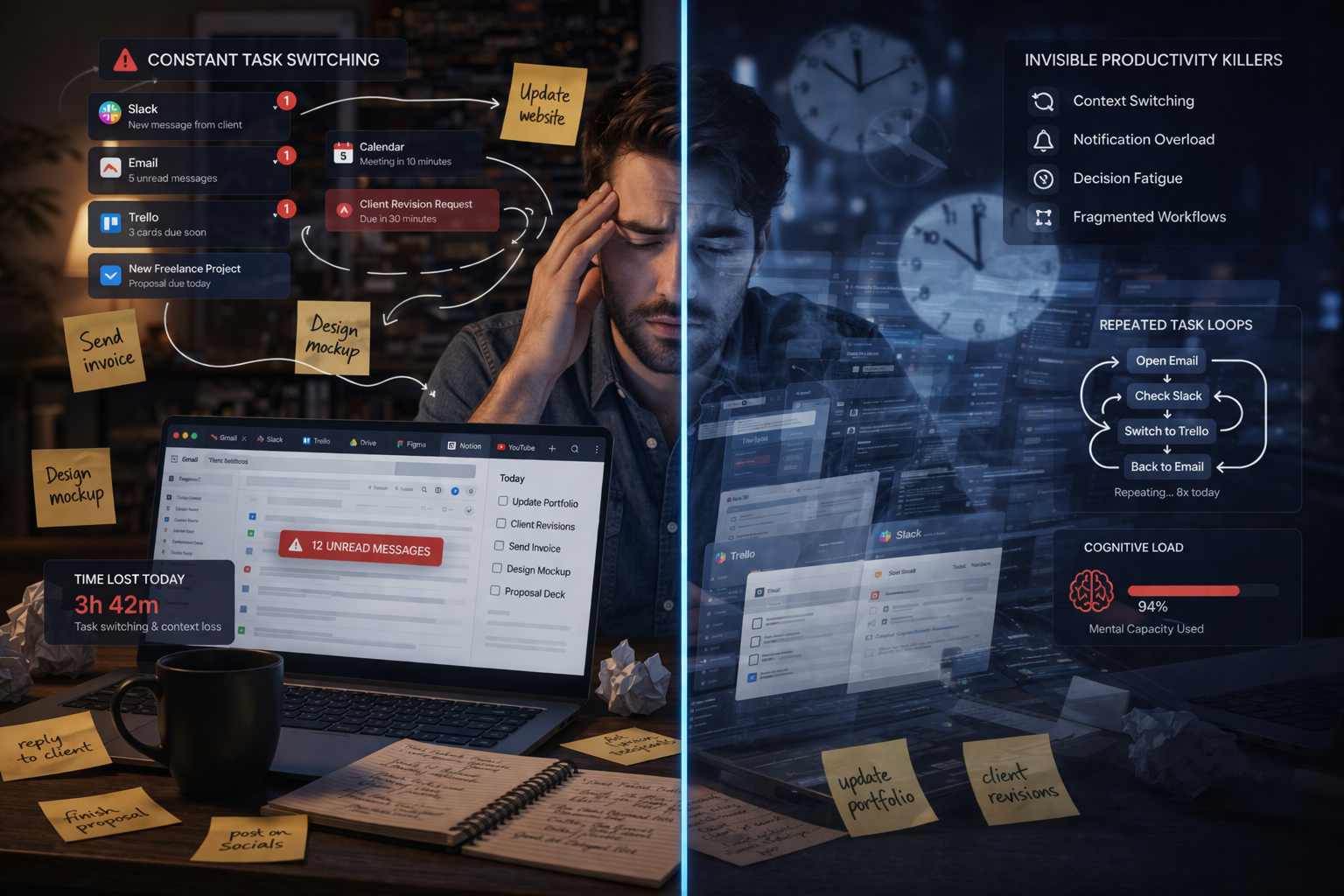
The Hidden Execution Problems That Limit Freelancer Growth
Most freelancers recognize they are not as productive as they could be—but the real constraints are rarely visible.
What limits growth are deeper execution problems built into how work is processed daily.
These are structural limitations, not surface-level inefficiencies.
What limits productivity for freelancers?
Freelancer productivity is limited by execution fragmentation, constant context switching, and lack of structured workflows, which create inefficiencies that prevent consistent output and scalability.
Problem 1: Execution Fragmentation
Freelancers rarely operate in a continuous workflow.
Execution is fragmented across:
- Client tasks
- Communication
- Admin work
- Content creation
- Business development
Each category requires a different cognitive mode, forcing constant context switching.
- Slower execution
- Reduced focus quality
- Increased mental fatigue
Time is not lost in work—it is lost in switching between work.
Problem 2: Invisible Time Loss
Freelancers track visible work:
- Hours worked
- Tasks completed
- Deadlines met
But real inefficiency occurs in invisible gaps:
- Time spent deciding what to do
- Switching between tasks
- Recovering focus after interruptions
These micro-losses compound into significant inefficiency.
- Longer working hours
- Lower effective output
- Reduced capacity for high-value work
Problem 3: Reactive Execution Model
Without a system, execution becomes reactive.
- Tasks are handled as they appear
- Urgency overrides importance
- Planning is replaced by immediate response
This results in:
- Interruptions
- Constant priority shifts
- Unfinished work
Reactive execution prevents deep work and consistent output.
Problem 4: No Execution Ceiling Control
Freelancers eventually hit a productivity ceiling.
- Workload increases
- More clients are added
- Tasks become more complex
Without a system:
- Work hours increase
- Stress levels rise
- Output does not scale proportionally
This creates a hard limit on growth.
At this stage, freelancers face a choice:
- Work more hours
- Or build a system that increases capacity
Problem 5: Cognitive Overload
Freelancers manage every aspect of their work:
- Task planning
- Execution
- Communication
- Decision-making
This creates continuous cognitive demand.
The brain operates as both executor and manager.
- Burnout risk increases
- Decision quality declines
- Efficiency drops over time
This is not sustainable without system support.
Problem 6: Lack of Workflow Continuity
In structured environments, work follows defined processes.
For freelancers, workflows are often:
- Undefined
- Inconsistent
- Dependent on memory
This results in:
- Repeated mistakes
- Rework and inefficiencies
- Inconsistent output quality
Without continuity, execution cannot improve over time.
Why These Problems Are Hard to Detect
These inefficiencies remain hidden because:
- Work still gets completed
- Deadlines are often met
- Income may still grow
But growth is slower than it should be, and effort increases disproportionately.
This creates a false sense of productivity.
The Compounding Effect of Inefficiency
Small inefficiencies compound over time:
- Minutes lost per task become hours per week
- Cognitive fatigue reduces long-term performance
- Execution inconsistency limits scalability
Minor inefficiencies become major growth constraints.
The System Gap
All these problems share a single root cause:
The absence of a structured execution system.
Without:
- Defined workflows
- Execution rules
- Automation layers
Freelancers rely on:
- Memory
- Effort
- Real-time decisions
This approach is inherently unstable.
The Transition Point
At some stage, freelancers recognize:
“I am working more, but not scaling.”
This signals:
- Effort has reached its limit
- System design must replace manual execution
This is where real productivity transformation begins.
These issues highlight the need for workflow optimization for freelancers, where structured systems replace fragmented execution.
To support this transition, explore AI productivity tools that integrate into structured workflows rather than operate independently.
What hidden inefficiencies reduce freelancer productivity?
From Scattered Work to Structured Execution
Most freelancers understand their productivity problems—but real transformation happens when execution is redesigned.
This is where work shifts from reactive output to controlled execution systems.
How does an AI productivity system improve freelancer workflow?
An AI productivity system improves freelancer workflow by replacing scattered task execution with structured workflows, reducing decision fatigue, and enabling consistent output regardless of workload changes.
Workflow-based productivity aligns with process optimization principles used in operations management and systems thinking. Workflow systems explanation
Before: The Reactive Work Model
Without a workflow system, freelancers operate in a reactive execution model.
This system supports freelancer workflow automation, enabling consistent execution without increasing workload complexity.
This looks like:
- Starting the day without a defined execution plan
- Switching between tasks based on urgency
- Constant interruptions from messages and requests
- Relying on memory to track work
The result:
- Unfinished tasks
- Delayed projects
- Inconsistent output
- High mental fatigue
Work feels busy, but progress remains unstable.
After: The System-Driven Execution Model
With a structured execution system, work follows defined workflows.
This looks like:
- Clear workflows for each type of work
- Defined execution sequences
- Tasks grouped by context and priority
- Automation supporting repetitive processes
The result:
- Consistent progress across projects
- Reduced cognitive load
- Faster execution speed
- Higher output quality
Work becomes predictable, controlled, and scalable.
The Shift That Changes Everything
The transformation is not about working harder.
It is about changing how work is processed through an execution system.
Freelancers move from:
- Managing tasks → Managing workflows
- Reacting to work → Executing structured processes
- Relying on memory → Using systems
This shift removes instability from daily execution.
How Daily Work Changes
Before the system:
- You decide what to do in real time
- You switch between unrelated tasks
- You rely on motivation to start work
After the system:
- The system defines what gets executed
- Workflows determine task order
- Execution follows predefined sequences
Decision-making is replaced by execution flow.
The Impact on Output and Growth
This transformation directly affects results:
- More work completed in less time
- Higher consistency across projects
- Ability to handle larger workloads
- Reduced burnout risk
Instead of increasing effort, freelancers increase execution capacity.
This enables sustainable growth.
Why This Transformation Is Sustainable
Discipline-based productivity depends on:
- Motivation
- Focus
- Energy levels
System-based execution depends on:
- Structured workflows
- Defined execution rules
- Automation support
This allows execution to remain stable even when conditions change.
The New Execution Standard
Once implemented, this system becomes the default mode of working.
Freelancers no longer:
- Start from scratch each day
- Rely on willpower to execute
- Struggle with inconsistent productivity
Instead:
- Workflows guide execution
- Systems maintain consistency
- Output becomes predictable
This defines the new standard for productivity.
The Key Realization
At this stage, freelancers recognize:
“Productivity is not about doing more—it is about executing through systems.”
This marks the transition from:
- Freelancer → Operator
Where execution is controlled rather than reactive.
This transformation enables workflow consistency for freelancers, ensuring structured execution replaces scattered work patterns.
This execution model integrates with AI-powered money management for freelancers, ensuring operational consistency aligns with financial stability.
How do freelancers move from chaotic work to structured productivity?
AI Tools vs Systems: What Actually Drives Productivity
Most freelancers eventually realize productivity is not a matter of effort—but a deeper misunderstanding still remains.
Believing that tools are the solution.
This assumption prevents the development of a functional execution system.
What is the difference between tools and systems in productivity?
Tools perform specific tasks, while systems define how work is structured and executed. Productivity improves when tools operate within systems, not when tools replace them.
The Misconception: Tools Create Productivity
Freelancers now have access to powerful AI productivity tools.
These tools promise:
- Faster execution
- Better organization
- Increased efficiency
While these benefits are real, they are often misinterpreted.
Tools increase capability—but they do not create execution structure.
Without structure:
- Tasks remain scattered
- Execution remains inconsistent
- Workflows remain undefined
This is why freelancers can use advanced tools and still feel unproductive.
The Reality: Systems Drive Productivity
A workflow system determines:
- What work is done
- When it is executed
- How it moves from start to completion
Tools support these actions—but do not define them.
Without a system, tools have no direction.
This leads to:
- Inconsistent execution
- Duplicated effort
- Fragmented workflows
Why Tools Alone Fail
When tools operate without a system:
- Each tool functions independently
- Tasks are spread across platforms
- Workflows are not connected
This creates:
- Confusion about where work exists
- More time managing tools than executing work
- Reduced efficiency despite increased activity
Complexity increases without improving execution quality.
The System-First Model
In a system-first approach:
- Workflows are defined first
- Execution rules are established
- Tools are assigned to support each step
This ensures:
- Every tool has a defined role
- Workflows remain stable
- Execution follows predictable patterns
Tools become components within a structured execution system.
The Key Difference in Practice
Consider two freelancers:
Freelancer A (Tool-Based)
- Uses multiple apps for tasks
- Switches tools based on immediate needs
- Manages work manually across platforms
Result: Inconsistent execution and high cognitive load
Freelancer B (System-Based)
- Uses fewer tools
- Operates within defined workflows
- Follows structured execution rules
Result: Consistent output with lower effort
How Tools Fit Into the Execution System
Within a structured workflow system, tools serve specific roles:
- Capture tools → collect tasks and inputs
- Workflow tools → organize execution
- Automation tools → reduce manual work
Each tool is:
- Assigned to a stage in the workflow
- Used consistently within that stage
- Integrated into the overall execution system
This removes tool confusion and improves efficiency.
The Risk of Tool-Centric Thinking
Focusing on tools instead of systems creates a repeating cycle:
- Adopt new tool
- Experience short-term improvement
- Execution breaks under complexity
- Search for another tool
This cycle prevents long-term productivity growth.
The System Advantage
When systems drive execution:
- Workflows remain stable
- Tools support execution instead of controlling it
- Output remains consistent across changing workloads
This forms the foundation of scalable productivity.
The Final Principle
Freelancers do not need more tools.
They need systems that define how tools are used.
Once this is in place:
- Tools amplify productivity
- Workflows maintain consistency
- Execution becomes predictable
This separates effort-based work from system-driven execution.
This reinforces system-driven productivity for freelancers, where structured workflows determine tool usage and execution outcomes.
Do freelancers need more tools or better systems?
How to Build an AI Productivity System as a Freelancer
Understanding productivity systems is only valuable if it leads to execution.
The objective is not to learn the system—it is to build and operate it consistently.
This section outlines how freelancers move from scattered work to a structured workflow system that enables controlled execution.
How do freelancers implement an AI productivity system?
Freelancers implement an AI productivity system by centralizing tasks, structuring workflows, defining execution rules, and integrating AI tools to automate repetitive work.
Step 1: Centralize All Work Inputs
The first step is to eliminate scattered task sources.
All work must flow into a single system:
- Client requests
- Emails and messages
- Internal tasks
- Ideas and future work
This creates a single source of truth for execution.
Without centralized input, workflows cannot be controlled.
Step 2: Define Core Workflows
Organize tasks into a small number of core workflows.
Examples:
- Client delivery workflow
- Content creation workflow
- Admin and operations workflow
- Business growth workflow
Each workflow becomes a repeatable execution system.
This removes randomness from how work is processed.
Step 3: Create Execution Rules
Execution rules define how work moves through the system.
These rules determine:
- What gets done first
- When tasks are executed
- How priorities are assigned
For example:
- Client work before internal tasks
- Deep work grouped into focused blocks
- Communication handled at fixed intervals
This removes constant decision-making from execution.
Step 4: Group Work Into Execution Blocks
Instead of switching tasks continuously, group similar work into structured execution blocks.
- Creative tasks executed together
- Admin tasks handled in separate blocks
- Communication processed independently
This reduces context switching and improves efficiency.
Step 5: Integrate AI Tools Into Workflows
Once workflows are defined, AI productivity tools are integrated to support execution.
Use tools for:
- Content drafting and generation
- Task automation and tracking
- Communication assistance
Tools support workflows—they do not define them.
To implement this effectively, explore best AI tools for freelancers and align them with structured workflows.
Step 6: Automate Repetitive Processes
Identify recurring tasks and automate them within the workflow system.
Examples:
- Client onboarding sequences
- Status updates and reporting
- Content production workflows
This reduces manual effort and increases execution speed.
Step 7: Maintain System Consistency
The final step is consistency.
The system must be followed:
- Daily
- Across all workflows
- Regardless of workload changes
Consistency converts structure into measurable results.
Common Implementation Mistakes
Freelancers often fail during implementation by:
- Building overly complex systems too early
- Adding too many tools without structure
- Skipping workflow definition
- Relying on motivation instead of systems
Start simple, then scale the system.
What Implementation Looks Like in Practice
At the beginning:
- Workflows may feel rigid
- Execution may require adjustment
- Systems may need refinement
Over time:
- Execution becomes automatic
- Workflows become natural
- Output becomes consistent
This is the transition from effort-based work to system-driven execution.
The Outcome of Implementation
Once implemented, freelancers achieve:
- Clear execution paths
- Reduced decision fatigue
- Higher output with less effort
- Scalable workflows
This is how productivity becomes predictable and scalable.
This process builds a complete workflow system for freelancers, where structured execution replaces reactive work patterns.
How do freelancers build a productivity system step by step?
How This Productivity System Connects With Your Financial and Growth Systems
Productivity does not operate in isolation—it functions as part of a broader freelancer operating system.
Without integration, execution alone cannot produce stable financial or growth outcomes.
Execution must align with:
- Financial systems
- Income systems
- Business operations
This is where system integration becomes critical.
How does productivity connect with financial systems for freelancers?
Productivity systems connect with financial systems by ensuring consistent execution, which stabilizes income, supports financial planning, and enables predictable business growth.
The Role of Productivity in the Freelancer Operating System
Within the FM Mastery framework, productivity is not just task completion.
It is the execution engine that drives all other systems.
Without consistent execution:
- Income becomes unstable
- Financial planning breaks down
- Business growth slows or stops
Execution directly impacts:
- Cash flow stability
- Debt management
- Income growth capacity
Connection to Financial Stability (Pillar 1)
Execution systems support financial stability by maintaining consistent output.
- Projects are completed on time
- Income becomes more predictable
- Cash flow stabilizes
This directly supports:
AI-powered money management for freelancers
Without execution consistency, financial systems cannot operate effectively.
Connection to Debt & Risk Control (Pillar 2)
Structured execution reduces financial pressure.
- Income variability decreases
- Emergency borrowing becomes less frequent
- Financial decisions improve
This supports:
AI debt system for freelancers
Consistent execution reduces reactive financial behavior.
Connection to Income Growth (Pillar 4)
Growth depends on execution capacity.
Without structured workflows:
- Freelancers cannot handle increased workload
- Opportunities are missed
- Scaling becomes limited
With a system:
- Workload increases without operational breakdown
- New income streams can be managed
- Growth becomes sustainable
Execution systems enable scalable income growth.
Connection to Business Systems (Pillar 5)
As freelancers evolve into operators, complexity increases.
- Client management
- Operations
- Process optimization
Without structured execution:
- Operations become inconsistent
- Processes break down
- Quality declines
With a system:
- Processes are repeatable
- Operations are controlled
- Business systems can scale
Execution systems bridge freelance work and scalable business operations.
The Compounding Effect of System Integration
When systems operate together:
- Execution drives consistent output
- Consistent output stabilizes income
- Stable income improves financial decisions
- Improved decisions enable growth
This creates a compounding system where each layer strengthens the others.
Without integration:
- Systems operate independently
- Improvements remain temporary
- Growth is constrained
The Full Freelancer Operating System
At full implementation, freelancers operate within a unified system:
- Execution system → controls productivity
- Financial system → controls money
- Growth system → expands income
- Business system → scales operations
This represents a shift from freelancing to system-driven work.
Why Most Freelancers Never Reach This Level
Most systems are built in isolation:
- Productivity tools without financial structure
- Financial plans without execution systems
- Growth strategies without operational systems
This results in:
- Misalignment between systems
- Inconsistent outcomes
- Limited scalability
Integration transforms isolated systems into a unified operating model.
The Strategic Advantage
Freelancers who integrate systems gain:
- Consistent execution
- Predictable income
- Scalable workflows
- Controlled growth
This forms the foundation of long-term stability and expansion.
This integration creates a complete freelancer operating system, where execution, finance, and growth systems function as a unified structure.
Explore the full system through:
How do productivity, finance, and growth systems work together for freelancers?
How Productivity Systems Compound Over Time for Freelancers
Most freelancers focus on short-term productivity improvements—but long-term growth is driven by systems, not tactics.
Real productivity gains come from compounding execution systems, not isolated improvements.
Many freelancers look for:
- Faster ways to complete tasks
- Better tools to manage work
- Techniques to increase daily output
These approaches can create temporary gains—but they do not produce sustained results.
How This Page Connects to the Full Productivity System
This page defines the structural execution system behind freelancer productivity.
It explains how workflows, execution logic, and automation create consistent output under variable workloads.
Detailed workflow implementation, task systems, and applied execution strategies are built on top of this foundation within the broader system.
Do productivity systems improve over time for freelancers?
Yes, productivity systems improve over time because structured workflows, automation, and execution rules create compounding efficiency, increasing output while reducing effort.
The Difference Between Linear Effort and Compounding Systems
Without a system, productivity remains linear:
- More work requires more time
- Output is directly tied to effort
- Growth is limited by available hours
With a structured workflow system, productivity becomes compounding:
- Workflows improve through repetition
- Automation reduces manual effort
- Execution becomes faster and more efficient
Output increases without proportional increases in effort.
How Systems Improve With Use
Each time a workflow is executed:
- Inefficiencies are identified
- Processes are refined
- Automation opportunities are introduced
As this repeats:
- Workflows become optimized
- Execution speed increases
- Error rates decrease
The system improves through continuous use.
The Role of Automation in Compounding
Automation is a key driver of compounding productivity.
As systems mature:
- Repetitive tasks are automated
- Manual steps are reduced
- Execution becomes streamlined
This creates:
- More available time
- Greater focus on high-value work
- Increased execution capacity
Automation converts effort into leverage.
The Stability Advantage
Compounding systems depend on stability.
Without a system:
- Productivity fluctuates daily
- Output depends on motivation and energy
- Work patterns remain inconsistent
With a system:
- Execution remains stable
- Workflows operate consistently
- Output becomes predictable
Consistency enables compounding growth.
The Long-Term Impact on Freelance Growth
Over time, compounding productivity systems lead to:
- Higher income potential
- Reduced working hours
- Improved work quality
- Greater scalability
This happens because:
- Execution becomes more efficient
- Capacity increases without burnout
- Workflows support growth instead of limiting it
This is how freelancers move from effort-based work to system-driven growth.
Why Most Freelancers Never Experience This
Most freelancers remain in a cycle of:
- Trying new tools
- Changing routines
- Seeking short-term improvements
This prevents compounding because:
- Systems are never fully built
- Workflows are constantly reset
- Consistency is never achieved
Compounding requires stability—not constant change.
The System Maturity Curve
As productivity systems develop, they move through stages:
- Initial setup → basic workflows and structure
- Optimization → refining execution processes
- Automation → reducing manual effort
- Scaling → handling larger workloads efficiently
Each stage builds on the previous one.
This progression creates a compounding effect.
The Strategic Advantage of Compounding Systems
Freelancers who build compounding systems gain:
- Long-term efficiency improvements
- Reduced dependency on effort
- Greater control over workload
- Scalable execution capacity
This separates short-term productivity from long-term operational advantage.
The Final Realization
At this stage, freelancers recognize:
“Productivity is not optimized daily—it is built and improved over time.”
This shifts focus from:
- Daily performance → System development
Where the system—not effort—drives results.
This creates compounding productivity systems for freelancers, where structured execution improves continuously.
To strengthen this compounding effect, integrate workflows with AI productivity tools that support long-term system development.
How do productivity systems improve over time for freelancers?
Common Productivity Mistakes Freelancers Must Avoid
Even with access to advanced tools and strategies, many freelancers fail to improve productivity.
The issue is not effort—it is repeating structural mistakes that prevent systems from working.
Understanding these mistakes is critical because:
- They block system effectiveness
- They create false progress
- They lead to repeated failure cycles
What productivity mistakes do freelancers make?
Freelancers commonly rely on tools without systems, switch tasks frequently, depend on motivation, and fail to define workflows, leading to inconsistent execution and reduced productivity.
Mistake 1: Relying on Tools Instead of Systems
A common mistake is assuming tools will fix productivity problems.
Freelancers often:
- Adopt multiple productivity apps
- Switch tools frequently
- Expect tools to create structure
Tools operate within systems—they do not create them.
- Tools increase complexity
- Execution remains fragmented
- Productivity does not improve
Correction: Build the system first, then assign tools to support it.
Mistake 2: Managing Tasks Instead of Workflows
Most freelancers rely on task lists instead of structured workflows.
- Random task execution
- Constant priority changes
- Unstructured work patterns
Tasks do not define execution—workflows do.
- Tasks compete for attention
- Execution becomes reactive
- Consistency is lost
Correction: Organize work into repeatable workflows.
Mistake 3: Constant Context Switching
Freelancers frequently switch between different types of work:
- Client work
- Communication
- Admin tasks
- Creative work
- Reduced focus
- Slower execution
- Increased mental fatigue
Productivity is lost in switching between work—not in the work itself.
Correction: Group tasks into execution blocks based on context.
Mistake 4: Relying on Motivation and Discipline
Many freelancers depend on:
- Motivation
- Discipline
- Focus
This approach fails because:
- Motivation fluctuates
- Discipline is inconsistent under pressure
- Work conditions constantly change
Behavior is unstable—systems provide stability.
Correction: Build systems that remove the need for constant decision-making.
Mistake 5: Building Complex Systems Too Early
Some freelancers attempt to create detailed systems immediately.
- Overcomplicated workflows
- Difficult implementation
- System abandonment
Complexity reduces usability.
Correction: Start simple and expand gradually.
Mistake 6: Ignoring Execution Rules
Without execution rules:
- Tasks are decided in real time
- Priorities shift constantly
- Consistency is lost
- Decision fatigue increases
- Work remains unfinished
- Efficiency declines
Correction: Define clear execution and prioritization rules.
Mistake 7: Treating Productivity as Daily Optimization
Many freelancers focus on improving daily performance:
- Trying new techniques
- Adjusting routines
- Optimizing schedules
- Short-term improvements
- Long-term inconsistency
Productivity is built as a system—not optimized daily.
Correction: Focus on system development instead of daily tweaks.
Mistake 8: Not Integrating Systems
Freelancers often build systems in isolation:
- Productivity systems
- Financial systems
- Growth strategies
Without integration:
- Execution and goals become misaligned
- Results remain inconsistent
- Scalability is limited
Correction: Integrate productivity with financial and growth systems.
The Pattern Behind These Mistakes
All mistakes share a common pattern:
Focusing on effort instead of structure.
- Improving behavior
- Switching tools
- Adjusting habits
Without improving:
- Workflows
- Execution rules
- System design
This prevents lasting progress.
The System-Based Correction
To avoid these mistakes:
- Define workflows before tools
- Reduce decision-making through structure
- Group work into execution blocks
- Build systems that operate consistently
This is how productivity becomes stable and scalable.
Avoiding these mistakes strengthens execution systems for freelancers, ensuring consistent workflows and predictable output.
To build a correct system, explore AI tools for freelancers and integrate them into structured workflows instead of using them independently.
What are the biggest productivity mistakes freelancers make?
Build a Productivity System That Works Without Constant Effort
At this point, the pattern is clear.
Freelancers do not struggle because they lack discipline.
They struggle because they are trying to execute without a system.
Without structure:
- Work becomes reactive
- Tasks compete for attention
- Execution becomes inconsistent
- Growth becomes limited
With a system:
- Workflows define execution
- Decisions are minimized
- Output becomes predictable
- Capacity increases over time
This is the difference between working harder and building leverage.
The System That Changes Everything
An AI productivity system for freelancers is not just about organizing tasks.
It is about:
- Controlling how work flows
- Reducing cognitive load
- Creating consistent execution
- Building scalable workflows
This system does not depend on:
- Motivation
- Energy levels
- Perfect conditions
It works because it is designed to handle variability.
What Happens If You Don’t Build This System
Without a structured execution system:
- Every new project increases complexity
- Workload leads to stress instead of growth
- Income potential remains limited by time
You stay busy—but not scalable.
What Happens When You Do
With a system in place:
- Workflows absorb increasing workload
- Execution remains consistent under pressure
- AI tools amplify output instead of adding noise
- Growth becomes sustainable
This is how freelancers transition into system-driven operators.
Fix Your Productivity System Before Your Workflow Breaks Again
If your execution is inconsistent today, it will stay inconsistent until the system changes.
No hacks. No guesswork. A complete system for consistent execution.
Continue Building Your Freelancer Operating System
This productivity system is one part of a complete framework designed to stabilize, control, and grow your freelance business.
To build the full system, continue with:
- AI-Powered Money Management for Freelancers
- AI Debt & Credit System for Freelancers
- AI-Smart Income Growth for Freelancers
- Best AI Tools for Freelancers
This is how individual improvements turn into a complete operating system.
Building an AI productivity system for freelancers is the foundation for consistent execution, scalable workflows, and long-term business growth.
How can freelancers build a productivity system that works consistently?