
Why Freelancers Struggle With Money (System Failures & Hidden Risks)
If money feels unstable no matter how much you earn, the problem is not your effort — it’s your system.
Explore the full structure of this guide and understand how each section connects to the complete freelancer money system.
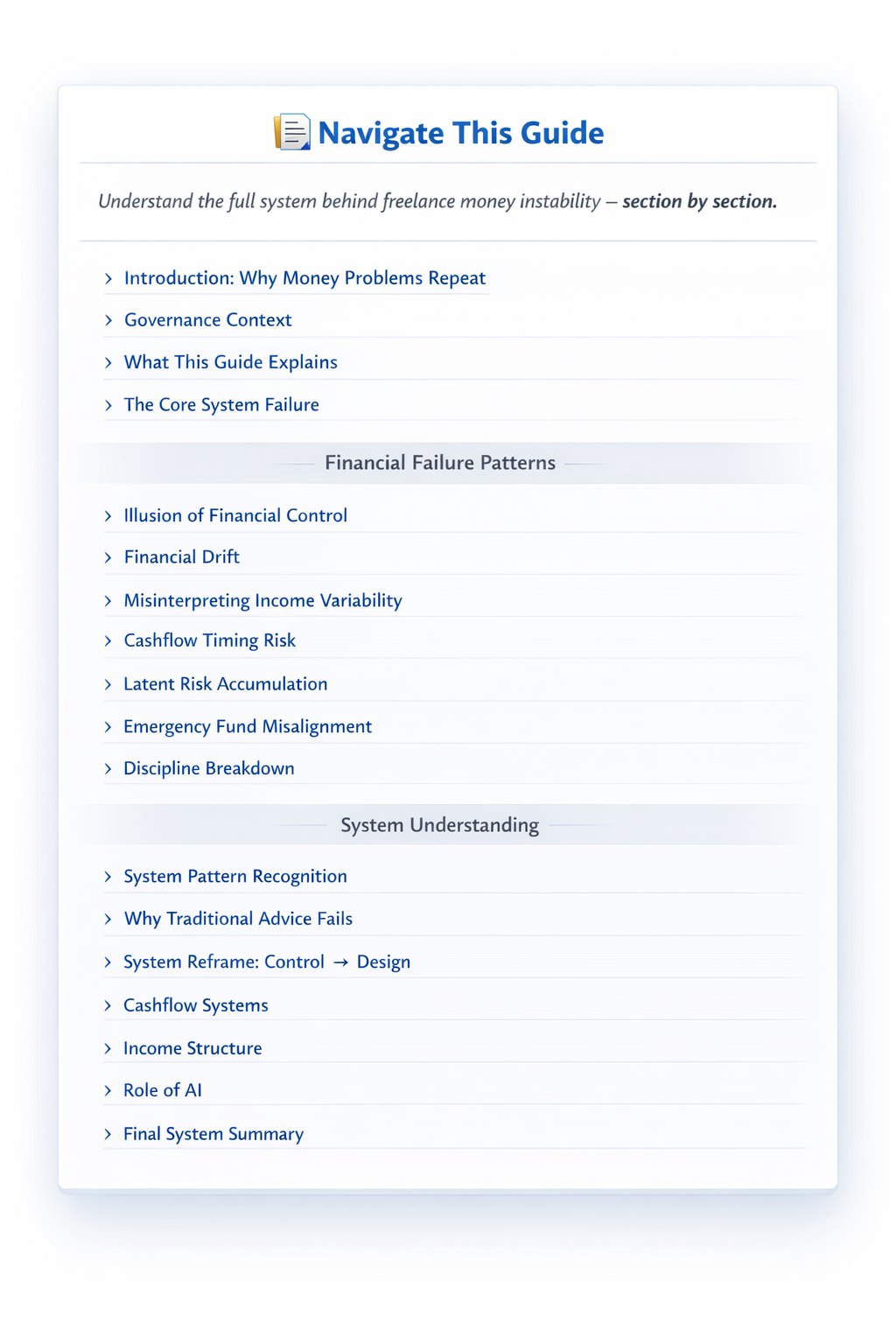
📑 Navigate This Guide
Understand the full system behind freelance money instability — section by section.
- Introduction: Why Money Problems Repeat
- Governance Context
- What This Guide Explains
- The Core System Failure
- Illusion of Financial Control
- Financial Drift
- Misinterpreting Income Variability
- Cashflow Timing Risk
- Latent Risk Accumulation
- Emergency Fund Misalignment
- Discipline Breakdown
- System Pattern Recognition
- Why Traditional Advice Fails
- System Reframe: Control → Design
- Cashflow Systems
- Income Structure
- Role of AI
- Final System Summary
🔷 SECTION 1 — Why Freelancers Struggle With Money
If budgeting never works for you, if money feels unstable no matter how much you earn, this page explains the real reason.
Freelancers don’t usually realize something is wrong with their money system—until the same problems keep repeating.
- You earn well but still feel unstable
- Some months feel easy, others stressful
- Savings don’t last as expected
- Budgeting works… until it suddenly doesn’t
You earn one good month, then the next month feels tight.
You try budgeting, but it breaks the moment income shifts.
You save, but somehow the buffer disappears faster than expected.
Pattern:
- income is coming in
- work is being done
- but stability never builds
This is one of the most common freelancer financial problems, yet it is consistently misunderstood.
If you’ve ever felt like your money problems keep repeating no matter how much you improve, this is why.
🔷 SECTION 2 — GOVERNANCE CONTEXT
This cluster sits at the top of the money management learning path.
This positioning is intentional.
Freelancers typically start by searching for solutions:
- how to budget
- how to save more
- how to manage irregular income
But without understanding the system underneath, these solutions fail to hold.
👉 Solving surface problems without understanding system behavior leads to repeated instability
This cluster exists to interrupt that pattern.
Instead of starting with solutions, it starts with diagnosis:
- Why systems break
- Why control is temporary
- Why instability repeats
This makes it fundamentally different from typical financial content.
It does not attempt to:
- fix financial problems
- provide budgeting tactics
- give step-by-step advice
Instead, it establishes something more foundational:
👉 Understanding why freelancers struggle financially at a system level
Because without this understanding:
- every solution feels temporary
- every improvement breaks under pressure
- every strategy becomes inconsistent
This page acts as:
- an entry point for awareness
- a pattern recognition layer
- a system diagnosis framework
This role is critical in the overall architecture:
Without this layer, freelancers attempt to apply advanced strategies on unstable foundations.
👉 That is why progress feels inconsistent even when effort increases
🔷 SECTION 3 — Why Freelancers Struggle With Money (System Explanation)
This cluster explains the hidden structure behind financial instability in freelancing.
This is not immediately obvious because financial instability rarely appears as a single clear problem.
Instead, freelancers experience it as:
- inconsistent savings
- stress during low-income months
- difficulty planning ahead
- feeling unstable despite earning well
These symptoms appear unrelated on the surface.
It directly addresses why freelancers struggle with money even when they are earning.
1. Why money problems repeat even when income grows
👉 Growth does not automatically create stability
2. Why traditional financial systems fail
👉 System mismatch is the root cause
3. Hidden risks in freelance income
- build slowly
- stay hidden
- appear under pressure
4. Why control feels temporary
👉 It is structural instability
Another key point this cluster clarifies:
Freelancers often confuse activity with progress
- trying new tools
- adjusting budgets
- changing habits
These actions create movement—but not stability.
👉 Without structural alignment, improvements do not compound
This is why the same financial problems keep returning in different forms.
What this page does NOT do:
- ❌ budgeting techniques
- ❌ saving strategies
- ❌ tools or tactics
What this page DOES:
- ✔ builds awareness
- ✔ explains patterns
- ✔ reveals system failures
- ✔ prepares for structured solutions
🔷 SECTION 4 — THE CORE SYSTEM FAILURE
At the center of every financial struggle freelancers face is one fundamental issue:
👉 A system mismatch
This mismatch is subtle but powerful.
Most financial systems are designed around stability assumptions:
- income arrives on time
- income amount is predictable
- expenses follow consistent patterns
Freelancing breaks all three.
👉 When system assumptions do not match reality, failure is inevitable
🧠 THE CORE PROBLEM
Freelancers are using systems designed for:
👉 predictable income
But they operate in:
👉 unpredictable income environments
⚖️ SYSTEM CONTRAST
| Stable Income System | Freelance Reality |
|---|---|
| Fixed monthly income | Variable income timing |
| Predictable expenses | Uncertain cashflow |
| Consistent planning | Irregular cycles |
🔁 FAILURE LOOP
Try to control → System breaks → Adjust → Repeat
This loop creates a dangerous illusion.
Because each cycle includes a temporary recovery phase, freelancers believe:
- the system works sometimes
- they just need to be more consistent
But in reality:
This reinforces the wrong conclusion:
“I need to improve my behavior”
instead of:
“The system does not match my income structure”
🚨 CRITICAL INSIGHT
Understanding this shift is critical because it changes how freelancers approach financial problems.
- from fixing symptoms → to analyzing systems
- from reacting → to designing
- from discipline → to structure
👉 Without this shift, every solution remains temporary
🔗 SYSTEM CONNECTION
Before applying any financial system, it’s important to understand why freelancers struggle with money and how system mismatches create instability.
🔷 SECTION 5 — FAILURE 1: THE ILLUSION OF FINANCIAL CONTROL
This is one of the most misunderstood freelancer financial problems — control that only exists under stable conditions.
This illusion is one of the key reasons why freelancers struggle with money despite feeling temporarily in control.
Freelancers often feel in control of their money—until suddenly, they’re not.
- a high-income month
- organizing expenses
- setting a budget
- building short-term savings
Temporary State: Everything feels stable
Reality: That stability is conditional
🧠 WHAT CREATES THE ILLUSION
- a budget reflects past income
- a savings plan assumes consistency
- expense tracking shows history
These tools create a snapshot of control, not a system of control.
👉 These tools break the moment income becomes unpredictable
Research on behavioral finance shows that perceived financial control often depends on stable conditions rather than actual system strength. See findings from behavioral finance concepts
⚠️ WHAT BREAKS THE ILLUSION
- budget becomes irrelevant
- allocations stop working
- savings assumptions collapse
⚖️ CONTRAST
| Perception | System Reality |
|---|---|
| I have control | System worked under stable input |
| I lack discipline | System cannot absorb variability |
🔗 SYSTEM CONNECTION
- Irregular Income Systems
- Income timing mismatch
- Adaptive system absence
👉 Control doesn’t break instantly — it erodes gradually.
Many debt problems originate from deeper system issues. Learn why freelancers struggle with money at a structural level.
🔷 SECTION 6 — FAILURE 2: FINANCIAL DRIFT
Financial drift is the gradual weakening of your financial system over time.
Financial instability rarely happens suddenly.
👉 It builds slowly, quietly, and invisibly
🧠 WHAT IS FINANCIAL DRIFT
- income shifts slightly
- expenses increase subtly
- decisions become reactive
🔍 WHY IT GOES UNNOTICED
- bills still get paid
- income still comes in
- no visible crisis
👉 Stability appears intact — but the system is weakening
📉 HOW DRIFT DEVELOPS
- small overspending normalizes
- variability increases gradually
- buffers get used more often
- recovery slows down
⚠️ KEY INSIGHT
🔗 SYSTEM CONNECTION
- Income instability
- Reactive decision patterns
- Shock vulnerability
👉 As drift increases, freelancers begin misreading their own income behavior.
🔷 SECTION 7 — FAILURE 3: MISINTERPRETING INCOME VARIABILITY
👉 The biggest mistake: treating variability as risk
🧠 THE DISTINCTION
Income Variability
- fluctuating income
- normal in freelancing
Income Risk
- income may stop
- structural instability
⚠️ WHY THIS CONFUSION IS DANGEROUS
- overreaction
- fear-based decisions
- reduced growth investment
👉 This creates defensive systems instead of adaptive systems
⚖️ CONTRAST
| Misinterpretation | Reality |
|---|---|
| Fluctuation = risk | Fluctuation = expected |
| Low month = failure | Pattern = system input |
🧭 IMPLICATION
🔗 SYSTEM CONNECTION
- Pricing systems
- Income planning
- Savings structure
👉 Misunderstanding variability leads directly to timing failures.
Before adjusting pricing, understand why freelancers struggle with money, even when income increases.
🔷 SECTION 8 — FAILURE 4: CASHFLOW TIMING RISK
Cashflow timing — not income — determines financial stability.
Freelancers often assume:
👉 Earning money = stability
But stability depends on:
🧠 WHAT IS CASHFLOW TIMING RISK
Cashflow timing risk is when income exists but arrives too late.
🔍 COMMON SCENARIO
- client pays after 30–60 days
- expenses are immediate
- cashflow misalignment occurs
⚠️ RESULT
- bills feel stressful
- savings are used early
- financial pressure increases
⚖️ CONTRAST
| Assumption | Reality |
|---|---|
| Income = stability | Timing = stability |
| Earning is enough | Timing defines usability |
🧭 WHY THIS MATTERS
This is another core reason why freelancers struggle with money even when their total income appears sufficient.
Cashflow timing issues are widely recognized as a major cause of financial instability in small businesses. According to SCORE
🔗 SYSTEM CONNECTION
- Payment cycles
- Invoice timing
- Cashflow systems
- AI Tools Hub
Strong systems begin with understanding why freelancers struggle with money at the core level.
🔷 SECTION 9 — FAILURE 5: LATENT RISK ACCUMULATION
👉 The most dangerous risks are the ones you cannot see.
Not all financial risks are visible.
Some risks don’t appear immediately.
They don’t trigger alarms.
They don’t disrupt your system right away.
👉 They build silently over time.
This is Latent Risk Accumulation
👉 False stability is created before real instability appears
🧠 WHAT IS LATENT RISK
- hidden financial weaknesses
- unrecognized fragility
- risk visible only under pressure
🔍 HOW IT BUILDS
- irregular income without buffers
- client dependency increases
- small compromises repeat
- low visibility into patterns
Each decision appears harmless.
Why freelancers fail to detect latent risk:
- no immediate consequences
- gradual changes feel normal
- focus remains on income, not system health
Because of this, freelancers often mistake:
- temporary stability for system strength
- income continuity for financial security
But together:
👉 They create structural vulnerability
⚠️ WHY IT’S DANGEROUS
- delayed payment
- client loss
- unexpected expense
👉 System fails not because of the event — but because of accumulated weakness
⚖️ CONTRAST
| Visible Risk | Latent Risk |
|---|---|
| Immediate | Hidden buildup |
| Easy to react | Hard to detect |
| Triggers action | Creates false confidence |
🧭 IMPLICATION
🔗 SYSTEM CONNECTION
- Weak buffer systems
- Income distribution issues
- Financial visibility gaps
👉 To manage hidden instability, freelancers rely on safety systems — but those systems often fail.
🔷 SECTION 10 — FAILURE 6: EMERGENCY FUND MISALIGNMENT
👉 Emergency funds are not designed for freelance reality.
Emergency funds are considered a universal solution.
But for freelancers:
👉 they become part of daily survival — not backup protection
🧠 THE TRADITIONAL MODEL
- stable income environment
- rare disruptions
- short-term coverage
Traditional financial advice around emergency funds is based on stable income assumptions, as outlined by <Consumer Financial Protection Bureau.
⚠️ THE FREELANCER REALITY
- frequent income gaps
- irregular payment cycles
- ongoing variability
👉 Emergency funds shift from backup → operating system
🔍 WHAT GOES WRONG
- used for expected gaps
- used for delayed payments
- used for variability
Instead of:
This creates a repeating pattern:
Save → Income gap → Use fund → Rebuild → Repeat
Over time, this cycle creates fatigue:
- saving feels ineffective
- progress feels temporary
- financial confidence declines
👉 The system converts protection into consumption
⚖️ CONTRAST
| Traditional Use | Freelancer Reality |
|---|---|
| Rare usage | Frequent usage |
| Backup system | Primary system |
| Preserved funds | Constant depletion |
🧭 RESULT
👉 Saving feels useless 👉 Progress never builds 👉 Stability never compounds
🔗 SYSTEM CONNECTION
- Cashflow timing issues
- Income smoothing absence
- System design gaps
👉 When systems fail repeatedly, freelancers begin blaming themselves.
🔷 SECTION 11 — FAILURE 7: DISCIPLINE BREAKDOWN
👉 The system breaks discipline — not the other way around.
Freelancers often blame themselves when financial systems fail.
- lack of discipline
- poor habits
- inconsistency
👉 This conclusion is misleading
🧠 WHAT ACTUALLY HAPPENS
- discipline needs predictability
- systems need repeatable patterns
- behavior depends on stability
Freelancing removes all three.
🔍 WHY DISCIPLINE FAILS
- decisions become reactive
- saving becomes inconsistent
- planning loses accuracy
This creates a behavioral cycle:
Instability → Reactive decisions → Inconsistency → Self-blame → Reset → Repeat
Over time, this cycle affects more than finances:
- decision confidence decreases
- planning becomes avoided
- financial anxiety increases
⚠️ MISINTERPRETATION
Freelancers think: “I need more discipline”
Reality: “The system makes discipline impossible”
⚖️ CONTRAST
| Assumption | Reality |
|---|---|
| I lack discipline | System lacks stability |
| I need better habits | System needs redesign |
🧭 IMPLICATION
- repeated failure cycles
- frustration
- confidence loss
🔗 SYSTEM CONNECTION
- System mismatch
- Financial drift
- Variability misinterpretation
👉 These failures are not separate — they are connected patterns.
🔷 SECTION 12 — SYSTEM PATTERN RECOGNITION
👉 All financial problems are symptoms of one system failure.
After examining these failures, a clear pattern emerges.
🧠 THE COMMON THREAD
All these issues are connected:
- illusion of control → temporary stability
- financial drift → gradual degradation
- misinterpretation → wrong decisions
- timing risk → pressure
- latent risk → hidden fragility
- emergency misuse → strain
- discipline breakdown → instability
⚖️ SYSTEM VIEW
| Symptom | Root Cause |
|---|---|
| unstable finances | system mismatch |
| inconsistent savings | variability not absorbed |
| stress during gaps | timing misalignment |
🧭 KEY INSIGHT
This explains why freelancers struggle with money not as isolated problems but as a single system failure.
🔁 SHIFT IN THINKING
Old: “How do I manage money better?”
New: “How should a system behave under irregular income?”
🔗 SYSTEM CONNECTION
- Irregular Income Systems
- Income Growth Systems
- AI Tools Hub
AI tools improve visibility, but first you need to understand why freelancers struggle with money and where systems break.
🔷 SECTION 13 — WHY TRADITIONAL FINANCIAL ADVICE FAILS FREELANCERS
👉 The advice is not wrong — the assumptions are.
Most financial advice works well—just not for freelancers.
This is a core reason why freelancers struggle financially even when they follow the “right” strategies.
🧠 THE ASSUMPTION GAP
- fixed monthly income
- predictable cashflow
- stable expense cycles
Freelancers operate in:
- variable income
- unpredictable timing
- inconsistent cycles
⚖️ DIRECT CONTRAST
| Traditional Advice | Freelancer Reality |
|---|---|
| Budget monthly | Income not monthly |
| Save fixed amount | Income not fixed |
| Plan consistently | Timing uncertain |
👉 This creates frustration, resets, and self-doubt
🔗 SYSTEM CONNECTION
- Irregular Income Systems
- Adaptive financial systems
- AI Tools Hub
👉 If control methods fail, the solution is not more effort — it is redesign.
Why this advice still feels correct:
- it works in stable environments
- it is widely repeated
- it creates short-term control
This creates a repeating cycle for freelancers:
Apply advice → Temporary control → Income shifts → System breaks → Reset → Repeat
Over time, freelancers begin to internalize the failure.
👉 Instead of questioning the system, they question themselves
This leads to:
- self-doubt
- overcorrection
- inconsistent financial behavior
The deeper issue is not knowledge.
🔷 SECTION 14 — SYSTEM REFRAME: FROM CONTROL TO DESIGN
👉 Stop trying to control money — start designing systems.
❌ OLD APPROACH
- control spending
- increase discipline
- force consistency
✅ NEW APPROACH
👉 Design systems that match income behavior
🧠 WHAT SYSTEM DESIGN MEANS
- systems absorb variability
- processes adapt to timing
- decisions align with patterns
If freelancers continue using a control-based approach, the system behaves in a predictable way:
- control works briefly
- variability breaks the system
- adjustments become reactive
- stability never compounds
Over time, this creates increasing instability—not stability.
👉 The more you try to control variability, the more unstable the system becomes
This is because control assumes consistency, while freelancing operates on variability.
System design reverses this logic:
⚖️ CONTRAST
| Control Approach | System Design |
|---|---|
| Force consistency | Adapt to variability |
| Fix behavior | Fix structure |
| React to problems | Prevent instability |
🔷 SECTION 15 — RELATION TO CASHFLOW SYSTEMS
👉 Cashflow is where income becomes usable — or unusable.
All failures converge into one layer: cashflow behavior.
This creates a critical distinction that most freelancers overlook:
Earned Income vs Usable Income
- earned income = money invoiced or expected
- usable income = money available when needed
These are not the same.
👉 You can earn well and still experience financial pressure
For example:
- you invoice $5,000
- payments arrive after 30–45 days
- expenses are immediate
This creates a gap between income and usability.
This is why high-earning freelancers can still feel financially unstable.
🧠 WHY CASHFLOW IS CENTRAL
- determines usability
- drives decisions
- defines stability
🔍 CONNECTION
- timing mismatch
- uneven inflow
- poor distribution
👉 Irregular income problems are actually cashflow system problems
🔗 NEXT STEP
🔷 SECTION 16 — RELATION TO INCOME STRUCTURE
👉 Stability depends on how income is structured — not just earned.
🧠 STRUCTURE IMPACT
- predictability
- decision confidence
- system stability
🔍 INCOME TYPES
- project-based
- retainer-based
- mixed income
👉 Without structure, variability compounds into instability
Each income structure produces a different level of system pressure:
This directly impacts:
- cashflow predictability
- planning accuracy
- stress levels
👉 The structure of income determines the behavior of the entire financial system
Without intentional structure, variability compounds into instability over time.
🔗 SYSTEM CONNECTION
- Income Growth Systems
- Pricing Systems
- Predictable Income Models
🔷 SECTION 17 — THE ROLE OF AI IN FINANCIAL SYSTEM STABILITY
👉 AI improves visibility — not structure.
🧠 WHAT AI ENABLES
- pattern detection
- early instability signals
- behavior tracking
- forecasting improvement
⚠️ LIMITATION
👉 AI cannot fix a broken system
This creates a common misconception:
Freelancers assume better tools = better stability
But tools only improve visibility.
👉 Visibility without structure can amplify poor decisions
For example:
- seeing income fluctuations more clearly
- reacting faster—but still incorrectly
This leads to:
- over-adjustment
- increased volatility
- decision fatigue
If the system is unstable, AI makes instability more visible—not resolved.
⚖️ CONTRAST
| Without AI | With AI |
|---|---|
| reactive decisions | data-driven decisions |
| low visibility | pattern recognition |
| late awareness | early signals |
🔗 EXPLORE
🔷 SECTION 18 — FINAL SYSTEM SUMMARY
👉 Freelancers don’t fail financially — systems fail freelancers.
🧠 CORE TAKEAWAYS
- income variability is normal
- instability is structural
- control is temporary
- risk accumulates silently
🔁 FINAL REFRAME
🧭 WHAT THIS PAGE DOES
- reveals hidden patterns
- explains system failure
- shifts mindset to structure
🚀 Build a Financial System That Actually Works
If this page helped you understand why your money system keeps failing, the next step is learning how to build one that works with your income — not against it.
This page is not designed to solve financial problems directly.
It is designed to shift understanding.
From: solving individual money problems
To: understanding system behavior
This shift is critical because:
- problems repeat when systems remain unchanged
- solutions fail when structure is ignored
- stability requires alignment, not effort
Ultimately, why freelancers struggle with money comes down to system mismatch, not lack of effort.
Understanding why freelancers struggle with money is the first step toward building systems that actually create stability.
This page forms the foundation for everything that follows: