
AI Smart Income Growth for Freelancers
AI income growth for freelancers is not about increasing effort — it is about building systems that allow income to scale predictably.
Scale freelance income predictably — without added volatility, burnout, or financial instability.
Most freelancers chase income growth too early — which increases instability instead of reducing it. This system exists at the final layer of the financial operating sequence, where stability, risk control, and operational capacity are already in place.
Here, income growth becomes controlled, repeatable, and structurally supported — not dependent on luck, urgency, or overwork. This is where freelance income stops being reactive and becomes engineered.
In practical terms, this means shifting from unpredictable income spikes to a system where monthly income variation is reduced.
Growth becomes progressively compounding instead of volatile.
This approach is part of a broader AI financial system for freelancers designed to manage financial decisions under income uncertainty.
This is not an isolated system — it is the final layer in a structured financial sequence.
This system builds on three foundational layers:
- AI-Powered Money Management — creates financial stability
- AI-Enhanced Debt & Credit Optimization — removes financial risk
- AI Productivity & Operations — builds execution capacity
Only after these systems are in place can income growth become sustainable.
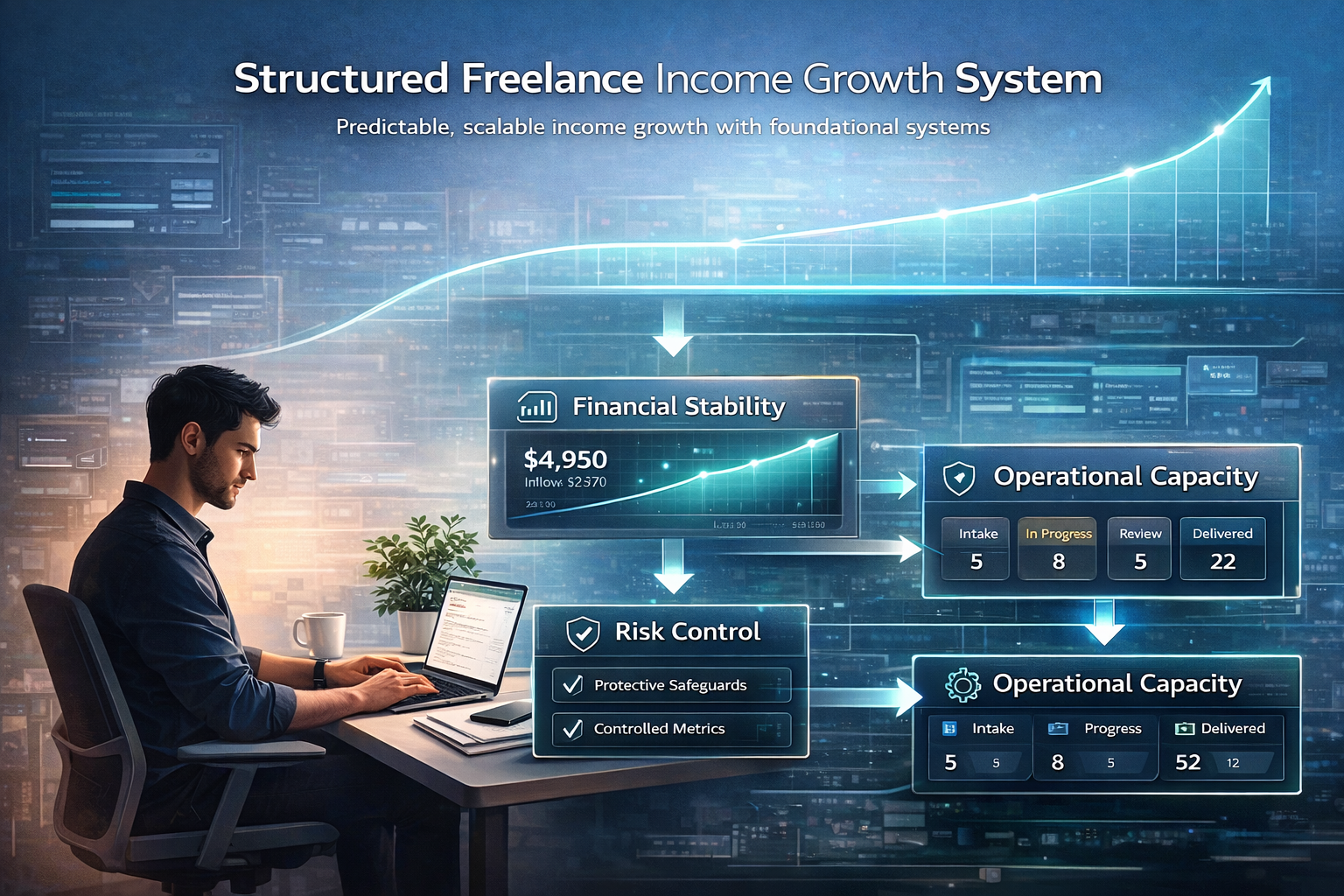
Income growth is not what most freelancers think it is.
What looks like progress is often just volatility in disguise.
Start Here Before Trying to Increase Your Freelance Income
Most freelancers try to grow income by increasing effort — taking on more clients, raising rates, or working longer hours.
If your work is unstructured, improving productivity without a system will only increase effort without improving output.
But without underlying systems, this approach increases instability instead of reducing it. Growth becomes inconsistent, difficult to sustain, and dependent on constant input.
When growth is attempted without stability → income becomes inconsistent.
When growth happens without risk control → financial pressure increases.
When growth exceeds operational capacity → burnout follows.
This is why income growth often feels temporary. It rises quickly, but collapses under pressure — forcing freelancers back into reactive work cycles.
The real problem is not income — it’s system order.
Freelancers do not struggle to grow income because opportunities are limited.
They struggle because growth is attempted before stability, risk control, and capacity are established.
This is where most financial advice breaks down.
It treats income as something to increase directly, instead of something that emerges from a structured system.
In practice, income growth is not something you force.
It is something that becomes possible only after the underlying systems are working together.
How Freelance Income Growth Actually Works (System Flow)
How Systems Remove Constraints That Limit Income Growth
Income growth becomes possible only when the constraints limiting it are removed. These constraints are not always visible, but they define how far income can expand.
Financial instability limits retention. Risk exposure limits expansion. Operational bottlenecks limit capacity. Systems exist to remove each of these constraints systematically.
Once constraints are removed, growth is no longer forced. It becomes a natural outcome of a system that is designed to support expansion.
Income growth is not driven by effort alone.
It is the result of a system where financial stability, risk control, and operational capacity work together to support expansion.
At this stage, income becomes an output of the system — not something that needs to be chased.
Growth happens when constraints are removed and the system allows income to expand naturally.
Stability → Risk Control → Capacity → Structured Growth
Stability System — Ensures income can be retained and not lost through volatility.
Risk Control System — Prevents growth from increasing financial pressure or instability.
Capacity System — Allows income to scale without exceeding time and energy limits.
When these systems are aligned, income growth becomes predictable and repeatable.
When they are not, growth becomes unstable and difficult to sustain.
Why Most Freelancers Hit Income Ceilings
Income ceilings occur when growth is constrained by systems that have not evolved.
Freelancers often increase effort to push beyond these limits, but without system upgrades, this only increases pressure without increasing sustainable income.
Breaking through income ceilings requires system changes, not effort increases. It requires removing bottlenecks and expanding capacity through structured systems.
How Freelance Income Growth Is Applied (Execution Layer)
Without this layer, tools remain unused, plans remain theoretical, and financial progress remains inconsistent.
Once the income growth system is in place, the next step is applying it through structured execution.
At this stage, growth is no longer driven by effort alone — it is supported by repeatable workflows and controlled income mechanisms.
Execution focuses on how income is expanded without increasing instability.
Instead of chasing opportunities, freelancers operate through systems that generate, convert, and retain income consistently.
Generation → Conversion → Retention → Compounding Growth
Income Generation Systems — Create consistent opportunities without relying on constant outreach or urgency.
Income Conversion Systems — Turn opportunities into paying clients through structured processes instead of unpredictable outcomes.
Income Retention Systems — Ensure income compounds by increasing client lifetime value and reducing income drop-offs.
When these mechanisms are in place, income growth becomes stable and repeatable.
Without them, growth depends on inconsistent effort and short-term wins.
From Linear Income to Compounding Growth Systems
Most freelancers operate in a linear income model, where income is directly tied to time and effort.
In this model, growth is limited. Increasing income requires increasing work, which eventually leads to burnout and capacity limits.
System-based growth shifts this model. Income becomes partially decoupled from effort, allowing growth to compound through retention, optimization, and automation.
How AI Enables Scalable Income Systems
AI plays a critical role in scaling income systems by reducing manual effort and increasing consistency.
It enables automation, improves decision-making, and allows workflows to operate without constant intervention.
This allows freelancers to scale income without increasing workload proportionally, making growth sustainable and repeatable.