
How Freelancers Manage Irregular Income (Cash Flow, Planning & Stability)
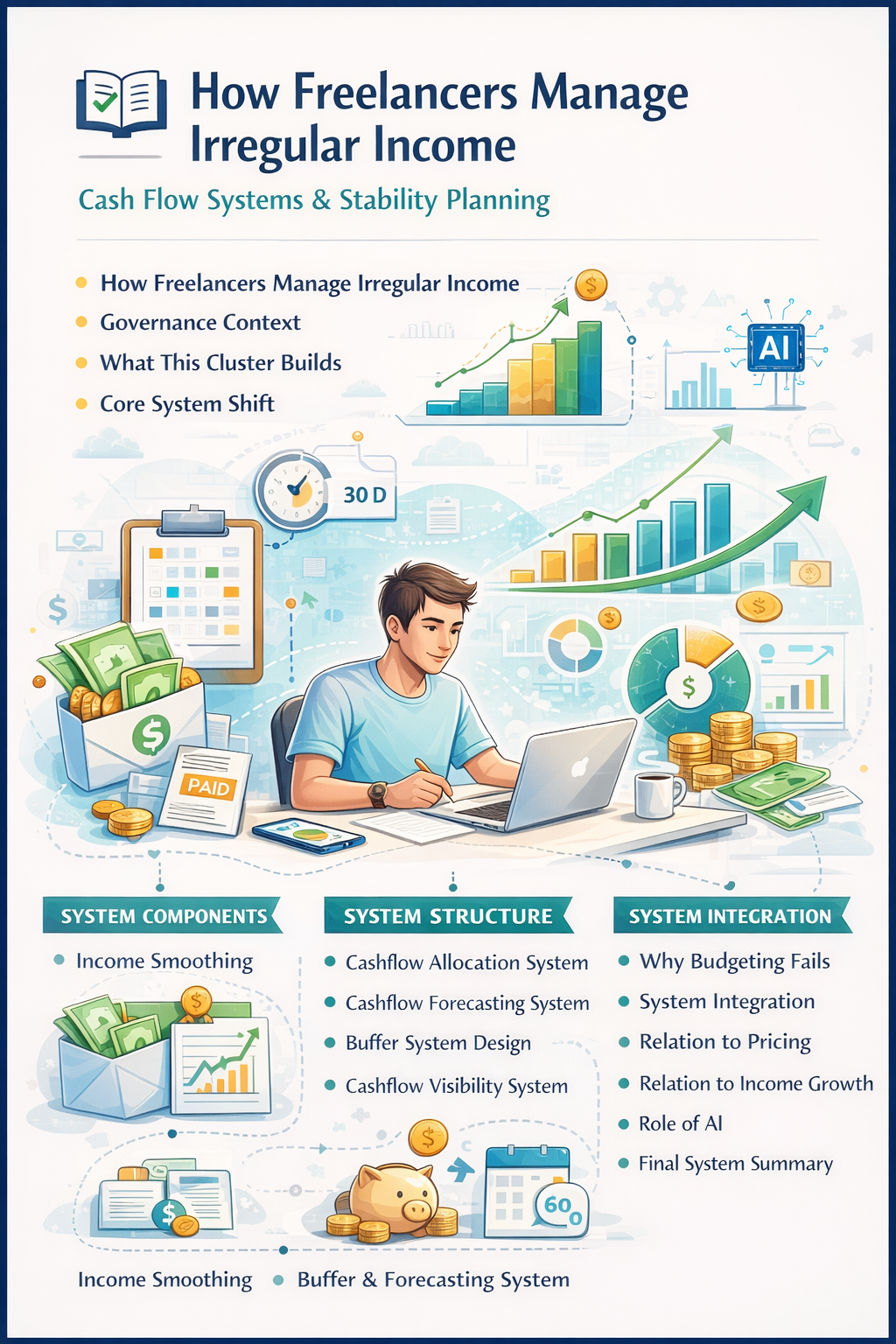
Freelancers don’t struggle because income is irregular.
They struggle because their financial systems are not designed to handle irregular income.
This is the core transition from the previous cluster:
How Do Freelancers Manage Irregular Income?
Freelancers manage irregular income by using cashflow systems like income smoothing, buffer planning, allocation structures, and forecasting instead of relying on fixed budgets.
👉 If you understand why freelancers struggle with money, the next step is learning how freelancers manage irregular income using systems—not discipline.
👉 Most freelancers don’t fail because of income—they fail because their system cannot handle irregular income.
This page explains exactly how freelancers manage irregular income by building systems that:
- absorb variability
- stabilize cashflow
- create predictability without fixed income
👉 This guide shows exactly how freelancers manage irregular income using systems—not guesswork.
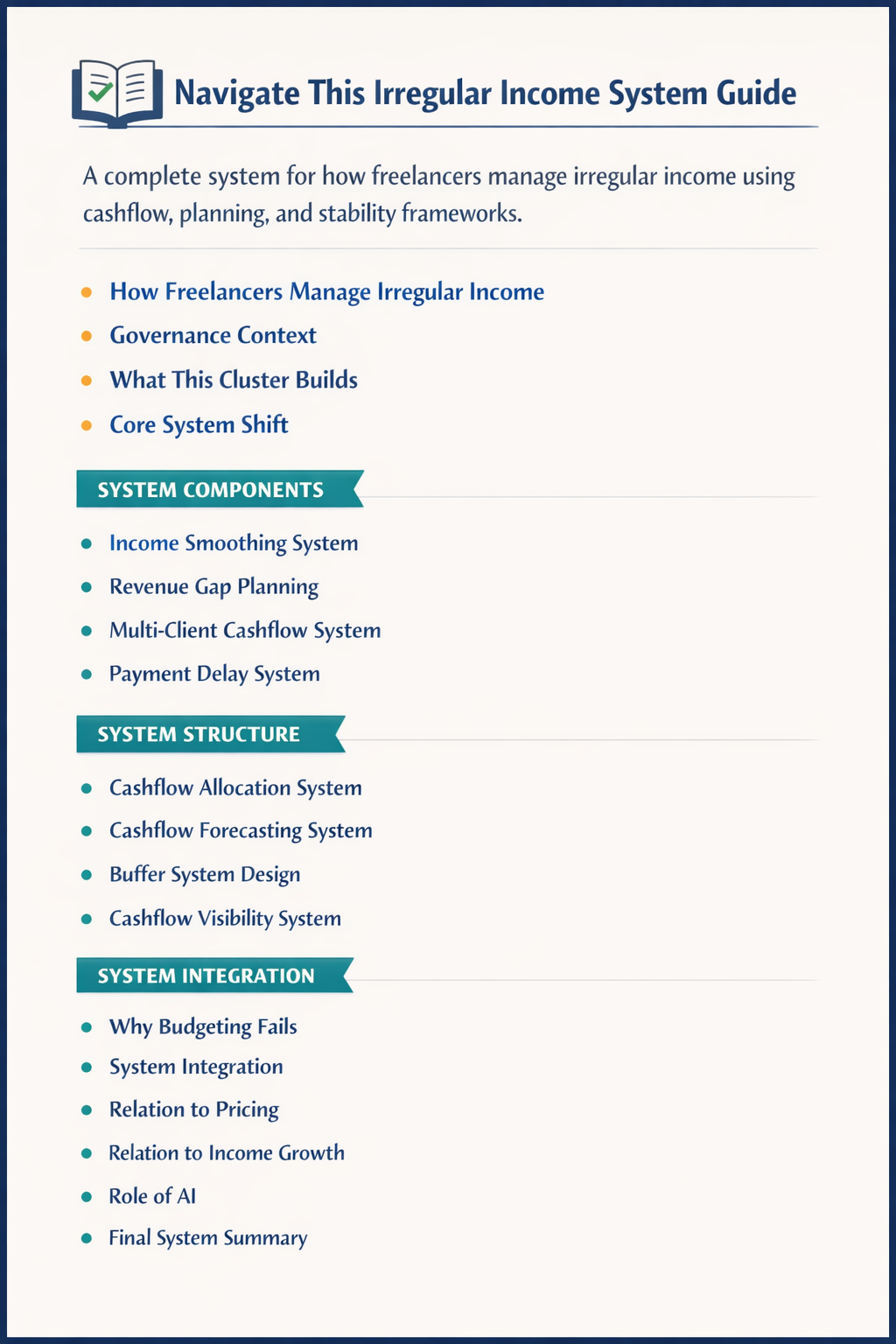
📑 Navigate This Irregular Income System Guide
A complete system for how freelancers manage irregular income using cashflow, planning, and stability frameworks.
- How Freelancers Manage Irregular Income
- Governance Context
- What This Cluster Builds
- Core System Shift
- SYSTEM COMPONENTS
- Income Smoothing System
- Revenue Gap Planning
- Multi-Client Cashflow System
- Payment Delay System
- SYSTEM STRUCTURE
- Cashflow Allocation System
- Cashflow Forecasting System
- Buffer System Design
- Cashflow Visibility System
- SYSTEM INTEGRATION
- Why Budgeting Fails
- System Integration
- Relation to Pricing
- Relation to Income Growth
- Role of AI
- Final System Summary
🔷 SECTION 1 — How Freelancers Manage Irregular Income
👉 Freelancers manage irregular income by designing systems that convert variability into stability.
The question is not whether income fluctuates.
Freelancing is inherently variable.
The real question is:
Most freelancers attempt to manage irregular income using:
- budgets
- saving discipline
- reactive adjustments
But these approaches assume stability.
👉 Irregular income cannot be managed using stable-income systems
This is why freelancers experience:
- income spikes followed by stress
- good months that don’t translate into long-term stability
- financial pressure despite earning enough
Understanding how freelancers manage irregular income requires shifting from:
Control → System Design
Because control is temporary.
Systems are persistent.
🔍 WHY IRREGULAR INCOME FEELS UNMANAGEABLE
Irregular income creates a perception of instability because most financial decisions are based on recent income, not system capacity.
Freelancers often make decisions using:
- last payment received
- current bank balance
- short-term expectations
This creates a distorted financial picture.
👉 Recent income ≠ sustainable financial capacity
This is a critical misunderstanding in how freelancers manage irregular income.
⚠️ SYSTEM MISALIGNMENT
The instability freelancers feel is not caused by income variability itself.
It is caused by:
- lack of time-based income distribution
- absence of cashflow systems
- reactive financial behavior
This aligns directly with the system failures explained in why freelancers struggle with money.
—🔷 SECTION 2 — GOVERNANCE CONTEXT
This cluster is the first operational layer after understanding system failures.
It answers the practical question:
Unlike traditional finance content, this page does not focus on:
- monthly budgeting
- fixed saving rules
- generic financial advice
Instead, it builds:
- cashflow systems
- income smoothing mechanisms
- planning under uncertainty
This makes it structurally different.
👉 It replaces static financial thinking with dynamic system behavior
This cluster connects directly to:
🔍 WHY THIS CLUSTER IS CRITICAL
Most financial content skips the system layer and jumps directly into tactics.
This creates a gap between:
Advice → Application → Results
This cluster closes that gap by focusing on:
- system design
- financial behavior modeling
- decision frameworks
🧠 SYSTEM-FIRST APPROACH
Instead of asking:
“What should I do with my money?”
This cluster answers:
This shift is what enables freelancers to manage irregular income consistently.
🔗 STRATEGIC CONNECTION
This cluster integrates with:
—🔷 SECTION 3 — WHAT THIS CLUSTER BUILDS
👉 This cluster builds financial stability without requiring stable income.
To understand how freelancers manage irregular income, you must understand what stability actually means.
Stability is not:
- fixed income
- predictable earnings
- consistent monthly cashflow
Stability is:
This cluster builds that ability through structured systems.
🔧 SYSTEM OUTPUTS
- predictable spending capacity
- controlled financial decisions
- reduced stress during low-income periods
⚠️ COMMON MISUNDERSTANDING
Freelancers often believe:
More income = more stability
But:
👉 Income without structure increases volatility
This explains why freelancers struggle even at higher income levels.
🔍 STABILITY VS PREDICTABILITY
Freelancers often confuse stability with predictability.
But these are fundamentally different concepts:
| Predictability | Stability |
|---|---|
| Fixed income | Controlled system |
| Known outcomes | Managed variability |
⚠️ WHY THIS MATTERS
When freelancers chase predictability, they:
- overwork to stabilize income
- depend on fewer clients
- increase risk exposure
But when they build stability systems, they:
- absorb variability
- reduce pressure
- improve decision quality
🧠 SYSTEM OUTCOME
Stable system → Predictable decisions → Reduced financial stress
🔷 SECTION 4 — CORE SYSTEM SHIFT
👉 Managing irregular income requires shifting from budgeting to cashflow systems.
Traditional financial systems are built on one assumption:
Income is predictable
Freelancing breaks this assumption.
As a result, traditional systems fail.
⚖️ CONTRAST
| Traditional System | Freelancer System |
|---|---|
| Monthly budget | Cashflow system |
| Fixed income planning | Variable income planning |
| Static allocation | Dynamic allocation |
🧠 KEY SHIFT
This is the foundation of how freelancers manage irregular income.
👉 Without this shift, every system breaks under variability
From this point forward, everything in this cluster builds on:
- cashflow visibility
- timing alignment
- system-driven decisions
For deeper financial system insights, refer to cash flow fundamentals.
🔍 WHY CASHFLOW SYSTEMS WORK
Cashflow systems are effective because they operate on timing—not assumptions.
Unlike budgets, which rely on expected income, cashflow systems respond to:
- actual income inflow
- real-time availability
- priority-based allocation
⚙️ CORE COMPONENTS OF CASHFLOW SYSTEMS
- income timing tracking
- allocation sequencing
- buffer integration
- decision checkpoints
📊 PRACTICAL APPLICATION
Instead of setting a monthly budget, freelancers operate using:
- available cashflow windows
- priority-based spending decisions
- adaptive financial planning
This is a fundamental shift in how freelancers manage irregular income.
To understand how cashflow differs from traditional budgeting, refer to cash flow fundamentals.
🧠 SYSTEM TRANSFORMATION
🔷 SECTION 5 — How Freelancers Manage Irregular Income with Smoothing Systems
👉 How freelancers manage irregular income starts with smoothing income into usable cashflow.
The first challenge freelancers face is not earning money.
It is making that income usable over time.
This is where most systems fail.
🧠 WHAT IS INCOME SMOOTHING
Income smoothing is the process of:
- distributing income across time
- reducing volatility in spending
- creating consistency from variability
Example:
- Earn $6,000 in one month
- Use across 2–3 months strategically
This is how freelancers manage irregular income without needing consistent earnings.
⚠️ WHY FREELANCERS STRUGGLE WITHOUT SMOOTHING
- spend based on recent income
- overestimate financial capacity
- face stress in low-income periods
👉 Without smoothing, income spikes create instability—not security
🔧 SYSTEM COMPONENTS
- buffer allocation layer
- time-based distribution
- controlled withdrawal system
To understand broader financial behavior systems, refer to income smoothing principles.
🔗 SYSTEM CONNECTION
👉 Once income is smoothed, the next challenge is managing gaps between income cycles.
🔍 WHY INCOME SMOOTHING IS THE FOUNDATION
Income smoothing is not just a tactic—it is the foundation of how freelancers manage irregular income at a system level.
Without smoothing, every financial decision becomes dependent on:
- recent income spikes
- short-term availability
- emotional reactions to cash balance
👉 Income without smoothing creates decision volatility
⚙️ ADVANCED SMOOTHING MODEL
High-performing freelancers extend smoothing beyond simple distribution:
- time-based allocation (weekly / biweekly release)
- income categorization before usage
- buffer-first allocation before spending
This creates a controlled flow of money instead of reactive spending.
📊 SYSTEM APPLICATION
Instead of asking:
“How much did I earn?”
The system asks:
This shift is critical in how freelancers manage irregular income consistently.
🔗 STRATEGIC CONNECTION
This system directly supports:
- Cashflow allocation systems
- Buffer system design
- System failure patterns
🔷 SECTION 6 — REVENUE GAP PLANNING
👉 Freelancers manage irregular income by planning for gaps before they happen.
Income gaps are not unexpected in freelancing.
They are inevitable.
🧠 WHAT ARE REVENUE GAPS
- time between client payments
- periods without active projects
- delays in onboarding new clients
⚠️ WHY FREELANCERS STRUGGLE WITH GAPS
- planning based on best-case income
- ignoring variability patterns
- reacting only after income stops
👉 Gaps create stress only when they are not anticipated
🔧 GAP PLANNING SYSTEM
- identify average gap duration
- build gap-specific buffers
- align expenses with gap cycles
This is a core part of how freelancers manage irregular income effectively.
📉 GAP IMPACT WITHOUT SYSTEM
Income gap → Panic → Reactive decisions → Financial pressure
🔗 SYSTEM CONNECTION
- Income smoothing system
- Cashflow allocation
- AI forecasting tools
👉 Managing gaps becomes easier when income is distributed across multiple sources.
This is where most freelancers lose control without realizing it.
🔍 WHY GAP PLANNING FAILS WITHOUT STRUCTURE
Freelancers often recognize income gaps—but fail to plan for them structurally.
This leads to:
- temporary adjustments instead of system-level planning
- over-reliance on savings
- stress-driven financial decisions
👉 Awareness of gaps is not enough—systems must absorb them
⚙️ ADVANCED GAP PLANNING
Effective gap planning includes:
- mapping income frequency across clients
- identifying recurring gap patterns
- aligning fixed expenses with worst-case scenarios
📊 GAP CYCLE MODEL
Income Period → Gap → Recovery → Stabilization → Repeat
Understanding this cycle helps freelancers manage irregular income proactively instead of reactively.
🧠 DECISION IMPACT
🔗 SYSTEM CONNECTION
- Forecasting systems
- Buffer systems
- AI tools for income prediction
🔷 SECTION 7 — MULTI-CLIENT CASHFLOW SYSTEM
👉 Freelancers manage irregular income by reducing dependency on a single income source.
One of the biggest risks in freelancing is income concentration.
👉 One client = one point of failure
This directly impacts how freelancers manage irregular income.
🧠 MULTI-CLIENT SYSTEM
- multiple income streams
- different payment cycles
- distributed revenue timing
⚖️ CONTRAST
| Single Client | Multi-Client System |
|---|---|
| high dependency | distributed risk |
| income shocks | smoother cashflow |
⚠️ COMMON ISSUE
- income peaks but not stability
- over-reliance on top client
- irregular payment alignment
👉 More income sources ≠ stability unless structured properly
🔧 SYSTEM STRUCTURE
- staggered client payments
- mixed income types (retainer + project)
- timing diversification
🔗 SYSTEM CONNECTION
- Pricing systems
- Income smoothing
- Cashflow timing systems
👉 Even with multiple clients, payment timing still creates instability.
🔷 SECTION 8 — PAYMENT DELAY SYSTEM
👉 Payment delays are one of the main reasons why freelancers struggle with money despite earning.
Freelancers often assume income equals stability.
But in reality:
🧠 PAYMENT DELAY PROBLEM
- invoices paid after 30–60 days
- expenses occur immediately
- cashflow mismatch occurs
⚠️ WHY THIS MATTERS
- forces use of savings
- creates artificial scarcity
- increases stress
👉 Freelancers struggle not because of income — but because of timing misalignment
🔧 PAYMENT DELAY SYSTEM
- invoice scheduling strategy
- partial payments or advances
- buffer alignment for delays
⚖️ CONTRAST
| Without System | With System |
|---|---|
| reactive cashflow | planned inflow timing |
| stress during delays | buffered stability |
For deeper insights on payment systems, see cash flow management research.
🔗 SYSTEM CONNECTION
- AI Tools Hub
- Best AI Tools
- Cashflow forecasting
🔍 WHY PAYMENT DELAYS DESTROY SYSTEM STABILITY
Payment delays are not just an inconvenience—they disrupt how freelancers manage irregular income at a system level.
This happens because:
- expenses are time-fixed
- income is time-variable
- cashflow alignment breaks
👉 Payment delays are a core reason why freelancers struggle to manage irregular income despite earning enough
⚙️ ADVANCED PAYMENT SYSTEM DESIGN
Freelancers can reduce timing risk and better manage irregular income through:
- milestone-based payments
- upfront deposits
- shortened invoice cycles
📊 TIMING ALIGNMENT MODEL
Expense timing ↔ Income timing → Cashflow stability
This alignment is a critical part of how freelancers manage irregular income effectively.
🧠 DECISION IMPACT
For deeper insights on small business cashflow timing, refer to cash flow management research.
🔗 SYSTEM CONNECTION
- Cashflow forecasting
- Buffer system design
- AI tools for invoice automation
- why freelancers struggle with money
🔍 WHY BUDGETING FEELS RIGHT BUT FAILS
Budgeting feels logical because it provides a sense of control.
However, that control is based on assumptions:
- income consistency
- stable timing
- predictable behavior
Freelancers operate outside these assumptions, which is why traditional budgeting breaks when applied to how freelancers manage irregular income.
👉 This is why freelancers struggle to manage irregular income using traditional budgeting systems
⚙️ BEHAVIORAL IMPACT
When budgets fail, freelancers experience:
- loss of confidence
- frequent resets
- decision fatigue
This creates a cycle where freelancers try to control irregular income using systems that were never designed for variability.
🔗 STRATEGIC CONNECTION
This directly connects to the broader system failure explained in: