AI-Based Capacity Planning & Workload Governance for Freelancers
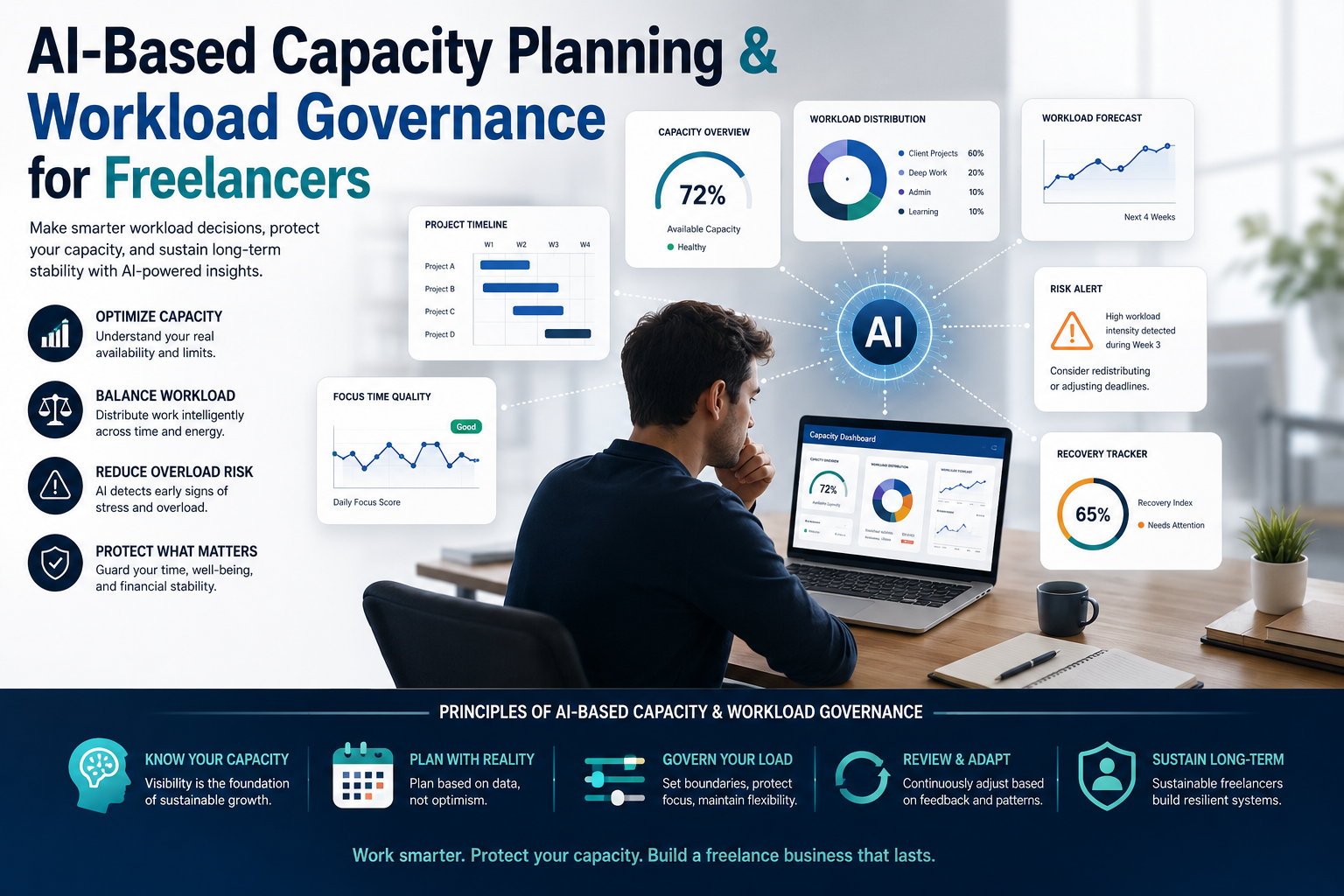
AI-Based Capacity Planning becomes necessary when freelancer environments stop failing visibly and start failing silently through accumulated workload pressure.
Many freelancers assume overload only becomes dangerous once burnout, missed deadlines, or operational breakdown becomes obvious.
In reality, instability usually begins much earlier.
Recovery flexibility narrows quietly.
Decision quality degrades gradually.
Execution pressure compounds invisibly.
Adaptive range weakens over time.
At first, these changes often appear manageable.
Income may still be increasing.
Clients may still remain satisfied.
Projects may still be delivered successfully.
Yet underneath, the freelancer environment may already be shifting from:
stable with resilience
to:
stable through continuous pressure absorption.
This distinction matters deeply because freelancers rarely operate inside fixed environments with predictable recovery conditions.
Projects become harder to step away from.
Downtime begins creating subtle anxiety.
Recovery starts feeling expensive.
Even successful periods carry low-level urgency that did not previously exist.
Within FM Mastery, workload governance is not treated as a productivity topic.
It is treated as a structural survivability system.
AI-Based Capacity Planning exists to evaluate whether the freelancer environment can safely absorb additional workload pressure without silently degrading recovery resilience, reversibility, execution quality, financial stability, and long-term adaptability.
This sub-cluster explains why unmanaged workload becomes a hidden instability mechanism, how execution overload compounds beneath growth, and why AI-assisted workload governance is increasingly necessary inside irregular income systems.
AI-Based Capacity Planning helps freelancers evaluate whether workload demand, recovery pressure, and execution complexity can be sustained safely without degrading adaptability, financial stability, structural resilience, or delivery reliability.
Higher Workload Demand
↓
Reduced Recovery Flexibility
↓
Decision Fatigue Accumulation
↓
Execution Rigidity
↓
Continuity Dependence
↓
Hidden Structural Fragility
↓
More Commitments
↓
Reduced Recovery Space
↓
Persistent Operational Vigilance
↓
Execution Compression
↓
Recovery Compression
↓
Decision Fatigue
↓
Delivery Instability
↓
Financial Volatility
Why Freelancers Misinterpret Workload Pressure
Freelancers commonly interpret rising workload pressure as a productivity issue.
When execution strain increases, the default explanations usually become:
- poor time management
- lack of discipline
- workflow inefficiency
- insufficient focus
- weak prioritization
These explanations are often incomplete.
Within FM Mastery, unmanaged workload is treated primarily as a structural and financial instability risk.
This is because execution overload rarely remains operational for long.
Once recovery flexibility narrows consistently, instability begins spreading into:
- delivery reliability
- cashflow timing
- decision resilience
- client consistency
- income predictability
- adaptive flexibility
The freelancer environment may still appear highly productive externally while internally becoming increasingly dependent on sustained overextension.
This creates a fragile operating structure where continuity depends more on pressure absorption than structural resilience.
The instability architecture explored earlier across:
- The Hidden Costs of Leverage
- Why Scaling Without Volatility Is Structurally Rare
- Capacity vs Ambition
already established how fragility accumulates through:
- reduced reversibility
- scaling asymmetry
- execution compression
- hidden overload accumulation
AI-Based Capacity Planning extends that framework into operational governance and workload survivability.
This approach is part of the broader AI-Powered Money Management pillar designed to help freelancers preserve stability under irregular income conditions.
The Real Problem Is the Absence of Capacity Governance
Most freelancers evaluate workload emotionally rather than structurally.
Questions often become:
- Can I handle more work?
- Can I push harder temporarily?
- Can I manage this deadline?
- Can I sustain this pace a little longer?
These questions measure willingness.
Workload governance evaluates survivability instead.
Within FM Mastery, workload tolerance is not measured only by whether tasks can technically be completed.
It is measured by whether execution pressure can be absorbed without:
- recovery degradation
- decision collapse
- delivery instability
- emotional compression
- cashflow volatility
- continuity dependence
This distinction is critical because freelancers frequently maintain high performance long after operational resilience has already started weakening underneath.
Income may still rise.
Client demand may still increase.
Projects may still appear stable externally.
Yet underneath, recovery bandwidth, adaptability, and decision clarity may already be narrowing significantly.
This is how workload pressure quietly becomes financial instability.
Missed recovery cycles eventually affect:
- delivery timing
- client trust
- workflow consistency
- billing regularity
- cashflow predictability
- decision quality
AI-assisted governance becomes increasingly valuable because human self-assessment becomes unreliable under sustained growth pressure.
Freelancers often normalize overload gradually.
Constant urgency begins feeling standard.
Compressed recovery feels temporary.
Persistent vigilance becomes routine.
Execution strain starts appearing normal.
This creates one of the most dangerous instability patterns inside freelancer systems:
high output masking structural degradation.
Why AI Improves Capacity Governance
AI-Based Capacity Planning becomes valuable because overload accumulation is difficult for humans to evaluate objectively while operating inside sustained pressure.
Freelancers adapt gradually to rising execution intensity.
What initially feels stressful eventually becomes normalized through repetition.
This adaptation creates blind spots.
Recovery compression may no longer feel unusual.
Decision fatigue may appear manageable.
Operational vigilance may start feeling necessary rather than destabilizing.
AI-assisted governance helps externalize these hidden instability signals.
Instead of relying entirely on emotional interpretation, freelancers can identify:
- workload congestion patterns
- recovery instability cycles
- timing compression trends
- decision saturation points
- execution bottlenecks
- delivery strain accumulation
This matters because humans frequently interpret survivability pressure emotionally rather than structurally.
AI systems improve governance by identifying recurring overload patterns before instability becomes difficult to reverse safely.
Within FM Mastery, AI is not positioned as a productivity replacement.
It functions as a governance layer designed to improve visibility around hidden workload fragility and execution instability.
The AI-Based Capacity Planning System Explained
Within FM Mastery, AI-Based Capacity Planning evaluates whether workload demand can be absorbed safely without destabilizing the freelancer environment over time.
The objective is not maximizing productivity endlessly.
The objective is preserving operational survivability while workload complexity expands.
This usually requires evaluating five structural dimensions simultaneously.
1. Workload Intensity
Freelancers often underestimate how quickly execution pressure compounds through overlapping commitments.
AI-assisted governance helps identify:
- delivery congestion
- overlapping timelines
- sustained pressure cycles
- workflow saturation patterns
- execution bottlenecks
Instability rarely emerges from one isolated task.
It emerges from cumulative pressure accumulation across multiple obligations simultaneously.
2. Recovery Flexibility
Recovery resilience is one of the most overlooked stability variables inside freelancer environments.
AI-Based Capacity Planning evaluates whether the environment still preserves:
- adaptive flexibility
- recovery space
- downtime tolerance
- decision neutrality
- cognitive recovery cycles
When recovery flexibility narrows consistently, the environment becomes increasingly dependent on uninterrupted continuity to maintain equilibrium.
3. Decision Density
Scaling workload rarely increases execution pressure alone.
It also increases decision complexity.
Freelancers begin managing:
- more communication variables
- more timing dependencies
- more client coordination
- more financial synchronization
- more operational uncertainty
AI-assisted governance helps identify when decision load itself becomes destabilizing.
4. Operational Reversibility
Healthy freelancer environments preserve the ability to slow down safely.
Workload governance evaluates whether freelancers can still:
- reduce commitments safely
- recover without operational damage
- decline projects without instability
- adapt during variability
- preserve execution flexibility
Once reversibility narrows, workload pressure becomes structurally dangerous because continuity dependence begins replacing resilience.
5. Continuity Dependence
Eventually, unmanaged workload creates environments that require uninterrupted execution simply to remain stable.
At this stage:
- downtime creates anxiety
- slow inbox periods feel threatening
- recovery carries emotional guilt
- interruptions create larger consequence
- responsiveness becomes compulsive
This is where workload pressure transforms into execution fragility.
Why Freelancers Often Miss Capacity Collapse Until Late
Execution overload rarely announces itself dramatically in the beginning.
Most freelancers continue producing strong output long after survivability margins have already started narrowing underneath.
This creates a dangerous illusion:
continued productivity becomes mistaken for structural stability.
Within FM Mastery, productivity and resilience are evaluated separately.
A freelancer may continue:
- delivering projects successfully
- earning more income
- maintaining client satisfaction
- appearing externally stable
while internally becoming:
- less adaptable
- less reversible
- more emotionally compressed
- more execution-dependent
- more operationally rigid
This is why many freelancers experience sudden instability during periods that externally appear highly successful.
The instability did not appear suddenly.
The overload had already been accumulating underneath for much longer.
AI-assisted workload governance becomes valuable because it identifies compression patterns before visible instability appears externally.
The objective is not eliminating workload pressure entirely.
The objective is preventing invisible overload accumulation from quietly destabilizing the freelancer environment over time.
How Workload Quietly Becomes a Financial Instability Mechanism
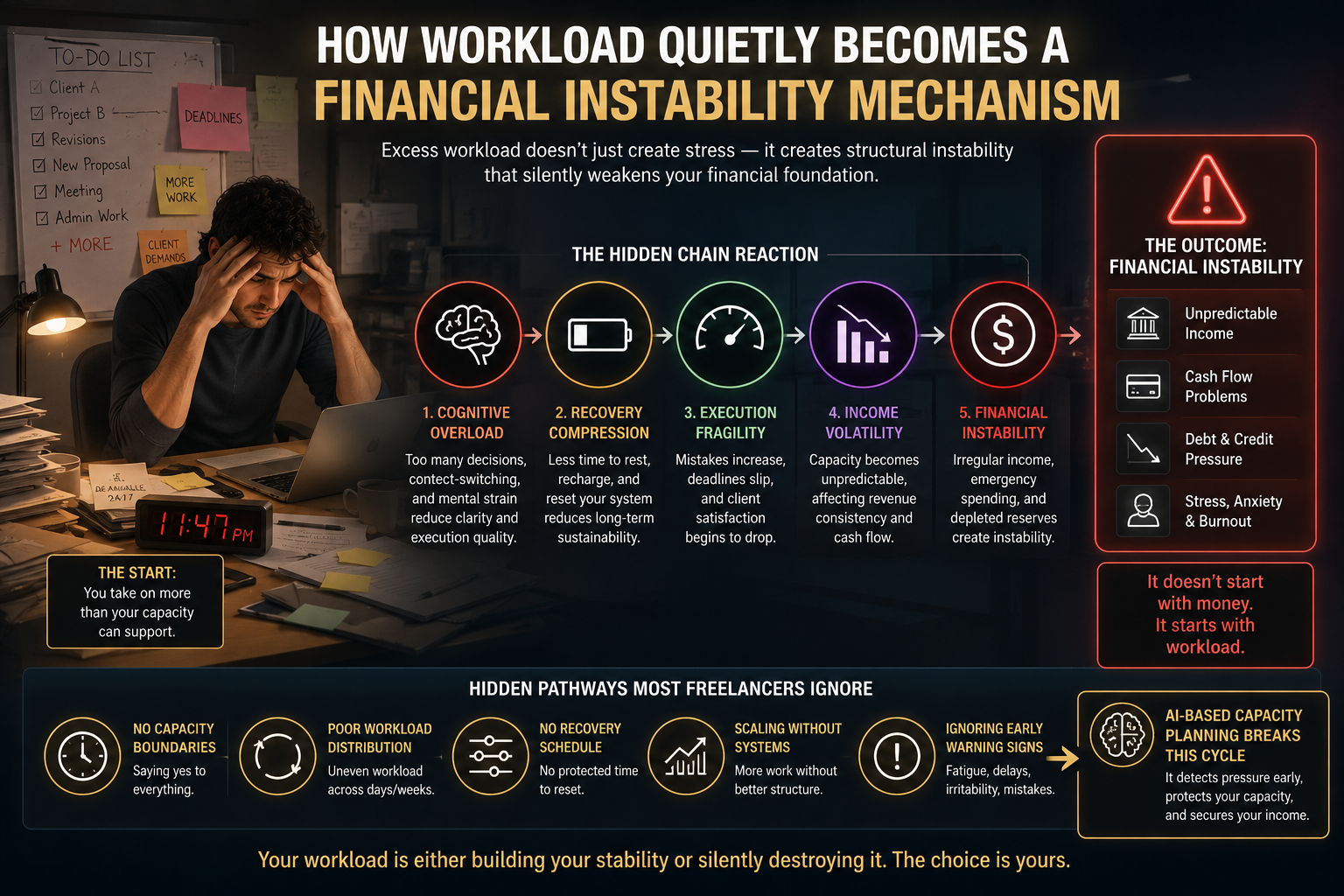
Workload instability often appears behaviorally before financial instability becomes obvious.
Freelancers frequently begin noticing:
- persistent recovery fatigue
- difficulty mentally disengaging after work
- constant background urgency
- fear of reducing responsiveness
- difficulty tolerating unscheduled downtime
- recovery guilt during slow periods
- compressed recovery cycles
- constant continuity monitoring
- reduced flexibility around decision-making
These patterns matter because they indicate that workload pressure is no longer being absorbed through resilience.
It is being absorbed through sustained overextension.
The progression usually unfolds gradually.
Stage 1 — Workload Expands During Growth
More opportunities create additional commitments and execution complexity.
Stage 2 — Recovery Flexibility Narrows
The freelancer environment begins sacrificing recovery space to preserve continuity.
Stage 3 — Vigilance Becomes Persistent
Operational calm now depends heavily on uninterrupted execution.
Stage 4 — Decision Quality Compresses
Fatigue, timing pressure, and cognitive saturation gradually reduce adaptability.
Stage 5 — Financial Instability Reappears
Missed recovery cycles eventually affect:
- delivery reliability
- cashflow consistency
- client trust
- income stability
- decision resilience
This is how unmanaged workload quietly transforms into financial instability.
Workload Governance Is a Structural Survivability System
Within FM Mastery, workload governance is not treated as productivity optimization.
It is treated as structural risk containment.
This distinction matters because freelancer environments operate under:
- irregular income variability
- recovery uncertainty
- execution asymmetry
- continuity pressure
- high decision density
Without explicit governance, freelancers often substitute personal overextension for resilience.
The environment may continue functioning temporarily while survivability margins quietly narrow underneath.
AI-Based Capacity Planning introduces external pattern recognition into this process.
Instead of relying entirely on emotional self-assessment, freelancers can evaluate:
- workload sustainability
- recovery compression
- workflow saturation
- execution volatility
- decision fatigue accumulation
This extends the instability architecture developed earlier across:
- The Hidden Costs of Leverage
- Why Scaling Without Volatility Is Structurally Rare
- Capacity vs Ambition
Those layers explained how fragility accumulates externally.
AI-assisted workload governance explains how instability compounds internally through unmanaged execution pressure and recovery compression.
Early Signs That Workload Is Quietly Becoming Structurally Dangerous
Execution overload usually appears gradually before obvious operational instability becomes visible.
Common warning signals include:
- difficulty recovering fully between delivery cycles
- persistent background urgency
- fear of reducing responsiveness
- constant continuity monitoring
- difficulty creating genuine downtime
- decision fatigue accumulation
- compulsive responsiveness
- emotional urgency during slow inbox periods
- growing dependence on uninterrupted execution
These signals do not necessarily indicate immediate collapse.
They indicate that the freelancer environment is becoming increasingly dependent on sustained pressure absorption to preserve stability.
That dependence is what quietly transforms workload into execution fragility.
Additional Structural References
Where This Fits Inside the Instability Authority System
This sub-cluster extends the instability architecture from:
financial fragility
→ scaling asymmetry
→ execution compression
→ workload governance
It directly follows:
That layer explained how freelancers quietly exceed structural tolerance during growth periods.
This layer explains how unmanaged workload transforms into hidden instability through recovery compression, execution rigidity, and continuity dependence.
The authority graph now progresses through:
- income instability
- hidden fragility
- leverage amplification
- scaling asymmetry
- capacity distortion
- workload governance
This creates a highly differentiated FM-native authority framework focused on structural survivability rather than generic productivity optimization.
Frequently Asked Questions
What is AI-Based Capacity Planning for freelancers?
AI-Based Capacity Planning helps freelancers evaluate whether workload demand, recovery pressure, and execution complexity can be sustained safely without destabilizing financial stability or operational resilience.
Why is workload governance important for freelancers?
Without workload governance, freelancers often rely on sustained overextension to preserve continuity, creating hidden instability through recovery compression and execution fragility.
How does workload become a financial instability problem?
Execution overload eventually affects delivery reliability, decision quality, client consistency, billing timing, and income predictability, transforming workload pressure into financial volatility.
What are early signs of execution overload?
Common signs include persistent recovery fatigue, operational vigilance, decision fatigue, fear of slowing down, compulsive responsiveness, and growing dependence on uninterrupted execution.
Why does AI-assisted workload governance matter?
AI-assisted governance helps identify overload patterns objectively before freelancers normalize sustained pressure and hidden instability internally.
The Hidden Risk Is Not Hard Work — It Is Ungoverned Load
Hard work itself is not structurally dangerous.
The hidden risk appears when workload expands without sufficient:
- recovery flexibility
- operational slack
- reversibility
- adaptive resilience
- execution governance
Freelancer environments can tolerate periods of elevated pressure.
What they cannot tolerate indefinitely is continuous overload absorbed through:
- recovery suppression
- decision compression
- constant vigilance
- adaptability loss
- continuity dependence
Within FM Mastery, AI-Based Capacity Planning exists to preserve structural survivability while workload pressure expands.
The objective is not eliminating ambition or growth.
The objective is preventing hidden overload accumulation from quietly destabilizing the freelancer environment over time.
Continue Exploring Structural Instability Systems
This sub-cluster is part of the Managing Irregular Income authority system inside the AI-Powered Money Management pillar.
As freelancer systems scale, workload governance becomes increasingly important because instability often re-enters through execution overload long before financial collapse becomes visible externally.
Related instability layers:
- The Hidden Costs of Leverage
- Why Scaling Without Volatility Is Structurally Rare
- Capacity vs Ambition
The objective is not maximizing output endlessly.
The objective is preserving adaptability, reversibility, and structural resilience while workload expands.
Freelancer instability rarely begins with obvious collapse.
More often, it begins through gradual recovery compression, operational vigilance, and sustained pressure absorption that slowly narrows survivability margins underneath continued productivity.
AI-Based Capacity Planning exists to identify those compression patterns before overload becomes difficult to reverse safely.
Within FM Mastery, recognizing workload as a structural survivability variable is not pessimism.
It is operational awareness.