
AI Debt Repayment System
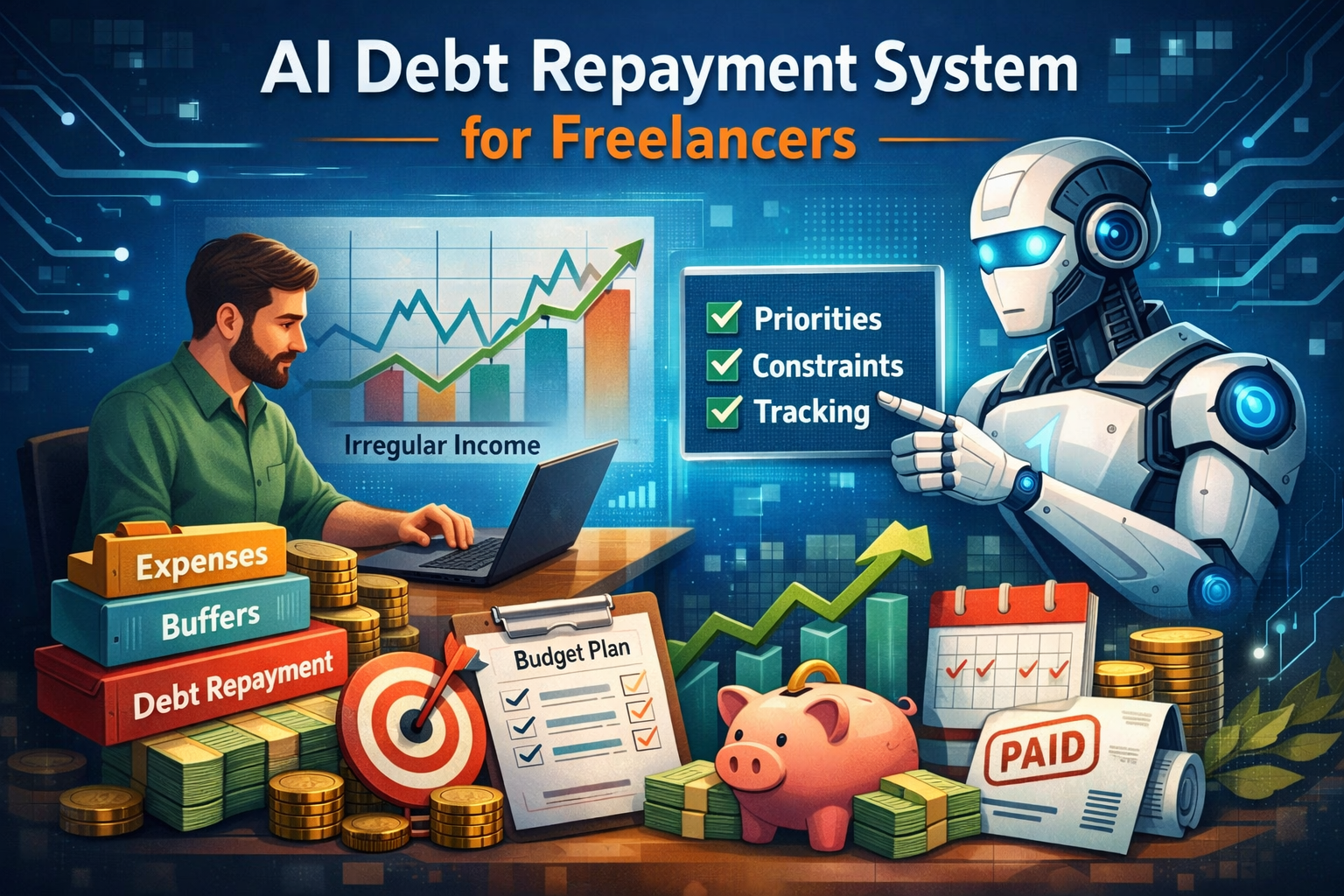
An AI debt repayment system is a structured financial framework designed to eliminate debt without increasing instability. It replaces reactive repayment decisions with controlled financial execution tailored for irregular income conditions.
Freelancers struggle with debt not because they lack repayment intent, but because traditional repayment strategies fail under income variability. This system introduces prioritization logic, repayment sequencing, and risk control mechanisms that function across fluctuating income cycles.
The objective is not aggressive repayment, but controlled elimination. Stability is preserved while debt is reduced, ensuring that financial progress does not create new risk.
Debt Problems for Freelancers
Debt behaves differently in a freelance environment because income is not fixed, predictable, or evenly distributed across time. Traditional debt repayment systems assume stable monthly earnings, which creates a structural mismatch for freelancers operating under irregular income conditions. A related issue is the reliance on short-term financial solutions. This mismatch is the primary reason why standard repayment advice fails to produce consistent outcomes.
For freelancers, debt pressure is not defined only by the total amount owed, but by the timing mismatch between income inflows and repayment obligations. Fixed due dates collide with unpredictable cashflow, creating recurring cycles of stress, missed payments, or reactive financial adjustments. These cycles compound over time, increasing both financial cost and psychological burden.
Another core issue is the absence of temporal distribution. Income is often treated as immediately available rather than being structured across future periods. This results in uneven allocation, where repayments may be overfunded during high-income phases and underfunded during low-income periods. The inconsistency weakens repayment efficiency and prolongs debt timelines.
Freelancers also face fragmented financial decision-making. Without a system, each repayment decision is made in isolation based on current income conditions. This increases cognitive load and reduces consistency. Over time, inconsistent execution becomes the dominant pattern, preventing systematic debt reduction.
In contrast, a structured system aligns repayment with income variability rather than resisting it. This alignment is a core principle within the AI-Enhanced Debt & Credit Optimization system, where debt is managed as part of a broader financial control framework rather than as a standalone problem.
The fundamental issue is not the presence of debt, but the absence of a system designed to handle it under variable income conditions. Without structural alignment, even well-intentioned repayment efforts produce unstable and inefficient results.
The fundamental issue is not the presence of debt, but the absence of a system designed to handle it under variable income conditions. Without structural alignment, even well-intentioned repayment efforts produce unstable, inefficient, and compounding financial outcomes.
Debt Repayment Playbook
System context: This guide sits within the AI-Enhanced Debt & Credit Optimization pillar at FM Mastery and represents the execution layer of debt recovery for freelancers with irregular income.

Why Freelancers Struggle With Debt Repayment (And Why Traditional Plans Fail)
Freelancers don’t usually fall into debt because they overspend recklessly.
They fall into debt because income timing is unpredictable, expenses are rigid, and traditional repayment advice assumes a stable monthly paycheck.
When income fluctuates, debt decisions become emotional. Minimum payments feel safe. Larger repayments feel risky. Credit cards quietly become short-term stabilizers — until interest compounds faster than income recovers.
This is where AI-powered debt repayment systems fundamentally change the equation — not by forcing discipline, but by removing decision fatigue and adapting repayment behavior to real cash-flow patterns.
Judgment: Traditional debt plans fail freelancers not because they lack commitment, but because fixed payments ignore income volatility and amplify stress-driven borrowing.
What Is an AI Debt Repayment Playbook for Freelancers?
An AI debt repayment playbook for freelancers is a structured system that uses adaptive cash-flow forecasting, behavioral rules, and automation to repay debt safely despite irregular income and timing uncertainty.
Unlike rigid payoff plans, this playbook prioritizes stability first and acceleration second.
What “AI Debt Repayment Optimization” Actually Means
This playbook is built around the AI-Guided Debt Repayment Control System™ (2026) — a step-by-step framework that adapts repayment behavior to real freelance cash-flow instead of fixed monthly assumptions.
AI debt repayment optimization does not mean letting an algorithm blindly pay your loans.
It means using systems that:
- Predict near-term cash-flow ranges
- Adjust repayment amounts dynamically
- Prioritize psychological safety over aggressive payoff
- Reduce late fees, utilization spikes, and stress-driven borrowing
For freelancers, the goal is stability first, speed second.
These repayment systems depend on the Smart Budget Alignment System™, explained in our psychology-based guide on AI-Powered Money Management for Freelancers.
Traditional vs AI-Optimized Debt Repayment
Traditional repayment methods assume:
- Fixed monthly payments
- Manual tracking
- Emotion-driven decisions
- High missed-payment risk
AI-optimized repayment systems enable:
- Variable payments aligned to income reality
- Automated monitoring
- Rule-based execution
- Predictive alerts and buffers
AI-Guided Debt Repayment Control System™ — Framework Summary
- Map predictable survival expenses
- Forecast near-term cash-flow ranges
- Set variable repayment rules (not fixed amounts)
- Automate minimum-safe repayments
- Increase payments only during surplus windows
- Review weekly to prevent repayment stress
If inconsistent income is the root cause of your debt stress, you will also benefit from this guide.
Behavioral Science Behind Smarter Debt Repayment
Behavioral economists describe freelance debt behavior as adaptive borrowing.
It feels rational in the moment — borrowing reduces stress today — but silently increases long-term fragility.
AI systems work because they externalize willpower:
- They replace judgment with rules
- They convert emotions into data
- They prevent “just this month” decisions from repeating indefinitely
This is not budgeting.
This is behavioral architecture.
AI Tools Freelancers Use for Debt Repayment
Examples include:
- Tally (US): Automated credit-card payoff sequencing
- Monarch Money: Cash-flow forecasting and debt visibility
- YNAB (with AI rules): Envelope-based repayment discipline
- Experian Boost: Credit score improvement via payment signals
Tools matter less than systems. The wrong tool with the right framework still fails.
Frequently Asked Questions
How do freelancers repay debt with irregular income?
Freelancers repay debt most effectively by aligning payments with real cash-flow rather than fixed monthly assumptions. This involves identifying a stable income floor, maintaining short-term buffers, and adjusting repayments dynamically during high- and low-income periods.
Is aggressive debt payoff risky for freelancers?
Aggressive payoff can be risky if it reduces short-term stability. Without a buffer, rapid debt reduction often leads to renewed borrowing when income fluctuates.
When should freelancers increase debt payments?
Freelancers should increase payments only after essential expenses are covered and a basic cash buffer exists. Surplus income periods — not hope — should drive acceleration.
Related Guides in This System
- AI-Powered Money Management for Freelancers (2026 Master Guide)
- How to Stay Stable When Income Is Unpredictable
Debt recovery holds only as integrated into the full FMOS framework , where cashflow control and stability prevent relapse.
Debt Is a Signal, Not a Failure
Debt is not proof of irresponsibility.
It is proof that your financial system was not designed for variable income.
AI-powered repayment systems don’t judge.
They adapt.
If you want to apply debt repayment in a structured, low-stress way, continue into the Debt Recovery & Financial Stability Pathway for Freelancers, where systems are implemented step by step for unpredictable income.
For a complete view of the frameworks used across this process, explore the AI-Enhanced Debt & Credit Optimization system for freelancers.
Debt Optimization System
AI Debt Repayment Optimization for Freelancers: How to Stay Stable When Income Is Unpredictable (2026)

AI debt repayment optimization for freelancers is the use of behavioral finance principles, adaptive budgeting, and AI-assisted cash-flow analysis to reduce reliance on credit and stabilize repayments despite irregular income.
In simple terms: AI debt repayment optimization helps freelancers stay current on bills and reduce debt by adjusting spending, saving, and repayments to real cash flow — not assumed monthly income.
Freelancers don’t fail at budgeting because they are irresponsible. They fail because traditional budgeting assumes a predictable paycheck.
AI-powered budgeting changes the question from:
“How much can I spend this month?”
to:
“How do I stay stable when income arrives unevenly, emotionally, and unpredictably?”
This guide explains how AI budgeting actually works for freelancers, why it succeeds where spreadsheets fail, and how it connects directly to debt prevention and long-term financial control.
Why Traditional Budgets Break for Freelancers (And Trigger Debt Cycles)
Classic budgeting models assume:
- Fixed monthly income
- Stable expense timing
- Rational decision-making
- Linear planning
Freelancers experience the opposite:
- Income arrives late, early, or in bursts
- Clients pause or disappear without notice
- Emotional spending follows high-stress periods
- Financial decisions are made under uncertainty
Behavioral economists refer to this as income volatility stress, which reliably causes:
- Over-spending after large payments
- Under-saving during high-income months
- Credit card reliance during dry spells
- Budget abandonment after one “bad month”
When budgets fail under volatility, freelancers don’t just abandon planning — they replace it with credit. This is how budgeting failure quietly becomes a debt problem.
What “AI-Powered Budgeting” Actually Means (No Hype)
AI budgeting does not mean:
- A robot deciding your spending
- Perfect income forecasts
- Removing human judgment
It means three practical capabilities:
1. Pattern Recognition Across Irregular Income
AI systems detect income timing patterns, seasonal slowdowns, client-specific volatility, and spending spikes tied to stress or relief.
2. Probability-Based Planning (Not Fixed Numbers)
Instead of asking, “What will I earn next month?”, AI systems ask, “What is the likely income range, and how should spending adapt within it?”
3. Behavioral Guardrails, Not Willpower
AI introduces friction during high-risk moments, reducing emotionally driven spending.
The Freelancer AI Budgeting Stack (What Actually Works)
1. Envelope-Based Budgeting (Core Layer)
Money is assigned only after it arrives, eliminating forecast fantasy.
2. Predictive Cash-Flow Modeling
Transaction-aware tools forecast obligations and highlight pressure points.
3. Automation That Prevents Budget Drift
Automations consistently outperform perfect plans.
How AI Budgeting Prevents Debt
- Makes survival costs visible
- Highlights early warning signs
- Creates buffer thresholds
- Reduces decision fatigue
Budgeting is debt prevention, not expense tracking.
A Simple AI Budget Framework Freelancers Can Follow
Step 1: Define a Predictable Floor
The minimum income required for stability.
Step 2: Split Income Into Three Buckets
- Stability: essentials + buffer
- Flex: variable spending
- Future: savings, taxes, debt
Step 3: Review Weekly
Small corrections prevent spirals.
How This Connects to the Bigger System
Money Management: Cash-flow stability
Debt Systems: Prevention and recovery
Income Systems: Predictability
Business Systems: Operational calm
Debt recovery holds only as integrated into the full FMOS framework, where cashflow control and stability prevent relapse.
Related Systems & Next Steps
AI debt repayment works only when embedded inside a broader freelancer financial system.
Money Management Foundation:
AI-Powered Money Management for Freelancers
Core Debt Framework:
AI-Enhanced Debt & Credit Optimization for Freelancers
Income Stability Layer:
AI-Smart Income Growth for Freelancers
Operational Stability:
AI Productivity & Operations for Freelancers
Next step: Build stability first. Debt shrinks naturally afterward.
Frequently Asked Questions
How does AI help freelancers repay debt with irregular income?
By adapting repayment to real cash flow instead of fixed assumptions.
Is budgeting alone enough?
No. Budgeting must be paired with buffers and adaptive rules.
When should freelancers prioritize debt repayment?
After short-term financial stability is achieved.
References & Further Reading
- OECD — Household Debt & Financial Resilience
- CFPB — Cash-Flow Variability Research
- Behavioral Economics of Income Volatility
Prioritization Framework
Debt repayment becomes unstable when prioritization is driven by emotion, urgency, or visibility rather than structured system logic. Freelancers often default to paying the most immediate or psychologically uncomfortable debt first, rather than the one that creates the greatest long-term financial impact. This leads to inconsistent outcomes and inefficient debt reduction.
A prioritization framework introduces decision consistency across all repayment cycles. Instead of reacting to each debt independently, the system evaluates obligations based on predefined criteria such as interest burden, risk exposure, and cashflow pressure. This ensures that repayment decisions remain stable even when income conditions fluctuate.
High-interest debt increases financial drag and compounds instability over time. Within the system, these liabilities are prioritized for accelerated repayment, but only within defined constraints. Aggressive repayment without regard for income variability can create liquidity stress, forcing future borrowing and reversing progress.
Low-interest or structured obligations are managed differently. These debts are maintained through consistent minimum payments while system surplus is directed toward higher-risk liabilities. This layered prioritization prevents overextension while maintaining forward progress.
The framework also incorporates temporal alignment. Debt is not only prioritized by cost, but by timing relative to income inflows. This reduces friction between repayment schedules and cashflow cycles, ensuring that obligations are met without destabilizing other financial functions.
Consistency is the defining feature of this framework. Each income event is processed through the same prioritization logic, eliminating situational decision-making. This reduces cognitive load and reinforces predictable financial behavior across variable income conditions.
This prioritization structure operates as part of the broader system environment, where decision frameworks replace isolated financial actions and create continuity across all financial systems.
AI Role
Artificial intelligence does not replace debt repayment systems. It enhances their execution by improving visibility, prediction, and consistency across variable income conditions. The system defines what should happen; AI improves how accurately and consistently it happens.
The primary function of AI within debt repayment is pattern recognition. Freelance income is irregular, but it is not random. AI systems detect recurring income behaviors, seasonal slowdowns, client-specific delays, and spending patterns tied to emotional or financial stress. These insights allow repayment decisions to align with actual financial behavior rather than assumptions.
Another critical role is probabilistic forecasting. Instead of relying on fixed income expectations, AI models estimate income ranges and financial pressure points. This allows the system to adjust repayment intensity based on likely conditions rather than optimistic projections. As a result, repayment becomes adaptive without becoming reactive.
AI also functions as a feedback layer within the system. It identifies deviations from predefined rules, such as over-allocation during high-income periods or underpayment during constrained cycles. By surfacing these deviations early, AI enables correction before instability compounds.
Automation further strengthens execution. Minimum payments, allocation rules, and monitoring processes can be systematized, reducing reliance on manual tracking. This minimizes cognitive load and eliminates the inconsistency that typically arises from decision fatigue.
Importantly, AI introduces behavioral guardrails rather than replacing human judgment. It creates friction during high-risk moments, such as excessive spending after large income inflows or avoidance during low-income periods. These guardrails reduce the likelihood of emotionally driven decisions disrupting the repayment system.
The role of AI is therefore supportive, not authoritative. It does not define priorities, constraints, or financial strategy. It reinforces them. When integrated correctly, AI transforms debt repayment from a reactive process into a controlled, system-driven operation that remains stable across income variability.
Risk Control
Debt repayment introduces risk when execution is not aligned with income variability. Freelancers often associate faster repayment with better outcomes, but uncontrolled acceleration can destabilize the broader financial system. Risk control ensures that debt reduction does not compromise liquidity, operational stability, or future decision flexibility.
The primary risk in freelance debt repayment is liquidity erosion. Allocating excessive funds toward debt during high-income periods reduces available cash reserves, creating vulnerability during subsequent low-income cycles. This forces reliance on credit, effectively reversing repayment progress and increasing long-term financial pressure.
Another critical risk is repayment inconsistency. When repayment amounts fluctuate without structure, obligations may be underfunded during constrained periods or overfunded during surplus phases. This variability disrupts continuity and reduces the effectiveness of the repayment system.
Risk control introduces boundaries that regulate repayment behavior across all income conditions. These boundaries define maximum allocation limits, minimum liquidity thresholds, and protected financial reserves. By enforcing these constraints, the system ensures that repayment remains sustainable rather than reactive.
Buffer protection is a core component of risk control. Emergency reserves and operational cash must remain insulated from aggressive repayment strategies. This separation prevents short-term progress from creating long-term instability.
Temporal risk is also managed within the system. Repayment schedules are aligned with income timing to reduce friction between obligations and cashflow availability. This alignment minimizes missed payments and reduces the need for reactive adjustments.
Risk control does not slow down debt repayment. It stabilizes it. By maintaining consistency across variable conditions, the system enables continuous progress without exposing the freelancer to financial shocks or behavioral reversals.
Scenario
Debt repayment systems are tested under real income conditions, not theoretical models. Freelancers operate across fluctuating income cycles, where high, low, and inconsistent periods require consistent system execution. Scenario application demonstrates how the system maintains stability without requiring structural changes.
In a high-income scenario, the system allocates surplus funds toward prioritized debt categories within defined limits. Repayment accelerates, but not at the cost of liquidity or buffer protection. The system prevents over-allocation by enforcing constraints, ensuring that future stability is not compromised by short-term progress.
In a low-income scenario, the system shifts into protection mode. Minimum obligations are maintained, and repayment intensity is reduced without breaking continuity. Core financial structures such as essential expenses and reserves remain intact. This prevents the need for reactive borrowing and maintains system integrity.
In an inconsistent income scenario, where earnings fluctuate unpredictably, control loops ensure uniform execution. Each income event is processed through the same allocation and prioritization rules. This removes the need for situational decision-making and reduces behavioral variability.
Unexpected disruptions, such as delayed payments or sudden expense spikes, are absorbed through system buffers rather than through structural changes. The system adapts through predefined rules instead of reactive adjustments, maintaining continuity under stress conditions.
The key principle across all scenarios is consistency without modification. The system does not change based on conditions. Execution adapts within constraints. This distinction ensures that debt repayment remains stable across all income environments.
Scenario-based application confirms that the system is not dependent on favorable conditions. It functions across variability, ensuring continuous progress without exposing the freelancer to instability or reversal cycles.
Implementation
Debt repayment systems fail when they remain conceptual. Implementation converts structured logic into repeatable execution, ensuring that every income event follows the same process regardless of conditions. For freelancers, implementation must be simple, consistent, and resistant to variability.
The first step in implementation is defining allocation rules. Income is not treated as a single pool but is distributed according to predefined categories such as essential expenses, buffer protection, and debt repayment. This prevents reactive allocation and ensures that repayment occurs within controlled limits.
The second step is establishing control loops. Each income event is processed through the same sequence: income recognition, allocation distribution, repayment execution, and system review. This loop eliminates isolated decision-making and creates continuity across cycles.
The third step is enforcing system constraints. Maximum repayment limits, minimum liquidity thresholds, and protected reserves are defined and applied consistently. These constraints prevent over-allocation during high-income periods and underfunding during constrained cycles.
The fourth step is integrating automation where possible. Minimum payments, allocation transfers, and monitoring processes are systematized to reduce manual intervention. Automation ensures that execution remains consistent even when attention or discipline fluctuates.
The final step is feedback integration. Each cycle is reviewed to identify deviations from system rules. Adjustments are made to improve execution accuracy, not to change the structure. This distinction preserves system integrity while allowing performance to improve over time.
Implementation is not a one-time setup. It is an ongoing execution process. The system gains strength through repetition, where consistent application reduces variability, increases predictability, and stabilizes debt repayment across all income conditions.
Failure Patterns
Debt repayment systems do not fail due to lack of knowledge or intent. They fail when execution becomes inconsistent across income cycles. Freelancers often understand what should be done, but without system enforcement, behavior adapts to short-term conditions rather than following structured rules.
One of the most common failure patterns is selective execution. Repayment rules are followed during stable or high-income periods but are ignored or adjusted during constrained cycles. This breaks continuity and prevents compounding progress. The system becomes conditional instead of consistent.
Another critical failure pattern is boundary violation. Constraints such as maximum repayment limits and minimum liquidity thresholds are often overridden in pursuit of faster debt reduction. While this may accelerate progress temporarily, it increases vulnerability and often leads to reversal through renewed borrowing.
Reactive adjustment is another source of failure. Freelancers frequently modify repayment behavior based on short-term income changes, client delays, or emotional responses. These adjustments introduce variability into the system, reducing predictability and weakening long-term outcomes.
Fragmentation of financial processes further compounds failure. When repayment operates independently from cashflow management, budgeting, and income systems, decisions become disconnected. This fragmentation prevents coordinated execution and increases the likelihood of conflicting financial actions.
Another recurring issue is over-reliance on motivation. Systems that depend on discipline or awareness instead of structured processes degrade over time. As cognitive load increases, consistency decreases, leading to gradual breakdown in execution.
The defining characteristic of failure patterns is not incorrect strategy, but inconsistent application. When system rules are applied uniformly across all conditions, these failure patterns are eliminated. Stability is achieved not through optimization, but through controlled, repeatable execution.
Integration with Cashflow
Debt repayment systems cannot operate independently from cashflow. For freelancers, income timing, expense obligations, and repayment schedules are interdependent. Without integration, repayment becomes misaligned with actual financial conditions, leading to instability and inefficiency.
Cashflow determines when repayment is possible, not just how much can be paid. Traditional systems treat repayment as a fixed obligation, but in a variable income environment, repayment must be synchronized with income inflows. This alignment ensures that obligations are met without creating liquidity gaps.
Integration begins with income recognition. Each inflow is processed through a structured allocation system where funds are distributed across essential expenses, buffer protection, and debt repayment. This ensures that repayment is always supported by real cash availability rather than assumptions.
Timing alignment is a critical component of this integration. Debt obligations are matched with expected income windows, reducing the risk of missed payments or forced adjustments. This temporal coordination minimizes friction between repayment schedules and cashflow cycles.
Cashflow integration also enables dynamic adjustment within controlled boundaries. During high-income periods, repayment can increase within predefined limits. During low-income periods, repayment intensity adjusts without breaking continuity. This flexibility is structured, not reactive.
Another key function is visibility. Integrated systems provide a clear view of upcoming obligations, available liquidity, and repayment capacity. This reduces uncertainty and allows decisions to be made within a controlled framework rather than under pressure.
Without cashflow integration, debt repayment operates in isolation, creating conflicts between financial priorities. With integration, repayment becomes a coordinated function within the broader financial system, ensuring stability, consistency, and sustained progress across variable income conditions.
Integration with Pricing
Debt repayment systems are directly influenced by pricing structures. For freelancers, income is not fixed, which means repayment capacity is determined at the point of income generation. If pricing is inconsistent, under-optimized, or disconnected from financial requirements, debt repayment systems inherit that instability.
Pricing defines the quality and predictability of cash inflows. When services are underpriced or irregularly structured, income becomes volatile not only in timing but also in magnitude. This variability increases pressure on repayment systems, forcing adjustments that reduce consistency and increase financial risk.
Integration with pricing ensures that income generation supports repayment objectives. Pricing models must account for essential expenses, buffer requirements, and debt obligations. This alignment transforms repayment from a reactive activity into a supported function within the broader financial system.
Capacity alignment is a critical component of this integration. Pricing must reflect sustainable workload levels to prevent income spikes followed by burnout-induced drops. When pricing is aligned with capacity, income becomes more stable, enabling consistent repayment execution.
Another key factor is margin awareness. Freelancers often focus on revenue rather than usable income after expenses. Without understanding effective margins, repayment decisions are based on inflated assumptions, leading to over-allocation and subsequent financial strain.
Pricing consistency also reduces decision variability. When income inputs are structured and predictable, the repayment system can operate with fewer adjustments. This strengthens control loops and improves long-term stability.
Without pricing integration, debt repayment operates downstream from unstable inputs. With integration, repayment becomes supported at the source, ensuring that income generation and debt reduction function as a unified system rather than as disconnected processes.
System Constraints
Debt repayment systems remain stable only when they operate within defined constraints. Without constraints, repayment behavior becomes reactive, adapting to short-term income changes rather than following structured rules. Constraints do not limit progress. They ensure that progress is sustainable across variable income conditions.
The most critical constraint is allocation control. Debt repayment must operate within predefined limits relative to available income. Allocating excessive funds during high-income periods may accelerate repayment temporarily, but it reduces liquidity and increases vulnerability during subsequent low-income cycles. Constraints prevent this imbalance.
Minimum liquidity thresholds form another essential constraint. A portion of income must remain protected to support essential expenses and buffer requirements. This ensures that repayment does not compromise operational stability or force reliance on credit during income gaps.
Temporal constraints regulate when repayment occurs. Instead of forcing payments based on fixed schedules, the system aligns repayment with income availability. This prevents friction between obligations and cashflow timing, reducing missed payments and reactive adjustments.
Behavioral constraints are equally important. These include rules that prevent over-allocation during surplus periods and underpayment during constrained cycles. By enforcing consistent behavior, the system reduces variability and maintains continuity across repayment cycles.
Constraint enforcement is what transforms a repayment plan into a system. Without enforcement, rules become optional and execution becomes inconsistent. With enforcement, repayment behavior remains stable regardless of external conditions.
Constraints are not restrictive. They are protective. They ensure that debt repayment operates as part of a controlled financial system rather than as an isolated activity influenced by income volatility and behavioral fluctuations.
Control Loops
Control loops are the mechanisms that ensure consistent execution across all income events. In a freelance environment, where income varies in timing and amount, control loops replace one-time decisions with repeatable processes. They ensure that each financial action follows the same structure regardless of external conditions.
At the core of a control loop is sequence standardization. Every income event is processed through a defined flow: income recognition, allocation distribution, repayment execution, and system review. This sequence eliminates isolated decision-making and creates continuity across cycles.
Control loops also introduce feedback integration. Each cycle produces data that reflects how closely execution aligned with system rules. Deviations such as over-allocation, underpayment, or missed constraints are identified and corrected in subsequent cycles. This continuous feedback strengthens system accuracy over time.
Another critical function of control loops is behavioral stabilization. By enforcing the same process repeatedly, control loops reduce reliance on motivation, discipline, or situational judgment. Behavior becomes a byproduct of the system rather than a variable influencing outcomes.
Control loops operate within defined constraints and risk boundaries. They do not override system rules but ensure that those rules are applied consistently. This alignment prevents drift and maintains stability across both high-income and low-income periods.
Over time, control loops reduce variability in financial outcomes. As execution becomes more consistent, the system produces predictable results despite income fluctuations. This predictability is the foundation of long-term debt reduction and financial stability.
Without control loops, systems degrade into a series of isolated decisions. With control loops, execution becomes continuous, structured, and resilient across all income conditions.
Scenario Expansion
Basic scenario application validates system behavior under standard income conditions. Scenario expansion extends this validation to edge cases, prolonged instability, and compounded financial pressure. Freelancers operate in environments where disruptions are not exceptions but recurring variables, making expanded scenario modeling essential.
One extended scenario involves prolonged income instability. When low-income periods extend beyond expected cycles, the system maintains minimum obligations while preserving liquidity and buffers. Rather than accelerating repayment during recovery, the system prioritizes stabilization until consistent inflows resume.
Another scenario involves income clustering, where large payments are followed by extended gaps. Without system control, this pattern leads to over-allocation during peak periods and underfunding during gaps. Within the system, allocation rules and constraints distribute resources across time, preventing volatility from translating into instability.
Unexpected financial shocks, such as sudden expense spikes or delayed client payments, introduce compounded pressure. In these scenarios, the system absorbs disruption through predefined buffers and constraint enforcement rather than reactive borrowing or structural changes. This preserves continuity and prevents escalation.
Multi-variable scenarios, where income instability, expense increases, and external uncertainty occur simultaneously, represent the most complex conditions. The system remains functional by maintaining fixed rules and adapting execution within those constraints. This ensures that complexity does not translate into unpredictability.
Scenario expansion also highlights system resilience over time. As multiple cycles are processed, the system becomes more stable, and deviations decrease. This iterative strengthening is not the result of structural changes but of consistent execution across varied conditions.
The purpose of scenario expansion is not to anticipate every possible condition, but to validate that the system can operate under uncertainty without modification. When a system performs across expanded scenarios, it demonstrates reliability, adaptability, and long-term stability.
System Evolution
Debt repayment systems do not evolve through structural changes. They evolve through improved execution consistency over time. For freelancers, where income variability remains constant, system evolution is defined by reduced deviation, increased predictability, and stronger alignment with predefined rules.
In early stages, execution variability is high. Allocation errors, inconsistent repayment, and behavioral drift are common as the system is being applied. These deviations are not failures but signals that highlight where execution diverges from system logic.
As control loops and constraints are applied consistently, variability decreases. Each income cycle reinforces correct execution, reducing the need for adjustments. Over time, repayment behavior becomes automatic, requiring less cognitive effort and producing more stable outcomes.
Evolution also occurs through improved feedback accuracy. As more data is generated from repeated cycles, the system becomes better at identifying patterns, predicting pressure points, and refining execution timing. This does not change the system structure but enhances its precision.
Another dimension of evolution is resilience. The system becomes capable of handling more complex and volatile scenarios without breakdown. What initially required active management becomes passive execution as consistency increases.
Importantly, evolution does not introduce complexity. Adding new rules or layers in response to short-term conditions weakens system integrity. True evolution simplifies execution by reinforcing existing structures rather than modifying them.
The outcome of system evolution is stability under all conditions. Debt repayment transitions from an active effort into a controlled process embedded within the broader financial system, ensuring long-term consistency and sustained progress.
Next Systems
Debt repayment systems are not end states. They are transitional layers within a broader financial operating system. Once repayment becomes stable and controlled, the system shifts focus from reduction to expansion, ensuring that financial stability translates into long-term growth.
The first transition is toward cashflow expansion. With debt pressure reduced and repayment stabilized, income allocation becomes more flexible. This allows for increased buffer development, improved expense control, and greater financial resilience across income cycles.
The second transition is reserve system development. Instead of using surplus income solely for repayment, funds are redirected toward building structured financial reserves. These reserves protect against future income volatility and reduce reliance on credit, preventing relapse into debt cycles.
The third transition involves income system alignment. With reduced financial pressure, freelancers can focus on improving income quality rather than reacting to short-term fluctuations. This includes stabilizing client pipelines, optimizing pricing structures, and reducing dependency on unpredictable income sources.
Another progression is operational stability. As financial stress decreases, decision-making becomes more strategic. Time and cognitive capacity shift from managing constraints to optimizing systems, improving both productivity and business performance.
The final stage is system integration. Debt repayment, cashflow management, income generation, and operational systems function as a unified structure. At this stage, financial decisions are no longer reactive or isolated. They are coordinated within a stable and predictable system.
The purpose of debt repayment is not elimination alone. It is transformation. Once stability is achieved, the system evolves into a platform for controlled growth, ensuring that financial progress compounds rather than resets.
Continue Building Your System: