FM Mastery Operating System • Step 2: Control
If debt keeps repeating, this is why.
AI Debt System for Freelancers: Stop Debt Cycles
AI debt management for freelancers is a system that eliminates recurring debt cycles by stabilizing repayment behavior and controlling financial risk under irregular income.
Debt doesn’t repeat because you lack discipline. It repeats because your system breaks when income changes.
Reduce financial pressure, control credit usage, and maintain consistent progress—regardless of income fluctuations.
This is not debt advice. This is a financial risk-control system built specifically for freelancers.
This system is designed specifically for freelancers dealing with irregular income, where traditional financial strategies consistently fail.
Most freelancers don’t have a debt problem. They have a system problem.
- ✔ Break recurring debt cycles permanently
- ✔ Control credit usage without relying on discipline
- ✔ Reduce financial pressure during low-income periods
No rigid repayment plans. No guesswork. Works even with unpredictable income.
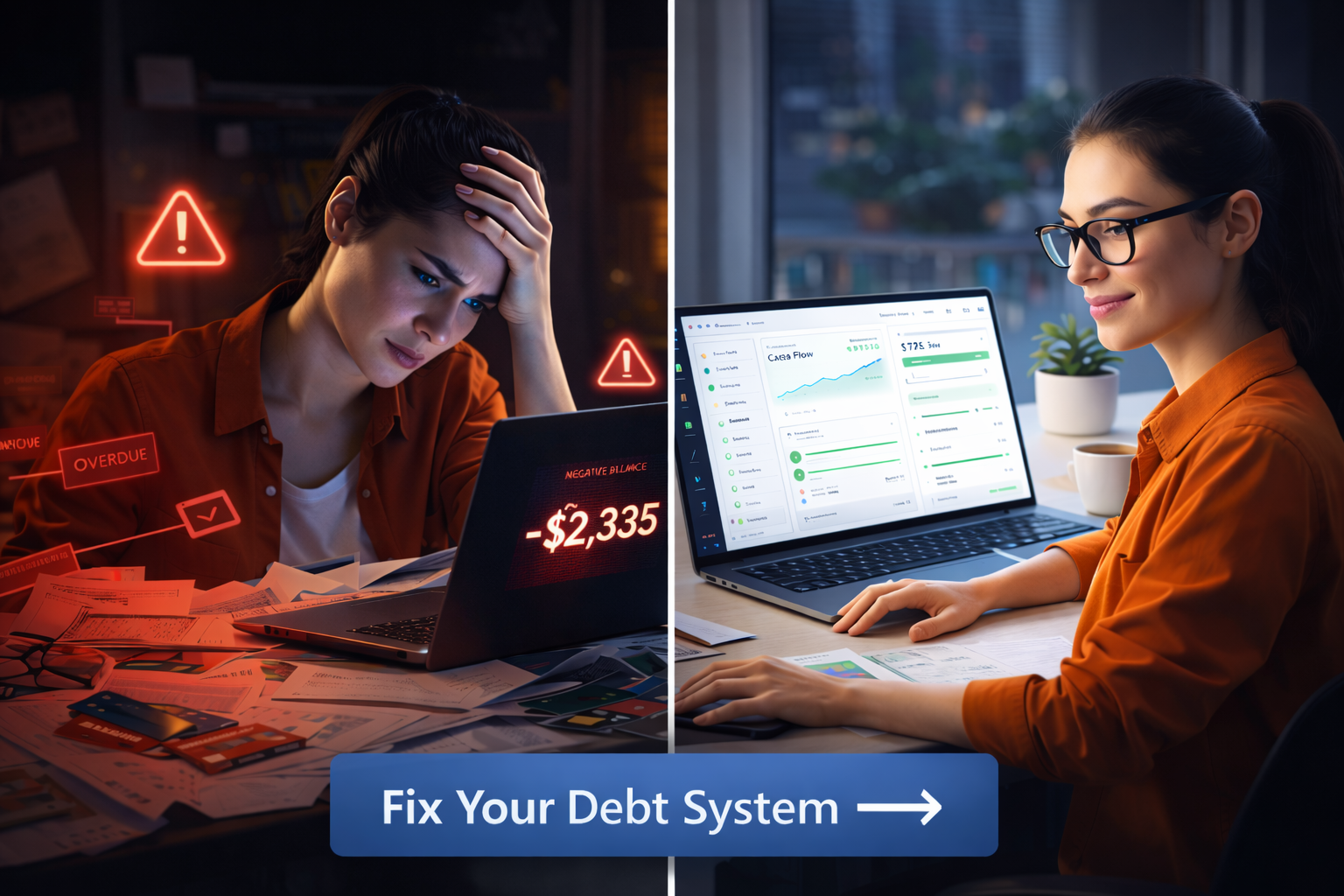
Is This Why Your Debt Never Actually Goes Away?
Debt for freelancers does not behave like it does for salaried individuals. It does not follow a linear path where consistent income leads to predictable reduction. Instead, it moves in cycles—growing, shrinking, and returning—depending entirely on how your income fluctuates over time.
This instability directly affects your financial system for freelancers, making consistent progress difficult without structural control.
At first, this can feel confusing. You may experience periods where you earn well, make progress, and believe you are finally gaining control. But then, without warning, income drops. In that moment, your entire financial structure shifts. The same system that worked during a high-income phase suddenly becomes unstable.
This is where most freelancers misdiagnose the problem.
They assume:
- They are not disciplined enough
- They are not earning enough
- They are making poor spending decisions
But in reality, the issue is structural.
Debt does not return because you failed. It returns because your financial system cannot survive income volatility.
The Hidden Pattern Most Freelancers Don’t See
There is a repeating cycle that happens almost invisibly:
- Income increases → confidence rises → repayments increase
- Debt reduces → pressure temporarily disappears
- Income drops → financial stress returns
- Credit is used again → debt rebuilds
Debt cycles are directly influenced by income variability, which is why traditional financial approaches fail for freelancers.
This is not random behavior.
This is a system loop.
The problem is that most freelancers are operating inside a financial structure that resets every time income changes. That means progress is never permanent—it is conditional.
A financial system defines behavior, which is why controlling the system leads to consistent financial outcomes.
Why This Feels So Frustrating
The emotional impact of this cycle is often underestimated. Freelancers experience a unique form of financial fatigue because they repeatedly move between progress and pressure.
This creates:
- Loss of financial confidence
- Avoidance of financial tracking
- Stress during low-income periods
- Overcompensation during high-income periods
Over time, this leads to a deeper problem:
You stop trusting your own financial decisions.
This is where debt becomes more than a financial issue—it becomes a behavioral constraint that affects every future decision.
The Real Problem Is Timing, Not Amount
Most advice focuses on how much debt you have. But for freelancers, the real issue is when that debt becomes active.
A manageable amount of debt during a high-income period can become overwhelming during a low-income phase.
This creates a dangerous dynamic:
- The same debt feels different depending on income timing
- Financial pressure spikes unpredictably
- Decision-making becomes reactive instead of structured
Debt becomes dangerous not because of its size—but because of its timing under income volatility.
This Is Not a Budgeting Problem
Many freelancers attempt to solve this using budgeting, expense tracking, or stricter discipline. These approaches fail because they assume consistency.
But freelancers do not operate in consistent environments.
When income fluctuates, any system that depends on fixed rules will eventually break.
This is why budgeting alone cannot solve freelancer debt.
What This Means for You
If you recognize this pattern, it means one thing:
You are not dealing with a debt problem. You are dealing with a system that cannot handle variability.
Until that system is replaced, every attempt to fix debt will remain temporary.
And every time income drops, the cycle will repeat.
The Shift You Need to Make
The goal is not to eliminate debt through effort alone.
The goal is to build a system where:
- Debt does not grow during low-income periods
- Repayment adapts to income automatically
- Financial pressure remains controlled
- Progress becomes permanent, not temporary
This is where the AI debt system begins.
Instead of reacting to financial changes, you create a structure that absorbs them.
That is the difference between managing debt—and controlling it.
What is an AI debt system for freelancers?
An AI debt system for freelancers is a structured financial system that adapts repayment and credit usage based on income variability. Instead of fixed plans, it stabilizes financial behavior, reduces pressure during low-income periods, and prevents recurring debt cycles.
Why does debt keep repeating for freelancers?
Why Traditional Debt Advice Fails Freelancers (And Makes the Problem Worse)
Most debt advice is built on a hidden assumption: your income is stable.
Everything—from repayment schedules to budgeting strategies—relies on consistency. Fixed monthly payments, predictable expenses, and linear progress models are all designed for salaried individuals.
Freelancers do not operate in that reality.
Your income fluctuates. Payment timing varies. Some months exceed expectations, while others fall short without warning. This creates a financial environment that is fundamentally incompatible with traditional debt systems.
The Structural Mismatch
When a system is designed for stability but applied to volatility, failure is not a possibility—it is guaranteed.
Traditional debt models assume:
- Fixed monthly repayment capacity
- Predictable income inflow
- Consistent financial behavior
Freelancer reality looks like this:
- Variable repayment capacity
- Unpredictable income timing
- Behavior influenced by financial pressure
This mismatch is the root cause of recurring debt cycles.
When freelancers try to follow fixed systems, they inevitably break during low-income periods. And when the system breaks, debt returns.
Why “Pay More, Spend Less” Doesn’t Work
Most financial advice reduces debt into a simple equation:
- Pay more toward debt
- Spend less overall
This logic works in stable environments. But in volatile environments, it creates unintended consequences.
During high-income periods, freelancers may overcommit to aggressive repayment. This reduces liquidity. When income drops later, they are forced to rely on credit again.
The result is not progress—it is a reset.
This creates a dangerous loop:
- Overpayment during good months
- Credit dependence during bad months
- Debt returns despite effort
Effort increases. Results do not.
Why Budgeting Fails Under Income Uncertainty
Budgeting assumes predictability. It requires you to plan spending and repayment based on expected income.
For freelancers, expected income is often uncertain.
This creates a disconnect:
- Budgets are based on projections
- Reality deviates from projections
- Plans break → stress increases → decisions become reactive
When the environment is unstable, rigid systems create instability.
This is why many freelancers feel like budgeting “doesn’t work” for them.
It’s not because they are doing it wrong. It’s because the system is not designed for their environment.
The Real Cost of Using the Wrong System
The biggest risk is not the debt itself—it is what the wrong system does over time.
When freelancers repeatedly fail to maintain financial control, it leads to:
- Loss of confidence in financial decisions
- Avoidance of financial tracking
- Increased stress during income fluctuations
- Delayed progress toward financial stability
Over time, this compounds into a larger problem:
You begin to operate defensively instead of strategically.
And once that happens, growth becomes impossible.
The System Shift That Changes Everything
The solution is not to optimize traditional debt strategies.
The solution is to replace them entirely.
Instead of forcing fixed repayment into a variable income system, you need a system that adapts.
This means:
- Repayment adjusts based on income conditions
- Credit usage is controlled by rules, not emotion
- Financial pressure is managed proactively
- Progress is maintained across all income cycles
This is the foundation of AI-Enhanced Debt & Credit Optimization.
From Effort-Based to System-Based Control
Traditional advice relies on effort:
- More discipline
- More tracking
- More restriction
This system replaces effort with structure:
- Predefined financial rules
- Adaptive repayment logic
- Automated decision frameworks
When the system is correct, consistency becomes automatic.
This Is the Moment of Realization
If you have ever felt like:
- You make progress but can’t maintain it
- Debt returns no matter what you do
- Your financial situation resets unexpectedly
Then this is the realization:
You don’t need better advice. You need a system that works under uncertainty.
Once that system is in place, debt stops behaving like a recurring problem—and starts behaving like a controlled variable.
What Is AI-Enhanced Debt & Credit Optimization?
AI-Enhanced Debt & Credit Optimization is not a strategy, a method, or a set of repayment techniques.
It is a system designed to control financial risk in environments where income is unpredictable.
Most financial systems attempt to eliminate debt by increasing repayment effort. This system does something fundamentally different:
It stabilizes the conditions under which debt exists.
Because in volatile income environments, stability—not speed—is what determines whether debt is eliminated or repeated.
This Is the Control Layer of Your Financial Operating System
Within the FM Mastery architecture, every financial outcome is governed by a layered system:
- Step 1: Stability → Control income variability impact
- Step 2: Control → Reduce financial risk (this system)
- Step 3: Capacity → Improve execution consistency
- Step 4: Growth → Expand income predictably
- Step 5: Integration → Automate financial decisions
This system operates as the control layer.
It sits between stability and growth, ensuring that financial risk is contained before any expansion occurs.
Without this layer, growth amplifies instability instead of solving it.
What This System Actually Does
Instead of focusing only on debt reduction, this system focuses on three critical outcomes:
- Reducing financial pressure
- Stabilizing repayment behavior
- Controlling credit usage under uncertainty
These outcomes are not achieved through effort, but through structure.
The system replaces reactive decisions with predefined rules that adapt automatically to income conditions.
The Core Shift: From Repayment to Risk Control
Traditional thinking focuses on repayment:
- How fast can you pay debt?
- How much can you reduce monthly?
- How aggressively can you commit?
This system focuses on risk:
- When does debt become dangerous?
- How does income variability affect repayment?
- How can pressure be reduced before it escalates?
This shift changes everything.
Because when risk is controlled, repayment becomes sustainable—and sustainability is what eliminates debt permanently.
The System Components
This system is built on three interconnected components:
1. Debt Visibility Layer
Complete clarity of obligations, interest exposure, and repayment priorities. This removes uncertainty and prevents avoidance behavior.
2. Adaptive Repayment Engine
Repayments are not fixed. They adjust dynamically based on income conditions, ensuring progress continues without creating pressure spikes.
3. Credit Behavior Control
Credit usage is governed by system rules, not emotional decisions. This prevents debt from rebuilding during low-income periods.
Together, these components create a self-regulating financial system.
How This System Adapts to Income Volatility
The defining feature of this system is adaptability.
When income increases:
- Repayment accelerates strategically
- High-interest obligations are prioritized
- Progress compounds instead of resetting
When income decreases:
- Repayment pressure reduces automatically
- Credit usage is controlled
- Financial stability is preserved
This ensures that no income cycle reverses your progress.
Why This System Works When Others Fail
Most systems fail because they rely on consistency from the user.
This system succeeds because it creates consistency through structure.
Instead of asking:
- “Can you stick to this plan?”
It ensures:
- “The plan adapts so you don’t have to.”
This removes the dependency on discipline.
And when discipline is no longer required, consistency becomes automatic.
Integration With the Broader Financial System
This system does not operate in isolation.
It is part of a broader AI financial system for freelancers designed to manage financial decisions under income uncertainty.
It connects directly with:
- AI-Powered Money Management → ensures stable financial foundation
- AI Productivity & Operations → ensures execution consistency
- Freelancer Business Systems → ensures full automation and integration
This creates a unified financial operating system.
The Outcome of Applying This System
Once implemented, this system changes the nature of debt completely.
- Debt stops behaving like a recurring problem
- Financial pressure becomes predictable and controlled
- Repayment becomes sustainable across all income cycles
- Progress becomes permanent instead of temporary
This is the difference between managing debt—and controlling it.
The Non-Negotiable Reality
If debt is not controlled at this stage, every future financial effort becomes unstable.
Growth will amplify risk.
Opportunities will be limited by financial pressure.
Decisions will remain reactive.
This is why this system is not optional.
It is the foundation that determines whether your financial future compounds—or collapses.
This system connects key elements of freelancer finance, including cash flow stability, credit utilization, repayment behavior, and financial risk control, creating a complete financial decision system.
How This Financial Risk System Actually Works
This is where the system moves from concept to execution.
Most financial advice stops at explanation. This system goes further—it defines how decisions are made, how behavior is controlled, and how outcomes become predictable under uncertainty.
This is not a method you follow. It is a system that operates continuously in the background.
The 3-Layer Debt Control Engine
At the core of this system is a structured engine composed of three interconnected layers:
- Layer 1: Debt Visibility → eliminates uncertainty
- Layer 2: Adaptive Repayment → aligns with income variability
- Layer 3: Credit Behavior Control → prevents relapse
Each layer solves a specific failure point that freelancers experience.
Layer 1: Debt Visibility (Eliminating Uncertainty)
The first failure in most debt systems is not repayment—it is lack of clarity.
Freelancers often operate with incomplete visibility:
- Unclear total obligations
- Untracked interest accumulation
- No prioritization of high-impact debt
This creates avoidance behavior. When financial information is unclear, the brain delays decisions.
Debt visibility removes this friction completely.
In this system, every obligation is mapped into a structured hierarchy:
- High-interest debt (priority reduction)
- Medium-impact obligations (controlled repayment)
- Low-impact liabilities (stability maintenance)
This ensures that every decision is based on clarity—not stress.
Layer 2: Adaptive Repayment (Replacing Fixed Systems)
This is the core innovation of the system.
Traditional systems use fixed repayment structures. This system uses adaptive logic.
Repayment is no longer fixed—it responds to income conditions.
Here is how it works:
During High-Income Periods
- Repayment increases strategically
- High-interest obligations are prioritized
- Liquidity is partially preserved (to prevent future collapse)
During Low-Income Periods
- Repayment pressure is reduced
- Essential obligations are maintained
- Credit usage is controlled (not eliminated blindly)
This creates a critical outcome:
No income cycle reverses your progress.
Instead of progress followed by regression, the system creates continuous forward movement.
Layer 3: Credit Behavior Control (Breaking the Relapse Cycle)
The biggest reason debt returns is not repayment failure—it is uncontrolled credit usage.
Under financial stress, freelancers make reactive decisions:
- Using credit to maintain lifestyle
- Delaying repayment decisions
- Justifying short-term borrowing
This system removes that variability.
Credit usage becomes rule-based, not emotion-based.
This includes:
- Predefined thresholds for credit usage
- Conditional access based on income state
- Automatic restriction during unstable periods
This prevents debt from rebuilding while repayment is in progress.
System Flow (Input → Control → Output)
This system operates through a continuous loop:
Input: Income variability + existing debt obligations
System: Visibility + adaptive repayment + behavior control
Output: Reduced financial pressure + stable debt reduction
This loop runs continuously, adjusting to every financial change without requiring constant decision-making.
Real-World Scenario: Without the System
A freelancer receives a large payment.
- They aggressively repay multiple debts
- Liquidity drops significantly
- Income slows next month
- Credit is used again
- Debt returns
Result: Progress resets.
Real-World Scenario: With the System
The same freelancer operates under the system:
- High-interest debt is prioritized first
- A portion of income is preserved for stability
- Repayment adjusts based on future risk
- Credit usage is controlled automatically
Result: Progress compounds instead of resetting.
Why This System Removes Financial Pressure
Financial pressure is not caused by debt alone. It is caused by uncertainty.
When you don’t know:
- How much to repay
- When to repay
- What happens if income drops
Every decision becomes stressful.
This system removes that uncertainty.
By defining rules in advance, it eliminates the need for constant decision-making.
This creates:
- Clarity → you know what to do
- Consistency → actions repeat automatically
- Confidence → decisions are no longer emotional
Integration With Execution Systems
This system does not operate manually.
It is supported by execution layers from AI Productivity & Operations, which ensure that decisions translate into consistent action.
Automation plays a key role:
- Tracking obligations
- Triggering repayment adjustments
- Maintaining behavioral constraints
This is how the system maintains consistency without relying on willpower.
The Key Difference: Control vs Effort
This system relies on control:
- Predefined rules
- Adaptive responses
- Automated decisions
When control replaces effort, consistency becomes automatic.
This Is the Point Where Debt Stops Being a Problem
Once this system is in place, debt changes its behavior.
- It stops growing unpredictably
- It stops reacting to income drops
- It becomes a controlled variable
And when something becomes controlled, it becomes solvable.
This is the transition from managing debt to controlling it.Why Debt Feels Uncontrollable (And Why That’s Not Your Fault)
Most freelancers believe their debt problem is caused by poor financial decisions.
They assume:
- They lack discipline
- They are not consistent enough
- They are making mistakes with money
This assumption is incorrect.
Debt feels uncontrollable not because of who you are—but because of the environment you are operating in.
The Behavioral Reality of Income Uncertainty
When income is stable, the brain can plan long-term. Decisions become structured, predictable, and rational.
When income becomes unpredictable, the brain shifts into short-term survival mode.
This shift is automatic.
It is not a choice—it is a biological response.
Under income uncertainty:
- The brain prioritizes immediate security over long-term stability
- Financial decisions become reactive instead of planned
- Risk tolerance increases during high-income periods
- Fear increases during low-income periods
This creates inconsistent behavior—even if your intentions are correct.
The Debt Reaction Loop (Psychological Pattern)
Freelancers operate inside a repeating behavioral loop that directly affects debt:
- High income → confidence increases → spending and repayment both rise
- Liquidity reduces → financial cushion weakens
- Income drops → stress increases → short-term decisions dominate
- Credit is used → debt increases → pressure compounds
This is the Debt Reaction Loop.
The key insight is this:
The loop is not created by debt—it is created by how the brain responds to uncertainty.
The Hidden Biases Driving Debt Decisions
Several cognitive biases reinforce this loop:
1. Loss Aversion
Freelancers avoid short-term discomfort (reducing spending or delaying lifestyle decisions), which leads to long-term financial pressure.
2. Recency Bias
After a high-income period, freelancers assume future income will remain strong, leading to overcommitment.
3. Scarcity Effect
During low-income periods, decision-making narrows, and survival-focused choices override long-term planning.
These biases are not flaws—they are predictable human responses.
Why Discipline Alone Will Always Fail
Most financial advice assumes that better discipline can solve these problems.
This creates a dangerous expectation:
- “I just need to be more consistent”
- “I need to control my spending better”
- “I need to stick to the plan”
But discipline cannot override environment.
When income is unstable, even highly disciplined individuals will experience breakdowns in behavior.
This is why freelancers often feel like they are failing—even when they are trying their best.
The System Solution: Removing Decision Pressure
This is where the AI debt system creates a fundamental shift.
It removes the need for constant decision-making.
Instead of asking you to make the right choice every time, the system defines the choice in advance.
This includes:
- Predefined repayment rules
- Conditional credit usage
- Adaptive financial responses to income changes
When these rules are in place:
- Decisions become automatic
- Behavior becomes consistent
- Emotional influence is reduced
This is how the system replaces discipline with structure.
From Reactive Behavior to Controlled Outcomes
Without a system:
- Income changes → behavior changes → results fluctuate
With a system:
- Income changes → system adapts → results remain stable
This is the defining difference.
The system absorbs volatility so you don’t have to.
Why This Creates Long-Term Stability
Once behavioral pressure is removed, financial decisions no longer depend on mood, stress, or income timing.
This leads to:
- Consistent repayment behavior
- Reduced financial anxiety
- Improved confidence in decision-making
- Long-term financial stability
And most importantly:
Debt stops behaving like an emotional problem—and becomes a controlled system variable.
The Critical Realization
If you have struggled with debt despite earning income, this is the realization:
You were not failing. Your system was failing under pressure.
Once the system is corrected, behavior follows automatically.
And when behavior becomes consistent, outcomes become predictable.
Why Freelancers Stay Stuck in Debt (Even When Income Increases)
One of the most confusing experiences for freelancers is this:
Income increases—but financial pressure does not go away.
This creates a contradiction that traditional financial advice cannot explain.
If earning more money should solve debt, why does the problem continue?
The answer lies in how debt behaves under income volatility.
The Illusion of Progress
When freelancers experience a high-income period, they often believe they are finally moving forward.
They make larger repayments, reduce outstanding balances, and feel a temporary sense of control.
At this stage, everything appears to be working.
But this progress is often unstable.
Because it is built on a condition:
Income must remain high.
The moment that condition changes, the system begins to break.
What Happens When Income Drops
Freelancer income does not follow a straight line.
It fluctuates based on client flow, project cycles, and market conditions.
When income drops:
- Cash flow tightens immediately
- Fixed repayment commitments remain unchanged
- Financial pressure increases rapidly
This creates a forced response:
- Credit is used to maintain stability
- Repayments are delayed or reduced
- Debt begins to rebuild
This is where the cycle restarts.
Uncontrolled credit utilization increases financial risk, especially during low-income periods.
The Core Problem: Static Systems in Dynamic Environments
Freelancer reality is dynamic:
- Income changes constantly
- Cash flow is unpredictable
- Financial conditions shift frequently
When a static system is applied to a dynamic environment, failure becomes inevitable.
This is why debt persists—even when effort increases.
The Hidden Cost of This Mismatch
The consequences of using the wrong system go beyond financial numbers.
Over time, freelancers begin to experience:
- Chronic financial stress
- Decision fatigue
- Avoidance of financial tracking
- Reduced confidence in long-term planning
This creates a deeper structural issue:
You begin operating reactively instead of strategically.
And once that happens, financial growth becomes unstable.
Why Income Growth Alone Makes the Problem Worse
There is a common assumption that earning more money will eventually solve debt.
For freelancers, this is often incorrect.
Without a stable system, income growth amplifies instability.
Here is why:
- Higher income leads to higher spending expectations
- Larger repayments reduce liquidity
- Future income is assumed to remain high
- When income drops, the system collapses at a larger scale
This creates a dangerous escalation:
More income → larger commitments → bigger financial resets
Instead of solving the problem, growth increases its impact.
The Compounding Effect of Instability
Every time the system resets, the impact compounds:
- Interest accumulates faster
- Recovery becomes harder
- Financial pressure increases
- Time to stability extends
This creates a long-term pattern:
Debt becomes a persistent background condition instead of a temporary problem.
Why This Cannot Be Solved With Effort
At this stage, many freelancers attempt to compensate with increased effort:
- Working more hours
- Taking on additional clients
- Cutting expenses aggressively
While these actions may provide short-term relief, they do not address the root issue.
Effort cannot fix a system that resets under volatility.
Without structural change, every improvement remains temporary.
The System Contrast: Traditional vs Adaptive
To understand the difference clearly, compare the two approaches:
Traditional System
- Fixed repayment schedules
- Dependent on consistent income
- Breaks during low-income periods
- Relies on discipline
AI Debt System
- Adaptive repayment logic
- Designed for income variability
- Adjusts during low-income periods
- Relies on predefined rules
This contrast explains why one system fails and the other works.
The Critical Realization
If you have experienced repeated debt cycles despite increasing income, this is the realization:
You are not failing to eliminate debt.
You are operating inside a system that cannot sustain progress.
Until that system changes, every attempt to move forward will eventually reset.
What Must Change
The solution is not to increase income, reduce spending, or improve discipline in isolation.
The solution is to replace the system that creates instability.
This means building a structure where:
- Repayment adapts to income conditions
- Financial pressure remains controlled
- Credit usage is governed by rules
- Progress continues across all income cycles
This is where the AI-Enhanced Debt & Credit Optimization system becomes essential.
The Point of No Return
Once you understand this, there is a clear shift:
You can no longer rely on traditional methods.
Because the problem is no longer about debt itself—it is about the system controlling it.
And once the system is corrected, the outcome becomes inevitable:
Debt stops repeating—and starts reducing consistently.
Why do freelancers fall into debt cycles?
Freelancers fall into debt cycles because their income is unpredictable while their financial systems are fixed. When income drops, financial pressure increases, leading to credit usage and debt rebuilding. This creates a repeating loop unless the system adapts to income changes.
How can freelancers control debt with irregular income?
What Changes When You Apply This System
Most freelancers don’t need more financial advice.
They need to see what actually changes when the system is correct.
This is where the difference becomes clear.
When you move from a reactive financial structure to a controlled system, debt stops behaving like a recurring problem—and starts behaving like a predictable variable.
Before the System: Reactive Financial State
Without a structured system, freelancers operate in a reactive loop.
Every financial decision depends on current income conditions, emotional state, and immediate pressure.
This creates instability across all areas of financial behavior.
- Repayment decisions change every month
- Credit is used unpredictably
- Financial planning feels uncertain
- Progress is temporary and easily reversed
In this state, even good decisions fail to produce long-term results.
Because the system resets under pressure.
After the System: Controlled Financial State
Once the AI debt system is applied, the structure changes completely.
Financial decisions are no longer dependent on emotion or timing—they are governed by predefined rules.
- Repayment adjusts automatically based on income
- Credit usage follows controlled thresholds
- Financial pressure becomes predictable
- Progress continues across all income cycles
This creates consistency without requiring constant effort.
The Shift From Uncertainty to Predictability
The most important change is not how much debt you repay—it is how predictable your financial system becomes.
Without a system:
- You don’t know what will happen next month
- Income changes create stress
- Decisions feel uncertain
With a system:
- You understand how the system will respond
- Income changes are absorbed
- Decisions become structured
Predictability removes financial anxiety.
From Temporary Progress to Permanent Stability
This creates a cycle of effort without long-term results.
The system changes this dynamic.
Progress becomes permanent because it is protected from income volatility.
Instead of resetting, each cycle builds on the previous one.
The End of Financial Whiplash
One of the most exhausting aspects of freelancer finances is inconsistency.
High-income periods create optimism.
Low-income periods create stress.
This constant shift creates what can be described as financial whiplash.
The system removes this entirely.
By stabilizing financial behavior, it reduces extreme fluctuations in both decisions and outcomes.
How Decision-Making Changes
Before the system:
- Decisions are reactive
- Choices depend on current income
- Emotions influence financial actions
After the system:
- Decisions are predefined
- Actions follow structured rules
- Emotion is removed from execution
This is the moment where control replaces uncertainty.
What This Means for Your Financial Future
When debt becomes controlled, it stops limiting your future decisions.
You gain:
- Clarity → you know exactly where you stand
- Confidence → decisions are no longer guesswork
- Stability → outcomes remain consistent
- Momentum → progress compounds over time
This creates a foundation for the next phase:
Growth without risk.
The Critical Difference Most People Miss
Most freelancers focus on eliminating debt.
This system focuses on eliminating the conditions that create debt.
That is why the results are fundamentally different.
Because when the system is correct:
- Debt does not return
- Progress does not reset
- Financial pressure does not spike unexpectedly
The Outcome Becomes Inevitable
Once this system is in place, the outcome is no longer uncertain.
Debt reduction becomes a controlled, predictable process.
Not because you are working harder.
But because the system no longer allows instability to reverse progress.
This Is the Turning Point
This is the point where most freelancers experience a shift:
They stop trying to fix their finances—and start controlling them.
And once that shift happens, everything else becomes easier.
Why Tools Alone Will Never Fix Your Debt
Most freelancers approach debt the wrong way.
They look for tools before they build systems.
This creates a pattern that feels productive—but ultimately leads to failure.
Because tools do not solve structural problems.
The Common Tool Trap
When financial pressure increases, freelancers naturally search for solutions.
They find:
- Budgeting apps
- Debt calculators
- Expense trackers
- AI finance tools
At first, these tools create improvement.
- Better visibility
- More awareness
- Short-term control
But over time, something happens:
The results fade—and the problem returns.
The Tool Failure Cycle
This creates a repeating loop:
- Find tool → implement → see improvement
- System pressure returns → tool becomes harder to maintain
- Consistency drops → results decline
- New tool is introduced → cycle repeats
Why Tools Break Under Income Volatility
Most tools are designed for stable financial environments.
They assume:
- Consistent income
- Predictable expenses
- Stable financial behavior
Freelancers operate in the opposite conditions.
When income changes, tools lose effectiveness because they rely on consistency that does not exist.
This is why tools feel powerful at first—but fail over time.
The System-First Approach
This system reverses the traditional approach.
Instead of starting with tools, it starts with structure.
The sequence becomes:
- System → defines rules and behavior
- Structure → creates consistency
- Tools → support execution
- Automation → ensures continuity
Tools only become effective when they operate inside a defined system.
What Happens When You Use Tools Without a System
Without a system:
- Tools require constant effort
- Decisions remain manual
- Behavior remains inconsistent
- Results fluctuate with income
This creates dependency on motivation.
And motivation is unreliable under financial pressure.
This is why most tool-based approaches fail.
What Happens When Tools Operate Inside a System
When tools are integrated into a system:
- They execute predefined rules
- They reduce manual decision-making
- They reinforce consistent behavior
- They adapt to changing conditions
Tools stop being solutions—and become system components.
The Role of AI Tools in This System
AI tools play a powerful role—but only when used correctly.
Inside this system, AI tools are used to:
- Track financial data in real time
- Trigger adaptive repayment adjustments
- Monitor credit usage patterns
- Maintain consistency across income cycles
They do not decide what to do—they execute what the system defines.
You can explore these tools inside the AI Tools Hub, where they are structured to support system execution.
The Critical Distinction
This is the difference most freelancers miss:
Tools improve performance temporarily.
Systems change outcomes permanently.
Why This Matters for Debt Control
Debt is not solved by better tracking, better apps, or better calculations.
It is solved by eliminating the conditions that allow it to return.
Only a system can do that.
Tools can assist—but they cannot replace structure.
The Strategic Advantage
Once you adopt a system-first approach:
- You stop chasing new tools
- You stop relying on motivation
- You stop resetting your progress
Instead, you build a structure where:
- Decisions are predefined
- Execution is consistent
- Results compound over time
This is how freelancers move from experimentation to control.
The Final Shift
If you have been switching between tools, trying different methods, and still seeing the same results, this is the realization:
You don’t need a better tool.
You need a system that makes tools effective.
Once that system is in place, every tool you use starts working as intended.
And when that happens, debt stops being a recurring problem—and becomes a controlled outcome.
What system prevents debt cycles from returning?
What You Should Do Next (Before This Cycle Repeats Again)
At this point, the problem is no longer unclear.
You understand why debt keeps returning.
You understand why traditional methods fail.
You understand why tools alone cannot solve it.
The only remaining question is whether you act before the next income cycle resets your progress.
The Risk of Doing Nothing
If nothing changes, the outcome is predictable.
This is not speculation.
This is a structural pattern.
And without intervention, it continues indefinitely.
The Decision Point
You are now at a decision point.
There are only two paths forward:
Path 1: Continue With the Current System
- Rely on income increases to fix debt
- Use tools without structure
- Repeat the same cycle
Outcome: Temporary progress, permanent instability.
Path 2: Implement a System That Controls Debt
- Stabilize repayment behavior
- Control credit usage
- Remove financial pressure
Outcome: Predictable reduction, long-term control.
The First Step: Build Control Before Growth
Most freelancers try to grow income before stabilizing their system.
This creates a hidden risk:
Growth amplifies instability.
Before moving forward, you must ensure that your financial foundation is stable.
If you have not already done this, start with:
This ensures that your cash flow system can support debt control.
The Second Step: Apply the Debt Control System
Once your foundation is stable, the next step is to apply the system you’ve just understood.
This includes:
- Creating full debt visibility
- Implementing adaptive repayment rules
- Controlling credit behavior
This is where the cycle breaks.
Because once repayment adapts and credit is controlled, the system no longer resets under pressure.
The Execution Layer (Where Most People Fail)
Understanding the system is not enough.
Execution is where most freelancers fail.
Not because they lack intent—but because they lack consistency.
This is why execution must be supported by systems.
To implement this correctly, you can use structured workflows from:
→ AI Productivity & Operations
These systems ensure that decisions are applied consistently—without relying on willpower.
The Tools That Support This System
Once your system is defined, tools become powerful.
Instead of searching randomly, you can use tools that align with your system structure.
Explore:
These tools are designed to support:
- Debt tracking
- Repayment automation
- Credit monitoring
Remember: tools support the system—they do not replace it.
The Next Stage: Growth Without Risk
Once debt is controlled, you unlock the next stage of your financial system.
Growth.
But this time, growth happens differently.
It is no longer reactive or unstable.
It is structured and predictable.
Continue to:
→ AI-Smart Income Growth for Freelancers
This is where income expansion becomes sustainable.
The Cost of Delay
Every income cycle you delay this system increases the cost of recovery.
- Interest compounds
- Financial pressure increases
- Time to stability extends
Delay is not neutral—it is expensive.
The System Decision
This is the point where most freelancers either:
- Continue repeating the cycle
- Or take control of it
The difference is not effort.
The difference is whether a system is in place.
Start Now (Before the Next Reset Happens)
Fix your debt system before the next income fluctuation forces you back into the same pattern.
This is not about urgency for the sake of action.
This is about timing.
Because once the next cycle begins, the system will either protect you—or reset you.
The outcome depends on what you build now.
How to stop debt cycles as a freelancer
- Stabilize cash flow before aggressive repayment
- Adjust repayment based on income changes
- Control credit usage with predefined rules
- Remove reliance on discipline
- Use tools only within a structured system
Where This Fits in Your Financial Operating System (And Why Order Matters)
Most freelancers approach financial improvement in the wrong order.
This system is part of a broader financial operating system for freelancers, connecting stability, control, productivity, and growth into one structured framework.
They try to fix debt while income is unstable, attempt growth before building control, and rely on tools without structure.
This creates fragmentation instead of progress.
The FM Mastery system solves this by enforcing a strict sequence.
Because in a system, order determines outcome.
The 5-Step Financial Operating System
Your financial system is not a collection of strategies—it is a structured progression.
Each layer builds on the previous one:
- Step 1: Stability → Control cash flow variability
AI-Powered Money Management - Step 2: Control → Reduce financial risk (this system)
- Step 3: Capacity → Improve execution consistency
AI Productivity & Operations - Step 4: Growth → Expand income predictably
AI-Smart Income Growth for Freelancers - Step 5: Integration → Automate and connect decisions
Freelancer Business Systems
This sequence is not optional—it is structural.
Why This System Comes Second (Not First)
Debt control is not the starting point.
If your income system is unstable, any attempt to control debt will fail under pressure.
That is why this system comes after:
This ensures:
- Cash flow is stabilized
- Spending is controlled
- Financial decisions are structured
Without this foundation, debt control collapses during volatility.
Why You Cannot Skip This Step
Many freelancers try to move directly from instability to growth.
This creates a critical failure point:
Growth amplifies whatever system exists.
If your system is unstable:
- More income → larger commitments
- More commitments → higher risk
- Higher risk → bigger financial resets
This is how freelancers earn more—and still feel financially stuck.
This system prevents that outcome by controlling risk before expansion.
The Role of This System in the Bigger Picture
This system acts as a stabilizer between two critical phases:
- Before: Stability → controlling income variability
- After: Growth → expanding income capacity
It ensures that the transition between these phases is controlled.
Without it:
- Stability breaks under growth pressure
- Debt increases during expansion
- Financial progress becomes inconsistent
What Happens After This System Is Applied
Once debt is controlled, your financial system becomes stable enough to support growth.
This unlocks the next phase:
Capacity and execution.
At this stage, the focus shifts to:
- Improving consistency in work output
- Building repeatable workflows
- Reducing operational friction
Continue to:
→ AI Productivity & Operations
This ensures that your financial system is supported by execution systems.
From Control to Growth (The Safe Transition)
Once both stability and control are established, growth becomes safe.
Not risky. Not reactive. Not unstable.
Predictable.
At this stage:
- Income growth does not create financial pressure
- Debt does not return during expansion
- Financial decisions remain structured
This is when you move to:
→ AI-Smart Income Growth for Freelancers
This is growth built on control—not chaos.
The Final Layer: Full System Integration
Once all layers are in place, your financial system becomes interconnected.
Decisions are no longer isolated.
They are automated, structured, and aligned.
This happens inside:
This is where:
- Income systems connect with financial systems
- Decisions are automated
- Long-term compounding begins
This is the end state of the system.
The Cost of Breaking the Sequence
If you ignore this sequence, the system breaks.
Common mistakes include:
- Trying to grow income before controlling debt
- Using tools without system structure
- Skipping foundational steps
The result is always the same:
Progress without stability—and eventual regression.
The Structural Truth
This is the principle that governs everything:
Stability → Control → Capacity → Growth → Integration
This is not theory.
This is system design.
And systems always produce predictable outcomes when followed correctly.
Your Position Right Now
You are currently at Step 2:
Control.
This is the point where financial instability is removed.
Once this step is complete:
- Debt stops repeating
- Financial pressure stabilizes
- Future growth becomes possible
This is the turning point between survival and control.
What Comes Next After You Control Debt
Controlling debt is not the final goal.
It is the point where real financial progress becomes possible.
Most freelancers remain stuck because they never reach this stage.
They spend years cycling between instability and temporary recovery, without ever building the foundation required for growth.
This system changes that trajectory completely.
The Shift From Survival to Control
Before this system, your financial decisions are driven by pressure.
- You react to income changes
- You manage debt under stress
- You prioritize short-term stability over long-term progress
This is the survival phase.
Once debt is controlled, that phase ends.
You are no longer reacting—you are operating with control.
This is the first time your financial system becomes stable enough to support forward movement.
Why Growth Is Impossible Without Control
Many freelancers try to grow income while debt is still unstable.
This creates a hidden risk:
Growth amplifies whatever system already exists.
If debt is uncontrolled:
- More income leads to larger financial commitments
- Larger commitments increase pressure during low-income periods
- Pressure forces reactive decisions
- Debt returns at a larger scale
This is why growth without control leads to instability—not progress.
Controlling debt eliminates this risk.
What Changes Once Control Is Established
When this system is fully applied, your financial environment transforms:
- Debt is no longer a limiting factor
- Financial pressure becomes predictable
- Cash flow remains stable across income cycles
- Decisions are structured instead of reactive
This creates the conditions required for sustainable growth.
The Next Layer: Capacity and Execution
Before you scale income, you need the ability to execute consistently.
This is the capacity layer.
At this stage, the focus shifts to:
- Improving productivity
- Building repeatable workflows
- Reducing decision fatigue in daily operations
Without this layer, growth efforts become inconsistent and unsustainable.
To build this foundation, continue to:
→ AI Productivity & Operations
This ensures that your system can support increased demand.
The Growth Phase (Where Income Becomes Predictable)
Once both control and capacity are established, you unlock the growth phase.
This is where most freelancers want to start—but should not.
At this stage:
- Income expansion becomes structured
- Client acquisition becomes predictable
- Revenue growth becomes consistent
This is growth built on a stable system—not on uncertainty.
Move forward to:
→ AI-Smart Income Growth for Freelancers
Why This Progression Works
This progression is not arbitrary.
It is designed to ensure that each layer supports the next.
Stability supports control.
Control supports capacity.
Capacity supports growth.
Growth supports integration.
When this sequence is followed, progress compounds instead of resetting.
The Long-Term Outcome
Once you move through these stages, your financial system reaches a different state entirely.
- Income becomes predictable
- Debt remains controlled
- Decisions become automated
- Financial growth compounds over time
This is where freelancers transition from managing money to controlling outcomes.
The Strategic Advantage Most Freelancers Never Reach
Most freelancers remain stuck in reactive financial cycles.
They never reach the stage where:
- Debt is no longer a concern
- Income is predictable
- Decisions are structured
This system creates that advantage.
Because it eliminates the instability that prevents progress.
The Turning Point
You are now at a critical point in your financial system.
This is where control replaces survival.
And once that happens:
- Growth becomes possible
- Decisions become strategic
- Outcomes become predictable
Continue to the Next Layer
Your next step is not optional—it is structural.
To move forward, you must build execution capacity before scaling income.
Start here:
→ AI Productivity & Operations
Then continue to:
→ AI-Smart Income Growth for Freelancers
This is how you move from control to compounding growth.
Why budgeting fails for freelancers with debt
Budgeting fails for freelancers because it assumes consistent income. When income fluctuates, fixed budgets break, leading to inconsistent decisions and increased reliance on credit. A system that adapts to income variability is required instead.
Common Mistakes That Keep Freelancers Trapped in Debt Cycles
Most freelancers do not fail because they lack effort.
They fail because they repeat patterns that reinforce instability.
These mistakes are not obvious. In many cases, they feel like the right thing to do.
But under income volatility, they produce the opposite result.
Understanding these mistakes is critical—because avoiding them is what protects your system.
1. Treating Debt as a One-Time Problem
Many freelancers approach debt as something that needs to be “cleared” once.
They focus on eliminating balances quickly, assuming the problem will not return.
This is the first major mistake.
Debt is not a one-time event—it is a system behavior.
If the system that created the debt is still active, the outcome is predictable:
- Debt is reduced temporarily
- Income fluctuates
- Debt returns
The goal is not to clear debt once. The goal is to eliminate the conditions that recreate it.
2. Overcommitting During High-Income Periods
When income increases, freelancers often feel a sense of relief and confidence.
This leads to aggressive repayment decisions:
- Paying off multiple debts at once
- Reducing liquidity too quickly
- Assuming income will remain stable
This creates hidden risk.
When income drops later, there is no financial buffer.
This forces reliance on credit—and the cycle begins again.
Without system control, high-income periods create future instability.
3. Ignoring Income Volatility in Financial Decisions
Most financial decisions are made based on current income—not future variability.
This creates a structural flaw:
- Decisions are optimized for the present
- Future instability is ignored
- The system fails when conditions change
Freelancers must design decisions around variability—not stability.
This is the core principle of this system.
4. Using Credit Reactively Instead of Structurally
Credit is not inherently bad.
But when used without structure, it becomes a tool for survival rather than control.
Reactive credit behavior includes:
- Using credit to cover shortfalls without a plan
- Making decisions based on urgency
- Ignoring long-term impact
In a system-driven approach, credit usage is controlled by predefined rules—not immediate pressure.
5. Relying on Discipline Instead of Systems
This is one of the most common—and most damaging—mistakes.
Freelancers believe that better discipline will solve financial problems.
This leads to:
- Strict budgeting attempts
- Manual tracking systems
- High reliance on motivation
But discipline is unreliable under financial stress.
When income fluctuates, even disciplined individuals experience breakdowns in behavior.
Systems remove the need for discipline by creating consistency automatically.
6. Using Tools Without a System
Many freelancers adopt tools in an attempt to improve their financial situation.
But without a system:
- Tools require constant effort
- Decisions remain manual
- Results fluctuate
This creates the illusion of progress without long-term stability.
Tools only work when they are part of a defined system.
Otherwise, they become another layer of complexity.
7. Trying to Grow Income Before Controlling Debt
This is a critical sequencing mistake.
Freelancers often focus on increasing income as the primary solution.
But without control:
- More income leads to larger commitments
- Financial pressure increases during downturns
- Debt returns at a higher level
Growth amplifies whatever system exists.
If the system is unstable, growth increases instability.
8. Avoiding Financial Visibility
When debt becomes stressful, many freelancers avoid looking at it.
This creates:
- Lack of clarity
- Delayed decisions
- Increased anxiety
Avoidance increases pressure—not reduces it.
Visibility is the first step in regaining control.
9. Making Decisions Based on Emotion Instead of Structure
Under financial pressure, decisions become emotional:
- Fear during low-income periods
- Overconfidence during high-income periods
This creates inconsistency.
Emotion-based decisions cannot produce stable outcomes.
The system replaces emotion with predefined rules.
10. Delaying System Implementation
This is the most expensive mistake.
Freelancers often delay action, assuming they will fix things later when income improves.
But delay has a cost:
- Interest compounds
- Debt increases
- Recovery becomes harder
Delay is not neutral—it accelerates the problem.
The Pattern Behind All These Mistakes
Every mistake above has a common root:
Operating without a system.
When decisions are made without structure:
- Behavior becomes inconsistent
- Outcomes become unpredictable
- Progress resets repeatedly
The System Correction
Once a system is applied:
- Decisions are predefined
- Behavior becomes consistent
- Outcomes stabilize
This eliminates the mistakes at their source.
The Key Insight
If you recognize any of these patterns, it does not mean you have failed.
It means your system has not been designed for variability.
Once that changes, these mistakes stop happening automatically.
Because the system no longer allows them.
How can freelancers control debt with irregular income?
Freelancers can control debt by using a system that adjusts repayment based on income, limits credit usage with predefined rules, and maintains financial stability across income cycles. This removes reliance on discipline and prevents debt from repeating.
Fix the System—Or the Cycle Will Continue
At this point, the pattern is clear.
Debt is not the problem.
The system controlling it is.
If the system does not change, the outcome will not change.
It does not matter how much you earn, how hard you try, or how many tools you use.
The cycle will repeat.
The Reality Most Freelancers Avoid
Every income cycle without a system creates the same result:
- Temporary progress during high-income periods
- Financial pressure during low-income periods
- Credit usage to maintain stability
- Debt rebuilding again
This is not a possibility.
This is a predictable outcome.
The Only Decision That Matters Now
You are not deciding whether to “manage debt better.”
You are deciding whether to continue the cycle—or eliminate it.
There are only two paths:
- Continue with the current system → repeat the same outcome
- Implement a system → create controlled, predictable results
This is a system decision—not a motivation decision.
What Happens When You Fix the System
Once the system is corrected:
- Debt stops rebuilding
- Financial pressure stabilizes
- Repayment becomes consistent
- Progress becomes permanent
This is the point where financial control begins.
Start With the Foundation
If your financial system is not yet stable, start here:
This ensures your cash flow system can support debt control.
Apply the Control System
Then apply what you have learned on this page:
- Build full debt visibility
- Implement adaptive repayment rules
- Control credit usage with predefined limits
This is where the cycle breaks.
Support Execution With Systems
To ensure consistency, use execution frameworks from:
→ AI Productivity & Operations
This removes reliance on willpower and ensures the system operates continuously.
Use Tools the Right Way
Once your system is defined, tools become effective.
Explore:
Use tools to execute the system—not replace it.
Move Forward to Growth
Once control is established, the next step is structured income expansion:
→ AI-Smart Income Growth for Freelancers
This is growth built on stability—not uncertainty.
The Cost of Waiting
Every cycle you delay:
- Debt compounds
- Financial pressure increases
- Recovery becomes harder
Delay is not neutral—it increases the cost of control.
Make the System Decision Now
Fix your debt system before the next income fluctuation resets your progress.
This is not about urgency.
This is about inevitability.
The system will either protect you—or reset you.
The outcome depends on what you build now.
Final Principle
Freelancers don’t need more discipline.
They need systems that remove financial risk.
Fix the system.
And the results follow automatically.