FM Mastery Operating System • Step 5: Business Systems
If your business feels harder to manage as you grow, your system is the problem.
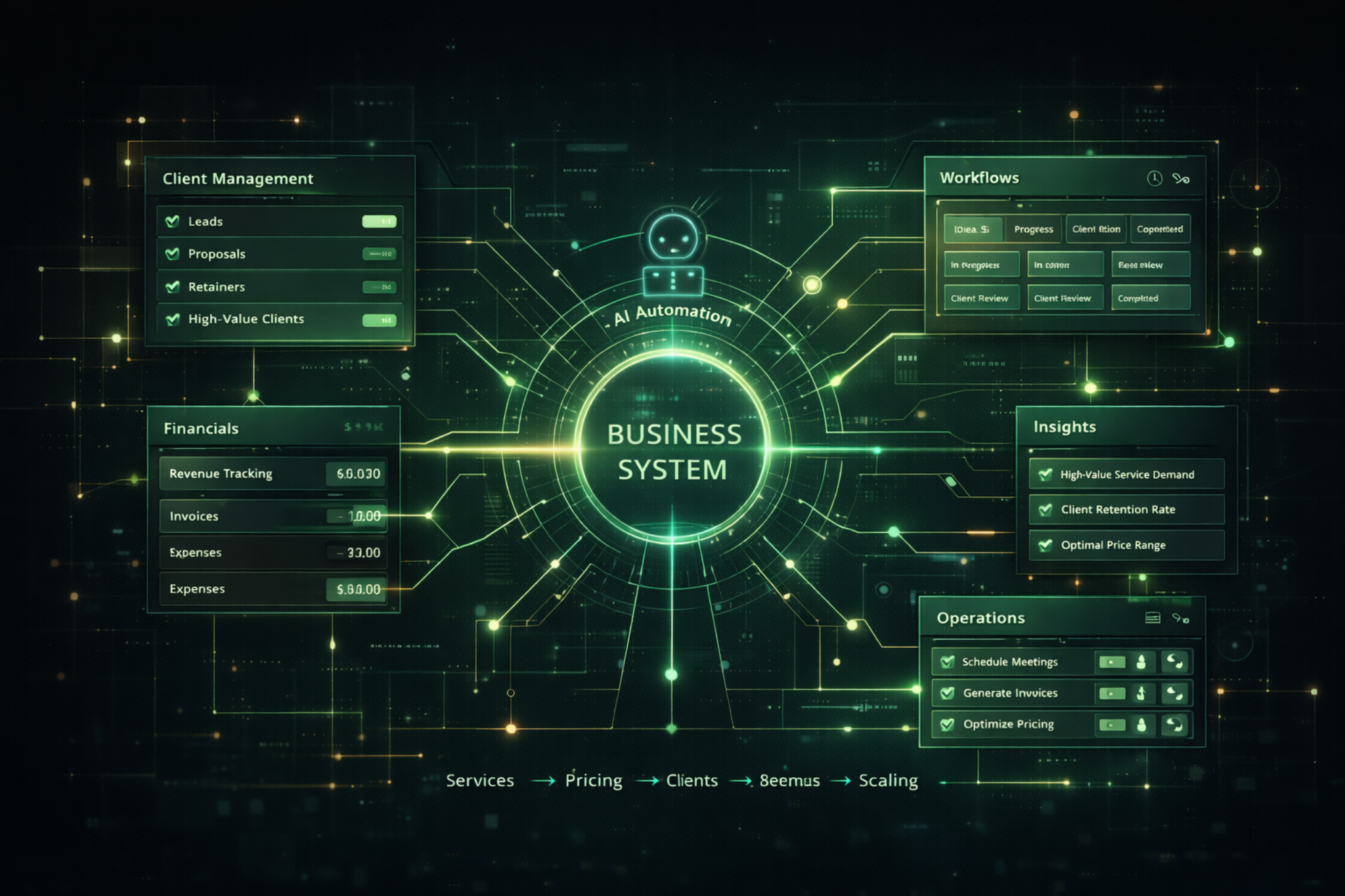
AI Freelancer Business System: Build a Scalable Business That Runs Without You
An AI freelancer business system transforms scattered operations into structured, repeatable workflows—so your business scales without increasing complexity.
Instead of relying on constant effort, systems organize clients, workflows, and revenue into a unified structure that supports long-term growth.
No chaos. No scattered operations. A complete system for scalable freelance business growth.
Built for freelancers managing unpredictable income and growing workloads.
Why Most Freelancers Struggle With Business Chaos as They Grow
Many freelancers experience a frustrating pattern.
Income increases—but the business becomes harder to manage.
The real problem is not growth. It is the absence of a structured business system.
Why do freelancers struggle with business chaos?
Freelancers struggle with business chaos because their operations are not systemized, leading to inconsistent workflows, repeated decision-making, and increasing complexity as income grows.
Without a defined system:
- Client communication becomes inconsistent
- Projects are managed manually
- Workflows change with every project
- Decisions are repeated instead of standardized
At the beginning, this feels manageable.
But as workload increases, the structure begins to break.
More work does not create stability—it increases operational pressure.
The Hidden Cost of Business Chaos
Business chaos is not just stressful—it directly limits scalability.
When systems are missing:
- Time is spent managing operations instead of delivering value
- Errors increase due to inconsistent execution
- Client experience becomes unpredictable
- Growth creates friction instead of leverage
Many freelancers respond by working more.
But increased effort does not solve structural problems.
It amplifies inefficiency.
Why Growth Makes Business Chaos Worse
As a freelance business grows, operational complexity increases faster than expected.
More clients mean:
- More communication to manage
- More deliverables to track
- More workflows to coordinate
- More decisions to make
Without systems, this creates a bottleneck.
Instead of scaling smoothly, the business becomes harder to control.
This is where most freelancers hit an invisible ceiling.
Why Freelance Work Without Systems Cannot Scale
Freelancing without a business system creates a structural limitation.
Growth appears possible—but cannot be sustained.
- Operations rely on memory instead of process
- Execution depends on effort instead of structure
- Delivery varies instead of being standardized
This leads to:
- Burnout from increasing workload
- Inconsistent results across projects
- Limited capacity for long-term growth
You are not scaling a business—you are managing complexity.
The Core Problem Behind Business Chaos
Freelancers do not struggle because they lack skill, clients, or opportunities.
They struggle because their business is not built as a system.
Until structure is introduced:
- Growth increases pressure instead of leverage
- Income creates complexity instead of stability
- Execution remains reactive instead of controlled
This is why business chaos must be replaced with a structured system.
What an AI Freelancer Business System Actually Is (And Why It Changes Everything)
An AI freelancer business system is a structured framework that organizes every part of your freelance business into predictable, repeatable, and scalable processes.
Instead of managing work manually, the system defines how your business operates—from client acquisition to delivery, communication, and financial control.
It replaces effort-driven operations with system-driven execution.
What is a freelancer business system?
A freelancer business system is a structured set of workflows, processes, and tools that standardize operations, reduce manual work, and enable scalable business growth.
From Freelance Work to a Structured Business
Most freelancers operate without a defined system.
Work is handled case by case, decisions are repeated, and processes change depending on the project.
This creates flexibility—but also inconsistency and inefficiency.
A business system transforms this completely.
- Workflows define how tasks are executed
- Processes standardize delivery
- Systems reduce decision-making
- Operations become predictable and scalable
This is the shift from doing freelance work to operating a structured business.
The Core Components of a Business System
A complete freelancer business system is built from interconnected components that control how the business operates.
Each system handles a specific function:
- Client acquisition system → controls lead flow and onboarding
- Workflow system → defines how work is executed
- Delivery system → ensures consistent output
- Communication system → standardizes client interaction
- Financial system → tracks revenue, costs, and profitability
When these systems operate independently, the business becomes fragmented.
When they are connected, the business becomes scalable.
How AI Enhances a Freelancer Business System
AI does not replace your business system—it strengthens how it operates.
Instead of relying on manual effort, AI supports:
- Automating repetitive processes
- Improving decision-making with data insights
- Reducing execution time across workflows
- Maintaining consistency at scale
This creates leverage.
The system becomes more efficient without increasing effort.
System vs Effort: The Critical Difference
Without a business system:
- Growth depends on how much you work
- Operations rely on memory and manual execution
- Every new client increases complexity
With a system:
- Growth depends on how well your system operates
- Processes handle execution consistently
- New clients are absorbed without chaos
This is the difference between being busy and being scalable.
The Real Outcome of a Business System
A freelancer business system does more than organize work.
It transforms how your business operates and grows.
- Operations become controlled instead of reactive
- Execution becomes consistent instead of variable
- Growth becomes stable instead of unpredictable
This creates a foundation for long-term scalability.
You are no longer managing tasks—you are operating a system.
The Core Systems That Power a Scalable Freelancer Business
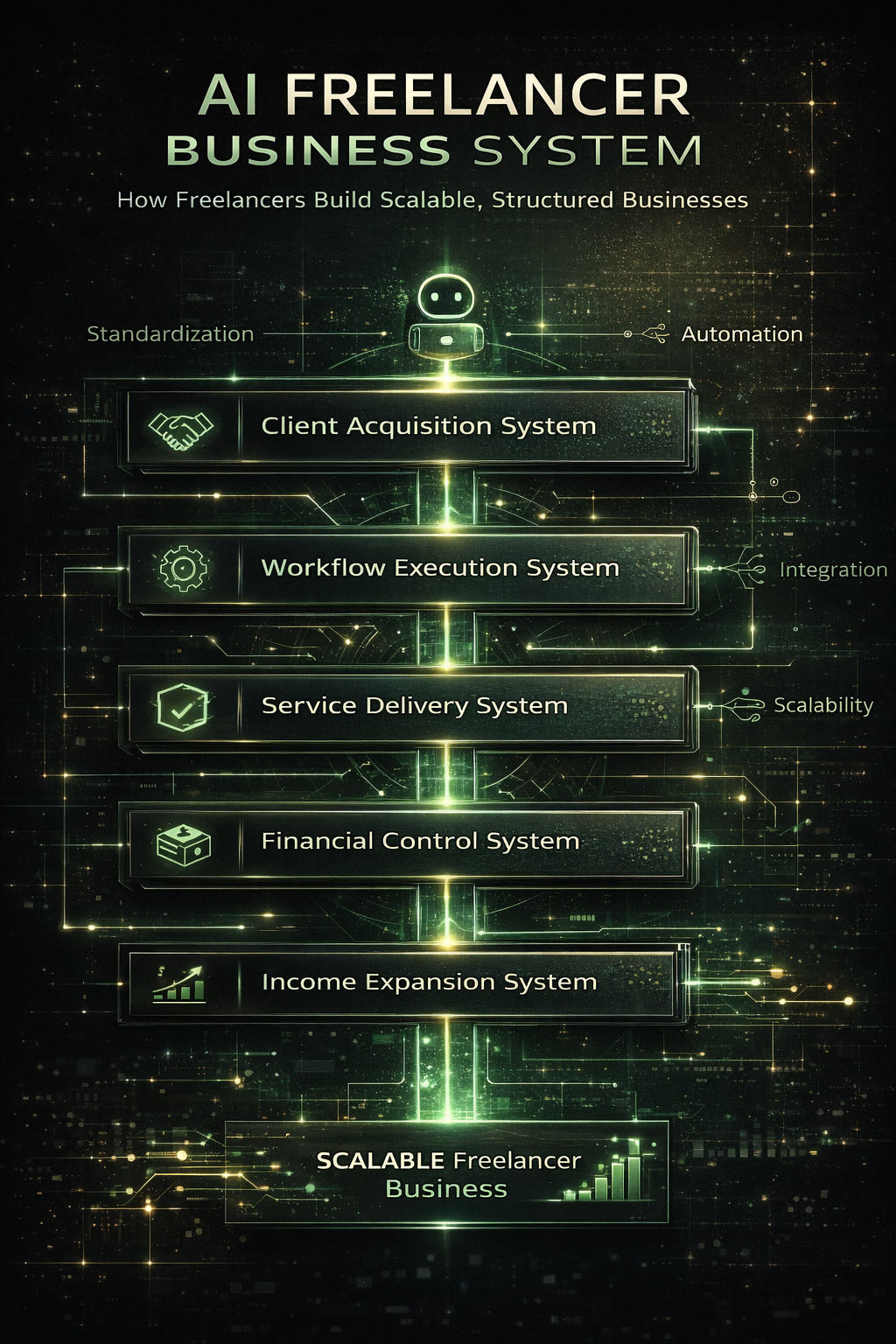
A freelance business becomes scalable when its operations are structured into interconnected systems.
Growth is not driven by effort—it is driven by how well these systems operate together.
An AI freelancer business system is built by defining, standardizing, and connecting the core functions of your business into a unified structure.
1. Client Acquisition System
This system controls how clients consistently enter your business.
- Lead generation channels are clearly defined
- Client qualification follows a structured process
- Onboarding is standardized and repeatable
A structured acquisition system replaces unpredictable client flow with controlled opportunities.
2. Workflow Execution System
This system defines how work is executed across projects.
- Tasks follow predefined sequences
- Execution becomes consistent across all work
- Variation is reduced through structured workflows
Execution shifts from reactive task handling to repeatable processes.
3. Service Delivery System
This system ensures output quality remains consistent regardless of workload.
- Services are clearly structured
- Delivery steps are standardized
- Output follows defined formats
Consistency in delivery builds reliability and scalability.
4. Communication System
This system controls how interactions with clients are managed.
- Communication follows defined formats
- Response workflows are standardized
- Expectations are set and managed proactively
Structured communication reduces friction and improves client experience.
5. Financial Control System
This system provides visibility into business performance.
- Revenue is tracked consistently
- Expenses and profitability are monitored
- Cash flow remains visible and controlled
Financial clarity enables informed decision-making and stable growth.
6. Income Expansion System
This system enables revenue to grow beyond time-based work.
- Services are packaged for scalability
- Pricing structures are optimized
- Recurring revenue models are introduced
Income becomes scalable instead of limited by capacity.
7. AI Integration Layer
AI enhances the efficiency and performance of all business systems.
- Repetitive tasks are automated
- Execution speed increases across workflows
- Decisions are supported with data insights
AI amplifies systems without adding complexity.
How These Systems Work Together
Each system controls a specific function, but scalability comes from integration.
- Client acquisition feeds structured workflows
- Workflows drive consistent delivery
- Delivery connects with communication systems
- Financial tracking reflects operational performance
- Income systems expand revenue capacity
When these systems operate together, the business functions as a unified operating system.
Why Most Freelancers Fail to Build Scalable Business Systems
Many freelancers increase income but fail to build a structured business.
The problem is not a lack of knowledge—it is the inability to transition from execution to system design.
Freelancers are trained to deliver work, not to build systems that support long-term scalability.
Why do freelancers fail to build business systems?
Freelancers fail to build business systems because they prioritize client work over structure, rely on manual processes, delay systemization, and use tools without defined workflows.
1. Prioritizing Work Over Structure
Most freelancers focus on completing client work instead of building systems.
- Time is consumed by delivery
- System development is delayed
- Operations remain unstructured
This creates a cycle where increasing workload prevents system creation.
Execution dominates, but structure determines scalability.
2. Delaying Systemization Until It Is Too Late
Many freelancers believe systems are only necessary at higher income levels.
- They postpone building workflows
- They manage operations manually
- They wait until complexity becomes overwhelming
At that point, fixing operations becomes significantly harder.
Systems built early create leverage. Systems built late require recovery.
3. Relying on Memory Instead of Processes
Without defined systems, freelancers depend on memory to manage operations.
- Tasks are tracked mentally
- Processes are not documented
- Workflows change constantly
This leads to inconsistency and errors.
A scalable business requires processes—not memory.
4. Overcomplicating Systems
When freelancers attempt to build systems, they often introduce unnecessary complexity.
- Too many tools are used
- Processes are over-engineered
- Structure becomes difficult to maintain
Complex systems reduce adoption and slow execution.
Effective systems are simple, structured, and repeatable.
5. Using Tools Without Systems
Tools are often treated as solutions instead of support layers.
- Tools organize tasks but do not define workflows
- Automation speeds execution but does not create structure
- AI enhances output but does not replace systems
Without systems, tools increase complexity instead of clarity.
6. Lack of Integration Across Operations
Freelancers frequently build disconnected solutions for different parts of the business.
- Separate tools for workflows, finances, and communication
- No connection between systems
- Fragmented operational structure
This reduces efficiency and creates inconsistencies.
A business system must be integrated—not isolated.
7. Avoiding System Thinking
System building requires a shift in how work is approached.
Instead of focusing on completing tasks, freelancers must define how tasks are handled consistently.
- Design processes instead of reacting to work
- Standardize execution instead of improvising
- Build repeatability instead of relying on effort
This shift is often avoided because it requires upfront effort.
System thinking is what enables long-term scalability.
The Underlying Pattern
All of these failures follow the same pattern.
Operating without a structured business system.
Freelancers remain focused on short-term execution instead of long-term structure.
- Immediate work takes priority
- Systems are delayed
- Growth creates pressure instead of leverage
This is why most freelance businesses fail to scale.
The System-Based Alternative
Freelancers who successfully scale take a different approach.
- They design systems before scaling
- They standardize workflows early
- They integrate operations across the business
This allows them to maintain control as complexity increases.
This is the difference between managing work and building a scalable business system.
How to Build an AI Freelancer Business System Step by Step
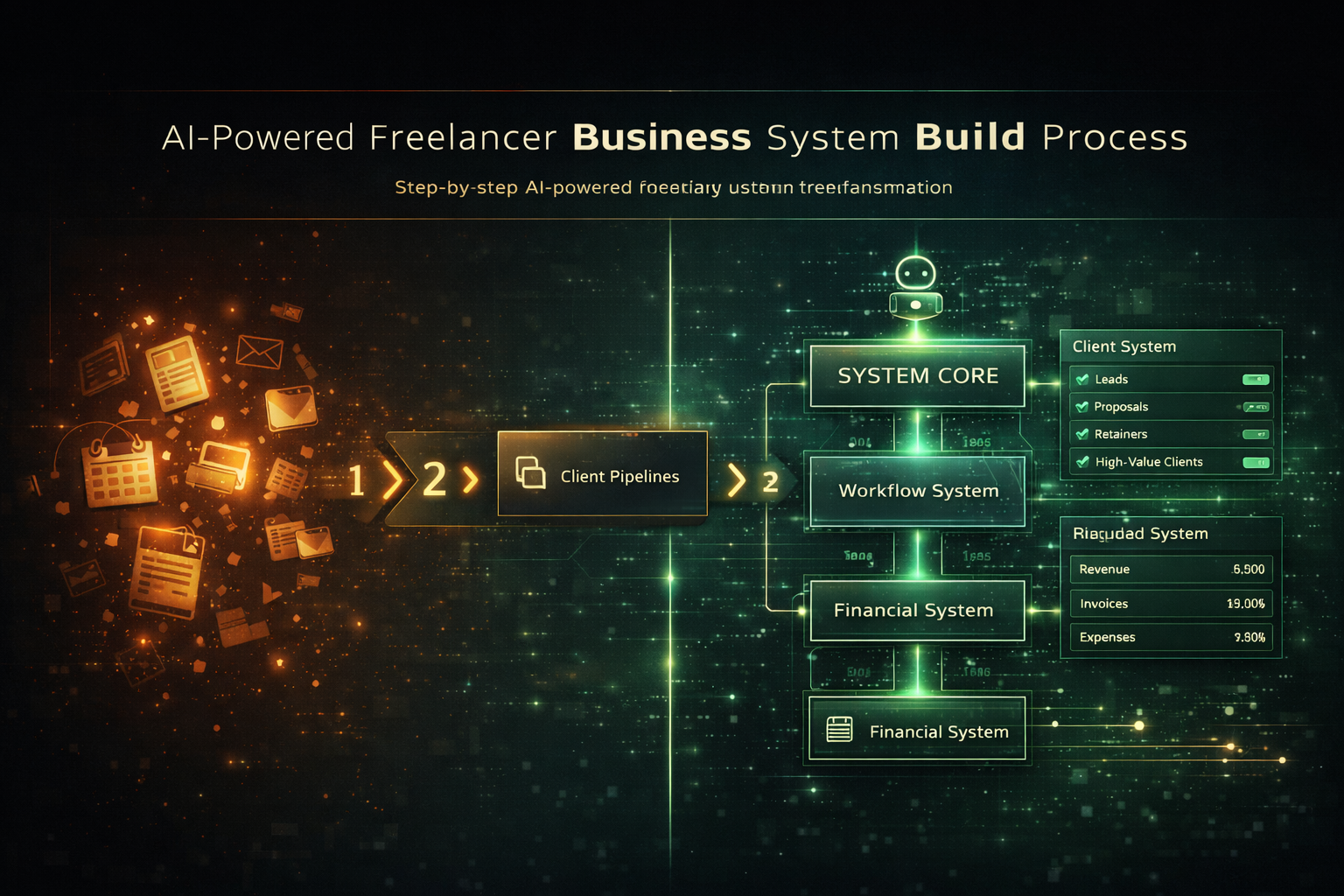
Understanding systems is only valuable when it leads to structured execution.
The objective is not to manage your business better—it is to build a system that runs it consistently.
This process transforms freelance work into a scalable business system.
How do freelancers build a scalable business system?
Freelancers build a scalable business system by defining workflows, standardizing services, structuring client processes, integrating financial tracking, and using AI to create repeatable operations.
Step 1: Map Your Current Business Operations
Start by identifying how your business currently operates.
- How clients are acquired
- How projects are managed
- How work is delivered
- How communication is handled
Clarity reveals where systems are missing.
Step 2: Define Core Workflows
Every recurring activity should follow a structured workflow.
- Break tasks into defined steps
- Standardize execution sequences
- Eliminate variation in how work is completed
Workflows convert inconsistent execution into repeatable processes.
Step 3: Standardize Services and Delivery
Custom work increases operational complexity.
- Define clear service structures
- Create repeatable delivery processes
- Set consistent output expectations
Standardization enables scalability without sacrificing quality.
Step 4: Build a Client Management System
Client interactions must follow a structured process.
- Define onboarding workflows
- Standardize communication formats
- Set timelines and expectations clearly
Structured client management reduces friction and improves efficiency.
Step 5: Implement Financial Tracking
A business system must include financial visibility.
- Track revenue consistently
- Monitor expenses and profitability
- Maintain clear cash flow awareness
This connects directly to your financial system: AI-powered money management for freelancers
Financial clarity enables controlled decision-making.
Step 6: Align Workflows With Productivity Systems
Execution systems must support business workflows.
- Tasks should follow structured processes
- Execution must remain consistent across projects
- Time usage should align with workflow design
This connects to: AI productivity system for freelancers
Productivity systems ensure efficient execution within your business.
Step 7: Integrate AI Across Systems
AI enhances how your business operates.
- Automate repetitive tasks
- Improve execution speed
- Support decision-making with data insights
Explore: AI tools for freelancers
AI increases leverage without increasing workload.
Step 8: Connect Systems Into a Unified Structure
Individual systems must be integrated.
- Client acquisition feeds workflows
- Workflows drive delivery
- Financial tracking reflects performance
Integration transforms separate processes into a business operating system.
Step 9: Maintain System Consistency
Systems only work when applied consistently.
- Follow defined processes
- Avoid reverting to manual execution
- Continuously refine workflows
Consistency turns structure into scalability.
Common Implementation Mistakes
Execution often fails due to poor implementation.
- Trying to systemize everything at once
- Building overly complex workflows
- Using tools without defined systems
- Failing to maintain consistency
Systems fail when execution lacks structure.
What Implementation Looks Like Over Time
At the beginning:
- Systems may feel restrictive
- Execution may slow temporarily
- Processes require adjustment
Over time:
- Workflows become natural
- Operations stabilize
- Execution becomes faster and more efficient
This is the transition from managing work to operating a system.
The Result of a Fully Built Business System
Once implemented, a freelancer business system creates:
- Predictable and structured operations
- Consistent execution across projects
- Reduced operational complexity
- Scalable business growth
This is how freelance work evolves into a system-driven business.
This process builds a scalable freelancer business system where execution, operations, and growth are controlled through structured systems.
How to Scale a Freelancer Business System Beyond Your Time and Capacity
Once a freelancer business system is built, the next stage is scaling it.
Scaling is not about doing more work—it is about expanding how your system operates without depending on your time.
This is where freelancers transition from structured execution to system-driven scalability.
How do freelancers scale a business system?
Freelancers scale a business system by standardizing processes, increasing leverage through automation and AI, and building systems that operate independently of their direct involvement.
The Limitation of System-Dependent Freelancing
Even with systems in place, many freelancers remain deeply involved in execution.
- Workflows still depend on their input
- Decisions require constant attention
- Operations slow down as workload increases
This creates a new constraint.
The system exists—but it is still dependent on you.
The Shift From Operator to System Owner
Scaling requires a change in role.
- From executing tasks → to managing systems
- From handling work → to overseeing outcomes
- From involvement → to system design
This is the transition from freelancer to system owner.
Standardization as the Foundation of Scaling
Scaling begins with deeper standardization across all processes.
- Workflows are clearly defined
- Processes are documented and repeatable
- Outputs follow structured formats
This ensures:
- Consistency across projects
- Reduced dependency on individual decisions
- Scalable execution across higher volumes
Standardization allows systems to expand without breaking.
Building Leverage Through Systems
Scaling depends on leverage rather than effort.
- Repetitive tasks are automated
- Decision-making is reduced through structure
- Processes are optimized for repeatability
This enables:
- More output without increasing workload
- Faster execution across operations
- Higher efficiency at scale
Leverage multiplies the effectiveness of your business system.
The Role of AI in Scaling Business Systems
AI becomes a critical component at the scaling stage.
- Handles repetitive execution tasks
- Supports decision-making with data insights
- Maintains consistency across workflows
This allows:
- Increased output without additional effort
- Reduced operational bottlenecks
- Faster system expansion
AI enables systems to operate with greater independence.
Reducing Dependence on Direct Execution
Scaling requires removing yourself from day-to-day operations.
- Stop executing every task
- Stop managing every detail
- Stop controlling every decision
Instead, focus on:
- Monitoring system performance
- Improving workflows
- Optimizing system efficiency
This is what allows your business to grow beyond your time.
Expanding System Capacity
A scalable system must handle increasing demand without breaking.
- Workflows support higher volume
- Processes remain stable under pressure
- Systems adapt as complexity increases
Without this:
- Operations become overwhelmed
- Quality declines
- Growth slows
Scalable systems are designed for expansion from the beginning.
The Compounding Effect of Scaled Systems
As systems scale, their impact increases over time.
- Efficiency improves with repetition
- Output increases without proportional effort
- Operations become more predictable
This creates:
- Higher returns with less involvement
- Greater operational control
- Long-term business scalability
Scaling transforms systems into long-term business assets.
Why Most Freelancers Never Reach This Stage
Many freelancers stop after building basic systems.
- They improve workflows but do not scale them
- They increase efficiency but not capacity
- They maintain control instead of creating leverage
This prevents:
- True scalability
- System independence
- Long-term growth
Scaling requires shifting from control to system design.
The Strategic Advantage of a Scalable Business System
Freelancers who scale their systems gain a significant advantage.
- Operations run independently
- Execution remains consistent at higher capacity
- Growth becomes sustainable and controlled
This is how a freelance business evolves into a scalable system-driven operation.
This creates a scalable freelancer business system where structured processes, automation, and leverage enable growth beyond individual capacity.
How a Freelancer Business System Connects and Aligns Every Part of Your Operations
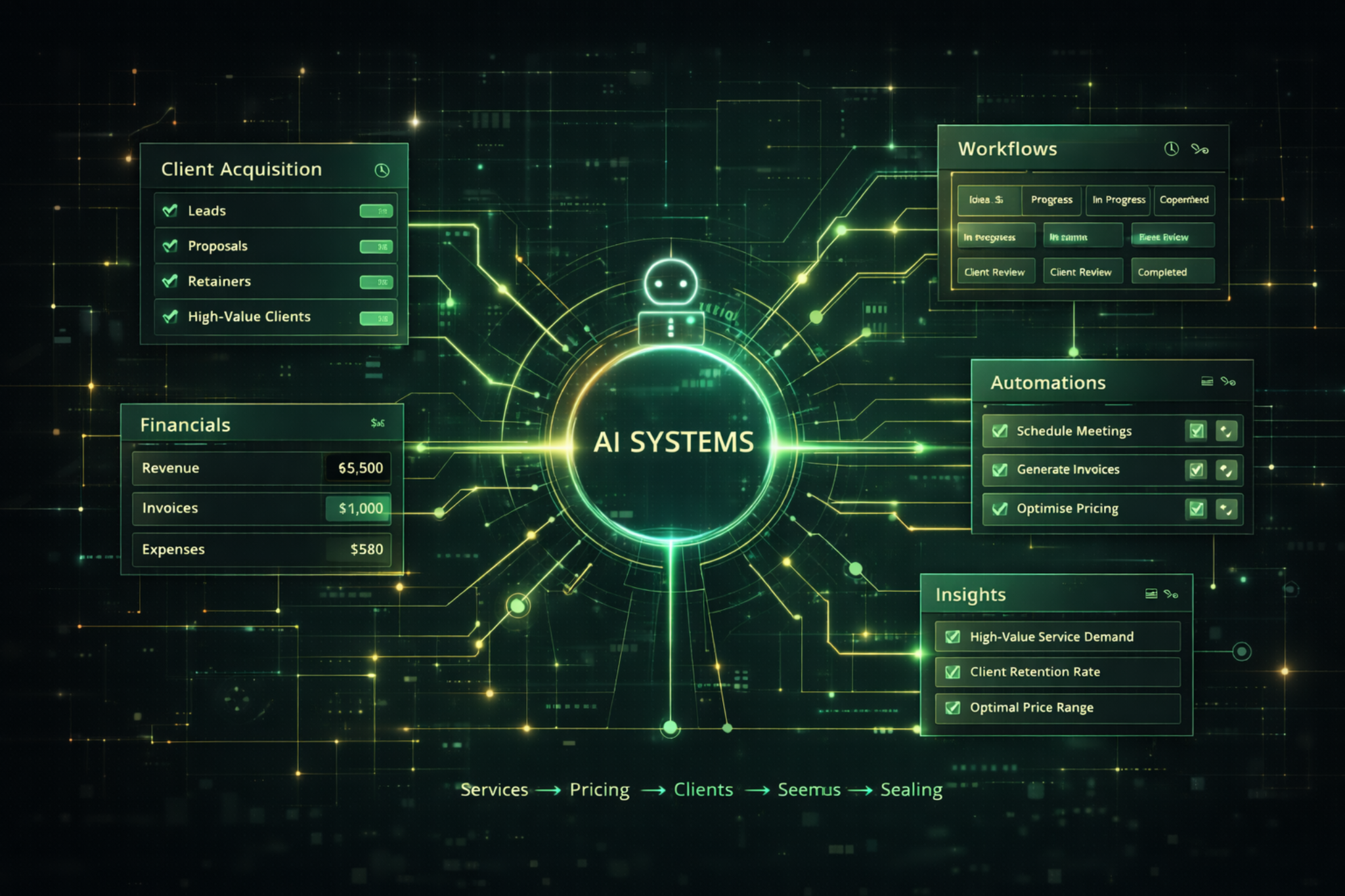
A freelancer business system is not a standalone structure.
It is the integration layer that connects all parts of your freelance business into a single operating system.
Without integration, systems operate independently.
With integration, the business operates as a coordinated structure.
How does a freelancer business system connect different systems?
A freelancer business system connects workflows, finances, client processes, and income systems into a unified structure that ensures consistent execution and scalable growth.
The Role of Integration in a Freelancer Business System
Each part of a freelance business solves a specific problem.
- Financial systems provide stability and control
- Execution systems manage workflows and output
- Growth systems expand income capacity
Individually, these systems improve performance.
Integration ensures they work together instead of creating friction.
What Happens When Systems Are Not Connected
Without integration, improvements remain isolated.
- Income grows but operations remain unstable
- Workflows improve but business structure stays fragmented
- Tools are used but processes remain inconsistent
This leads to:
- Operational inefficiencies
- Inconsistent execution
- Limited scalability
Disconnected systems create complexity instead of leverage.
What Happens When Systems Are Integrated
Integration aligns all business functions into a unified structure.
- Financial decisions support business operations
- Workflows align with service delivery
- Execution remains consistent across all projects
- Growth becomes structured and predictable
The business operates as a system—not a collection of tasks.
The Business System as the Coordination Layer
The freelancer business system acts as the coordination layer across all operations.
- It aligns financial control with execution
- It connects workflows with service delivery
- It ensures systems support growth instead of limiting it
This reduces:
- Decision fatigue
- Operational friction
- Execution inconsistencies
Coordination is what makes systems functional at scale.
How Integration Strengthens System Performance
When systems are connected, performance improves across the business.
- Processes become more efficient
- Execution becomes faster and more predictable
- Errors decrease through structured workflows
This creates:
- Higher operational efficiency
- Greater consistency in delivery
- Improved scalability
Integrated systems perform better than isolated improvements.
The Sequence Behind Effective Integration
Integration only works when systems are built in the correct sequence.
- Stability systems must be established first
- Execution systems must be structured next
- Growth systems must be controlled before scaling
Only after these are in place:
- Business systems connect everything
Integration is the final layer—not the starting point.
The Long-Term Impact of an Integrated Business System
Freelancers who integrate their systems achieve:
- Consistent and predictable operations
- Reduced complexity as the business grows
- Greater control over execution and outcomes
- Scalable and sustainable business growth
This creates a business that functions reliably under pressure.
You are no longer managing separate systems—you are operating an integrated business system.
The System-Level Perspective
At a higher level, a freelancer business system represents:
- The alignment of all operational processes
- The coordination of financial and execution systems
- The structure that supports long-term scalability
This is what transforms freelance work into a structured business.
Integration is what makes the entire system work as one.
To see how systems connect in practice, explore:
How a Freelancer Business System Compounds and Becomes Stronger Over Time
A freelancer business system does not deliver its full value immediately.
Its real power comes from compounding—where systems improve, strengthen, and become more efficient over time.
This is what separates short-term progress from long-term business scalability.
How does a freelancer business system compound over time?
A freelancer business system compounds over time by improving workflows, increasing efficiency, reducing errors, and creating leverage through consistent execution and system refinement.
The Difference Between Linear Effort and System Compounding
Effort-based growth follows a linear pattern.
- More work leads to more output
- Progress depends on time and energy
- Growth slows as workload increases
System-based growth behaves differently.
- Processes improve with repeated use
- Execution becomes faster and more efficient
- Output increases without proportional effort
This is the foundation of compounding in a business system.
How Business Systems Improve With Use
Every system becomes more effective the more it is used.
- Inefficiencies are identified during execution
- Processes are refined based on real usage
- Workflows become faster and more reliable
This creates a continuous improvement cycle:
- Execute the system
- Identify friction points
- Refine processes
- Increase efficiency
Each cycle strengthens the system.
The Role of Consistency in Compounding
Compounding depends on consistent system usage.
- Processes must be followed regularly
- Workflows must remain structured
- Execution must stay aligned with the system
Without consistency:
- Systems break down
- Efficiency is lost
- Results become unpredictable
Consistency converts systems into long-term assets.
How Integration Accelerates Compounding
Compounding increases when systems are connected.
- Financial clarity improves decision-making
- Structured workflows improve execution speed
- Integrated systems reduce friction across operations
This leads to:
- Faster system improvements
- Stronger operational alignment
- Higher long-term efficiency
Integrated systems compound faster than isolated ones.
The Impact of Compounding on Business Operations
As systems strengthen over time:
- Operations require less manual control
- Execution becomes more predictable
- Errors decrease through structured processes
- Client experience improves consistently
This results in:
- Higher operational capacity
- Greater consistency across projects
- Improved scalability
The business becomes more stable as it grows.
From Efficiency to Leverage
As systems improve, they begin to create leverage.
- Workflows handle more output
- Processes reduce manual effort
- Execution becomes faster without added workload
This allows:
- More results with less effort
- Higher output without burnout
- Faster scaling of operations
Leverage is the result of compounding systems.
Why Most Freelancers Never Experience Compounding
Many freelancers never reach this stage because they do not maintain systems consistently.
- Systems are abandoned when workload increases
- Processes are not followed consistently
- Manual work replaces structured execution
This prevents:
- System improvement
- Efficiency gains
- Long-term scalability
Without consistency, systems cannot compound.
The Long-Term Advantage of Compounding Systems
Freelancers who maintain structured systems over time gain a significant advantage.
- Operations become predictable and stable
- Decision-making becomes easier
- Efficiency increases across all processes
- Growth becomes scalable and sustainable
This creates a business that improves continuously instead of resetting with each challenge.
The system becomes stronger with time—not dependent on constant effort.
The System Perspective
A freelancer business system is not static.
It evolves through:
- consistent execution
- continuous refinement
- system integration
This aligns with a core principle:
Systems are designed to improve over time—not rely on increasing effort.
Build a Freelancer Business System That Runs Without Constant Effort
At this point, the pattern is clear.
Freelancers do not struggle because they lack skill or opportunities.
They struggle because their business is not structured as a system.
Without a business system:
- Operations remain fragmented
- Growth increases complexity
- Execution depends on constant involvement
- Scaling becomes difficult to sustain
With a system:
- Operations become structured and predictable
- Workflows connect across the business
- Execution becomes consistent and efficient
- Growth becomes scalable and controlled
This is the difference between managing work and operating a scalable business system.
The System That Connects Everything
An AI freelancer business system is the final layer of a complete freelance operating system.
It integrates all core functions into one coordinated structure:
- Financial systems provide stability and control
- Execution systems ensure consistent workflows
- Growth systems expand revenue capacity
- Business systems connect everything into a unified structure
This is what transforms freelance work into a scalable business.
What Happens Without This System
Without structured systems:
- Growth creates pressure instead of leverage
- Work becomes harder to manage
- Operations remain disconnected
- Long-term scalability is limited
You increase income—but not business stability.
What Happens When You Build It
With a structured business system:
- Operations remain stable as demand increases
- Execution becomes predictable and efficient
- Systems operate together instead of independently
- Growth becomes sustainable and scalable
This is how freelancers transition into system-driven business operators.
Build Your Freelancer Business System Before Complexity Slows You Down
If your business feels harder to manage as it grows, the system—not more effort—is the solution.
No chaos. No fragmented workflows. A complete system for scalable freelance business growth.
Built for freelancers managing unpredictable income and increasing workload.
Continue Building Your Freelancer Operating System
A business system is the final layer—but it works best when connected with the full operating structure.
Explore the complete system:
This is how individual systems become a complete, scalable operating system.
Building an AI freelancer business system is the final step in creating a structured, scalable, and resilient freelance business.