
FM Mastery Operating System • Step 4: Growth
If your income is stuck despite working more, this is why.
AI-Smart Income Growth System for Freelancers: Scale Without Burnout
An AI-smart income growth system for freelancers builds predictable revenue, expands earning capacity, and removes income plateaus using structured workflows instead of more effort.
Freelance income does not scale with effort alone. Growth requires systems that improve pricing, increase capacity, and create repeatable revenue streams.
- ✔ Increase income without increasing workload
- ✔ Build scalable and repeatable revenue systems
- ✔ Eliminate income plateaus and stagnation
No chasing clients. No guesswork. A system for predictable income growth.
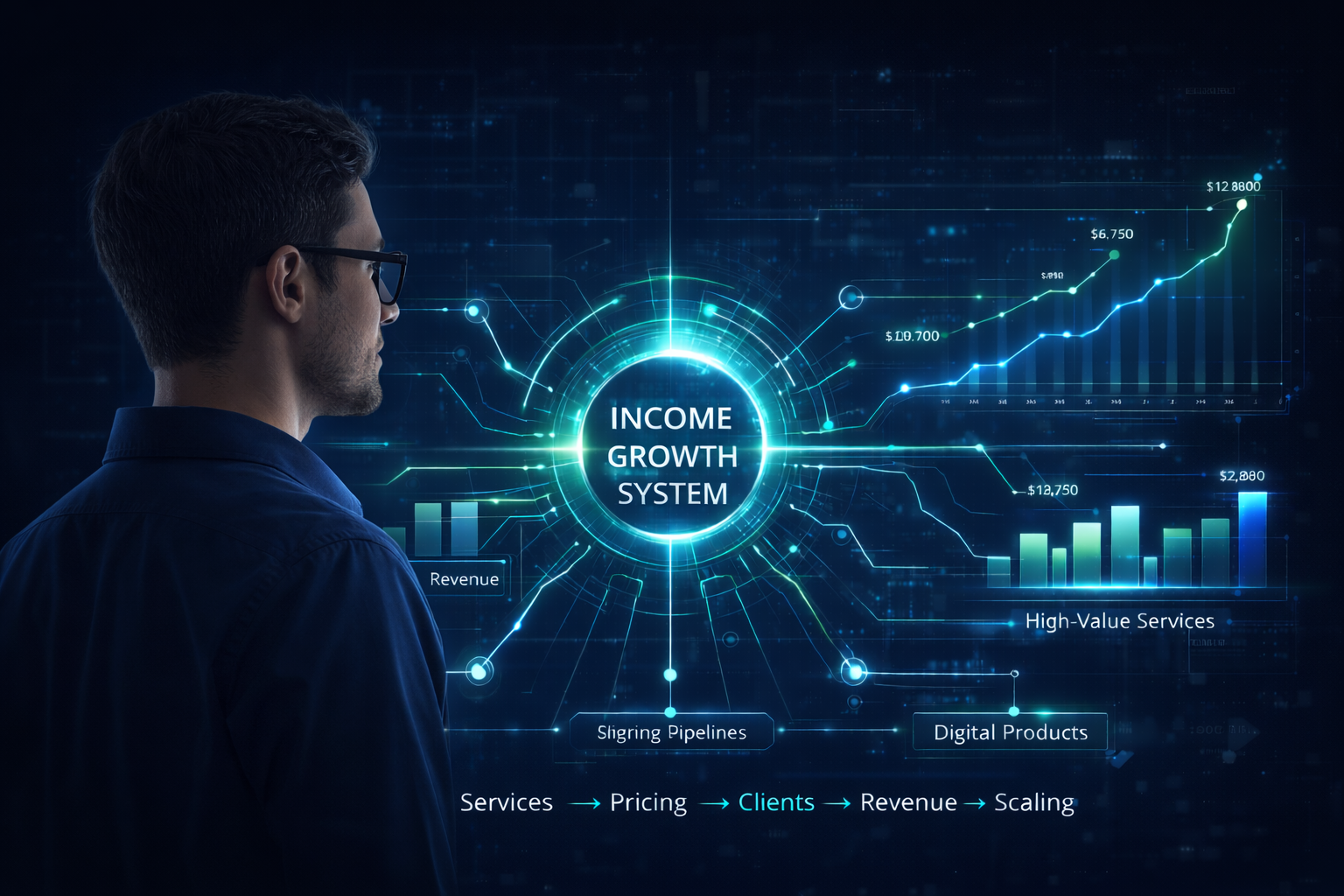
This approach is part of a broader AI financial system for freelancers designed to manage income growth, financial stability, and decision-making under income uncertainty.
What is AI-smart income growth for freelancers?
AI-smart income growth for freelancers is a system that increases revenue by improving pricing, expanding capacity, and creating scalable income streams using structured workflows and AI-driven execution.
Why Most Freelancers Hit an Income Plateau
Many freelancers reach a point where income stops growing, even though they continue working more.
The problem is not effort—it is the absence of a structured growth system.
At early stages, income increases with effort:
- More clients → more income
- More hours → higher earnings
- More projects → increased cash flow
But over time, this model breaks.
Income stops scaling because effort reaches its limit.
Why do freelancers struggle to grow their income?
Freelancers struggle to grow their income because earnings remain tied to time and effort instead of scalable systems that increase value, capacity, and leverage.
The Hidden Income Ceiling
Every freelancer operating without a system eventually reaches a ceiling:
- Time becomes limited
- Energy becomes constrained
- Workload becomes unsustainable
This creates a fixed upper limit on income.
No matter how much effort increases, income cannot scale beyond this point.
Why More Work Stops Working
The default response to stagnant income is to work more.
Freelancers attempt to:
- Take on more clients
- Accept lower-value work
- Extend working hours
This approach leads to:
- Burnout
- Declining work quality
- Reduced long-term capacity
More work increases pressure—but does not create scalable income.
The Real Problem: No Growth System
Income growth requires a system—not just activity.
Without a structured growth framework:
- Revenue depends entirely on active work
- Pricing remains inconsistent
- Opportunities are not leveraged effectively
This creates:
- Unpredictable income growth
- Plateaus after initial progress
- Limited scalability
Without systems, income expansion becomes unstable and capped.
The Difference Between Linear and Scalable Income
Freelance income typically starts as linear:
- More time → more income
- Less time → less income
But scalable income operates differently:
- Systems increase output without increasing time
- Processes enable higher-value work
- Capacity expands beyond individual effort
This is the shift from working more to earning through systems.
How the Plateau Affects Long-Term Growth
Income plateaus create long-term limitations:
- Growth slows or stops completely
- Financial goals are delayed
- Business expansion becomes restricted
Over time:
- Freelancers remain at the same income level
- Opportunities are missed
- Work becomes repetitive instead of expanding
This prevents transition into scalable income models.
The Illusion of Progress
Many freelancers believe they are progressing because:
- They are busy
- They are completing more work
- They are earning slightly more
But:
- Workload increases faster than income
- Effort replaces strategy
- Growth remains limited
Busyness creates the illusion of growth without real scalability.
The Root Cause of Income Stagnation
At its core, income stagnation comes from:
Operating without a structured income growth system.
Without:
- Defined growth workflows
- Clear pricing strategy
- Leverage through systems and AI tools
Freelancers remain dependent on:
- Time-based work
- Manual effort
- Inconsistent opportunities
This is what creates long-term income limitations.
What This Means for Freelancers
If income is not growing, it is not a motivation problem.
It is a system design problem.
Solving it requires:
- Shifting from effort-based work to system-based growth
- Building scalable workflows
- Using AI to increase capacity and leverage
This is the foundation of an AI-smart income growth system for freelancers.
Why do freelancers hit an income plateau?
How Income Growth Actually Works for Freelancers
Freelance income does not grow through effort alone—it grows through systems that expand capacity, increase value, and create leverage.
Income growth is not about doing more work. It is about changing how work produces revenue.
To achieve this, freelancers must shift from an effort-based model to a system-driven growth model.
How do freelancers increase income without working more?
Freelancers increase income without working more by improving pricing, optimizing workflows, and using AI-driven systems to increase output and efficiency.
An AI-smart income growth system for freelancers works by combining value expansion, capacity growth, and leverage into a structured revenue model.
The Three Drivers of Income Growth
All sustainable income growth comes from three core system drivers:
- Value expansion
- Capacity expansion
- Leverage creation
Without these, income remains limited by time.
1. Value Expansion: Increasing What Your Work Is Worth
The first driver of income growth is increasing the value of your work.
Without value expansion:
- Pricing remains fixed
- Income depends on volume
- Growth is limited
With value expansion:
- Higher pricing becomes possible
- Revenue increases per output
- Income grows without additional workload
Income growth begins with value—not effort.
2. Capacity Expansion: Doing More Without Burnout
Capacity defines how much work you can handle effectively.
Without systems:
- Capacity is limited by time and energy
- Workload quickly becomes overwhelming
With structured workflows and AI:
- Execution becomes faster
- Repetitive tasks are reduced
- More work can be handled without added stress
Capacity expansion allows income to grow without increasing pressure.
3. Leverage Creation: Multiplying Output Through Systems
Leverage enables income to scale beyond direct effort.
Without leverage:
- Every dollar requires time
- Work must be repeated manually
With leverage:
- Systems generate repeatable value
- Processes scale output
- Income becomes less dependent on time
Leverage transforms effort into scalable income.
How These Drivers Work Together
Income growth is not driven by a single factor—it comes from combining all three drivers.
- Value increases pricing potential
- Capacity increases output
- Leverage multiplies results
When combined:
- Income accelerates
- Workload becomes manageable
- Scaling becomes achievable
This creates a system where growth is embedded into execution.
The Shift From Linear to System-Based Income
Without a system:
- Income = time × effort
With a structured model:
- Income = (value × capacity) × leverage
This shift fundamentally changes how income is generated.
Instead of working more to earn more, freelancers begin designing systems that produce higher revenue per unit of work.
The Role of AI in Income Growth Systems
AI plays a critical role in enabling scalable income systems.
- Improves execution speed
- Automates repetitive processes
- Enhances output quality
This directly supports:
- Capacity expansion
- Leverage creation
To implement this effectively, explore:
AI enables systems—but it does not replace them.
Why Most Freelancers Never Reach This Stage
Most freelancers focus on short-term actions:
- Getting more clients
- Working more hours
- Increasing immediate income
This prevents system development because:
- No time is invested in building growth systems
- Work remains reactive
- Income stays linear
Growth requires system design—not just increased activity.
The Outcome of a Growth System
When a system is implemented:
- Income increases without proportional effort
- Work becomes scalable
- Growth becomes predictable
This is the foundation of an AI-smart income growth system for freelancers.
This builds a system-driven revenue model for freelancers, where structured workflows, pricing strategy, and leverage drive consistent growth.
How does income growth actually work for freelancers?
The Core Systems That Drive Income Growth for Freelancers
Income growth is not driven by a single strategy—it is built through multiple systems working together.
Each system acts as a growth engine that expands revenue in a specific way.
Without these systems:
- Income remains inconsistent
- Growth depends on effort
- Scaling becomes difficult
With structured systems:
- Revenue becomes predictable
- Growth becomes repeatable
- Income expands beyond time constraints
What systems help freelancers grow their income?
Freelancers grow their income using systems such as pricing optimization, client acquisition workflows, service packaging, and AI-powered execution processes that increase value, capacity, and scalability.
1. Pricing Optimization System
Pricing is one of the most powerful income growth levers.
Without a structured pricing model:
- Rates remain static
- Income depends on workload
- Growth is limited
With a pricing system:
- Rates increase based on value
- Revenue grows per project
- Income expands without additional work
Pricing systems increase revenue without increasing effort.
2. Client Acquisition System
Growth requires a consistent flow of opportunities.
Without an acquisition system:
- Client flow is unpredictable
- Income fluctuates significantly
- Growth stalls during slow periods
With a structured acquisition workflow:
- Client flow becomes consistent
- Opportunities increase steadily
- Revenue becomes more stable
Consistent acquisition supports sustained income expansion.
3. Service Packaging System
How services are structured directly affects scalability.
Without packaging:
- Work is customized for every client
- Pricing remains inconsistent
- Scaling becomes difficult
With structured service models:
- Offers become standardized
- Pricing becomes clearer
- Delivery becomes more efficient
Service packaging transforms work into scalable offerings.
4. Workflow Efficiency System
Efficient workflows increase execution capacity.
Without workflow systems:
- Execution is slow
- Capacity is limited
- Growth is restricted
With structured workflows:
- Execution becomes faster
- Capacity increases
- More revenue can be generated
This connects directly to:
AI productivity system for freelancers
Efficiency systems expand earning capacity.
5. AI Leverage System
AI enables freelancers to multiply output without increasing effort.
Without AI integration:
- Tasks remain manual
- Output is limited
- Growth requires more time
With AI:
- Tasks are automated
- Output increases
- Time is freed for high-value work
Explore:
AI tools for freelancers and best AI tools for freelancers
AI creates leverage that accelerates income expansion.
6. Income Diversification System
Relying on a single income source limits long-term growth.
Without diversification:
- Income risk increases
- Growth opportunities are restricted
With diversified revenue streams:
- Multiple income sources are created
- Revenue becomes more stable
- Growth accelerates
Diversification expands income beyond a single channel.
How These Systems Work Together
Each system contributes to growth in a different way:
- Pricing increases value
- Acquisition increases opportunities
- Packaging improves scalability
- Workflows increase capacity
- AI creates leverage
- Diversification expands revenue sources
When combined:
- Income grows faster
- Work becomes scalable
- Revenue becomes predictable
This creates a structured income growth framework for freelancers.
This builds a system-driven revenue model, where multiple systems work together to generate consistent and expanding income.
What systems help freelancers grow their income?
Why Most Freelancers Fail to Scale Their Income
Many freelancers attempt to grow their income—but most remain stuck at a certain level.
The issue is not lack of effort. It is the absence of scalable systems.
Even experienced freelancers struggle to move forward because their growth approach is not structured for scalability.
Why do freelancers struggle to scale their income?
Freelancers struggle to scale their income because they rely on time-based work, lack structured growth systems, and fail to build leverage through pricing, workflows, and automation.
1. Relying on Time-Based Income
Most freelancers earn based on time:
- Hourly work
- Project-based pricing tied to effort
- Manual service delivery
This creates a limitation:
- Income is capped by available time
- Growth slows as workload increases
Time-based income prevents scalable expansion.
2. Focusing on More Work Instead of Better Systems
When income stalls, the default response is to increase activity.
- Taking more clients
- Working longer hours
- Accepting lower-value projects
This approach:
- Increases stress
- Reduces efficiency
- Limits long-term growth
More work increases pressure—but does not create scalable results.
3. Lack of Pricing Strategy
Without a structured pricing system:
- Rates remain inconsistent
- Value is not fully captured
- Income growth becomes unpredictable
Freelancers often:
- Underprice their work
- Delay rate increases
- Compete on cost instead of value
Weak pricing limits long-term income potential.
4. No Scalable Service Structure
Custom work for every client reduces scalability.
Without structured service models:
- Work must be recreated repeatedly
- Execution remains inefficient
- Capacity is restricted
This leads to:
- Inconsistent delivery
- Slower execution
- Reduced scalability
Scalability requires structured service systems.
5. Ignoring Workflow Efficiency
Inefficient workflows reduce income potential.
Without optimized execution:
- Tasks take longer than necessary
- Capacity remains limited
- Opportunities are missed
This directly connects to:
AI productivity system for freelancers
Efficiency is essential for scalable income growth.
6. Not Using AI for Leverage
AI tools provide a significant advantage—but many freelancers do not use them effectively.
Without AI integration:
- Work remains manual
- Output is limited
- Growth requires more effort
With AI-enabled systems:
- Execution becomes faster
- Repetitive work is automated
- Capacity increases
Explore:
AI enables leverage—but only within structured systems.
7. Lack of Income Diversification
Relying on a single income stream increases risk and limits growth potential.
Without diversification:
- Income depends on a narrow source
- Opportunities remain limited
- Growth becomes constrained
This creates:
- Higher income volatility
- Restricted scalability
Diversification expands long-term income potential.
The Pattern Behind These Failures
All of these issues share a common pattern:
Operating without a structured income growth system.
Freelancers focus on:
- Effort
- Activity
- Short-term gains
Instead of:
- Systems
- Leverage
- Scalable structures
This prevents long-term income expansion.
The System-Based Alternative
Freelancers who scale income successfully follow a different approach:
- They build structured growth systems
- They focus on value and leverage
- They optimize workflows and pricing
This allows them to:
- Increase income without proportional effort
- Handle higher workloads efficiently
- Create scalable revenue streams
This is the difference between working more and building income systems.
Avoiding these failures is essential to building a structured income growth framework for freelancers, where growth is driven by systems rather than effort.
Why do freelancers fail to scale their income?
How to Build an AI-Smart Income Growth System as a Freelancer
Understanding income growth is only valuable if it leads to structured execution.
The goal is not to earn more randomly—it is to build a system that increases income consistently.
This section outlines how freelancers move from effort-based income to scalable, system-driven revenue.
How do freelancers build a scalable income system?
Freelancers build a scalable income system by optimizing pricing, structuring services, improving workflows, integrating AI tools, and creating repeatable revenue processes.
Step 1: Define Your Income Baseline
Start by understanding your current income structure.
Identify:
- Primary income sources
- Average monthly earnings
- Income variability patterns
This establishes a clear starting point for structured growth.
Without a defined baseline, growth cannot be measured or improved effectively.
Step 2: Identify High-Value Work
Not all work contributes equally to income growth.
Analyze:
- Which services generate the most revenue
- Which clients provide the highest value
- Which work creates long-term opportunities
Growth depends on prioritizing high-value work over volume.
This shifts focus from activity to impact.
Step 3: Optimize Pricing Structure
Pricing must reflect value—not effort.
Instead of:
- Charging based on hours
- Keeping rates static
Move toward:
- Value-based pricing
- Tiered service models
- Clear pricing frameworks
Pricing optimization increases revenue without increasing workload.
Step 4: Structure Services for Scalability
Convert custom work into structured offerings.
- Standardize deliverables
- Create repeatable service packages
- Reduce variability in execution
Structured services enable scalable income growth.
This reduces complexity while improving efficiency.
Step 5: Build Workflow Efficiency
Income growth depends on execution efficiency.
Without workflow systems:
- Tasks take longer than necessary
- Capacity remains limited
With structured workflows:
- Execution becomes faster
- Capacity increases
- More work can be handled effectively
This connects directly to:
AI productivity system for freelancers
Efficiency expands earning capacity.
Step 6: Integrate AI for Leverage
AI tools increase output without increasing effort.
Use AI for:
- Content generation
- Task automation
- Client communication
Explore:
AI tools for freelancers and best AI tools for freelancers
AI multiplies execution capacity and enables leverage.
Step 7: Create Repeatable Revenue Streams
Move beyond one-time income sources.
- Retainer models
- Recurring services
- Productized offerings
Repeatable revenue creates predictable income growth.
This reduces dependency on constant client acquisition.
Step 8: Maintain System Consistency
The system must be applied consistently to produce results.
- Follow structured workflows
- Apply pricing rules consistently
- Maintain execution discipline
Consistency converts structure into scalable income.
Common Execution Mistakes
Freelancers often fail during implementation by:
- Trying to grow income without systems
- Focusing on volume instead of value
- Ignoring pricing strategy
- Using AI tools without structured workflows
Growth fails when systems are not applied correctly.
What Implementation Looks Like in Practice
At the beginning:
- Systems may feel restrictive
- Adjustments may be required
- Execution may not be smooth
Over time:
- Workflows become natural
- Income becomes more stable
- Growth becomes consistent
This is the transition from effort-based income to system-driven growth.
The Outcome of Implementation
Once implemented, freelancers achieve:
- Predictable income growth
- Higher earning capacity
- Reduced dependency on time
- Scalable revenue systems
This is how income becomes scalable and sustainable.
This process builds a system-driven revenue model for freelancers, where structured execution replaces unpredictable earnings.
How do freelancers build a scalable income system?
How Freelancers Scale Income Beyond Time-Based Work
At a certain point, income growth through freelance work alone reaches its limits.
True scaling begins when income is no longer tied directly to personal output.
This is where freelancers transition from service providers to system-driven operators.
How do freelancers scale income beyond freelance work?
Freelancers scale income beyond freelance work by building systems, creating leverage through automation, and developing revenue streams that are not directly tied to their time.
The Limit of Solo Freelancing
Even with optimized systems:
- Time remains finite
- Energy has limits
- Execution capacity eventually plateaus
This creates a natural ceiling.
Scaling requires removing the dependency on personal execution.
The Shift From Freelancer to Operator
Scaling income requires a fundamental shift:
- From doing work → to designing systems
- From executing tasks → to managing processes
- From earning per project → to building scalable revenue streams
This is the transition from freelancer to system-driven operator.
System-Based Scaling Models
Income scaling is achieved through structured models that extend beyond individual effort.
Common models include:
- Productized services
- Retainer-based income models
- Digital products and assets
- Automated service delivery systems
These models create income that is not directly tied to time.
Leveraging Systems Instead of Time
Scaling depends on leverage.
Instead of increasing manual workload, freelancers begin to:
- Build systems that handle execution
- Automate repetitive processes
- Standardize delivery workflows
Leverage enables income to grow without proportional effort.
The Role of AI in Scaling
AI accelerates the transition from freelancer to scalable operator.
- Automates execution tasks
- Enhances output quality
- Reduces dependency on manual work
This supports:
- System-based delivery
- Higher output capacity
- Faster scaling
Explore:
AI enables scale—but only when integrated into structured systems.
Scaling Through Process Standardization
Standardization is essential for scaling.
Without standardized processes:
- Work remains inconsistent
- Scaling becomes difficult
- Quality varies across projects
With structured systems:
- Processes become repeatable
- Execution becomes predictable
- Scaling becomes manageable
Standardization transforms services into scalable systems.
Building Income That Compounds
Scalable systems create compounding effects over time.
- Systems improve with use
- Processes become more efficient
- Revenue increases without proportional effort
This creates:
- Long-term income growth
- Reduced reliance on active work
- Greater financial stability
Compounding systems are the foundation of scalable income expansion.
Why Most Freelancers Never Reach This Stage
Most freelancers remain focused on:
- Short-term income
- Client-based work
- Immediate results
This prevents scaling because:
- Systems are not developed
- Leverage is not created
- Long-term assets are not built
Scaling requires a shift from short-term work to long-term system development.
The Strategic Advantage of Scaling Systems
Freelancers who build scalable systems gain:
- Income that grows beyond time constraints
- Reduced workload pressure
- Greater control over operations
- Long-term revenue expansion
This is how freelance work evolves into scalable business systems.
This builds a system-driven revenue model for freelancers, where income is generated through structured processes, automation, and leverage rather than direct effort.
How do freelancers scale income beyond freelance work?
How Income Growth Connects With Financial and Operational Systems
Income growth does not operate in isolation—it functions as part of a complete freelancer operating system.
Without integration, income expansion becomes unstable, inconsistent, and difficult to sustain.
To scale effectively, income systems must connect with:
- Financial management systems
- Execution and productivity systems
- Business operations
This is where system integration becomes essential.
How does income growth connect with other freelancer systems?
Income growth connects with financial, productivity, and operational systems by ensuring consistent execution, stable cash flow, and scalable processes that support long-term business expansion.
The Role of Income Growth in the Freelancer Operating System
Within the FM Mastery framework, income growth is not just about increasing earnings.
It is the expansion layer built on execution efficiency and financial stability.
Without integration:
- Income increases become temporary
- Financial systems become unstable
- Operations become overwhelmed
With integrated systems:
- Growth becomes sustainable
- Financial decisions improve
- Operations scale effectively
Connection to Financial Stability (Pillar 1)
Income growth directly influences financial systems.
- Higher income improves cash flow stability
- Better revenue supports structured financial planning
- Income consistency reduces financial pressure
This connects to:
AI-powered money management for freelancers
Without financial systems, income growth becomes difficult to manage effectively.
Connection to Debt and Risk Control (Pillar 2)
Increased income without control can introduce financial risk.
- Higher earnings may lead to uncontrolled spending
- Poor financial decisions can offset growth
- Debt may increase despite rising income
With integrated systems:
- Income expansion remains controlled
- Financial risks are reduced
- Decisions become more strategic
This supports:
AI debt system for freelancers
Growth must be controlled to remain sustainable.
Connection to Productivity Systems (Pillar 3)
Income growth depends on execution capacity.
- More revenue requires higher output
- Higher-value work requires efficient workflows
- Scaling requires structured execution systems
This connects directly to:
AI productivity system for freelancers
Without execution systems, growth cannot scale effectively.
Connection to Business Systems (Pillar 5)
As income increases, operational complexity grows.
- More clients
- More processes
- Higher expectations
Without structured operations:
- Quality declines
- Systems become inconsistent
- Growth becomes difficult to sustain
With integrated business systems:
- Processes become repeatable
- Operations remain stable
- Scaling becomes manageable
Operations enable income growth to scale sustainably.
The Compounding Effect of Integrated Systems
When systems operate together:
- Execution drives consistent output
- Output increases revenue
- Revenue improves financial stability
- Financial stability supports further growth
This creates a compounding system where each layer strengthens the others.
Without integration:
- Systems operate independently
- Growth becomes inconsistent
- Results remain limited
The Unified Freelancer Operating System
At full integration, freelancers operate within a complete system:
- Financial system → controls money
- Execution system → drives productivity
- Growth system → expands income
- Business system → scales operations
This is the transition from freelance work to a system-driven business.
Why Integration Is the Real Advantage
Most freelancers build systems in isolation:
- Income strategies without financial structure
- Financial planning without execution systems
- Productivity systems without growth alignment
This leads to:
- Inconsistent results
- Limited scalability
- Structural inefficiencies
Integration transforms isolated efforts into a scalable operating model.
The Strategic Outcome
Freelancers who integrate systems achieve:
- Predictable income growth
- Stable financial management
- Efficient execution
- Scalable business operations
This creates a complete freelancer operating system.
Explore the full system through:
How does income growth connect with financial and operational systems?
How Income Growth Systems Compound Over Time for Freelancers
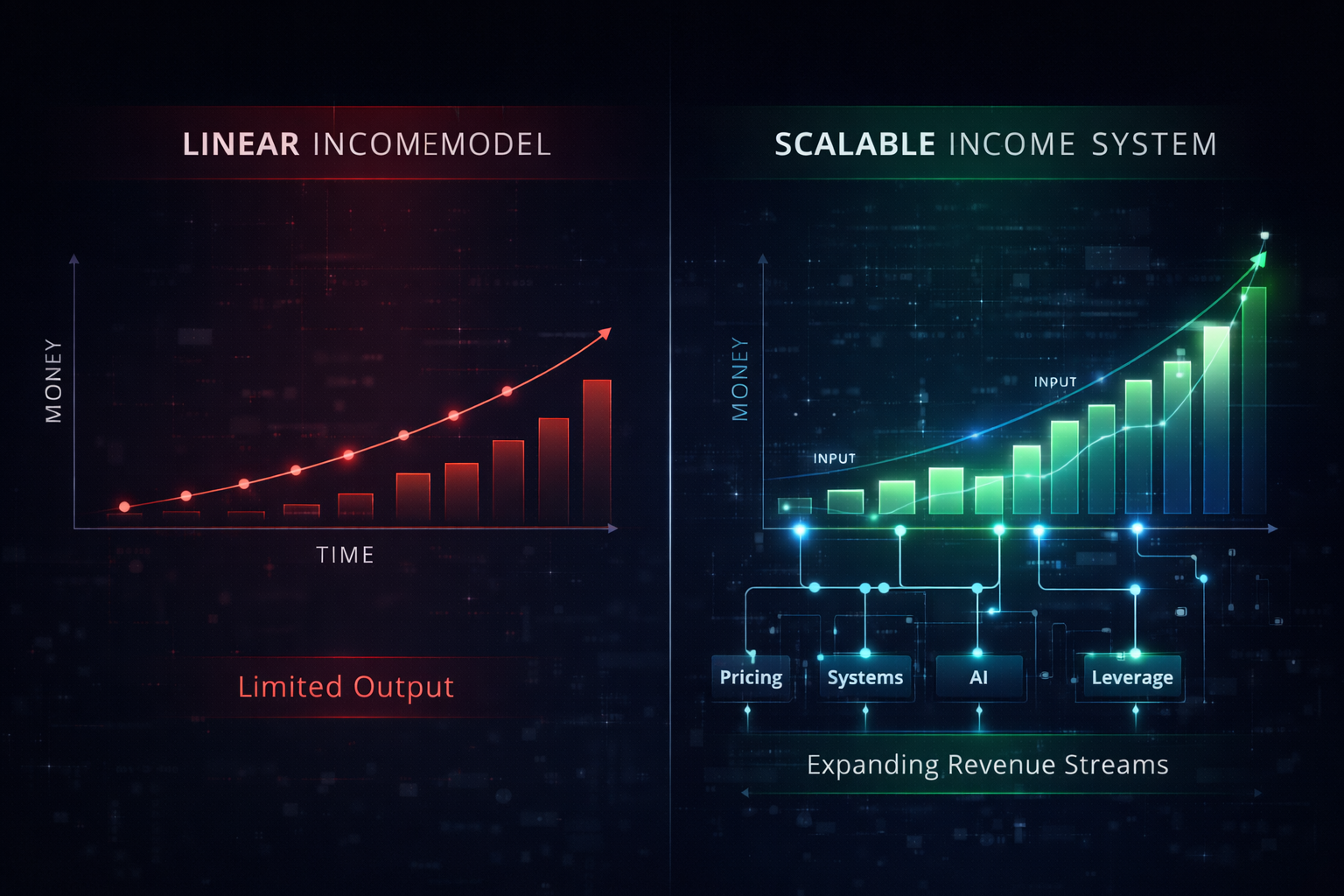
Linear income is limited by time, while scalable income systems grow through pricing, leverage, AI, and structured revenue streams.
Most freelancers focus on short-term income increases—but long-term growth is driven by compounding systems rather than isolated efforts.
Income growth becomes powerful when systems improve, scale, and reinforce each other over time.
Without compounding:
- Income growth remains slow
- Effort increases continuously
- Results plateau over time
With compounding systems:
- Income growth accelerates
- Effort becomes more efficient
- Results improve over time
Do income systems compound over time for freelancers?
Yes, income systems compound over time because improvements in pricing, workflows, and leverage increase revenue while reducing effort, creating accelerating growth.
The Difference Between Linear Income and Compounding Growth
Without structured systems, income grows linearly:
- More work produces more income
- Growth depends on time and effort
- Scaling is limited
With compounding systems, income grows differently:
- Pricing improves progressively
- Workflows become more efficient
- Leverage increases output
Income increases without proportional increases in effort.
How Income Systems Improve With Use
Each time a system is applied:
- Processes are refined
- Inefficiencies are removed
- Execution becomes more efficient
Over time:
- Pricing becomes optimized
- Workflows become faster
- Output increases
Systems improve continuously through repeated use.
The Role of Pricing in Compounding
Pricing is one of the strongest compounding drivers.
As value increases:
- Rates improve over time
- Revenue per project grows
- Income scales without additional workload
Pricing improvements multiply income growth over time.
The Role of Efficiency in Compounding
Efficiency increases income capacity.
With optimized workflows:
- Tasks take less time
- More work can be completed
- Output increases
This connects to:
AI productivity system for freelancers
Efficiency converts time into higher earning potential.
The Role of Leverage in Compounding
Leverage amplifies results beyond direct effort.
Through:
- AI automation
- Standardized processes
- Scalable systems
Freelancers can:
- Produce more output
- Handle larger workloads
- Generate higher income
Leverage transforms effort into scalable results.
The Stability Requirement for Compounding
Compounding depends on consistency.
Without consistent systems:
- Processes reset frequently
- Improvements are lost
- Growth remains unstable
With consistent execution:
- Systems improve continuously
- Results become predictable
- Growth accelerates
Consistency enables long-term compounding.
A well-built AI-smart income growth system for freelancers improves continuously, allowing income to grow without proportional increases in effort.
The Long-Term Impact on Income Growth
Over time, compounding systems lead to:
- Higher revenue with less effort
- Increased financial stability
- Reduced dependency on time
- Greater scalability
This happens because:
- Systems improve continuously
- Efficiency increases capacity
- Leverage multiplies results
This is how income growth becomes sustainable and scalable.
Why Most Freelancers Never Experience Compounding
Most freelancers:
- Change strategies frequently
- Focus on short-term income
- Do not build stable systems
This prevents compounding because:
- Systems are never fully developed
- Processes are constantly reset
- Consistency is not maintained
Compounding requires stability—not constant change.
The Income Growth Maturity Curve
Income systems evolve through stages:
- Initial growth → basic pricing and client acquisition
- Optimization → refining workflows and pricing
- Leverage → automation and system expansion
- Scaling → managing larger revenue systems
Each stage builds on the previous one.
This progression enables continuous growth.
The Strategic Advantage of Compounding Systems
Freelancers who build compounding systems gain:
- Long-term income growth
- Reduced reliance on effort
- Greater control over revenue
- Scalable earning capacity
This is the difference between temporary income and sustained financial expansion.
The Final Realization
At this stage, freelancers understand:
“Income growth is not increased manually—it is built and compounded through systems.”
This shifts focus from:
- Short-term earnings → long-term system development
Where systems—not effort—drive continuous income expansion.
This builds compounding income systems for freelancers, where structured improvements drive long-term growth.
Do income systems compound over time for freelancers?
Build an Income Growth System That Scales Without More Work
At this point, the pattern is clear.
Freelancers do not struggle because opportunities are limited.
They struggle because income is not supported by a structured system.
Without structure:
- Income depends on time
- Growth becomes inconsistent
- Workload increases without scalability
- Revenue plateaus over time
With a system:
- Income becomes predictable
- Growth becomes repeatable
- Capacity increases without burnout
- Revenue expands beyond effort
This is the difference between working more and building scalable income systems.
The System That Drives Income Growth
An AI-smart income growth system for freelancers is not just about increasing earnings.
It is about:
- Designing structured revenue systems
- Optimizing pricing and value delivery
- Building repeatable income workflows
- Creating leverage through AI and automation
This system does not depend on:
- More hours
- More effort
- Constant client acquisition
It works because it is designed for scalability.
What Happens If You Don’t Build This System
Without a structured income system:
- Growth slows or stops
- Workload increases without proportional income
- Financial progress is delayed
You stay active—but not scalable.
What Happens When You Do
With a system in place:
- Income grows consistently
- Revenue becomes predictable
- Work becomes scalable
- Growth becomes sustainable
This is how freelancers transition into system-driven operators.
Fix Your Income System Before Your Growth Stalls Again
If your income is inconsistent today, it will remain inconsistent until the system changes.
No hacks. No shortcuts. A structured system for consistent and scalable income growth.
Continue Building Your Freelancer Operating System
Income growth is one part of a complete system designed to stabilize, optimize, and scale your freelance business.
To build the full system, continue with:
- AI-Powered Money Management for Freelancers
- AI Debt & Credit System for Freelancers
- AI Productivity System for Freelancers
- Best AI Tools for Freelancers
This is how individual improvements connect into a complete operating system.
Building an AI-smart income growth system for freelancers is the foundation for scalable revenue, predictable growth, and long-term financial expansion.
How can freelancers build a scalable income growth system?