
Why Budgeting Fails With Irregular Income (Timing Mismatch Explained)
Budgeting fails with irregular income because income timing does not align with fixed expense cycles, creating a structural mismatch between when money is earned and when it becomes available for use.
This mismatch is not caused by insufficient income, but by the separation between earning, invoicing, approval, and actual access to funds. Freelancers often generate income consistently over time, yet the availability of that income is delayed or unevenly distributed.
Traditional budgeting systems assume that income arrives in predictable intervals and can be immediately allocated to expenses. When this assumption breaks, financial planning loses synchronization, even if total earnings remain stable.
This is why budgeting fails with irregular income under variable conditions: the system depends on timing alignment, while freelance income operates independently of fixed schedules.
The result is temporary financial pressure, perceived instability, and inconsistent allocation decisions—not because of overspending, but because of timing misalignment between inflows and obligations.
Understanding this definition is critical, because it shifts the problem from personal discipline to structural timing mismatch, which must be addressed at the system level rather than through behavioral correction alone.
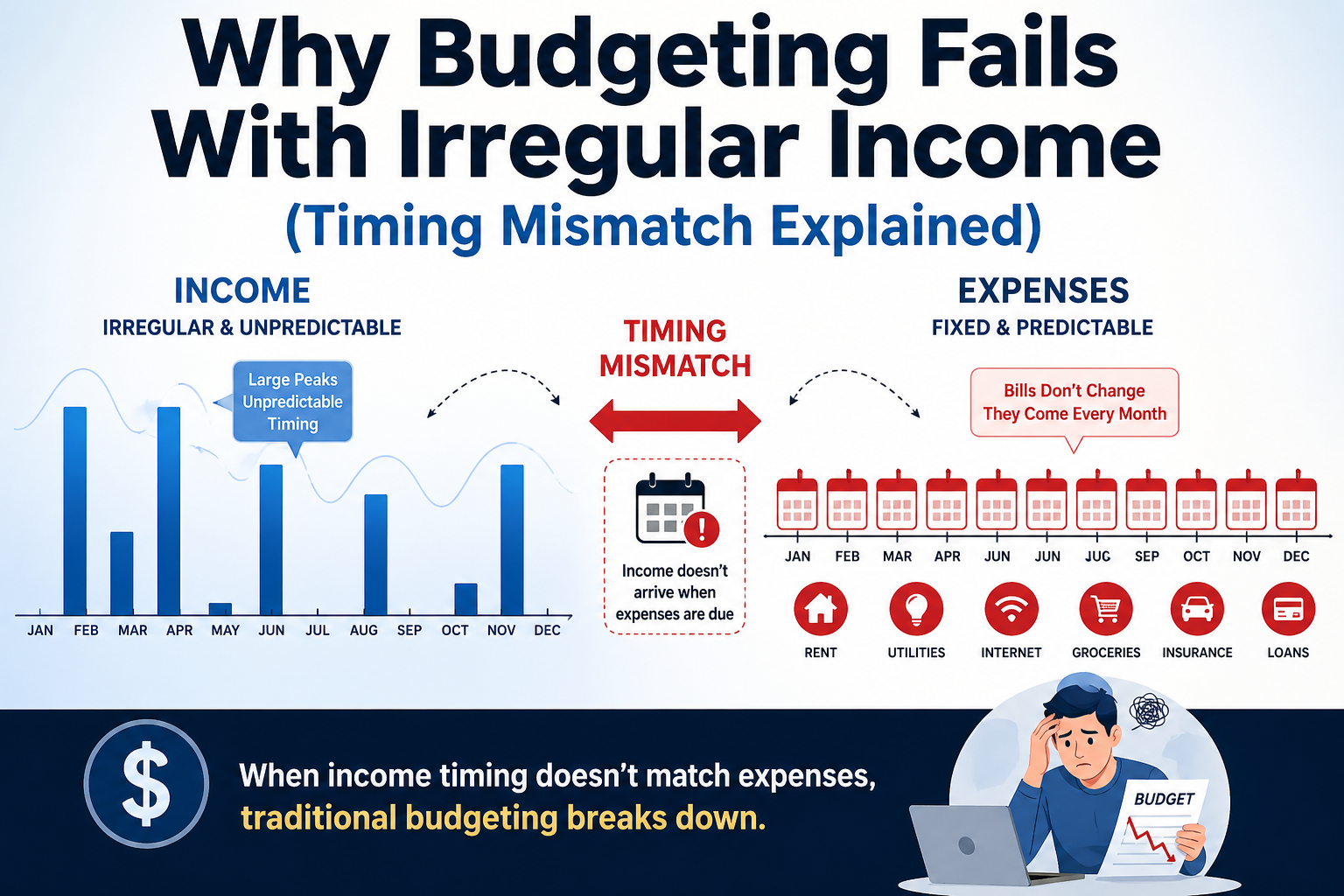
Why budgeting fails with irregular income: income arrives unpredictably while expenses follow fixed schedules, creating timing mismatch and financial instability for freelancers.
Why budgeting fails with irregular income is primarily due to timing mismatch—traditional budgeting assumes predictable income, while freelance income arrives unpredictably, breaking alignment with expenses.
Budgeting does not fail because freelancers lack discipline.
It fails because income does not arrive when the system expects it.
This timing mismatch makes stable financial planning appear inconsistent even when earnings remain unchanged.
Structural Context
Understanding why budgeting fails with irregular income begins with income timing dispersion across irregular payout cycles. Calendar-based systems assume synchronized inflows and expenses. When this alignment breaks, budgeting appears unstable even if total earnings remain consistent.
This misalignment is not immediately visible because total income over longer periods may remain stable. However, budgeting operates on short-term cycles, typically monthly, which makes it highly sensitive to timing shifts.
When income arrives earlier or later than expected, the system interprets this as imbalance. In reality, the structure of income has changed, not the amount.
This explains why income feels unpredictable even when total revenue does not materially change.
Perceived instability is therefore a result of timing distortion, not actual financial inconsistency.
Quick Answer
Traditional budgeting assumes predictable income timing and stable monthly inflows.
Freelance income operates with variable payout timing and uneven distribution.
When timing fluctuates, allocation breaks. This is why budgeting fails with irregular income — the issue is structural, not behavioral.
In other words, budgeting is designed to operate within a controlled timing environment. Freelance income introduces variability into that environment, making the system unable to maintain balance.
Why This Happens for Freelancers
Budgeting models were designed for payroll systems:
• Fixed pay dates
• Known inflow amounts
• Stable intervals
These conditions create a predictable financial rhythm, allowing budgeting to function as a stable allocation system.
Freelance systems operate differently:
• Irregular invoice approvals
• Client-controlled payout schedules
• Payment clustering
• Timing gaps between earning and access
These factors introduce variability at multiple stages, including earning, invoicing, approval, and payment release.
As explained in cashflow timing risk, income may exist while remaining inaccessible. This separation is a core reason why budgeting fails with irregular income.
This creates a disconnect between financial reality and budgeting assumptions, where income exists conceptually but cannot yet be used for allocation decisions.
What Budgeting Assumes
1. Income Arrives on Schedule
Allocation depends on predictable timing.
Budgeting requires income to arrive at expected intervals so that expenses can be matched accordingly.
2. Monthly Inflows Are Stable
Spending assumes consistency.
Stable inflows allow categories to be funded reliably without adjustment.
3. Income Matches Expense Cycles
Cash flows align with obligations.
Expenses such as rent, utilities, and subscriptions operate on fixed schedules, requiring synchronized inflows.
When these assumptions fail, budgeting cannot stabilize financial outcomes.
This breakdown explains why budgeting fails with irregular income even when freelancers maintain consistent work output and earnings over time.
How Variable Timing Disrupts Monthly Allocation
Budgeting is calendar-based. Freelance income is event-based.
Calendar-based systems rely on predictable timing, while event-based income depends on when payments are triggered and processed.
When payments shift:
• one month appears underfunded
• another appears inflated
• decisions become distorted
These distortions affect perception, making it difficult to distinguish between real financial issues and timing-related fluctuations.
For example, a delayed payment may create a temporary shortfall, even though the income has already been earned.
This creates reactive financial behavior, where decisions are made based on perceived scarcity rather than actual financial position.
This explains why budgeting fails with irregular income even when total earnings remain consistent.
The system misinterprets timing variation as financial instability, leading to incorrect adjustments and reduced confidence in budgeting.
Timing mismatch between income arrival and expenses creates perceived financial instability.
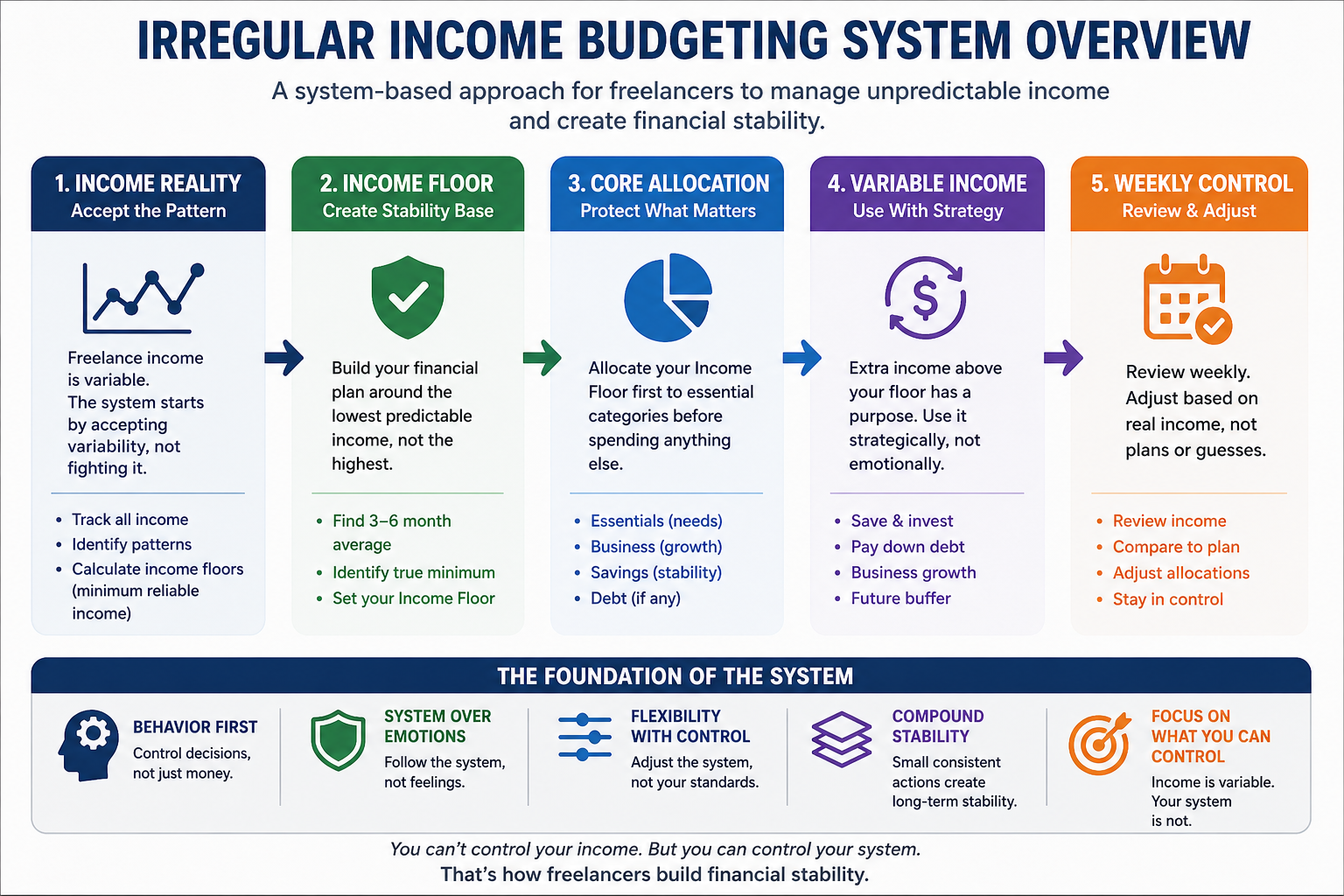
Role Within the Irregular Income Budgeting System
This component operates ONLY within the irregular income budgeting system for freelancers.
It explains why budgeting fails with irregular income but does not provide the solution.
The system resolves this mismatch through structural control.
Within the broader system, this component serves as a diagnostic layer. It identifies the exact point where traditional budgeting logic breaks under real-world income conditions.
Without understanding timing mismatch, freelancers often misinterpret budgeting failure as a behavioral issue. This component removes that confusion by isolating the structural cause.
The irregular income budgeting system depends on this clarity to implement corrective mechanisms such as timing alignment, allocation sequencing, and controlled distribution.
This reinforces that the system owns the solution, while this component defines the failure condition that must be addressed.
Limitations of This Component
- does not fix budgeting
- does not control income timing
- does not provide financial structure
This component explains the failure mechanism only.
Psychology, discipline, or increased tracking cannot resolve timing mismatch without structural changes. This component intentionally avoids solution-level guidance to prevent misapplication.
It does not introduce tools, methods, or workflows. Instead, it isolates the cause so that solutions can be applied correctly within the system.
Attempting to use this component as a standalone fix will result in continued instability, because the underlying structural mismatch remains unresolved.
System Connection
Timing Mismatch → Budgeting System → Financial Stability
This sequence highlights the dependency between diagnosis and resolution.
Timing mismatch creates instability by disrupting the relationship between income and expenses.
The budgeting system restores stability by restructuring how income is allocated, timed, and controlled.
Without identifying timing mismatch, the system cannot be applied effectively, because the root cause remains misunderstood.
This component therefore acts as the entry point into system-level correction.
Return to Budgeting System
To fully understand why budgeting fails with irregular income, you must see how the system resolves timing mismatch.
👉 Return to the full budgeting system
This page isolates the failure mechanism but does not provide execution pathways.
You should return to the system when:
- budgeting feels inconsistent despite stable income
- timing gaps create financial pressure
- allocation decisions become reactive
The system introduces structural controls that eliminate timing mismatch and restore predictable financial behavior.
Without returning to the system, the problem remains understood but unresolved.
Related Components
Why Irregular Income Feels Unstable
Psychology-Based Budgeting for Freelancers
These components connect directly to timing mismatch:
- instability explains how timing mismatch is perceived
- behavioral budgeting explains how decisions respond to that instability
Together, they form a complete understanding of why budgeting fails under irregular income conditions.
Execution Note
Tools can track spending but cannot fix timing mismatch.
Research on financial behavior under uncertainty supports this: CFPB Financial Research
Most budgeting tools operate on static assumptions, requiring users to adapt behavior to predefined structures.
When income timing is inconsistent, these tools reflect instability rather than resolve it.
Effective execution requires structural adjustment before tool usage. Without system alignment, tools only surface the symptoms of timing mismatch.
This page explains one component: timing mismatch.
It does not explain the full budgeting system.
Its purpose is to isolate the structural reason why budgeting fails with irregular income, ensuring that the problem is correctly identified before solutions are applied.
For complete financial control, this component must be integrated with the full system, which manages timing, allocation, and decision flow.
Why budgeting fails with irregular income is not due to discipline—it is caused by timing mismatch between income and expenses.
This component identifies the problem. The system solves it.
Freelancers often interpret inconsistent budgeting outcomes as personal failure, when in reality the issue lies in how traditional systems are structured.
When income arrives unpredictably, even well-planned budgets break down because they rely on synchronized inflows and expenses.
Understanding why budgeting fails with irregular income shifts the focus from behavior to structure, allowing freelancers to apply the correct solution instead of increasing effort within a broken model.
Timing mismatch is not a temporary issue—it is a fundamental characteristic of freelance income systems. Without addressing it at the system level, financial instability will continue regardless of income level or discipline.
This is why identifying the problem correctly is the first step toward achieving long-term financial stability.
FAQ
Why does budgeting fail with irregular income?
Because income timing does not align with fixed expenses, creating structural mismatch.
Traditional budgeting depends on predictable inflows. When income arrives at irregular intervals, allocation becomes inconsistent, making budgeting appear unreliable even when total earnings remain stable.
Is budgeting failure a discipline problem?
No. It is caused by system mismatch, not behavior.
Freelancers often assume they need better control or stricter budgeting habits. However, the issue lies in the mismatch between income timing and budgeting structure, not in personal discipline.
Can freelancers use traditional budgeting?
Only if income timing is stabilized.
Without adjusting for timing variability, traditional budgeting will continue to produce inconsistent results. Freelancers need systems that adapt to income flow rather than assume fixed schedules.
Why does income timing matter more than income amount?
Because financial decisions depend on when money is available, not just how much is earned.
Even high earnings cannot prevent instability if funds are not accessible when expenses occur.
What is timing mismatch in budgeting?
Timing mismatch occurs when income arrives at different times than expenses are due, creating temporary financial pressure despite sufficient total income.