
AI-Based Client Portfolio Risk Management for Freelancers
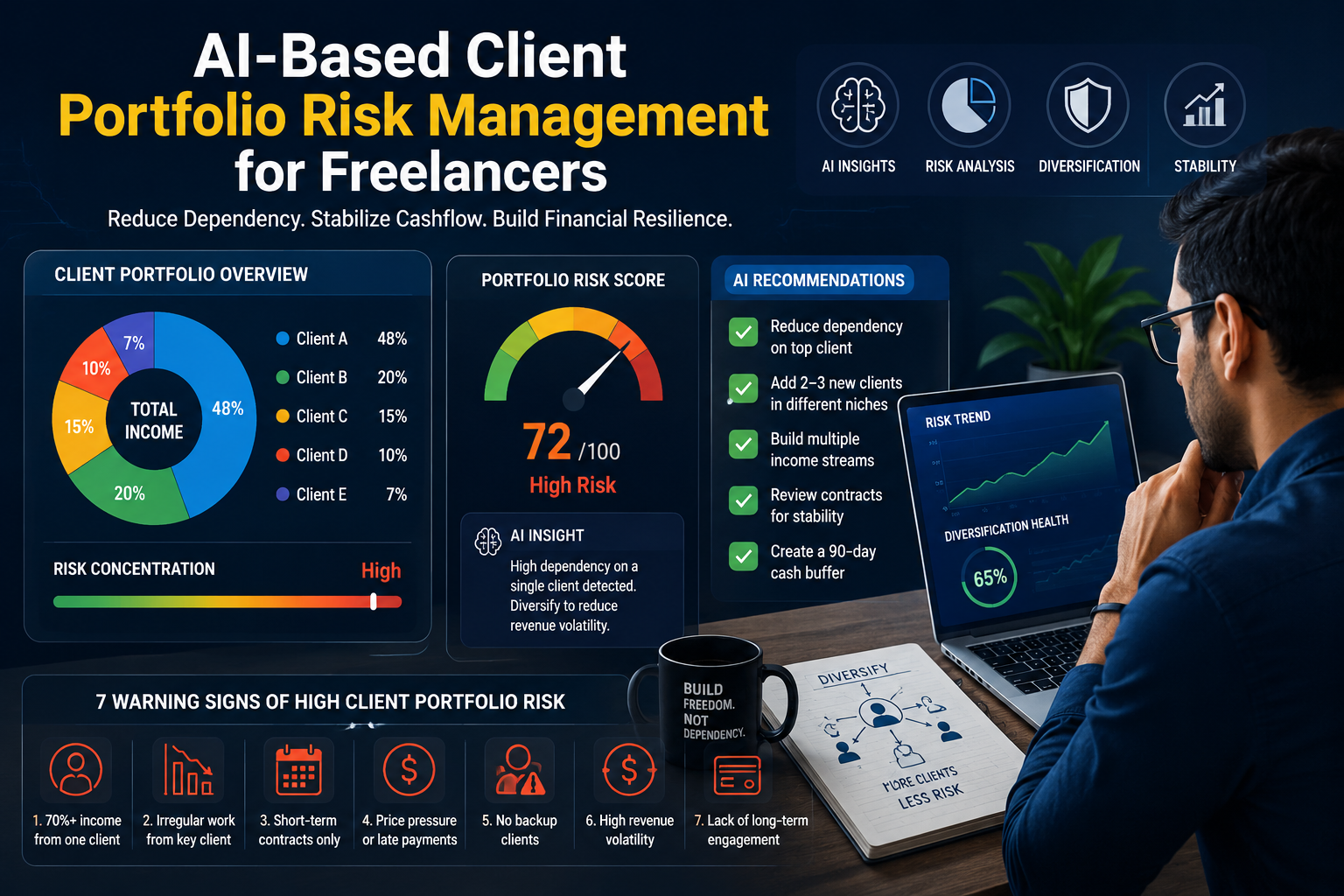
AI-Based Client Portfolio Risk Management for Freelancers becomes essential once freelancer environments stop failing visibly and begin destabilizing silently through dependency concentration.
Many freelancers assume instability primarily comes from inconsistent income, pricing pressure, market volatility, or workload unpredictability.
In reality, a large portion of freelancer fragility often originates from client concentration structures hidden underneath apparently stable revenue.
Income may appear diversified.
Multiple clients may exist simultaneously.
Cashflow may still appear stable externally.
Yet underneath, the freelancer environment may already depend heavily on:
- one dominant client
- a narrow revenue stream
- a concentrated payment cycle
- a small continuity base
- one operational relationship
At first, this often feels efficient rather than dangerous.
The dominant client may appear reliable.
Projects may continue consistently.
Revenue concentration may even create temporary psychological comfort.
Over time, however, dependency quietly changes operational behavior.
Pricing flexibility weakens.
Negotiation neutrality narrows.
Availability pressure increases.
Recovery flexibility compresses.
Projects become emotionally heavier.
Delayed replies create subtle anxiety.
Dominant accounts start receiving disproportionate attention.
Eventually, the freelancer environment becomes increasingly dependent on preserving continuity with a narrow group of clients simply to maintain structural equilibrium.
Within FM Mastery, this is not treated as a relationship issue.
It is treated as dependency fragility.
AI-Based Client Portfolio Risk Management exists to evaluate whether client concentration stabilizes the freelancer environment or silently amplifies structural instability through dependency asymmetry.
This sub-cluster explains how client portfolio structures quietly create hidden fragility, why diversification is frequently misunderstood, and how AI-assisted governance helps freelancers identify destabilizing concentration exposure before continuity disruption becomes financially dangerous.
AI-Based Client Portfolio Risk Management for Freelancers helps identify dependency asymmetry, concentration exposure, and hidden continuity fragility before client disruption destabilizes cashflow timing, pricing flexibility, operational resilience, and financial stability.
Revenue Concentration
↓
Pricing Dependence
↓
Reduced Negotiation Neutrality
↓
Continuity Anxiety
↓
Operational Rigidity
↓
Hidden Financial Fragility
↓
Behavioral Dependence
↓
Reduced Flexibility
↓
Fear of Disruption
↓
Structural Instability
↓
Reduced Negotiation Neutrality
↓
Behavioral Compression
↓
Continuity Anxiety
↓
Financial Fragility
Why Freelancers Frequently Misdiagnose Client Risk
Most freelancers evaluate client stability through surface-level visibility.
Questions usually become:
- How many clients exist?
- How much revenue is generated?
- How long has the relationship lasted?
- How consistent is the workload?
These measurements frequently create false confidence.
Within FM Mastery, client portfolio stability is not determined by client count alone.
It is determined by dependency distribution.
A freelancer may technically have multiple clients while still remaining structurally dependent on:
- one dominant account
- a narrow concentration of recurring clients
- one payment cycle
- one continuity source
- one operational anchor
This distinction matters because apparent diversification often disguises hidden concentration exposure.
The freelancer environment may continue functioning normally while:
- pricing flexibility weakens
- decision neutrality compresses
- continuity fear increases
- adaptability narrows
- risk tolerance declines
This creates a fragile environment where the loss, delay, renegotiation, or behavioral shift of one client can materially destabilize:
- cashflow timing
- workload continuity
- delivery pressure
- income predictability
- financial confidence
The instability architecture explored earlier across:
- The Hidden Costs of Leverage
- Why Scaling Without Volatility Is Structurally Rare
- Capacity vs Ambition
- AI-Based Capacity Planning
already established how fragility compounds through:
- dependency pressure
- recovery compression
- execution overload
- reduced reversibility
- hidden instability accumulation
Client dependency fragility extends that framework into revenue concentration, continuity exposure, and structural dependence risk.
This approach is part of the broader AI-Powered Money Management pillar designed to help freelancers preserve structural survivability under irregular income conditions.
The Real Problem Is Dependency Asymmetry
Within FM Mastery, client risk is defined primarily through dependency asymmetry rather than client quantity.
Dependency asymmetry exists when one or a small number of clients exert disproportionate influence over:
- income continuity
- pricing decisions
- cashflow timing
- workload balance
- emotional stability
- operational behavior
This influence often develops gradually.
At first, the dominant client may simply appear valuable.
Over time, however, concentration quietly changes freelancer behavior.
Negotiation becomes more cautious.
Pricing confidence weakens.
Availability pressure increases.
Recovery flexibility narrows.
Freelancers may begin:
- hesitating to challenge scope pressure
- prioritizing dominant clients excessively
- remaining constantly available
- feeling anxious during delayed communication
- avoiding difficult pricing conversations
The freelancer environment may still appear stable externally while internally becoming increasingly dependent on preserving continuity with a narrow client base.
This is where client concentration transforms into structural fragility.
The problem is rarely visible diversification.
The problem is hidden concentration underneath apparent diversification.
A freelancer may technically serve multiple clients while still depending heavily on:
- one payment cycle
- one dominant project stream
- one decision-maker
- one continuity source
- one revenue anchor
This is why many freelancers experience instability unexpectedly after:
- client churn
- invoice delays
- contract pauses
- pricing renegotiations
- budget reductions
The instability often existed long before the disruption itself appeared.
Once dominant clients delay payments, reduce scope, or pause engagement, concentrated dependence frequently transforms immediately into:
- cashflow instability
- income compression
- delivery pressure
- financial anxiety
- recovery disruption
This is how hidden concentration exposure quietly becomes financial fragility.
Why AI Improves Client Portfolio Risk Governance
AI-assisted governance becomes valuable because freelancers frequently normalize concentration exposure gradually.
As continuity stabilizes temporarily, dependency may begin feeling safe rather than structurally dangerous.
This creates interpretive blind spots.
The dominant client may appear secure.
Revenue may appear predictable.
Cashflow may appear stable.
Yet underneath, concentration exposure may continue expanding silently.
AI-Based Client Portfolio Risk Management improves governance by identifying:
- revenue concentration thresholds
- dependency asymmetry patterns
- client timing exposure
- continuity imbalance
- hidden portfolio fragility
- concentration trends over time
- behavioral dependency signals
This matters because humans frequently interpret structural dependence emotionally rather than analytically.
Freelancers may avoid confronting concentration risk because:
- the relationship feels secure
- income currently appears stable
- growth remains visible
- the client appears trustworthy
AI-assisted governance introduces external pattern recognition into this process.
Instead of evaluating client relationships through optimism or fear, freelancers can evaluate whether the portfolio structure itself increases or reduces instability exposure.
Within FM Mastery, AI is not positioned as a replacement for judgment.
It functions as a governance layer designed to improve visibility around hidden dependency fragility, continuity imbalance, and concentration instability.
The Client Portfolio Fragility System Explained
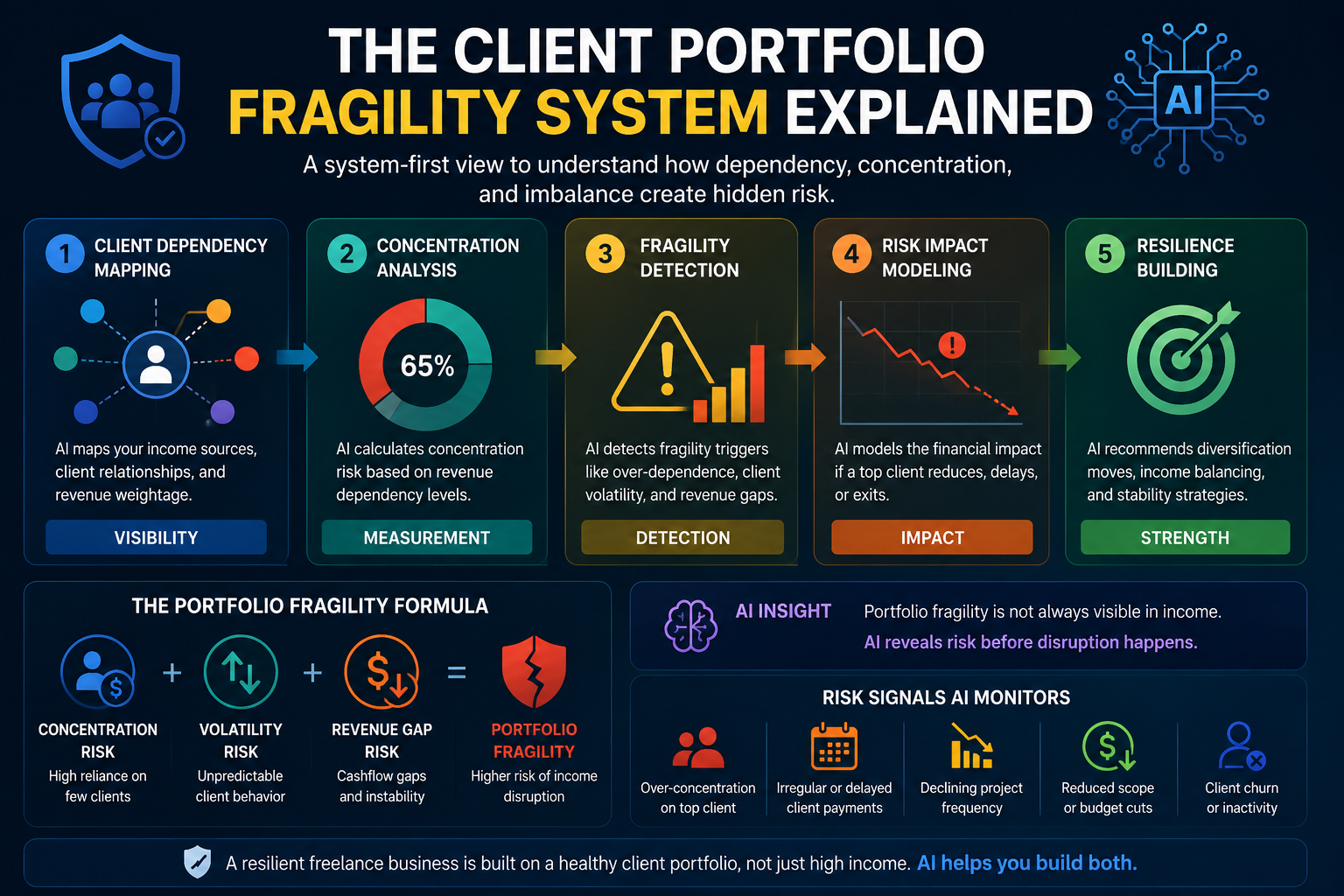
Within FM Mastery, client portfolio fragility develops when continuity becomes overly dependent on a narrow concentration of relationships.
The freelancer environment may still appear externally stable while internally becoming increasingly exposed to disruption sensitivity.
This usually develops through five structural shifts.
1. Revenue Concentration Expands
One or a small number of clients gradually begin dominating:
- cashflow timing
- monthly revenue
- workflow continuity
- financial confidence
- operational predictability
At first, this may appear efficient.
Over time, however, survivability becomes increasingly tied to preserving continuity with a narrow concentration base.
2. Negotiation Neutrality Declines
As structural dependence grows, pricing behavior often changes subtly.
Freelancers may become:
- less assertive during negotiation
- more tolerant of instability
- more cautious around pricing adjustments
- less willing to challenge scope pressure
- more fearful of disruption
This creates hidden behavioral fragility underneath apparent stability.
3. Continuity Dependence Increases
Eventually, preserving the relationship becomes structurally important for maintaining equilibrium.
Slow responses begin creating anxiety.
Contract uncertainty feels destabilizing.
Revenue timing becomes emotionally charged.
This is where concentration exposure begins affecting operational resilience directly.
4. Reversibility Narrows
Healthy freelancer environments preserve the ability to:
- decline projects safely
- replace clients gradually
- absorb disruption calmly
- adapt without instability
As dependency concentration grows, this flexibility weakens.
The environment becomes increasingly dependent on preserving continuity with specific accounts.
5. Fragility Becomes Externally Visible
Eventually, one disruption exposes the concentration already present underneath:
- client churn
- payment delays
- scope reduction
- contract pauses
- pricing pressure
At this stage, instability often appears sudden externally even though fragility had been accumulating internally for much longer.
Why Client Concentration Often Feels Safe Until It Fails
Client concentration frequently creates psychological comfort before it creates visible instability.
Revenue may become more predictable temporarily.
Workflow continuity may feel smoother.
Administrative complexity may decline.
This often creates the illusion that concentration itself improves stability.
Within FM Mastery, however, temporary continuity is not automatically treated as resilience.
A freelancer environment becomes structurally resilient only when variability can be absorbed without destabilization.
Dependency concentration reduces that adaptability.
The freelancer may continue:
- earning stable revenue
- maintaining workload consistency
- appearing externally secure
while internally becoming:
- less reversible
- more negotiation-sensitive
- more emotionally dependent
- less adaptable during disruption
- more continuity-dependent
This is why many freelancers experience severe instability after the loss of one client even when overall revenue previously appeared healthy.
The hidden instability already existed inside the concentration structure itself.
How Client Dependency Quietly Becomes Financial Fragility
Client concentration usually becomes behaviorally visible before financial instability appears externally.
Freelancers frequently begin noticing:
- fear of losing a dominant client
- pricing hesitation
- difficulty reducing availability
- increased continuity anxiety
- higher emotional sensitivity to delays
- over-accommodation behavior
- reduced negotiation confidence
- dependency-driven caution
- difficulty tolerating uncertainty
These patterns matter because they reveal that portfolio concentration is beginning to influence operational behavior directly.
The progression usually unfolds gradually.
Stage 1 — Revenue Concentration Increases
A small number of clients gradually dominate continuity and financial predictability.
Stage 2 — Behavioral Dependency Appears
Pricing, communication, and availability behaviors become increasingly influenced by continuity preservation.
Stage 3 — Reversibility Weakens
The freelancer environment loses flexibility around adaptation and replacement.
Stage 4 — Continuity Anxiety Expands
Disruption exposure begins carrying larger emotional and financial consequence.
Stage 5 — Fragility Becomes Financially Visible
Client disruption eventually affects:
- cashflow timing
- income stability
- decision confidence
- operational resilience
- recovery flexibility
This is how hidden concentration exposure quietly transforms into structural instability.
Client Portfolios Are Stability Systems — Not Just Revenue Sources
Within FM Mastery, client portfolios are evaluated as structural stability systems rather than simple revenue collections.
This distinction matters because freelancer environments operate under:
- irregular income variability
- continuity pressure
- operational asymmetry
- timing instability
- behavioral dependency risk
Without governance, freelancers often substitute concentration efficiency for resilience.
The environment may appear stable temporarily while survivability margins quietly narrow underneath.
AI-Based Client Portfolio Risk Management introduces external pattern recognition into this process.
Instead of relying entirely on emotional interpretation, freelancers can evaluate:
- dependency concentration
- client distribution balance
- revenue asymmetry
- continuity exposure
- portfolio fragility accumulation
This extends the instability architecture developed earlier across:
- The Hidden Costs of Leverage
- Why Scaling Without Volatility Is Structurally Rare
- Capacity vs Ambition
- AI-Based Capacity Planning
Those layers explained how instability compounds through leverage, scaling asymmetry, execution overload, and recovery compression.
Client portfolio fragility explains how dependency concentration quietly amplifies financial instability underneath apparent continuity.
Early Signs That Client Dependency Is Becoming Structurally Dangerous
Client concentration usually becomes behaviorally visible before obvious financial instability appears externally.
Common warning signals include:
- fear of client loss
- pricing hesitation
- continuity anxiety
- difficulty enforcing boundaries
- over-accommodation behavior
- emotional sensitivity to delays
- dependency-driven decision-making
- reduced negotiation neutrality
- difficulty tolerating uncertainty
These signals do not necessarily indicate immediate collapse.
They indicate that the freelancer environment is becoming increasingly dependent on preserving continuity with a narrow client base.
That dependence is what quietly transforms concentration exposure into fragility.
Additional Structural References
Where This Fits Inside the Instability Authority System
This sub-cluster extends the instability architecture from:
financial fragility
→ scaling asymmetry
→ execution compression
→ workload governance
→ client dependency fragility
It directly follows:
That layer explained how workload overload creates execution fragility.
This layer explains how dependency concentration amplifies financial instability through continuity exposure, negotiation compression, and structural asymmetry.
The authority graph now progresses through:
- income instability
- hidden fragility
- leverage amplification
- scaling asymmetry
- capacity distortion
- workload governance
- client dependency fragility
This creates a highly differentiated FM-native instability framework focused on structural survivability rather than generic freelancing advice.
Frequently Asked Questions
What is AI-Based Client Portfolio Risk Management for freelancers?
AI-Based Client Portfolio Risk Management helps freelancers identify dependency concentration, continuity exposure, and hidden portfolio fragility before client disruption destabilizes financial stability.
Why is client concentration dangerous for freelancers?
Client concentration creates dependency asymmetry where one or a small number of clients exert disproportionate influence over income continuity, pricing behavior, and operational resilience.
What is dependency asymmetry?
Dependency asymmetry occurs when freelancer stability depends heavily on a narrow concentration of clients, making disruption more financially and emotionally destabilizing.
How does client concentration create instability?
Concentration reduces negotiation neutrality, increases continuity dependence, weakens reversibility, and amplifies disruption sensitivity throughout the freelancer environment.
Why does AI-assisted client risk governance matter?
AI-assisted governance helps identify hidden concentration patterns objectively before freelancers normalize dependency exposure and structural fragility internally.
The Hidden Risk Is Not Client Growth — It Is Dependency Compression
Client growth itself is not structurally dangerous.
The hidden instability appears when continuity becomes overly dependent on a narrow concentration of relationships without sufficient:
- distribution balance
- reversibility
- pricing neutrality
- adaptability
- portfolio resilience
Freelancer environments can tolerate periods of concentration.
What they cannot tolerate indefinitely is structural dependence absorbed through:
- continuity fear
- pricing hesitation
- behavioral caution
- adaptability loss
- dependency-driven pressure
Within FM Mastery, AI-Based Client Portfolio Risk Management exists to preserve structural survivability while client exposure expands.
The objective is not eliminating strong client relationships.
The objective is preventing hidden concentration fragility from quietly destabilizing the freelancer environment over time.
Continue Exploring Structural Instability Systems
This sub-cluster is part of the Managing Irregular Income authority system inside the AI-Powered Money Management pillar.
As freelancer systems scale, dependency governance becomes increasingly important because hidden concentration exposure often destabilizes otherwise stable financial systems long before visible income collapse appears externally.
Related instability layers:
The objective is not maximizing continuity endlessly.
The objective is preserving reversibility, adaptability, and structural resilience while client exposure expands.
Freelancer instability rarely begins through obvious collapse.
More often, it develops gradually through hidden dependency concentration, continuity pressure, negotiation compression, and behavioral fragility that slowly narrow survivability margins underneath apparent stability.
AI-Based Client Portfolio Risk Management exists to identify those concentration patterns before disruption becomes structurally destabilizing.
Within FM Mastery, recognizing client portfolios as stability systems rather than simple revenue sources is not pessimism.
It is structural awareness.